

创作上传
VIP
收藏下载
登录 | 注册有礼
查看完整案例

收藏

下载

分享

翻译


Concept
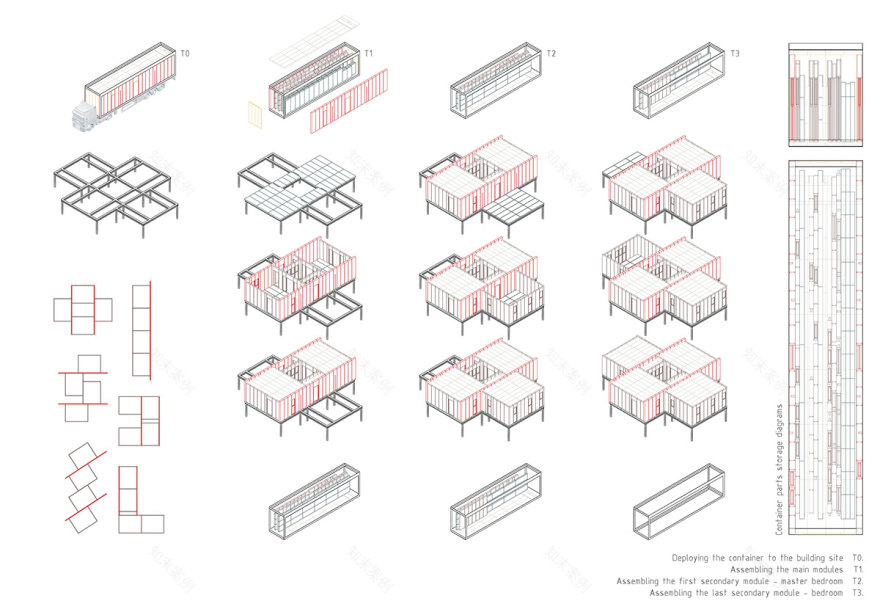
In order to achieve a great a extent of mobility our design focuses around the concept of the Pop-Up House. The package – a custom 12.20 m x 2.40 m x 3.15 m container – carrying the components needed, is to be disassembled and incorporated along the components in order to form the house. Therefore the package – the boxing is not to be thrown away but used as part of the construction. The package consists of small pieces that are assembled on-site in intermediate modules (self-supporting structural assemblies). The smaller pieces are maneuverable on a human scale and form small parts of the house shell. Using only this set of components, a large variety of housing layouts can be built, from the most compact to the most dispersed therefore increasing the layout versatility and site adaptability.
Location
Our goal is to achieve a modular house that may be suited for a wide array of environments, varying from urban to rural. The house can be set in a plot that is connected to amenities or can be equipped to be set on an off-grid plot, granting it to possibility to produce the required amenities.
Parts and components
There are 35 types of prefabricated components forming the package as well as stored in the package, the majority (27 types) being custom wall pieces (the high walls that form the package walls and the main module’s walls, smaller wall components, end walls, wall joints or walls containing windows or doors) as the other 4 parts represent ceiling and floor. Smaller and lighter wall are also used in order to provide the interior walls meant to separate functions in the same module.
Modules and assembly
In order to unfold the modular house a foundation is required, we would recommend using a ground screw system in order to flexibly and sustainably adapt a wide array of terrain.
The first step is to unload the package unto the site and to start dismantling in order to obtain the parts needed. All the parts are orderly stored inside according to the steps required to set up the first / main module, to expanding it to the secondary modules.
The first module (the utilities support module – it contains the technical spaces as well as the kitchen, a small bathroom, the proposed small central courtyard and the living room which at this step could be used as a spare bedroom).
Once the first module is completed, it can be expanded to the secondary modules, the bedrooms, no necessary order of priority is required between the bedrooms although we propose setting up the master bedroom first.
Technical features
All technical spaces are grouped around the entrance / kitchen area, including the main piping for water distribution and removal for all the bathrooms to be set in the secondary modules. Heating is provided by the floor components which can be equipped with heating systems to be linked with the main technical area.
Sustainability
Using our plug and play design, we try to avoid the wasting of materials and the product / house itself. If a smaller space is needed, the module can be dismounted and stored away. If the house itself is no longer needed, it could also be stored away back in the original container and according to its condition it can be refurbished and could even be sold once more.
Increasing and decreasing the dwelling due to its modular capability is also a way of granting more control over features such as the amount of energy intake used (such as heating).


© Laura Mazâlu, Gabriel Chivu, Ștefan Mircea, Thomas Herrera
南京喵熊网络科技有限公司 苏ICP备18050492号-4知末 © 2018—2020 . All photos and trademark graphics are copyrighted by their owners.增值电信业务经营许可证(ICP)苏B2-20201444 苏公网安备 32011302321234号
苏公网安备 32011302321234号客服
消息
收藏
下载
最近