

创作上传
VIP
收藏下载
登录 | 注册有礼
查看完整案例



收藏

下载

分享

翻译

How do you design offices for a company that's in hypergrowth? That's what Sonya Simmonds set out to do for Spotify. Having previously worked for architecture firms in London and Stockholm on projects for clients such as Bloomberg, Schroders and the Discovery Channel, she's now the global head of design and build at the world's most popular audio-streaming subscription service. She explains how the team reassessed its strategy to create dynamic, flexible and experiential workplaces.
SONYA SIMMONDS: Spotify is in a period of hypergrowth, and has been for some years. Back in 2019, we started to assess how our real estate aligned with our growth and realized that something didn't feel right. We were constantly running out of space, a story common to many growing companies. But if we looked out across our open office spaces with dedicated desking, we saw empty workstations. How could we need more real estate when our office floors felt and appeared empty?
The first step towards a solution was gathering utilization data on our biggest offices in Stockholm, New York and London. The apparent emptiness of our spaces was due to a variety of reasons. Like many companies, we had open-plan offices with meeting rooms; since people weren't comfortable talking in the former, they'd use the latter. We were also meeting-heavy. Meeting rooms therefore became overbooked, but when people missed meetings, those spaces weren't made available to others, resulting in underutilized space. In addition, when one of us travelled to another office with dedicated desks, we often had to sit at someone's highly personalized workspace, which can feel uncomfortably imposing.
If we wanted to do a global rollout, we needed a solid plan. So, we started listening to what people did and didn't like, what they needed and wanted from our spaces. To me, a layered approach seemed logical, and the result was what we today call our Dynamic Workplace strategy. We were all set to start implementing this new strategy – and then the pandemic hit. But instead of pressing pause, we took the opportunity to push ahead while our offices were unpopulated.

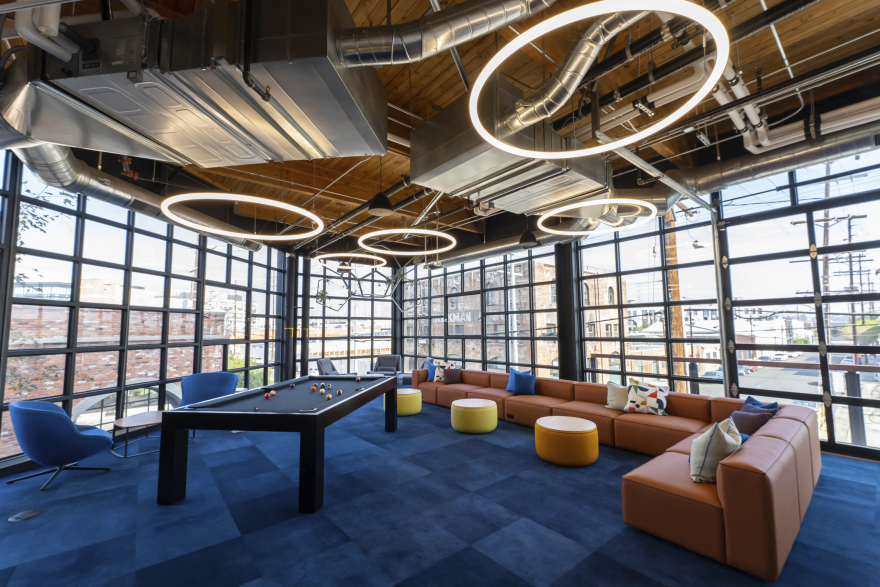
Located in LA, Spotify's US production hub includes workspaces, studio production and viewing and listening rooms spread across three buildings. The entrance is designed to reflect the feeling of arriving in a nightclub, with dynamic lighting for different moods.
Each Dynamic Workplace project starts with a raw base. We take the building and expose or retain as many of the existing features as possible to remain humble and true to the space. This approach also informed our future real estate strategy – we would be looking for interesting buildings and, as we became more established, we didn't necessarily need central business district locations but could position ourselves in a city's more creative sectors.
The next layer is the interior fit out. Up until 2019 every Spotify office looked different – it was difficult to define the Spotify office. We started to set global design standards and decided to hire local architects to make our base design locally relevant and culturally reflective. We usually approach three or four local architects after doing a lot of dedicated research to find the right fit for the job, including poring through magazines and staying on top of who's winning awards. We're looking for creatives who base their design on spatial experience rather than adopting a one-size-fits-all approach. And we want their style, their personality, for them to bring something to the table. We don't stipulate any design competition or pitch requirements – what we want to see is their true essence, what they stand for, and whether they align with our values: innovative, collaborative, sincere, passionate and playful.
For each project, we do a deep due diligence on the building as well as interview our local teams to understand who they are and what they need. This helps us to set up a very clear baseline for the local architects, so that they don't get too bogged down in guesswork. We also provide guidelines for furniture, sustainability and accessibility. These guidelines indicate our main priorities – for example, it's not important for us to have a piece of paper that proves we're sustainable, but it is important that we follow sustainability practices.


At its Miami building in the centre of the Wynwood Arts District – designed with OTJ Architects – the company showcases artists and creators from Central and South America. Photos: Brad Devins
As for the furniture, we suggest pieces that are sustainable and support the various ways our 'band members' work – that's what we call the Spotify team, as all our employees are treated like one big band. We've moved away from a uniform, desk-ownership approach towards what our platform does best – it's a system that allows for user choice. We want to offer spaces to use based on people's mode or mood. Collaborative spaces are as equally important as focus areas, and we noticed that specific groups want different environments – after all, those in HR, finance and artist relationships are different types of people who work in different ways, so why shouldn't each team have personalized environments? The furniture choices also needed to answer some of our aims for improving diversity and inclusion in our spaces, such as making enclosed retreat areas and enhancing acoustics.
The final stage in our new layered approach is about the experience, which was completely lacking in previous Spotify offices. When I joined, we were about to embark on an experiential project for 4 World Trade Center – 14 floors of art work needed to be done in the New York skyscraper – but we also had 19 other office projects planned for the forthcoming year, so it was the perfect time to reimagine our goal to focus on brand experience, curation and creation. We redesigned a global package of wayfinding to make each space easier to navigate and to give the offices a consistent look. Accessibility in the platform is integral to our beliefs, and we should be just as accessible with our spaces. Now, the text in our spaces connects to our brand identity and is used in the most easy-to-read manner – lower case, high contrast – to align with our neurodiverse design requirements. We looked at our meeting room names, which reflect artists, playlists and podcasts, and did a deep analysis to ensure they were equitably representative. We added on-brand Spotify features to meeting room signage – below the room name, a scannable Spotify barcode directs you to the corresponding playlist on the platform. And, to remind us of who we are and what we produce, we started to display our existing assets, such as playlist art work and marketing campaigns.
An important part of our platform, and therefore also our offices and studios, is to foster creativity. To keep us engaged and excited, it's crucial that our offices reflect the brand and serve as bases for creators, and we often work with local visual and audio artists to achieve this essence. For three of the 14 floors in New York, for example, we fed back into the education system in New York with an open call for art work. We also did a series with diverse artists from different backgrounds, and used local creators and production teams. We want art pieces that express the local vibe at that point in time and celebrate audio in some way while matching our brand aesthetic: bold, colourful and graphic. Most of these installations were made according to briefs or with input from our band members.


Nestled among skyscrapers in Milan's city centre, Spotify's southern European home was designed with local architecture firm E45 to combine cosy home comforts with the company's global brand experience. The art work in the reception – which refers to recording studios through the use of acoustic panels – is reflected in the rug beneath. Photos: Andrea Martiradonna
Assessing the bigger picture of the workplace and how the office will function post-pandemic, we need to look at aligning our HR policies with the flexibility of our Dynamic Workplace strategy – which was, thankfully, the perfect partner to the Work from Anywhere (WFA) initiative. WFA is Spotify's version of a hybrid workforce – it allows employees to choose between an Office Mix, whereby they work predominantly on site, and a Home Mix, which reflects the opposite. I'll be honest: on the one hand, I was excited by the flexibility that this would offer people, but on the other, I was freaking out. We'd never had to 'sell' the idea of coming to the office before – it was just a place where you came and did your work. Suddenly, our on-site offerings are competing with the home, co-working spaces, cafés – and anywhere else our band members want to work. This means that the office needs to learn from the home and become a much more comfortable and appealing place to be – somewhere with better acoustics and more greenery.
Now we've reached a stage where we not only need to utilize and measure how we use space, but to understand that people want to use it for other types of activities on a much more random basis. Not having a steady stream of people coming and going makes it harder to plan – we'll have to be even more flexible with our spaces, much more attentive to our experiential offer, and think about how to deliver our service in a virtual way. Looking forward, it's exciting, and I can imagine possibilities where our offices and studios will become much more porous. Maybe the lower sections of our buildings will be more open and integrate with the streetscape, or we could open up our amenities such as auditoriums. Maybe some of our spaces will become larger communal meeting areas – not just for internal meetings but also external ones. Or perhaps the spaces and meetings we have will become a blend of virtual and reality. A new office reality is up for discussion and design, and it's a hugely interesting period for rethinking what we need and what we can offer our band members and our local and global communities. As we move forward, we'll openly share our design strategies and what we're working on, continue to collaborate with like-minded companies, aim to learn more, and be okay with experimenting and reiterating.

In Berlin, Spotify worked with architects MNA Merten Nibbes and TP Bennett to maintain the integrity of the historical building while softening its raw aesthetic. Photos: Acrylicize
Our job in the field of architecture and design is to problem-solve on all levels, to innovate and integrate from the macro to the micro, and to design sustainably and inclusively for the future. In the Spotify workplace team, we'll remain true to our initial three pillars when it comes to our built spaces: flexibility, sustainability and wellbeing will be at the heart of our solutions. And we won't stop there – by embracing Spotify's core values such as playfulness, we'll have fun on this unpredictable journey.
This interview was originally featured in Frame 145. Get your copy here.

 59
592020/06/04 00:00:00
422020/02/13 11:50:00
南京喵熊网络科技有限公司 苏ICP备18050492号-4知末 © 2018—2020 . All photos and trademark graphics are copyrighted by their owners.增值电信业务经营许可证(ICP)苏B2-20201444 苏公网安备 32011302321234号
苏公网安备 32011302321234号客服
消息
收藏
下载
最近