

创作上传
VIP
收藏下载
登录 | 注册有礼
查看完整案例

收藏

下载

分享
非常感谢
FABRIC
Appreciation towards
FABRIC
for providing the following description:
来自丹麦的FABRIC赢得了哥本哈根国王花园里面一个临时展馆设计。这个名叫 ‘Trylletromler’的设计在丹麦最古老的绝对形状几何对称园林中,通过“围栏”,以“模糊”“混沌”的状态出现,边界和空间在这里不再清晰。
2013年9月开放。
FABRIC has won the international design competition for a temporary pavilion in the King’s Garden in Copenhagen. The design is named ‘Trylletromler’, the Danish name for the 19th century invention of the ‘Zoetrope’.
The competition, issued at the end of January 2013 by Akademisk Arkitektforening, the Danish Architects’ Association in cooperation with the local department in Copenhagen, invited architects to design a temporary pavilion located in the King’s Garden, that should be accessible, public, innovative, removable and challenging in its idiom. At the same time there will be limited financial means for realization.

The Renaissance garden design of Rosenborg Castle is the oldest known example of garden design in Denmark. The design draws heavely on principles of Euclidean geometry. This language of absolute space, was long regarded as the construction principle of the world. Architecture, urbanism and landscape design essentially were aiming to create order out of chaos using absolute shapes: line, square, triangle, sphere and cone. The Baroque alterations of the original design introduced maze like elements in the grid, diagonal paths and the elaboration of the two tree- lined avenues: Kavalergangen and Damegangen. After these alterations the garden was never drastically changed. This classical representation of space was meticulously maintained until today.

The question to design a pavilion for the Kings Garden in Copenhagen thus offers the challenge to introduce a new understanding of space. An understanding of space that poses questions rather than answers. An understanding that blurs absolute boundaries and clear separation. And an understanding that allows ambivalence and hybridity. In this situation FABRIC proposes a ‘blurring strategy’ by replacing the understanding of a pavilion, with the most elementary architectural element in garden design: the fence.

这个临时展馆位于一片开敞的林地之中。近乎透明的“围栏”创造出一个流动模糊的空间。围栏将使用300万个标准件木材组成,上面有动感的图纹。

The strategy of ‘blurring’ addresses three independent paradoxes by provoking the notions inside and outside, by introducing a maze that is paradoxically transparent and by creating an illusion of motion. First of all, the fence as a freestanding structure is designed to restrict movement across a boundary. By folding and wrinkling the fence on the location, it produces new meanings of being spatially included or excluded.
By secondly forcing openings in the fence, the boundary that is described by it will become penetrable. In this curving fence a series of openings are cut using absolute shapes like circle, rectangle, triangle and parabola, creating a series of straight and stippling paths through the pavilion. Most openings appear as a partly raising of a curtain. One cut in the fence however seems without reason. This small irregular cut near Rosenburg Caste only allows kids into the pavilion, escaping their parents gaze, exploring a new view on the world. By avoiding placing the openings on obvious routes of straight lines of sight, visitors are forced to find their way out of the sequence of spaces created by the fence, which acts like a see through maze.

透明的围栏上使用到了一些绝对形状图形作为开口,比如圆形,三角形,正方形,抛物线。人们进入这里,在空间中游走并找寻新的入口。就像是一个具有透明感的依然有乐趣的迷宫。这个木材动感围栏将为人们带来对空间的全新认识。

Thirdly, the fence gives new meaning by its potential to create the illusion of motion via the so called moiré patterns while moving along the fence. The fence is made out of three thousand standard pieces of Nordic timber, that are joined using an irregular pattern of wedges. The repetitive openings between the bars of the fence and their connections create a continuous moving image. When one thinks of a fence made out of sticks with narrow vertical slits arranged on a circular layout the image of a Zoetrope – or ‘wheel of life’ – jumps to mind. This 19th century device triggers an impression of movement within a still image, making it look alive hence introducing a new understanding of space.
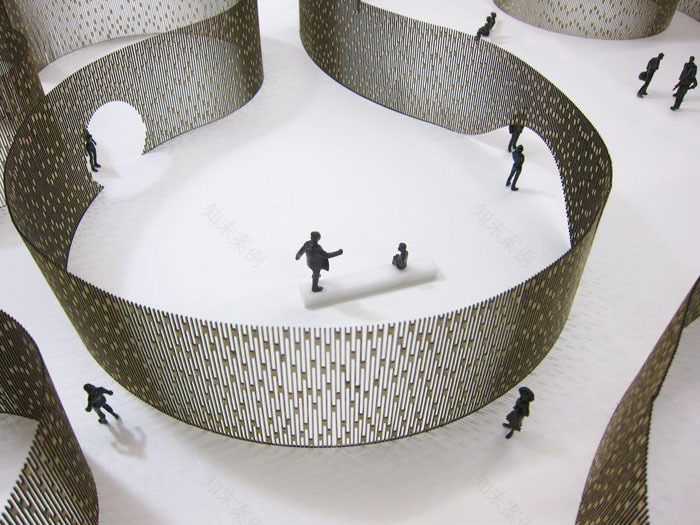
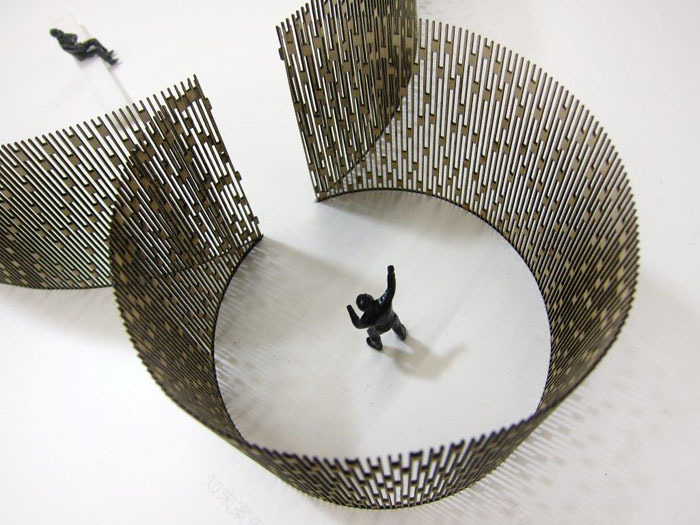
具有种种美丽的设计平面由10个圆发展而来,并与周边关系相互呼应,让人们可以得到总体上的更多探索。这个是一个具有挑战的完美创新展馆。
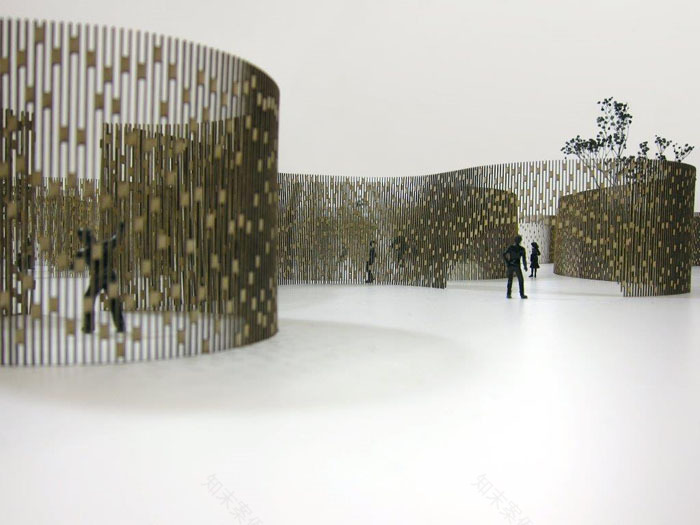
Based on these three principles an intriguing floor plan was designed using a composition of ten perfect circles. The plan design reacts to given circumstances such as the exit of the rose garden, the statue at the water, sightlines towards the castle, existing tree lines and the position of solitary trees. The jury emphasized the experiential qualities of the ‘Trylletromler’. The spatial quality offered by the pavilion is supported by the many rooms and directions users can explore. Especially considering the fact that the pavilion will be erected in late summer. In this season the Kings Garden is visited intensively, where the pavilion will act as a testimony of current knowledge and opportunities within the architectural profession. According to the jury the project therefore demonstrates the best desire and ability of architects to challenge and innovate the concept of the pavilion.


“We are very pleased that we can support this initiative – after international model – to have a pavilion build here in Denmark for the very first time. Both the Danish and international public will have the opportunity to see alternative and innovative solutions for the construction industry. This is fully in line with our aim to support projects that promote the architectural profession from development and interaction with the community”, says Bo Rygaard, CEO of The Dreyer Foundation, which has supported the competition.
The winning proposal will now be further processed and implemented in cooperation with the Copenhagen Technical College, Moelven A / S, the Danish Architects’ Association and its local department in Copenhagen before the opening of the pavilion on 13 September 2013 in the King’s Garden.
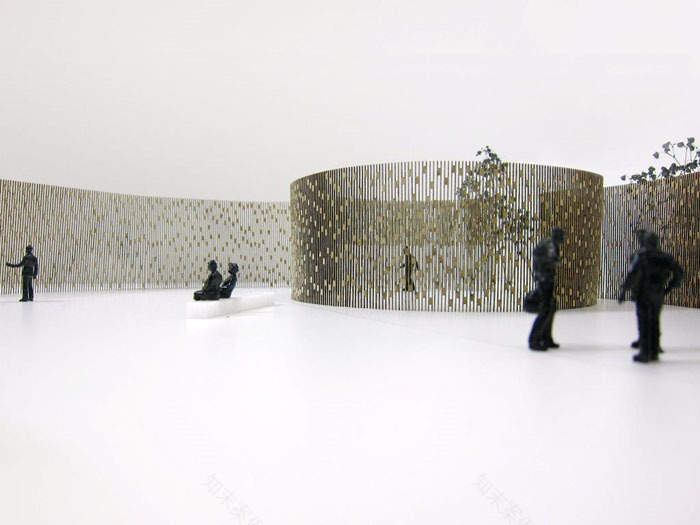


about .FABRIC
FABRIC is a knowledge intensive design practice, which is conducted by Eric Frijters
and Olv Klijn. Their involvement in architecture, urbanism and regional strategies
results in FABRICations. FABRIC connects design and research. Thinking while doing
rings our motto, whereas a hands-on approach ultimately leads to knowledge based
designs and innovative solutions.
team FABRIC
design directors: Eric Frijters, Olv Klijn; project team: Greta Mozzachiodi, Guillermo
Lavernia, Charlotte Simpson and Ida Fløche Moller
construction team
MOELVEN Denmark A/S, Copenhagen Technical College
financial support
The Dreyer Foundation, Danmarks Nationalbank’s Anniversary Foundation, National
Arts Foundation, MOELVEN Denmark A/S, Copenhagen Technical College, The Danish
Architects’ Association
Exhibition
The in total 83 proposals that were handed are on display at the Danish Architects’
Association from 13 May to 1 August. There is free admission to the exhibition in the
building’s opening hours.
public opening
13 September 2013
MORE:
FABRIC
,更多请至:
南京喵熊网络科技有限公司 苏ICP备18050492号-4知末 © 2018—2020 . All photos and trademark graphics are copyrighted by their owners.增值电信业务经营许可证(ICP)苏B2-20201444 苏公网安备 32011302321234号
苏公网安备 32011302321234号客服
消息
收藏
下载
最近