

创作上传
VIP
收藏下载
登录 | 注册有礼
查看完整案例

收藏

下载

分享

翻译
Architects:Faculty Design / Coburg University Germany
Area :19 m²
Year :2022
Photographs :Sebastian Kolm
Lead Architect :Rainer Hirth
Lba Ma Arch : Anders Macht
Design Team : Til Frank, Christopher Nguyen
Rendering : Anders Macht
Interior Volume : 66m3
Living Area According To Wfl Vo : 19 m²
U Value Of Walls, Roof And Floor : 0,13 W/m2K
Calculated Heating Energy Requirement : 900 W
Photovoltaics Collector Area : 22 m²
Photovoltaics Collector Power : 4,4 KWp
Capacity Electricity Storage : 9,6 kWh
Power Of Installed Radiant Heating : 900 W
Fresh Water Tank, External Filling : 300 l
Rainwater Storage Tank : 750 l
Black Water Tank, External Emptying : 500 l
Cost Of Materials For Shell, Cost Group Kg : 30030.000 €
City : Coburg
Country : Germany


How to build sustainability? A very current question - that moves a lot of people, as well as Master students of the course „DESIGN and MAKE sustainably“ guided by Prof. Dr. Rainer Hirth at Coburg University of Applied Sciences and Arts. The project started with a number of seminars about problems coming from the building sector. According to a UN report from 2020, the construction sector is responsible for 38 % of all CO2 emissions globally; for an immense and constantly growing consumption of resources, and, for example, in Germany for around 55 % of all waste. The constantly increasing demand for living space per capita - the average is currently 48 sqm in Germany - eliminates all progress in sustainability through the rebound effect. And is everything correct what we calculate in terms of energy consumption etc.?

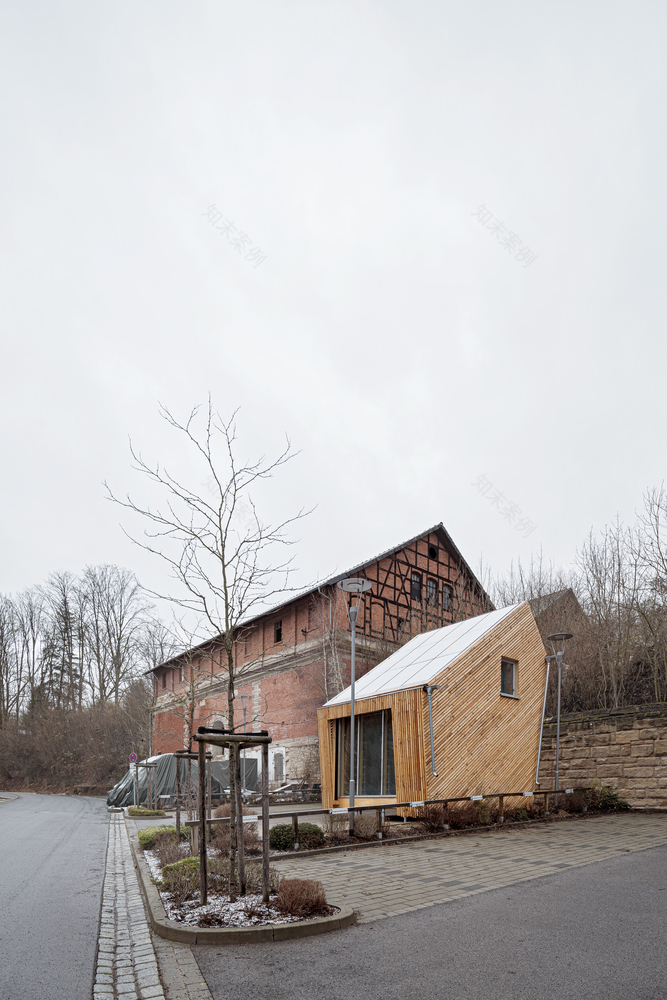
So the idea came up to build an „alternative“ research building and to monitor the performance „in reality“ with one or two inhabitants over a period of five years. The goal became an experimental building based on the cradle-to-cradle principle, CO2 - neutral, not connected to the grit, operated by solar power only, and made exclusively from reused and renewable materials only. The project began with an urban planning analysis - it became clear very soon that Tiny Houses only make sense for densification in inner cities on leftover plots, on top of buildings, or in car parks.


Under no circumstances should they consume new land in the outskirts. The built prototype occupies a car park and is thus also a statement of less car traffic. What is a Tiny House? What do we need to live on an acceptable level of comfort? A question of definition. The self-defined assumption - a bed for two, a wardrobe, a laptop working space, a micro bathroom, and a small optimized kitchen in a light, open, and architecturally sophisticated building. And surely a sofa to relax and „smart“ and flexible furniture to host at least four guests.


The research building has a 19 sqm useable area on two levels. And it had to be sustainable, inexpensive, and easy to build and to dismantle - following the cradle-to-cradle principle. The Circular Tiny House CTH*1 team avoided completely CO2-emitting building materials/mineral binders such as concrete lime plaster, etc. It is almost exclusively made from renewable materials such as straw, timber, and clay. All building material came from nearby: timber lightly damaged the bark beetle - still strong but not fulfilling the high visual standards anymore. And clay, chalk, and reused building components like windows gained from nearby demolished buildings.


The application of the cradle-to-cradle principle was also specified, neither nails nor glue was used. The building can be dismantled completely with a battery screwdriver after the monitor period of five years. There will be neither a demolition hammer nor a rubbish container the straw and the clay will be plowed under by the supplier. Timber, windows, doors, etc will come back to the building sector.

The CTH’1 on the campus will be used as a guest flat of the Faculty of Design with a semester-related period of use from 15 March to 1 December - fully autonomous for 10,5 months by roof-integrated photovoltaic modules and a large batterie. Rainwater will be collected, purified, and used for all purposes. These assumptions will be scientifically monitored and verified over a period of five years.

▼项目更多图片



南京喵熊网络科技有限公司 苏ICP备18050492号-4知末 © 2018—2020 . All photos and trademark graphics are copyrighted by their owners.增值电信业务经营许可证(ICP)苏B2-20201444 苏公网安备 32011302321234号
苏公网安备 32011302321234号客服
消息
收藏
下载
最近