

创作上传
VIP
收藏下载
登录 | 注册有礼
查看完整案例

收藏

下载

分享
该项目是日本最大的化妆品公司资生堂旗舰店的改造项目。资生堂品牌创办于1872年,是东京银座的首家西洋药妆店。
The renovation project of the flagship store of Shiseido, the largest cosmetics company in Japan, started in 1872 as Japan’s first Western-style pharmacy in Ginza, Tokyo.
外观 | Exterior

“SHISEIDO THE STORE ”旗舰店包含4个楼层,每个楼层提供不同的服务。首层和二层用于化妆品零售,其中首层的产品主要面向外国游客,二层还包含一间护肤沙龙。三层设有一个摄影室和美容美发沙龙,四层则是咖啡厅、活动空间和私人美妆咨询室。
“SHISEIDO THE STORE ” has four floors, each serving various functions and services. Cosmetics are sold on the ground and 1st floors: products on the ground floor are aimed at foreign tourists, and the 1st floor also houses a skin care salon. There is a photo studio and a hair and make-up salon on the 2nd floor, and on the 3rd floor there is a cafe, event space and private booths for beauty consultations.
▼入口,entrance

1层 | 1F
▼首层用于化妆品零售,cosmetics are sold on the ground and 1st floors


▼楼梯细部,stair case detail


▼产品展示区,product display area


▼细部,detail

▼产品成为展示墙的一部分,the products are integrated with the interior construction


▼产品展示架,shelves for display

2层 | 2F
▼二层零售区,product selling area on the first floor


▼护肤沙龙,skin care salon


设计的主要思路是融合室内装潢与化妆之间的共性。在粉刷墙壁和地面的时候,先上一层底漆,然后进行粉刷和抛光,最后再饰以保护层。化妆也是一样,首先进行护肤,然后涂上底妆,最后再涂唇膏和眼影等彩妆。这些共性激发了设计师利用资生堂产品和相关的材料来进行店铺空间的改造。
The main concept of the interior design was to integrate the common elements of interior construction and makeup. When preparing a wall or floor, first you apply the undercoat, then layers of paint or buffing, and finally a protective topcoat. Make-up follows a similar order. First you apply skincare, then primer and foundation for the base, then touches of color such as lipstick or eye shadow. These similarities in process inspired the concept of renovating the space to apply make-up to the store’s interior using Shiseido products and related materials.
3层 | 3F
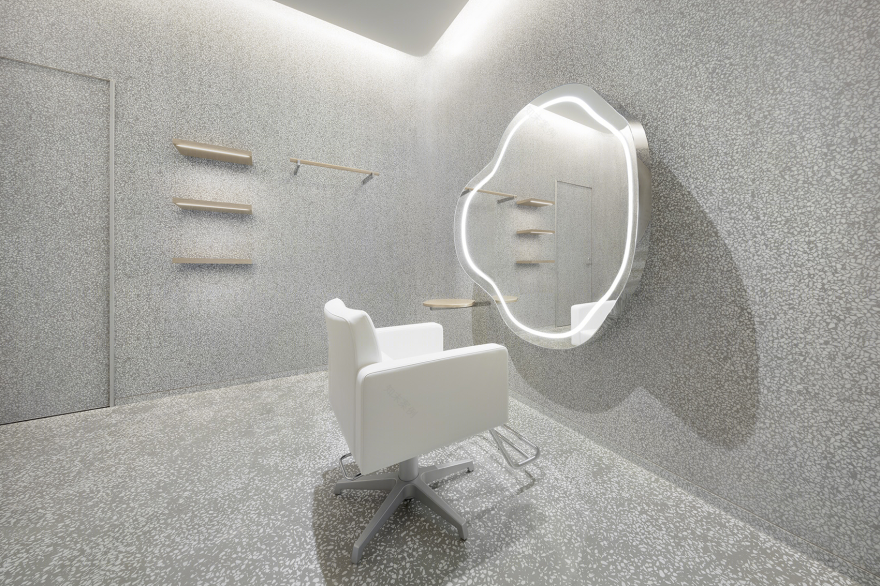
▼三层空间包含摄影室和美容美发沙龙,the second floor consists of a photo studio and a hair and make-up salon


▼墙面细部,detailed view of the walls


▼美容美发沙龙,hair and make-up salon



▼走廊,corridor

4层 | 4F
▼位于四层的咖啡厅,cafe on the third floor


▼活动区域及私人美妆咨询室,event space and private booths for beauty consultations


▼化妆间,make up room


▼洗手间,rest room


细节 | Detail
纤薄的化妆棉材料被应用到墙壁当中,搭配下方的照明,产生柔和的光线。山茶花油——资生堂产品(尤其是护发产品)中的重要原料——被涂在未经修饰的天然木料上,使其随时间的流逝变得愈发优雅。眼影产品用化妆刷涂抹在墙面上,形成类似于大理石的纹理。混合了指甲油的涂料还被用于天花板装饰品中,带来微妙的闪光。这些隐藏的细节展示了日本美学的本质,同时也恰当地表达了资生堂的品牌文化。

Paper made from thinly spread cotton pads was used on the walls; lit from underneath, it gives off a soft glow. Camellia oil—a key ingredient at Shiseido, especially in its hair care products—was applied to natural, unprocessed wood, to give it a beautiful aged finish as time passes. Eye shadow was layered onto the walls with make-up brushes to give a marble-like finish, and nail polish was mixed into the paint used for the ceiling art, giving a subtle shimmer that catches the shifting light. Hidden touches like these have their roots in the Japanese sense of beauty and are a fitting expression of Shiseido’s perspective.
▼模仿竹子的立柱造型,the columns resembling sections of bamboo

▼纤薄的化妆棉材料被应用到墙壁当中,paper made from thinly spread cotton pads was used on the walls


▼混合了指甲油的涂料还被用于天花板和地面,nail polish was mixed into the paint used for the ceiling art and the floor


设计中的图形元素来自山茶花的花朵形状,这也是资生堂自1915年以来便一直使用的品牌标识。整个空间中充满了源自日本传统工艺的主题:模仿竹子的立柱造型、制造和纸时常用的镂空工艺、传统竹篮的编织图案以及传统复合纸的纹理等等。

The design motif has been derived from a silhouette of the camellia flower, Shiseido’s icon since 1915.Forms of the motif, each inspired by techniques from Japan’s traditional crafts, can be found throughout the space: it appears in the form of columns, resembling sections of bamboo; as cut-outs in the style of kiri-e paper craft; in woven patterns resembling traditional baskets; and modeled like traditional papier-mâché hariko.
▼无处不在的山茶花元素,the design motif has been derived from a silhouette of the camellia flower


最后,建筑的窗户背面还使用了线帘,并装饰以传统的日式绳结(あわじ結び),从远处看则形成了山茶花的形状。这种绳结在日本象征着长久的联系,表达了资生堂与顾客建立持久关系的愿望。
Finally, string curtains were used behind the windows of the building. A traditional decorative knot called awajimusubi, was tied at specific points on the strings to form the outline of a camellia flower when viewed from afar. The awajimusubi knot is a traditional Japanese symbol which stands for a long-lasting bond and connection, representing Shiseido’s desire to build an enduring relationship with its customers.
▼窗户背面使用了线帘,并装饰以传统的日式绳结,string curtains were used behind the windows of the building, tied with traditional decorative knot called awajimusubi

▼绳结从远处看则形成了山茶花的形状,the knots form the outline of a camellia flower when viewed from afar


南京喵熊网络科技有限公司 苏ICP备18050492号-4知末 © 2018—2020 . All photos and trademark graphics are copyrighted by their owners.增值电信业务经营许可证(ICP)苏B2-20201444 苏公网安备 32011302321234号
苏公网安备 32011302321234号客服
消息
收藏
下载
最近