

创作上传
VIP
收藏下载
登录 | 注册有礼
查看完整案例

收藏

下载

分享

翻译

Next in our high-tech architecture series is Norman Foster's Renault Distribution Centre in Swindon, one of the most expressive and distinctive examples of the style.
Completed in 1982 by Foster Associates, which became Foster + Partners, the Renault Distribution Centre was the main UK distribution facility for French car manufacturer Renault.
With its expressed structure it is one of the clearest demonstrations of high-tech architecture, a style that emerged in the 1960s and celebrates a building's structure.
It was the second industrial building that Foster built in the city of Swindon, following the Reliance Controls created while he was part of Team 4.

The Renault Distribution Centre has a visible, expressive structure
Unlike other huge, often anonymous distribution sheds, the 25,000-square-metre building has an extremely distinctive profile created by 59 bright-yellow masts and arched steel-beams that support the roof.
The building's distinctive roof was created as Renault required a flexible space with large, open spaces for the industrial warehouse racking and storage, which would need to be reconfigured regularly throughout the life of the building.

The building is designed in square modules
In total the structure is made from 42 square modules that are each 24 metres by 24 metres. Each module has a PVC membrane roof stretched across a grid of arched steel-beams that are held up by ties connected to masts at their corners.
Related story Dezeen's introduction to high-tech architecture
A total of 36 of these modules, arranged on a nine by four grid, enclosed 20,000 square-metres of warehouse space.

The building has a clearly expressed structure
A further three modules were built to contain a training school, workshops, offices and a staff restaurant.
A large, open showroom with cars suspended from the roof, which was often used for events, occupied two additional bays at the end of the building, while the final module is open to create a covered entrance.
As at the Reliance Controls building, the functions of the building were not differentiated by the architecture, with the same structural system covering the warehouse space, offices and showroom.

All of the building's functions are contained under one roof
The building was also intended to be a physical piece of branding for the French car company with each of the masts painted bright Renault yellow. To further emphasis the yellow painted elements, the walls, which are entirely independent of the structure, were inserted two metres into the building.
Related story Norman Foster is high-tech architecture's international figurehead
"It is the building's almost festive Renault-yellow skeleton that gives the centre such an identifiable character," explained Foster + Partners.
"Significantly, this created such a memorable image that the building, alone among the company's facilities, did not need to carry the Renault logo."
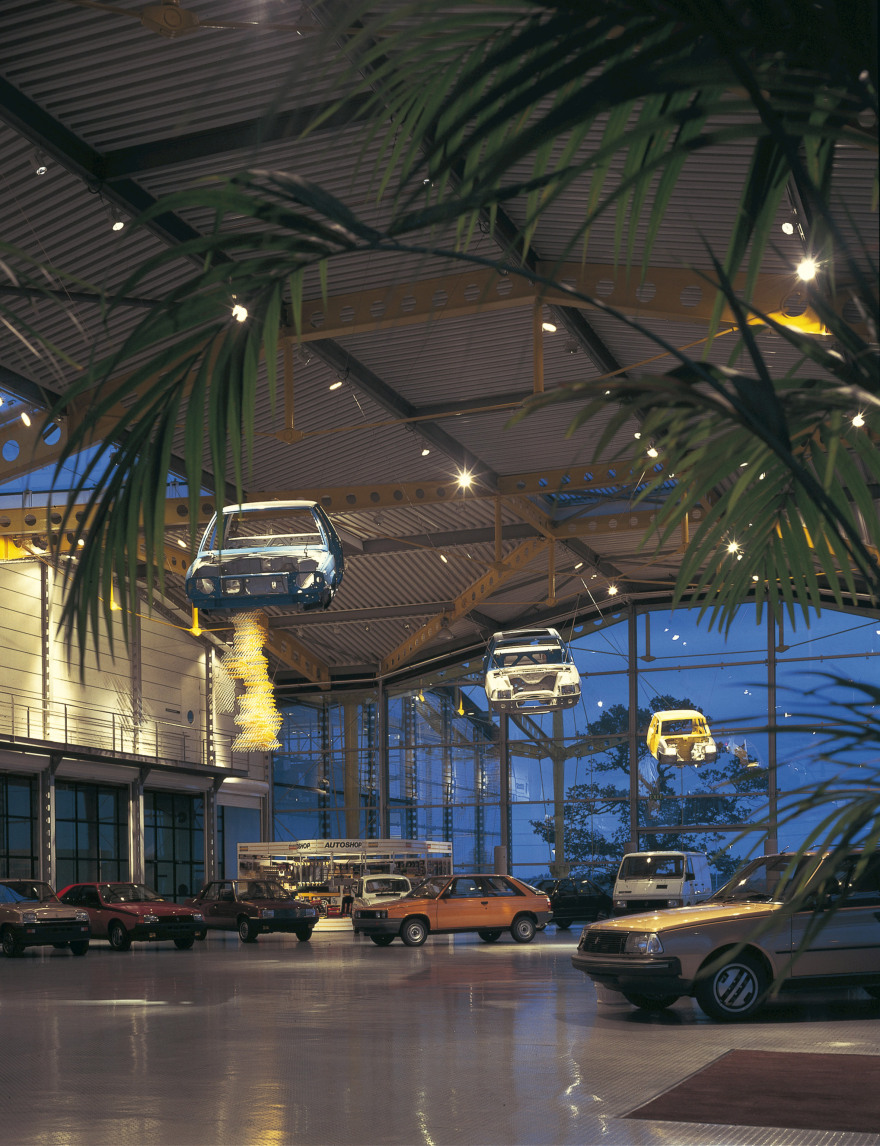
Cars were hung from the roof of the showroom. Photo is by Alistair Hunter
Along with the building, Foster's studio designed the majority of fixtures for Renault including the warehouse storage units and a range of office furniture.
Glass-topped tables, which were developed for the studio's own offices, were modified for the distribution facility's offices, restaurant and reception. The tables were developed by Italian furniture manufacturer Tecno and placed on sale in 1986 – they are still in production.
Renault sold the building in 2001, and since then it has been known as the Spectrum Building. It is currently occupied by a tyre distribution centre and the Kidz About play centre – something that Foster told the Architects' Journal he was "delighted" by.
"We are delighted that the Renault building has proved flexible enough to accommodate a kids' playground and hope that they are inspired by its design," he said.

Dezeen's high-tech series explores the architecture style
Led by architects Foster, Richard Rogers, Nicholas Grimshaw, Michael and Patty Hopkins and Renzo Piano, high-tech architecture was the last major style of the 20th century and one of its most influential.
Our high-tech series celebrates its architects and buildings ›
Photography is by Richard Davies, unless stated. Illustration is by Jack Bedford.
南京喵熊网络科技有限公司 苏ICP备18050492号-4知末 © 2018—2020 . All photos and trademark graphics are copyrighted by their owners.增值电信业务经营许可证(ICP)苏B2-20201444 苏公网安备 32011302321234号
苏公网安备 32011302321234号客服
消息
收藏
下载
最近