

创作上传
VIP
收藏下载
登录 | 注册有礼
查看完整案例

收藏

下载

分享
布鲁日会议中心(BMCC)坐落于历史城区的核心地带,是由 Eduardo Souto de Moura 和 META architectuurbureau 两家事务所共同设计的地标性城市改造项目。建筑的底层是一个多功能展厅(4500 平方米),兼具了带顶公共空间的功能,与附近街区融为一体。上方几个楼层是会议区域,可供 500 多人使用。在选择 Souto de Moura 和 META 作为项目建筑师的过程中,布鲁日市政府有力地证明了其在建筑质量方面首屈一指的声誉。
The Bruges Meeting & Convention Centre (BMCC) is a landmark urban renewal project by Eduardo Souto de Moura and META architectuurbureau, located in the heart of the historic city. With a multifunctional exhibition hall on the ground floor (4,500 m²), which also serves as a public covered square, the building is an integral part of the neighbourhood. The upper floors accommodate a conference area for over 500 participants.
In selecting Souto de Moura and META for this project, the City of Bruges sealed its reputation as a champion of architectural quality.
▼项目概览,General view ©Filip Dujardin

区域导向的动态项目 District-oriented and dynamic
Souto de Moura 和 META 的项目团队共同打造了一处开放且几乎无障碍的展览空间,用以容纳各种类型的活动,包括贸易展览、会议、公众聚集乃至音乐会等等。另一方面,当展厅的玻璃外墙开启时,该空间又将转变为带顶的公共广场,可供过往的行人使用,由此成为街区的一个组成部分。
The architectural team – Eduardo Souto de Moura and META architectuurbureau – has delivered an open and virtually obstacle-free exhibition hall that can accommodate every type of event, from trade fairs and conferences to public gatherings and even concerts. But at the same time, by opening up the outer glass walls of the exhibition hall, the area can be transformed into a public covered square, accessible to passers-by and an integral part of the neighbourhood.
▼建筑与街区关系,The centre and the neighborhood©Filip Dujardin

布鲁日会议中心
庄严与温馨并存
Bruges Meeting & Convention Centre
Monumental and welcoming architecture
建筑的功能划分和灵活使用是该建筑最明显的两个优势。通过置入共享的入口,展览区与会议区可以独立或者同时使用。展览区呈水平状布局并朝向社区,可以直接从外部进入,会议区则是在垂直方向上堆叠布局。
Functional division and flexible use are two of the building’s greatest assets. Connected by a shared entrance, the exhibition and conference areas can be used independently or simultaneously. While the exhibition hall is organised horizontally, oriented towards the neighbourhood and immediately accessible from outside, the conference area is stacked vertically.
▼从广场望向建筑主立面,View to the main facade from the square©Filip Dujardin

具有庄严感的建筑坐落在玻璃基座上,一方面提高了地面层的透明度,另一方面也强调了该楼层可作为带顶广场的公共特征。建筑入口处设有显著的悬臂结构,提供了一条有遮挡的进入路径。“悬浮”的顶篷带来四季适用的集会场所,同时也在前院与入口之间形成了过渡。
The monumental building rests on a glass plinth. This enhances the transparency at ground level whole emphasising the public character of what can also be a covered square. The entrance is dominated by an impressive cantilever that provides a covered entrance. The floating canopy – a sheltered meeting place in both summer and winter – also organises a gradual transition between the forecourt and the building’s entrance.
▼“悬浮”的顶篷在首层营造出灰空间
The floating canopy covering the ground level©Filip Dujardin

宏伟的砖砌柱子为立面赋予了吸引人的韵律感,坚固的属性使其为建筑带来大面积的阴凉,同时又兼具了整体遮阳的功能。站在二层时,这些立柱将人们的目光从室内引向外部空间,朝着市中心的方向远眺,则可以看见布鲁日天际线中最具标志性的三座建筑:钟楼、圣萨尔瓦多大教堂和圣母大教堂。
The massive brick columns lend an attractive cadence to the façade. With their solid character, they provide plenty of shade but also serve as an integral sun shield. From the second floor, they direct the viewer’s gaze from inside to outside and over the city centre, where the three towers of the Belfry, the Saint Salvator’s Cathedral and the Church of Our Lady define the Bruges skyline.
▼砖砌柱子带来吸引人的韵律感,The massive brick columns lend an attractive cadence to the façade©Filip Dujardin

▼从室内望向砖砌立柱,View towards thebrick columns from internal space©Filip Dujardin


▼露台,Terrace©Filip Dujardin

以砖材致敬布鲁日的历史
Brick with a nod to historic Bruges
与城市色调相匹配的红色砖材为建筑赋予了坚固和宏伟的观感。砖块被完全潜入砂浆,平坦的接面暗含着对传统砌筑技术的致敬——这也是对布鲁日历史的一种参照。
The building has a robust, massive appearance thanks to the use of reddish brown bricks that correspond to the colour palette of the city. The bricks are fully set in the mortar and with a simple levelled joint they allude to traditional masonry techniques. A reference to historic Bruges.
▼建筑立面局部,Facade partial view©Filip Dujardin

全面的功能与“三个坐席”原则 Comprehensive programme with three-chairs principle
展览区与会议中心的结合将两种功能自然地衔接起来,此外,额外设置的会议设施不仅可以满足容纳超过 500 人团体的使用需求,还能够对布鲁日旅游业的复兴起到促进作用,因为参与会议的游客主要集中在旅游人数较少的工作日来访。
Combining an exhibition hall with a conference centre creates a natural convergence between the two functions. Moreover, the addition of a convention facility not only meets the demand for accommodating groups of 500+ people in the heart of Bruges, but also responds to Bruges’ tourist offering, with conference visitors finding their way to the centre mainly on the less touristy weekdays. In this way, the fairs and conventions will contribute to the tourist revival.
▼首层入口,Entrance©Filip Dujardin

▼大门,The gate©Filip Dujardin

▼首层多功能展厅,Multifunctional exhibition hall on the ground floor©Filip Dujardin


会议中心的设计遵循了“三个坐席”的原则,即为每位与会者配备三个座位,分别位于全体会议大厅、会议室和餐饮区。其中餐饮区可直接通往露台,后者享有无与伦比的城市视野。详细来看,会议中心包括一个可分区的礼堂(配备超过 500 个可伸缩座位)、12 个同样可分区的会议室、一个 675 平方米的餐厅、与餐厅相邻的 176 平方米的露台、一个地下自行车库,以及宽敞的、方便组织者使用的停车场。
The conference centre has been designed according to the three-chairs principle: a conference participant has a seat in the plenary hall, in the meeting rooms and in the catering area. The latter adjoins a terrace that offers an unrivalled view across the city. In more detail, the programme also includes a divisible auditorium with retractable seating for over 500 visitors, 12 meeting rooms that are also divisible, a catering area of 675 m², an adjoining terrace of 176 m², an underground bicycle shed and spacious, user-friendly parking for organisers.
▼礼堂,Auditorium©Filip Dujardin


▼礼堂前厅,Auditorium front hall©Filip Dujardin

▼会议室,Meeting room©Filip Dujardin


Beursplein 和周边区域
传统、和谐与创新
The Beursplein and its surroundings
Tradition, harmony and innovation
作为重建计划的一部分,Beursplein 及其周围街道均得到了完整而全面的更新。人行道、街道和中央场地被重新设计为一个广场,兼具了柔和的流动性与雄伟的视觉特征。该空间同样为布鲁日会议中心提供支持,它以包罗万象的姿态调和了室内与室外,以及广场与城市之间的关系。
The Beursplein and surrounding streets were all renewed – façade by façade – as part of the redevelopment scheme. The pavement, the street and central area were redesigned into a square, with soft mobility and an ambitious visual quality. The public space supports the BMCC. An all-embracing gesture that mediates between indoors and outdoors, but also between the square and the city.
▼建筑后方立面,Rear facade©Filip Dujardin

曾经作为停车场的 Beursplein 区域如今成为了气氛宁静的城市广场。精心设计的街道界面为周边提供了额外的自由空间,不仅为居民带来活动的机会,同时也能够为附近的餐饮店、学校和酒店提供便利。考虑到人流密度方面的控制,街道轮廓被嵌入到几乎完全平坦的广场中,这也让软性道路代替了汽车交通,在空间中占据优先地位。
The Beursplein, which used to be a car park, has primarily become a new urban square that radiates tranquillity. A well-conceived street profile creates additional free space around the perimeter. This not only benefits the residents, but also the catering industry, the nearby schools, the student facilities and the hotels. Because of the limited intensity, the street profile is embedded in a virtually level square. As a result, car traffic becomes secondary and the soft road user takes precedence in the space.
▼建筑主立面夜景,Main facade at dusk©Filip Dujardin

融合艺术作品 Art integration by Philip Aguirre y Otegui
项目团队与布鲁日市政府共同为广场挑选了名为“De Bron”(源头)的青铜雕塑作品,由出生于 1961 年的比利时艺术家 Philip Aguirre y Otegui 创作。该作品为前院空间赋予了独特的艺术气息与活力,成为受到各年龄段游客喜爱的集会场所。
A bronze sculpture by the artist Philip Aguirre y Otegui (b. 1961, Schoten, Belgium) was selected for the square in consultation with both the City of Bruges and the architects. With De Bron [The Source], the artist brings the forecourt to life, a meeting place for young and old.
▼设有雕塑的广场,Thesquare with the sculptureDe Bron©Filip Dujardin

▼轴测图,axon© Eduardo Souto de Moura+METAArchitectuurbureau

▼场地位置示意,floor plan implantation© Eduardo Souto de Moura+METAArchitectuurbureau

▼地下一层平面图,floor plan level -1© Eduardo Souto de Moura+METAArchitectuurbureau

▼首层平面图,floor plan level 0© Eduardo Souto de Moura+METAArchitectuurbureau

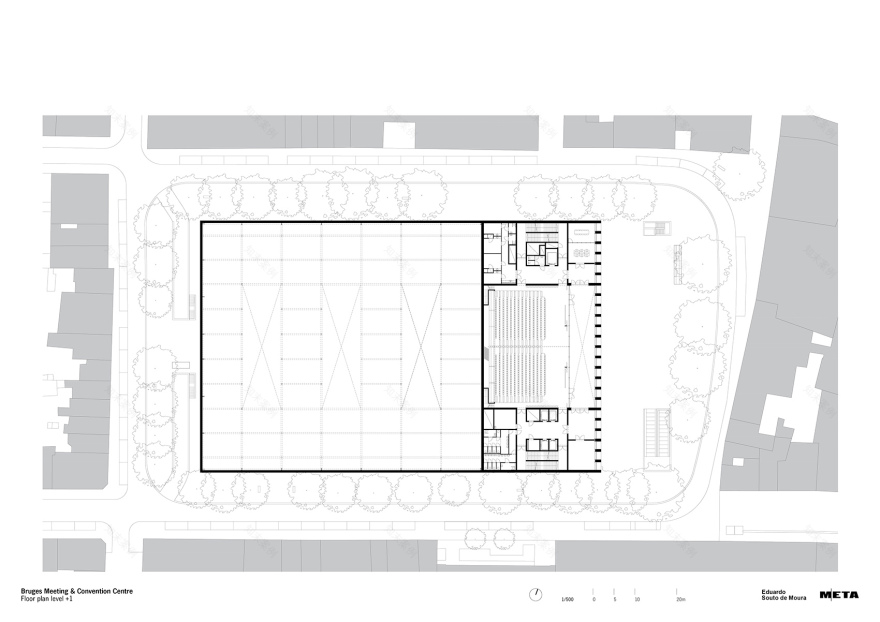
▼二层平面图,floor plan level +1© Eduardo Souto de Moura+METAArchitectuurbureau
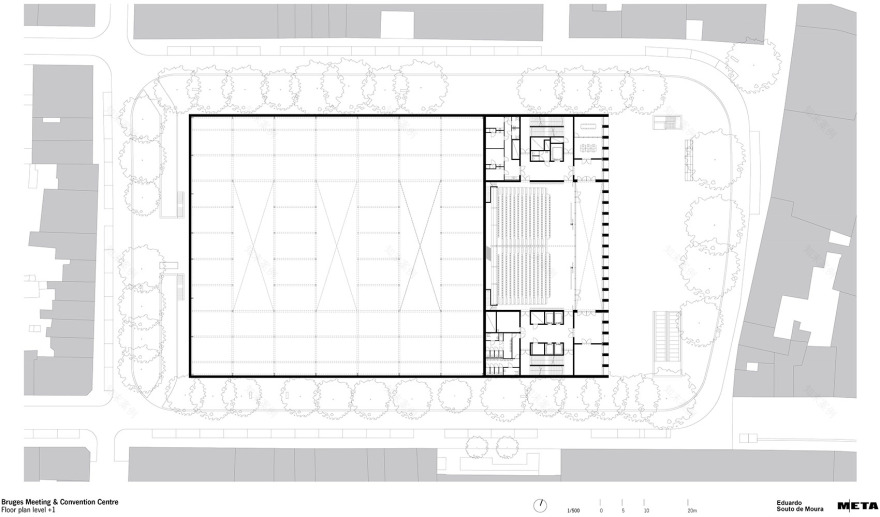
▼三层平面图,floor plan level +2© Eduardo Souto de Moura+METAArchitectuurbureau

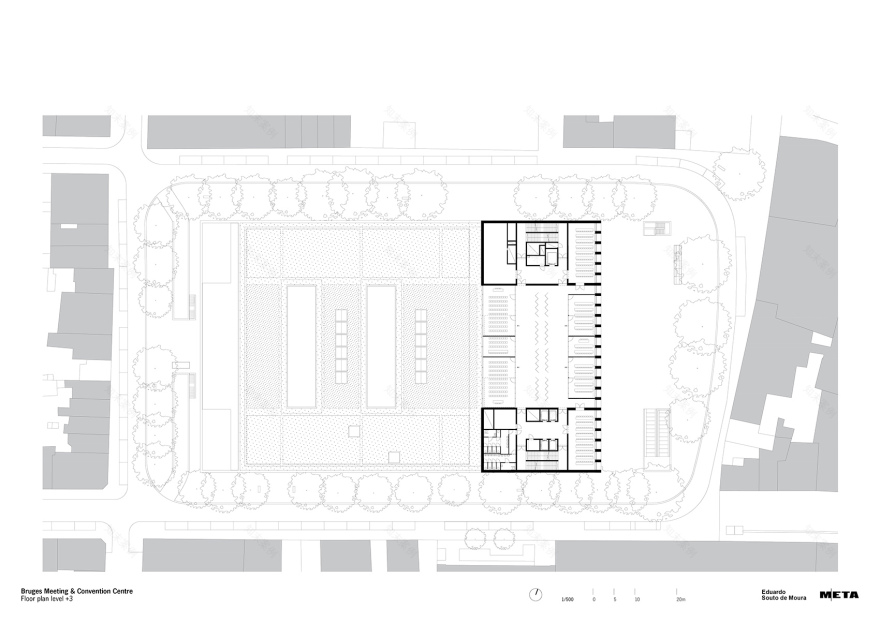
▼四层平面图,floor plan level +3© Eduardo Souto de Moura+METAArchitectuurbureau

▼五层平面图,floor plan level +4© Eduardo Souto de Moura+METAArchitectuurbureau

▼剖面图,section© Eduardo Souto de Moura+METAArchitectuurbureau





南京喵熊网络科技有限公司 苏ICP备18050492号-4知末 © 2018—2020 . All photos and trademark graphics are copyrighted by their owners.增值电信业务经营许可证(ICP)苏B2-20201444 苏公网安备 32011302321234号
苏公网安备 32011302321234号客服
消息
收藏
下载
最近