

创作上传
VIP
收藏下载
登录 | 注册有礼
查看完整案例

收藏

下载

分享
“白蜡木小屋”是康奈尔大学建筑、艺术和规划学院在 2020 年完成的一项重要实践,旨在应对美国诸多地区遭受白蜡树蛀虫侵袭的危机。这种蛀虫名为白蜡窄吉丁(Emerald Ash Borer),被认为是在 2002 年夏季通过贸易和旅行被带入美国本土的森林,如今正威胁着全国 87 亿棵树木和纽约州近十分之一的白蜡树的生命。康奈尔大学建筑系的两位助教 Leslie Lok 和 Sasa Zivkovic,同时也是 HANNAH 设计事务所的共同负责人,在纽约北部的乡村地区设计并建造了一座全尺寸的木屋原型,在提出应对环境危机的方案的同时,也推动了机器人和 3D 打印等技术在木材与混凝土建筑中的应用。
The College of Architecture, Art, and Planning at Cornell University announce an important step in their creative and critical response to the Emerald Ash Borer beetle, an invasive species devastating native Ash trees across the country.
The Emerald Ash Borer is thought to have been introduced to American forests via human trade and travel in the summer of 2002, and today threatens 8.7 billion trees across the country and nearly one in ten Ash trees in New York state.
Leslie Lok and Sasa Zivkovic, both assistant professors of architecture at Cornell and co-principals of their design firm, HANNAH, have designed and constructed a full-scale prototype cabin home in rural Upstate New York that responds to the environmental crisis, and, advances the use of technologies such as robotics and 3D printing in timber and concrete construction.
▼森林景观中的小屋,Drone photo of cabin in forest landscape©HANNAH

▼小屋正立面,带有宽阔的窗户 Front elevation of cabin with large window ©Andy Chen

▼小屋东北角,Northeast corner of cabin©Andy Chen

将垂死的白蜡树变为可利用的材料
The Dying Ash Tree, Upcycling a New ‘Waste Material’
时至今日,传统的锯木厂仍然无法将被蛀虫侵蚀的成熟白蜡树用作房屋建筑的木材来源,其中一部分原因来自这些树木的不规则形状。“受到侵害的白蜡树通常只能慢慢腐烂或者被作为能源进行焚烧,但这两种情况都会造成二氧化碳的大量释放。”Sasa Zivkovic 表示:“因此,如果能够用受到侵染的白蜡木进行建造,不仅能够大大提高固碳量,而且还可以减少对许多常用木材品种的砍伐。”
▼过程示意:从白蜡树到外立面板,Process diagram: from ash tree to surface panel©HANNAH

▼为建造小屋收集的原木,Collection of logs sourced for the cabin©HANNAH

▼从弯曲的原木切割而来的木板,Sliced wood panel from curved log©HANNAH

Until recently, mature ash trees compromised by the Ash Borer have not been usable by conventional sawmills as a source of lumber for home construction in part because of their irregular geometries. “Infested ash trees often either decompose or are burned for energy,” said Zivkovic. “Unfortunately, both scenarios release CO2 into the atmosphere, and so the advantage to using compromised ash for construction is that is that it both binds the carbon to the earth and offsets the harvesting of more commonly used wood species.”
▼小屋转角外观,Cabin corner©Andy Chen

机器人和 3D 打印混凝土使理想成为可能 Made Possible by Robotics and 3D-Printed Concrete
凭借不断进步的技术(尤其是机器人和 3D 打印混凝土技术)以及它们在建筑设计学科和建造行业中的应用,被蛀虫侵染的白蜡树获得了被重新利用的可能。康奈尔大学机器人建造实验室(Robotic Construction Lab)的团队为此建立了一个定制的机器人制造平台,专门用于处理因为受到侵染而变得形态不均的白蜡树。“RCL 的团队将首先通过 3D 扫描将这些成熟树木的复杂且不规则的几何形状进行数字化的转译,然后再利用编程的机器人对这些木材进行切割和加工。”
▼制造过程示意:不规则木材的切割、切割轨迹和相应的表面形态©HANNAH Fabrication diagram: robotic slicing of irregular wood geometries, tool paths, and corresponding surface conditions

▼左:机器人切割的立面原型©HANNAH;右:机器人切割原木的过程©Andy Chen
Left: Robotically cut façade prototype; Right: Robot slicing tree fork
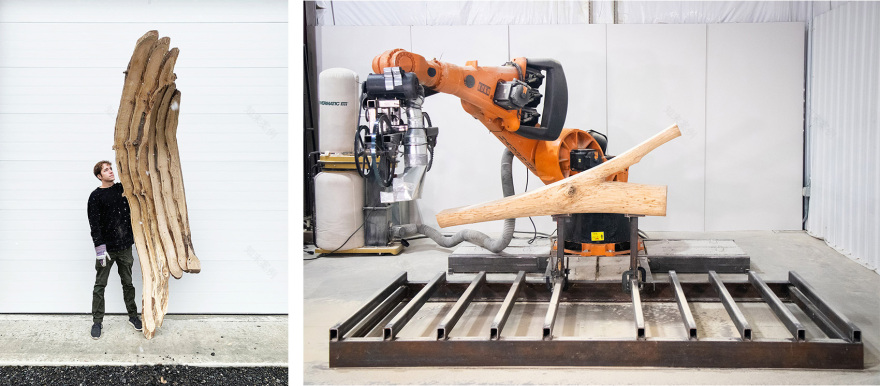
Consistently advancing technologies — specifically robotics and 3D printed concrete — and their use in the architectural design discipline and construction industries make the use of infested ash trees possible. Zivkovic is director of the Robotic Construction Lab (RCL) at Cornell, where the team built a custom robotic platform for the sole purpose of processing the irregular ash trees. “The team at RCL built the robotic platform specifically for processing irregular ash trees. Basically, we begin by creating 3D scans as a basis for translating and digitizing the complex and irregular geometries of the mature trees. The robot is then programmed to cut and process irregular wood geometries — it is through these current technologies that we can work with this material,” explains Zivkovic.
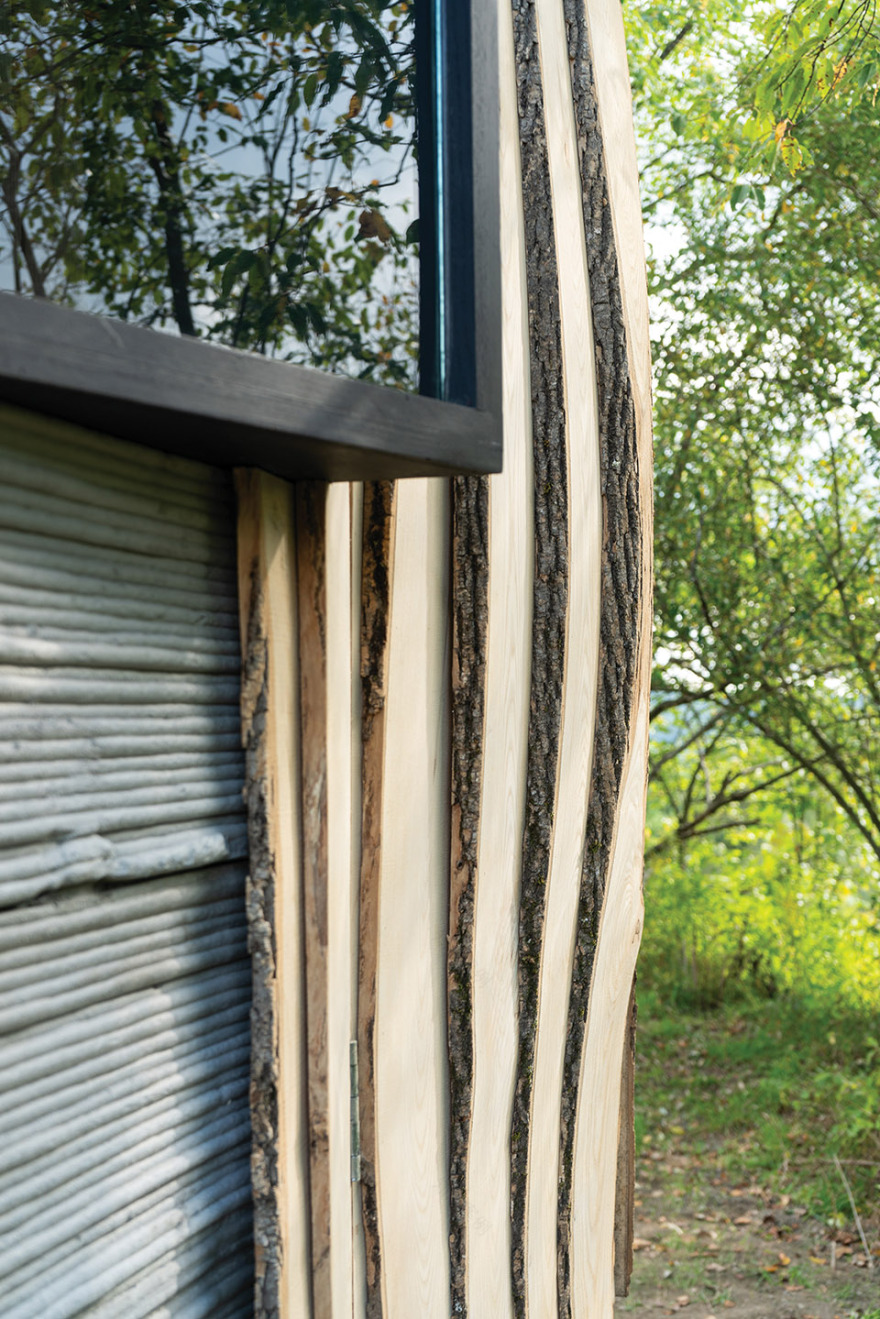
▼烟囱、大门和挡雨篷细节,View of chimney, door, and awning©Andy Chen

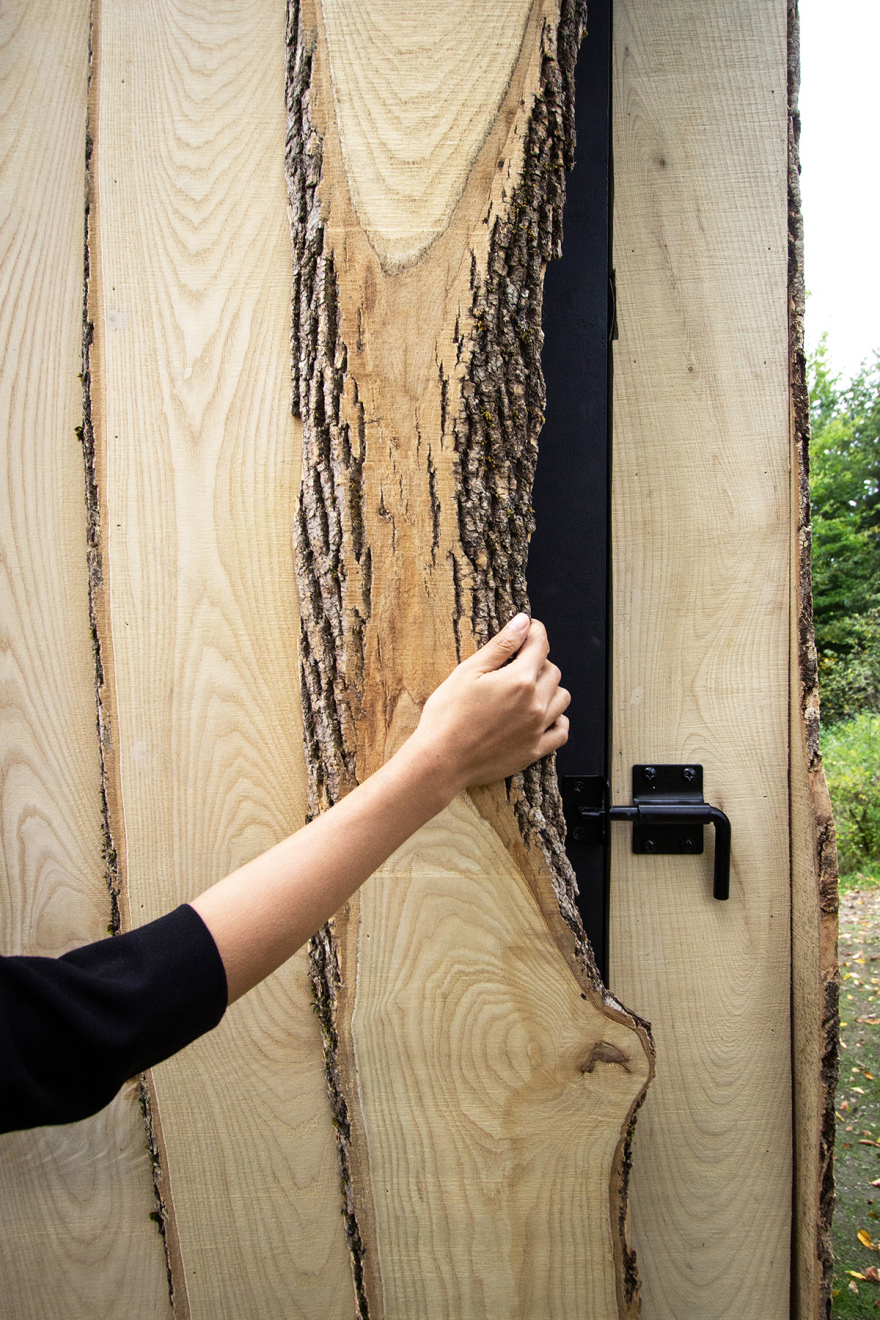
▼大门侧立面 & 铰接式窗户轮廓
Side elevation of door & Side profile of articulated window opening©Andy Chen

此外,考虑到混凝土是全球使用最广泛的建筑材料之一,康奈尔大学的研究人员还开发了全尺寸的 3D 打印系统,可以在不需要模板的情况下,最大程度地减少生产过程中的混凝土用量,从而显著地改善了混凝土建筑的二氧化碳足迹。
“我们都知道混凝土建造占据二氧化碳排放总量的 8%,”Leslie Lok 解释说:“通过 3D 打印,我们避免了使用模板造成的浪费,并且可以巧妙地让混凝土仅被使用在结构需要的部位,从而在保持建筑完整性的同时显著减少材料的使用。”
▼3D 打印设备和混凝土基座模型,Top view of 3D printer and concrete leg modules©Reuben Chen

▼3D 打印在地面砖上留下的刻痕,printed concrete tool paths design floor tiles©Reuben Chen

In response to the use of concrete, one of the most widely used building material on earth, the Cornell researchers developed the full-scale 3D printing system that requires no formwork and uses the absolute minimum amount of concrete in the production process. This saves a significant amount of material, significantly improving the CO2 footprint of concrete construction. “We know that concrete is responsible for 8% of total CO2 emissions,” explains Lok. “By using 3D printing, we eliminate the use of wasteful formwork and can deposit concrete smartly and only where structurally necessary, reducing its use considerably while also maintaining a building’s integrity.”
▼3D 打印的混凝土结构,Finished 3D printed concrete structure with scale figure©Andy Chen

▼小屋东南视角,Southeast view of the cabin©Andy Chen

▼小屋西北视角,Northwest corner of cabin©Andy Chen
未来的展望
A Vision for Tomorrow
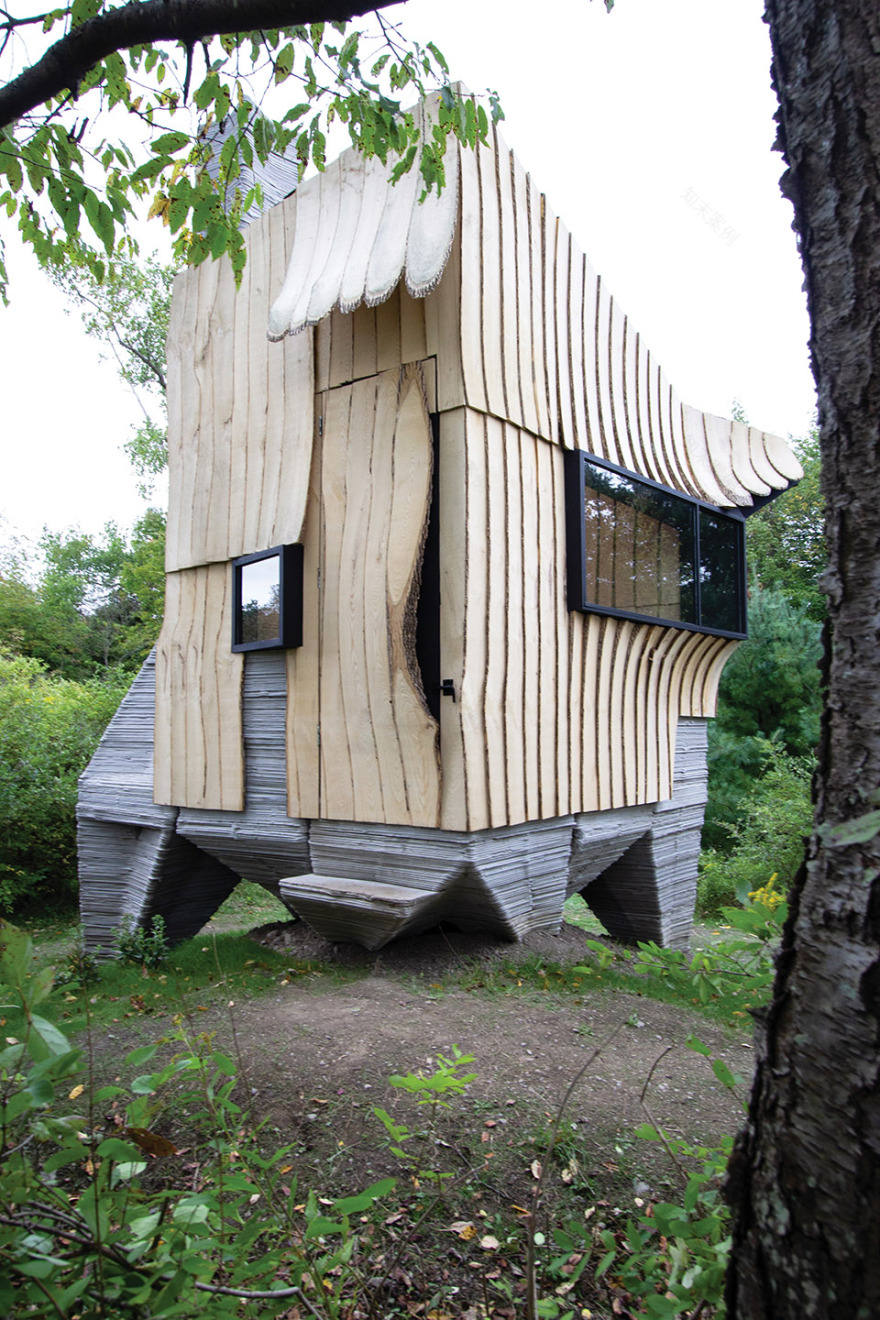
“白蜡木小屋”展现了在美国乃至全世界实施可持续住房设计、开发和建造的一种全新方式。其创新性的设计将混凝土和木材这两种在美国使用最广泛的建筑材料结合起来,从根本上重新思考了运用它们的技术和方法。
The cabin demonstrates a new way to think about sustainable housing design, development, and construction in the United States and perhaps beyond. Its inventive design combines two of the most widely used construction materials in the US (concrete and timber), rethinking techniques and approaches for using them from the ground up.
▼小屋内部空间,Interior view©Andy Chen


▼室内细节,Interior detail of the cabin©Andy Chen

▼从东北角望向烟囱,Northwest corner with chimney©Andy Chen

▼支撑基座底部视角,Underside of corbelled legs©Reuben Chen

▼建造现场,On-site construction©Reuben Chen

▼平面图,Plan©HANNAH

▼立面展开图,Unfolded elevation diagram©HANNAH

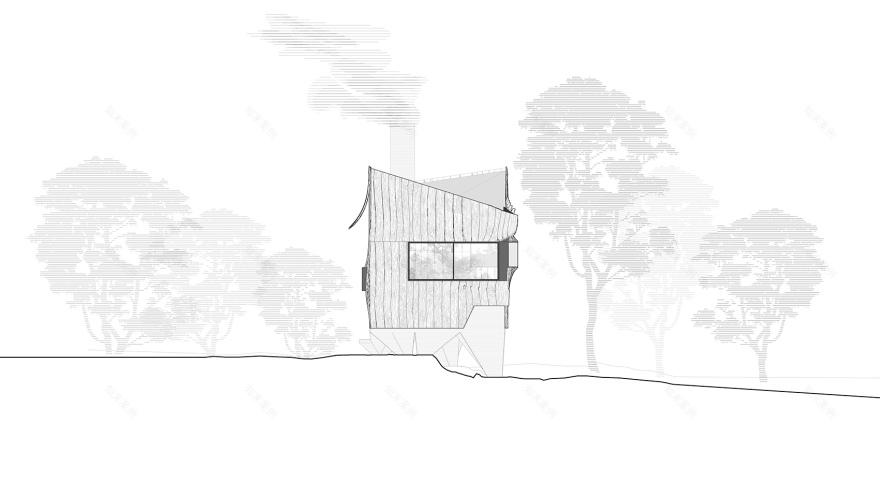
▼南立面图,South elevation©HANNAH

▼剖面图,Section©HANNAH

▼机器人切割的结构隔热板面(SIP),Drawing of robotically sliced Structural Insulated Panel (SIP)©HANNAH

PROJECT CREDITS
HANNAH project leadership: Leslie Lok and Sasa Zivkovic (Principals)
Project team concrete: Christopher Battaglia, Jeremy Bilotti, Elie Boutros, Reuben Chen, Justin Hazelwood, Mitchie Qiao / Assembly and documentation team concrete: Alexandre Mecattaf, Ethan Davis, Russell Southard, Dax Simitch Warke, Ramses Gonzales, Wangda Zhu / Project team wood fabrication and design: Byungchan Ahn, Alexander Terry / Wood studies: Xiaoxue Ma, Alexandre Mecattaf / Assembly and documentation team wood: Freddo Daneshvaran, Ramses Gonzalez, Jiaying Wei, Jiayi Xing, Xiaohang Yan, Sarah Elizabeth Bujnowski, Eleanor Jane Krause, Todd Petrie, Isabel Lucia Branas Jarque, Xiaoxue Ma / Representation team: Byungchan Ahn, Kun Bi, Brian Havener, Lingzhe Lu / Cornell Arnot Teaching and Research Forest: Peter Smallidge (Arnot Forest Director)
Project realized with scientific support from the Cornell Robotic Construction Laboratory (RCL) / Sponsors: AAP College of Architecture, Art, and Planning; AAP Department of Architecture; HY-Flex Corporation; Cornell Atkinson Center for a Sustainable Future, Cornell Arnot Teaching and Research Forest
Special thanks to: Andrea Simitch and Val Warke.




南京喵熊网络科技有限公司 苏ICP备18050492号-4知末 © 2018—2020 . All photos and trademark graphics are copyrighted by their owners.增值电信业务经营许可证(ICP)苏B2-20201444 苏公网安备 32011302321234号
苏公网安备 32011302321234号客服
消息
收藏
下载
最近