

创作上传
VIP
收藏下载
登录 | 注册有礼
查看完整案例

收藏

下载

分享
项目概述
PROJECT STATEMENT
这个在Acadia国家公园边缘的5英亩的场地曾经是哈佛大学校长及美国缅因州景观保护运动的先驱Charles William Eliot的避暑别墅。在设计师介入之前,原先的房产已经被拆除,场地内的大片土地也已被重新投入建设。该项目对传统意义上的景观复原做了重新阐述,用简单的设计语言对历史遗迹进行了重新整理,以深入到水边的旅程作为设计结构。虽然设计手法是现代化的,但整个项目都使用的是熟悉的本土材料和植物。而对这个已经被废弃的场地进行复原,并使其达到茂盛精致的景观效果,深切地表现出了业主及设计者对Eliot的遗迹的尊敬与缅怀。
This five-acre site at the edge of Acadia National Park was once the summer home of Charles William Eliot, president of Harvard University and pioneer of the American landscape preservation movement in Maine. Prior to our involvement, the original estate had been demolished and large areas of the site were blasted for new construction. The project redefines the traditional understanding of landscape restoration, weaving site history with legible design form, structured as a journey down to the water. The design interventions are distinctly modern, but the materials palette and the plant communities remain familiar and indigenous. The result is an entirely restored, thriving, and hardy landscape created on a previously devastated site, created in honor of Eliot’s primitive piece of coastal Maine.

▲场地平面 Site Plan
项目说明
PROJECT NARRATIVE
场地背景
这个占地五英亩的土地位于沙漠山的南部海岸,连接着Acadia 国家公园和大西洋的东方之路。这块土地曾经是哈佛大学校长Charles William Eliot于1879年购买的120英亩庄园的一部分,而Charles William Eliot也是年轻而有影响力的景观设计师Charles Eliot的父亲。在Eliot生活的时代,沙漠山曾一度受到富豪家庭的青睐,这些家庭从城市移居到缅因州来享受这里夏季奢侈的滨海生活。Eliot家族在这片土地上的文化历史可以和沙漠山镀金时代的定居,Acadia国家公园的起源以及新英格兰土地保护运动联系起来。然而,到20世纪中叶,这处房产几经转让,其中植物生长肆无忌惮,房产也年久失修。几十年后,该项目的业主产生了一个购买家庭度假别墅的愿望。在决定建造新房子的时候,设计师被带到了这里,一处为建筑基础做好准备而被炸过的场地。
解读场地历史和生态
该场地的历史激发了设计师了解和复原起初把Eliot吸引到这里的场地精神。现在这片土地上几乎找不到过去的使用痕迹,但设计师的设计兴趣在于使用被遗忘的历史来作为设计方法。就像Eliot一样,该项目的客户设想了一个与周围野生环境完全融合的度假场所。他们希望场地感觉像是一个微型的Acadia国家公园,并具有独特的路径和往返上下的通道。这个设计被构思成一个通向水边的序列,经过深入的设计,反映出了现场地形变化。林地小径连接着主建筑,露台,较低处的客房,码头和海滩。但是,即便这是个简单的序列也带来了复杂的技术挑战。由于施工爆破,不仅造成了三英亩的树木破坏,使土地贫瘠并暴露在恶劣的海洋条件下,并且还导致场地内出现了一些动物遗骨和裸露的岩层。由于这片土地曾经是Acadia国家公园的延伸,因此将其重新生态化,是该项目的主要设计目标。
景观序列
该项目的主要设计焦点是遗失的风景。 设计师研究了该地的生态历史,探索了将成为恢复策略基础的本土植物群落。 设计师还深入了解该地区的历史,对Eliot的遗产和沙漠画的早期照片特别着迷,因为它们描绘了沿海草地,盐沼以及其它景观场景,比现存的单一常绿树林要多得多。 根据这一历史性的研究,加上对Acadia及其周边地区的实地考察,这些资料为现场修复提供了更广泛的理论依据。 能有机会复原当地植物群落多样性,令设计团队十分受鼓舞,因为在土壤如此贫瘠的基岩上种植大树是不实际的。早期阶段研究中的复原目标涉及了整个场地。其结果证明在这片场地内的植物多样性经改造后将有所提高。
由于在三个受干扰的区域上种植大树几乎是不可能的,所以设计师改变了Eliot的早期的景观序列设想,并重新引入红枫树湿地,桦树灌丛,金缕梅,高山草甸和超过八十英高的草袋。 密集的种植设计涉及了土壤,巨石,树木,灌木,地被,苔藓,甚至幼苗的布局和布置。 在仔细选择恢复区域并确定适宜的植物群落之后,设计师通过注入当代元素来增强人工与自然的对比。
向水接近的旅程
入口处,一条卵石车行道与一个架在复原小溪上的花岗岩桥相交。 住宅是道旁的一层建筑,周边种植了红枫林和当地桦树。 一个石制露台和小型草坪从主建筑下层延伸出来,可以看到蔓越莓群岛的壮丽景色。 由青苔,地衣,沙滩石和沙子构成的花园营造出了一个微型Acadia国家公园景观,并成为了这个家最年轻的成员。 主建筑的平台是由两堵插入现有场地边缘的风化钢墙围合。台阶和林地小径由东到西被编织到现有地形,陡峭的山坡以及多样的植物群落当中,人们在其中行走可以捕捉到岛屿和场地内地标的独特景观。
在场地较低处,另一组钢墙划定了客房区域的洼地,以此用来收集场地内径流和融雪。一条花岗岩步道连接了当地的湿地植物区,这个湿地植物区比岩壁花园露台上的本地苔藓带更为复杂。设计师还设计了一个石阶,通往船坞,码头和沙滩的岩层。而该项目中选择的材料和施工方法,均满足高耐久性,可以应对敏感的陡坡和现有景观。一个当地的工匠家庭负责该项目的所有石工工作,以保证工程都采用最传统的做法。从附近采石场采集的花岗岩被用在了台阶,长凳和火坑中,而风化钢的使用塑造出了极简主义风格,并与场地内的富铁基岩产生共鸣。
能够完成该项目并保持长期管理很大程度上得益于业主对恢复复杂的生态系统的决心,土壤学家创造性的专业知识,当地泥瓦工的精湛工艺,以及景观承包商对当地顽强的耐盐碱植物的深入研究。为了确保植物在场地内长期生存的能力,团队对土壤规格和种植方面的技术方面进行了大量研究,并编写出了应用于每一季的管理规划。虽然该项目的设计手法是现代化的,但材料和植物的选择和使用都是当地所熟悉的。对这个已经被废弃的场地进行复原,并使其达到茂盛精致的景观效果,深切地表现出了业主及设计者对Eliot的遗迹的尊敬与缅怀。

▲这幅草图反映出了“水之路”的设计概念,并揭示了现场生态,地形,潜在项目和植物群落之间的关系, this sketch explores the concept of a ‘path to water’ that examines the relationship between site ecology, topography, potential program and plant palette.

▲花岗岩小桥横跨在经恢复的小溪之上。 林下混合种植的苔藓和多年生木本植物为从Acadia而来,路经此地的野生动物提供了生态路径, the vehicular granite bridge spans the formerly piped portion of the restored stream. The transplanted ground plane of mossy boulders and woody perennials, with new canopy and understory, provide an ecological connection for wildlife moving through the site from Acadia.

▲主建筑和车库位于景观下方,周边点缀着美国红枫,白桦,冷杉,以及蕨类和蓝莓等植物,the Main House and Carriage House sit low in the landscape, embedded in a grove of Acer rubrum ‘Autumn Blaze,’ Betula nigra ‘Heritage,’ and Abies balsamea, with understory of hay-scented fern and lowbush blueberry.

▲设计师不仅将院落中的草坪和游戏区与路径连接了起来,还在其中种植了苔藓,地衣,铺上了卵石,沙子和贝壳,a small lawn and play area are integrated with the site’s trail system and include a moss and lichen collection, fruiting groundcovers, beach stone, sand and shells.

▲沿着小径从游戏区出来,可以看到一个铺有木板的观望台。一方大理石石凳和几步台阶构成了一个小平台,周围种植着一些苔藓和蕨类植物,并由一块钢板限制出了边界,following the trail west from the play garden, one encounters this woodland overlook. A reclaimed granite bench and steps define a small terrace planted with moss and fern and retained with steel.

▲在花园的东边,是一条由花岗岩和石子铺成的石阶小路,旁边倚靠着一堵锈板墙,并在旁边新种植了白桦,白杨,云杉,蕨类,蓝莓和黑果木,east of the play garden, a steel wall retains granite steps and a granular path through a new community of birch, poplar, spruce, hay-scented fern, blueberry and huckleberry.

▲再往东,这条小径会穿过一片新种植的冷杉和云杉混交林。 而经过一条铺满石块的洼地之后,该石阶小径便会到达30英尺高处的步行桥,further east, the trail winds through a newly planted grove of fir and spruce. Salvaged stone steps negotiate thirty feet of grade change to a footbridge spanning a rocky swale along the drive.

▲沿着由零碎的花岗岩铺成的小径向下走就会到达客房,而这途中会经过一片新栽植的由当地植物构成的混交林,其中包括常绿,落叶树种,以及林下灌木和地被。这些树木的规格在一英寸到十二英寸不等,the west trail of crushed granite descends to the Guest House through a new woodland of native evergreen and deciduous trees, understory and groundcovers. Newly planted trees range in size from an inch and a half to twelve inch caliper.
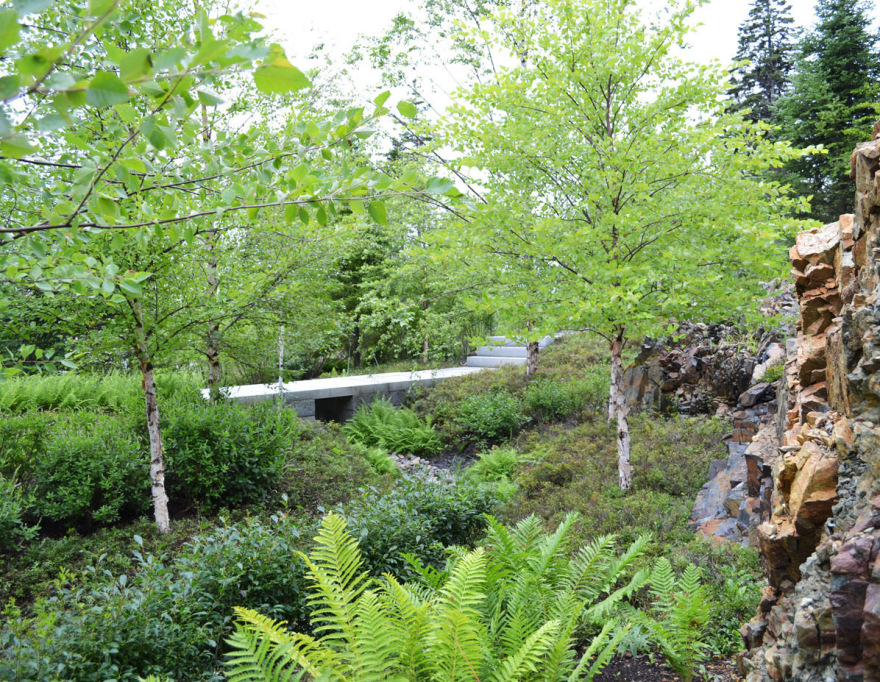
▲洼地花园收集并控制着场地内的雨水径流,用于浇灌其中的蕨类,冬莓和墨西哥莓果。其上的花岗岩步行桥则连接着位于小径西侧的客房入口平台,the swale garden collects and controls a majority of site runoff and hosts colonies of fern, winterberry, and inkberry. The granite footbridge connects the west trail to the Guest House entry terrace.

▲位于西侧的小径在客房平台处从卵石表面转换成了花岗岩表面,the west trail transitions from a gravel surface to a dry-laid granite path and terrace at the Guest House.

▲新开凿出的岩壁为旁边的洼地,湿地植物,花岗岩台地提供了背景,并为苔藓生长提供了条件。钢板限制出了平台的边界,并作为含铁的岩床,newly exposed ledge provides a backdrop for the swale garden, wetland plants and a thermal granite terrace with moss insertions. Steel retains the terrace, referencing the iron-rich bedrock.

▲从客房向西走便可以到达蔬果园,其平台铺装融合了青苔及带状花岗岩铺面。 蕨类植物和海葵与这些带状图案相呼应,moving east from the Guest House toward the kitchen garden, the terrace paving incorporates bands of moss and split face granite. Drifts of fern and anemone echo the banding pattern.

▲蔬果园的设计保持和周边景观相似的风格,以示尊重。 线性种植床起到连接洼地花园,客房和较低的码头和海滩步道的过渡作用,the kitchen garden was conceived with respect for Beatrix Farrand’s nearby landscapes. The linear beds transition between the ledge swale garden, the Guest House and the lower walk to the pier and beach.
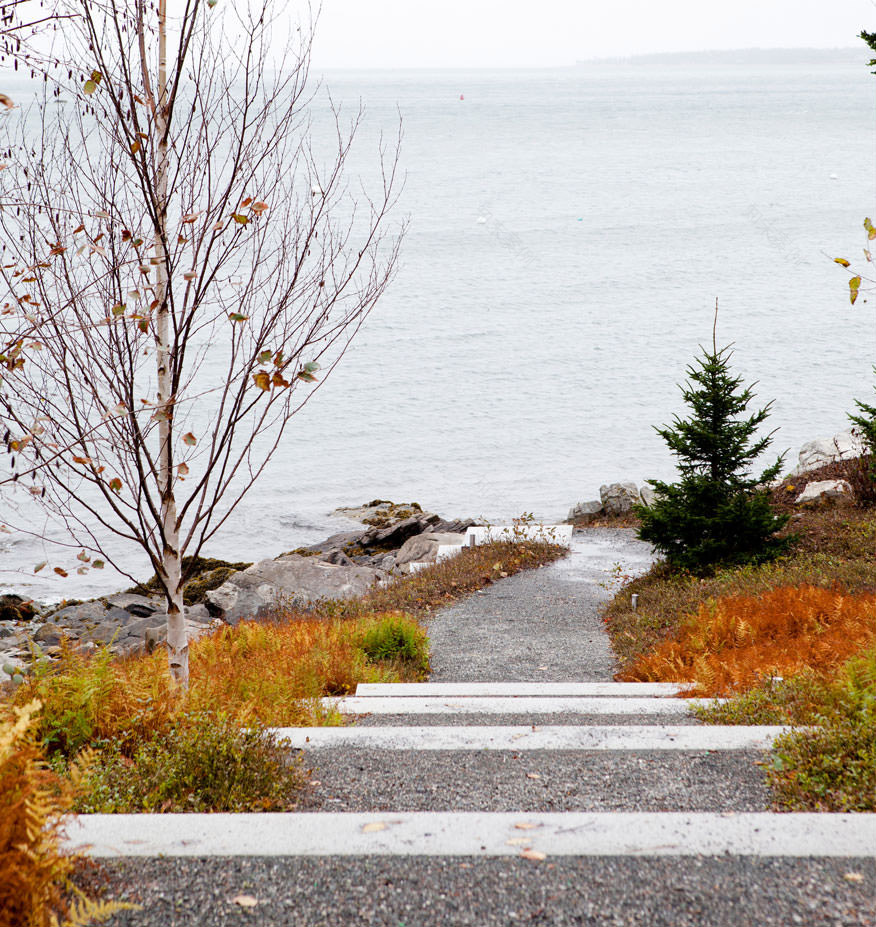
▲从客房到码头的花岗岩碎石台阶被蕨类,蓝莓,桦树和云杉所包围,the final descent from the Guest House to the pier traverses granite and gravel steps framed by hay-scented fern, blueberry, birch and spruce.
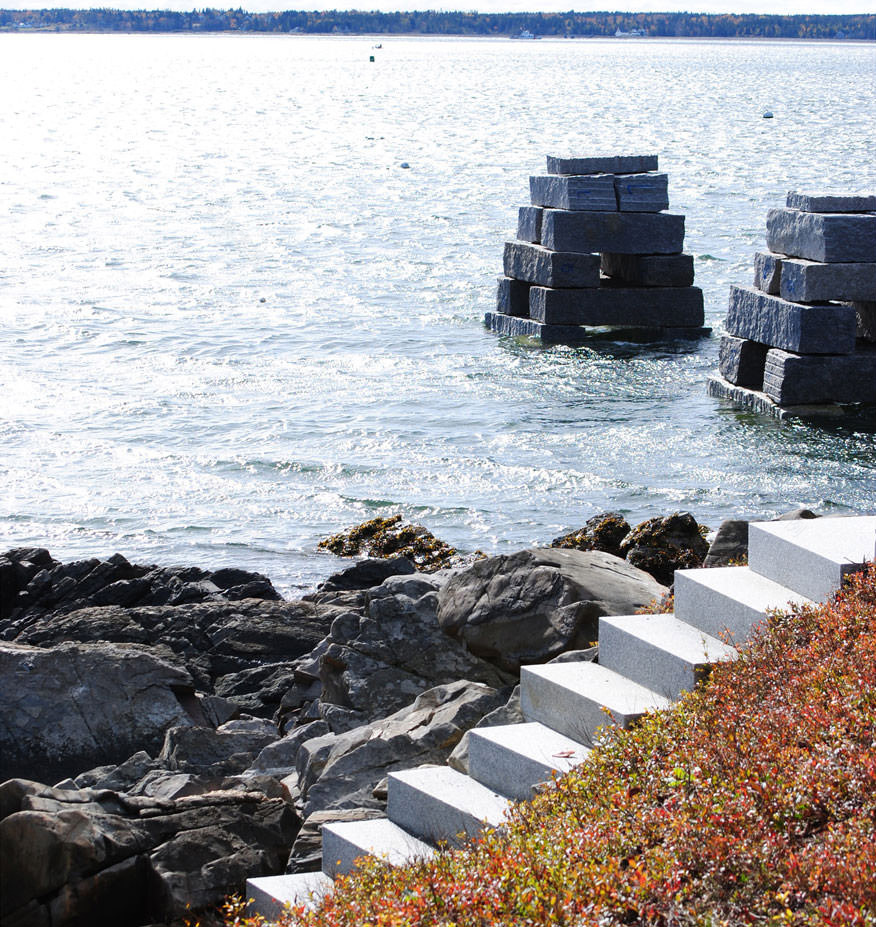
▲花岗岩台阶重新塑造了现有的海岸线以提供安全的岸边通道。 新种植的地被和被加固的土壤保护了堤岸免受冬季风暴的冲击,granite stairs scribed to existing ledge provide safe access to the beach. Newly planted groundcovers and reinforced soil protect the bank from the force of winter storms.
PROJECT NARRATIVE
Site Context
The five acre site lies on the southern coast of Mount Desert Island and is bound by Acadia National Park and the Eastern Way of the Atlantic. The property was once part of an original 120-acre estate, purchased in 1879 by Charles William Eliot, the president of Harvard and father of the young and influential landscape architect, Charles Eliot. During Eliot’s time, Mount Desert was becoming popular with affluent families relocating from urban areas to extravagant coastal retreats of Maine for the summer. The site’s cultural history with the Eliot legacy is directly linked to the Gilded Age settlement of Mount Desert, the origins of Acadia National Park, and the New England land preservation movement. By the mid 1900s however, the property had changed hands, the landscape had succeeded into a climax forest, and the estate had entered benign disrepair. Our Client acquired the property decades later with a vision for a new family retreat. We were brought onto the project during the construction of a new house, well after the site had been blasted for the building foundations.
Interpreting Site History and Ecology
The site history that we uncovered inspired us to understand and restore the spirit that originally drew Eliot to this landscape. The property held few physical traces of past land use, but our interest in channeling its forgotten history shaped the design approach. Much like Eliot, our Client envisioned a family sanctuary fully integrated with the surrounding wild. They wanted the site to feel like a micro-Acadia with distinct trails and accessibility from the upper to the lower site. The design was conceived as a procession down to the water, carefully inserted and responding to the site’s topography. Woodland trails connect the main house, terraces, lower guest house, pier and beach. However, even this simple program posed complex technical challenges. As a result of construction blasting, the site was left with three acres of vulnerable trees growing on thin pockets of soil, exposed to harsh maritime conditions, and piles of talus and raw ledge. The property had once been an extension of Acadia National Park, and reconnecting it ecologically became a critical goal of the project.
A Landscape of Succession
The notion of a lost landscape became our primary focus. We researched the site’s ecological history, looking for native plant communities that would become the basis of the restoration strategy. We delved deeper into the history of the region, fascinated by the early photographs of Eliot’s estate and paintings of Mount Desert that depicted coastal meadows, salt marshes, and other landscape scenes far more varied than the monoculture evergreen forest that now covered the property. This historic research, coupled with numerous field visits in and around Acadia, provided a more extensive palette and rationale for site restoration. The opportunity to diversify the plant communities was encouraging, because with such a thin soil profile over bedrock, planting large trees was not practical. The goal evolved to restoring zones across the site according to earlier stages of succession. This allowed for even more biodiversity than was present prior to the new construction.
Because planting large trees was nearly impossible throughout the three disturbed acres, we adapted Eliot’s early stages of landscape succession and reintroduced red maple wetlands, birch thickets, witch hazel groves, alpine meadow and pockets of lawn over eighty feet of grade change. Intensive planting involved the physical layout and placement of soils, boulders, trees, shrubs, groundcovers, mosses and even seedlings. After carefully siting areas of restoration and identifying the appropriate plant communities, contemporary elements were inserted surgically to heighten the contrast between man-made and natural.
A Journey to the Water
A gravel entry drive crosses the restored stream over a new granite bridge. The dwellings are one-story from the road, embedded in a grove of red maples and native birches. A stone terrace and small play lawn extend from the lower level of the main house and open to expansive views of the Cranberry Islands. A garden of moss, lichen, beach stone, and sand bring a micro-Acadia to the youngest members of the family. The main house terrace is defined by two weathering steel walls notched into existing ledge. Steps and woodland trails are woven into the grain of existing geology from east to west, traversing steep slopes and varied plant communities, capturing distinct views to islands and site landmarks.
At the lower site, another set of steel walls define the guest house ledge swale, which captures site runoff and snowmelt. A granite path bridges native wetland plants, a wilder zone of restoration than the bands of native mosses in the ledge garden terrace. A stone stair is scribed into the ledges leading down to the boat house, pier, and beach. Materials and construction methods were chosen for durability and sensitivity to the steep slopes and existing landscape. A family of local craftsmen constructed all masonry work in the tradition of their Acadia bridge-building grandfathers. Salvaged granite from a nearby quarry appears throughout as steps, benches, and a fire pit, and weathering steel was selected for its minimalism and resonance with the site’s iron-rich bedrock.
The completion and long-term management of this project has relied heavily on the Client’s commitment to restore a complex ecosystem, the expertise of a creative soil scientist, the exceptional craft of local masons, and the hands-on knowledge of a landscape contractor committed to sourcing Maine-grown, salt-tolerant, rugged plants. Technical aspects related to soil specifications and planting were heavily researched in order to ensure the long-term viability of the site, and a management plan written by our team is used throughout every season. The design interventions are modern, but the materials palette is regional and the plant communities familiar and indigenous. The result is a thriving and diverse landscape created on a previously devastated site, in honor of Eliot’s primitive piece of coastal Maine.
PROJECT CREDITS
Lead Designer:Stephen Stimson, FASLA, Lauren Stimson, ASLA
Architects: Gwathmey Siegel and Associates
Soil Scientists: Pine and Swallow Environmental
Civil Engineer: CES Environmental
Landscape Contractor: Atlantic Landscape Construction
Stone Masons: Harkins Masonry
Arborist: Jason Watson
南京喵熊网络科技有限公司 苏ICP备18050492号-4知末 © 2018—2020 . All photos and trademark graphics are copyrighted by their owners.增值电信业务经营许可证(ICP)苏B2-20201444 苏公网安备 32011302321234号
苏公网安备 32011302321234号客服
消息
收藏
下载
最近