

创作上传
VIP
收藏下载
登录 | 注册有礼
查看完整案例

收藏

下载

分享
业主想要一处轻松惬意的临时性居所。概念上来讲,有点类似丛林小木屋,但在空间关系和使用体验上,要精致得多。在设计的过程中,建筑师根植于基地环境和生态性能,并最终塑造出这座满足各功能要素的小作品。
Whether visiting alone, with a large group of guests or as a family, the owners were looking for a relaxed, welcoming environment, conceptually similar to a cottage yet more refined, particularly in the relationships among spaces and between people. The goal was to have a present, living and enthusiastic architecture that engages the senses.
The design process, grounded in the setting, symbiosis with the site and a reduced environmental footprint, led to a reflection process on the functional elements and their optimization.
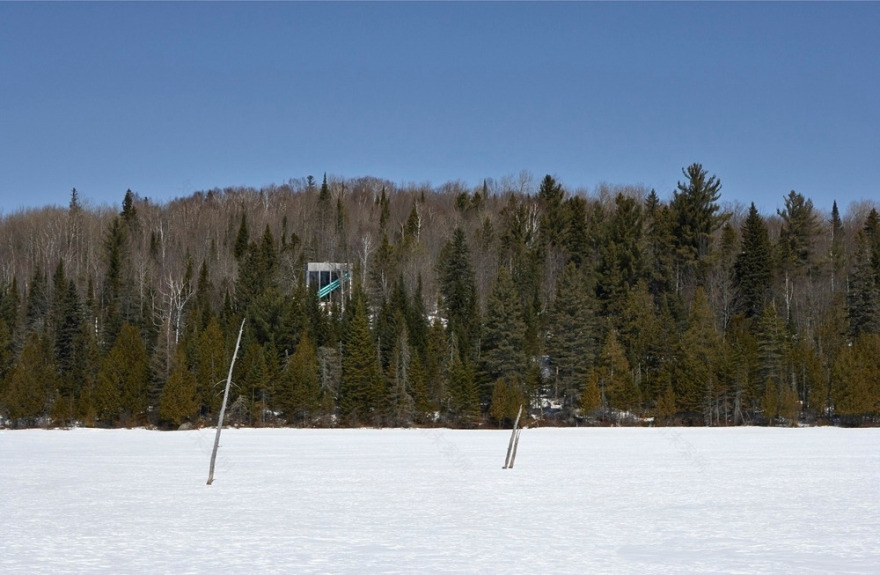

最小化/最大化
Minimum/maximum
建筑的功能被划分为两类。建筑师将“最小化的空间”,即需要更多私密性和内置于房屋中的空间集中布置在北侧;“最大化的空间”容纳其他所有功能,占据房屋的南侧,可以自由使用和改造。
The functions are divided into two types. Minimalist spaces housing functions requiring built-in elements or greater privacy are clustered on the north side. A “maximal” space, containing all other functions, occupies the south side and allows free use of the space, open to interpretation and transformation.
▽ 图纸和分析图,drawings and diagrams


阶梯长凳
Bleacher-style benches
建筑师在将正交的阶梯形的长凳放入主要空间内。这件大号家具同时具有其他多种功能:它是室内的集会场所,是交通空间,是阳光过滤器,还是书架。同时,它具有很大的改造空间,可以通过如下三种方式打造个性化的空间:可移动的木板经过重新排列可以作为桌子和台阶;夹层虽然连接到主体结构,但可以根据需要重新布局;混凝土楼板上方模数化的由标准构件制成的座椅也可以以一种完全不同的方式重新排布。
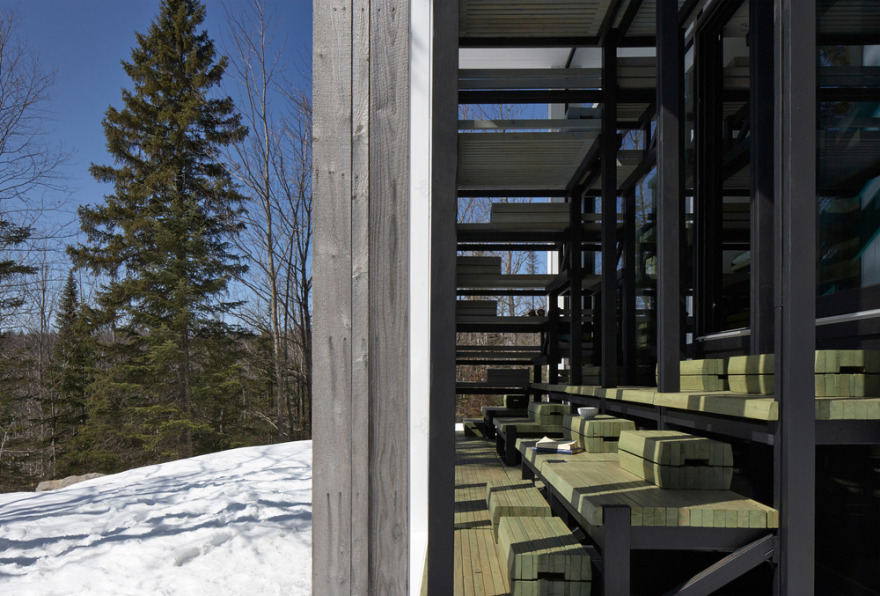
建筑西侧和南侧的长凳成阶梯状从室外地面一直延伸至室内,营造了多空隙的空间效果。坐在最上方的长凳上,可以观赏室外的美景。靠近厨房位置的长凳是食物准备区也是可供8人同时就餐的长桌。
Bleacher-style benches, meeting at right angles, are built into the main space. They are simultaneously oversized furniture, an agora, a circulation area, filters, dividers, bookshelves, structural elements, etc. They can be modified in three ways: as movable blocks that can be rearranged at will (for use as end tables, backrests, steps, etc.), as intermediate levels attached to the main structure but capable of being reconfigured regularly and, collectively, as benches resting on the concrete slab, which can be reassembled in an entirely different way.
On the south and west faces respectively, the benches are at ground level. Their incline extends the site’s topography to the inside of the house, thereby accentuating it. As a result, spaces are defined in a more or less porous manner. At the top the benches make it possible to enjoy the view while maintaining physical and visual continuity with the ground. Near the kitchen, the benches become both food preparation areas and tables seating up to eight people. The bench system is modular, and most of its constituent elements are standardized.
▽ 从室外延伸到室内的长凳,the benches extending from the outside to the inside
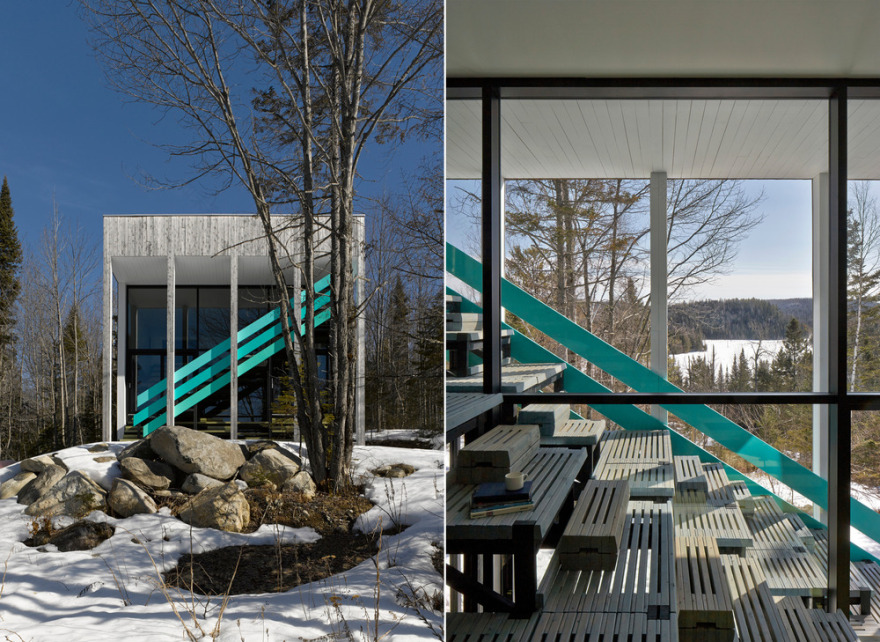


▽ 厨房和餐厅,the kitchen and the long table

▽ 随意变换的标准构件,rearranging the space freely with the movable blocks

感官体验
Senses and perception
反差、氛围、材料、光线、模度连同周围环境,共同营造出独特的感官体验。仿佛身处树冠之间,空间即开放又给人以安全感。当客人来访时,气氛又全然不同。适合聚会的空间非常适合互动。壁炉、电影放映机和羽绒靠枕使人们可以尽情地享受空间。下方的空间更内向和紧凑。光线经过长凳的过滤,呈现复杂而恒变的特质。细长的柱子如同丛林中密集的枝干。最小化空间内丰富的暗色软性装饰使得它看上去想一个洞穴。
乍一看去,自然与建筑是各自独立的。但通过氛围的营造、关系的塑造、仿照自然的特质以及材料和光线的运用,自然和建筑之间紧密的关系逐渐浮现出来。
At first glance, the difference between natural and built forms is highlighted. The close links uniting the architecture with nature emerge through ambiances, relationships, mimetic qualities, materials and light.
▽ 适合独处和聚会的惬意舒适的空间,the relaxed space

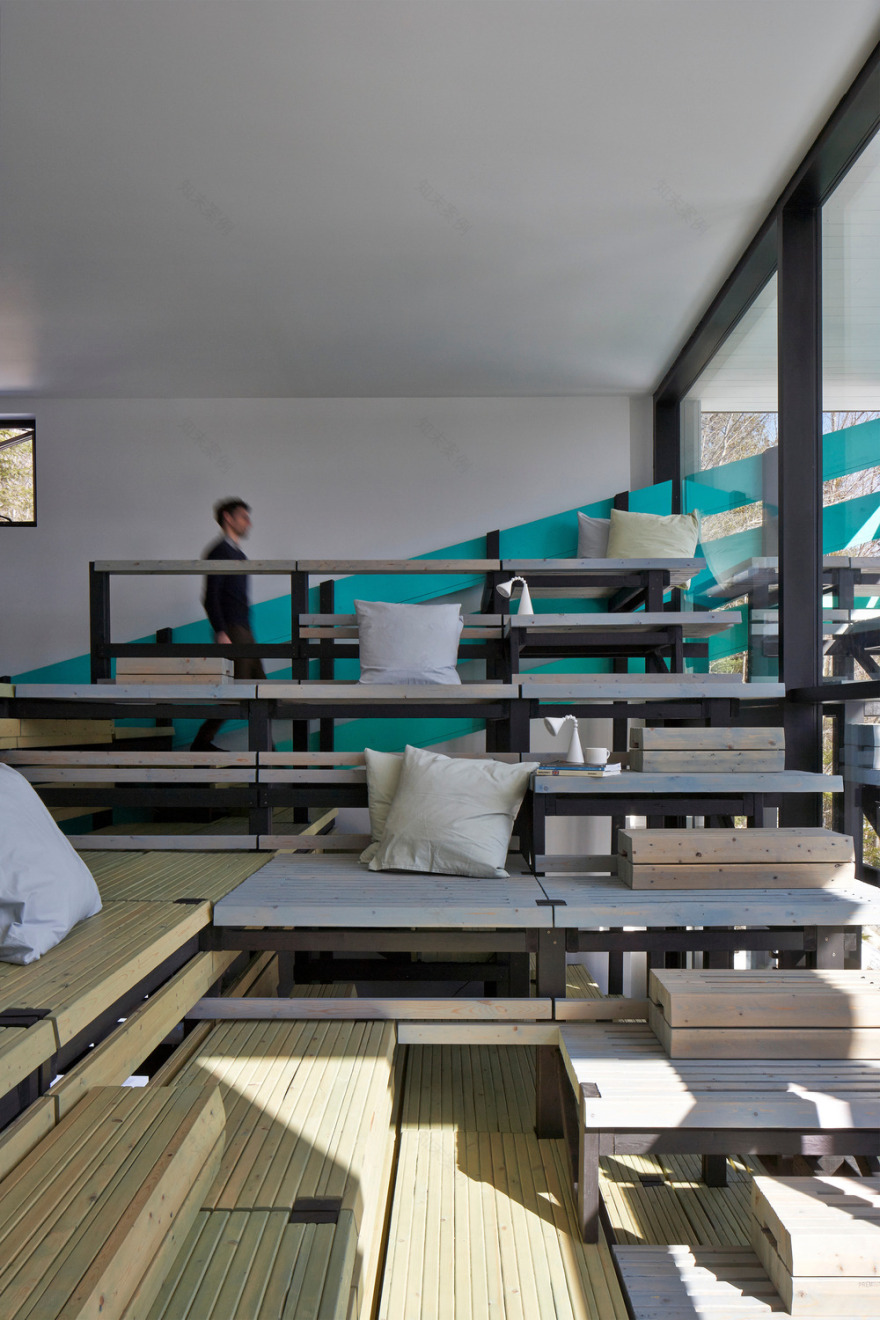
▽ 长凳下方的空间,the space below


可持续性
Sustainable construction
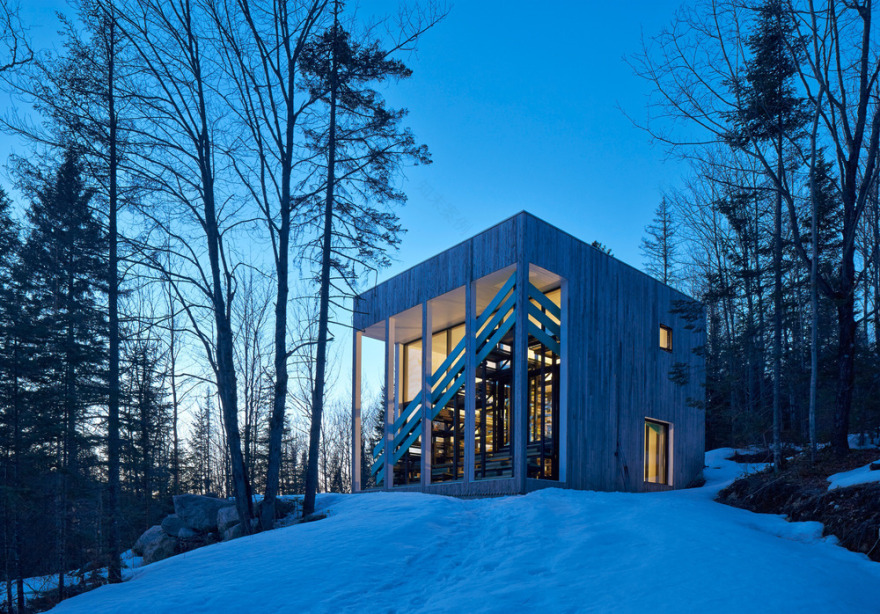
从项目的选址阶段开始,优化项目的生态性就是建筑师关注的焦点之一。建筑南向的落地玻璃立面在提供了优美景色同时,将被动式太阳能取暖的能效提高至最大。窗户上方的大尺度悬挑根据太阳角度的变化来设计,既保证冬天阳光可以进入室内,又能阻挡夏天过多的阳关进入室内,造成温度过热。
建筑所在的高地和其朝向保证了自然通风的有效进行。前侧窗户的底部和后侧窗口可以通过压差进行对流。
方体的造型和相对使用空间而言较少的建筑表面积,一方面节省了建筑材料,另一方面提升了房屋的能效。就材质而言,来自当地伐木场的白色雪松板保留了木材的原汁原味。
From the site-selection phase, optimizing bioclimatic potential was one of the project goals. By building the structure with a fully south-facing façade, the arrangement of the parcel made it possible to make the most of a set of windows with a fine view that maximize passive solar heating. A large overhang, designed to make use of the changing angle of the sun, prevents overheating in summer while admitting as much winter sunlight as possible.
The building’s elevated position and its orientation allow effective natural ventilation. Front windows that open at the bottom and rear windows that open at the top promote cross-drafts and take advantage of differential pressure.
With its cube shape and advantageous ratio of envelope to usable volume, the structure promotes energy efficiency and economical use of materials. The shape also made a smaller footprint possible. The white cedar tongue-and-groove siding, sourced from a local sawmill, was left in its natural state.
▽ 东立面,east façade

▽ 夜景,night view
Typology : Residential
Area : 80 m² (140 m² floor area
Conception : 2011-201
Construction : 2012-201
Architect : Architecturama
Project team : Sylvain Bilodeau, architecte, Nicolas Mathieu-Tremblay, architecte
Structure: Genivar (now WSP)
General Contractor : Les entreprises Sylvain Lachance
Exterior cladding : Éco-Cèdre Inc.
Photos : James Brittain Photography
南京喵熊网络科技有限公司 苏ICP备18050492号-4知末 © 2018—2020 . All photos and trademark graphics are copyrighted by their owners.增值电信业务经营许可证(ICP)苏B2-20201444 苏公网安备 32011302321234号
苏公网安备 32011302321234号客服
消息
收藏
下载
最近