

创作上传
VIP
收藏下载
登录 | 注册有礼
查看完整案例

收藏

下载

分享

△ Rafael Aranda, Carme Pigem and Ramon Vilalta Photo by Javier Lorenzo Domínguez
拉斐尔·阿兰达、卡莫·皮格姆和拉蒙·比拉尔塔荣获2017年普利兹克建筑奖
Rafael Aranda, Carme Pigemand Ramon Vilalta Receive the 2017 Pritzker Architecture Prize
自然景观与人文建筑有机融合,从而创造出与时空紧密联结的建筑物。
Landscape and architecture are united to create buildings that are intimately connected to place and time.
2017年3月1日, 美国伊利诺伊州芝加哥:普利兹克建筑奖暨凯悦基金会主席汤姆士·普利兹克今天宣布,拉斐尔·阿兰达、卡莫·皮格姆和拉蒙·比拉尔塔共同荣获2017年普利兹克建筑奖,该奖项由凯悦基金会赞助,是国际上公认的建筑界最高荣誉。
自1988年在家乡创立RCR 建筑事务所以来,这三位来自西班牙加泰罗尼亚地区奥洛特镇的建筑师,一直密切合作。他们的作品表现出对地形及其氛围的执著尊重,将自然意向进行抽象的空间表达。阿兰达、皮格姆和比拉尔塔探求户外与室内空间的关联,平衡虚实关系,创造出极富情感与体验的建筑。
Chicago, IL (March 1, 2017)—Rafael Aranda, Carme Pigem and Ramon Vilalta have been selected as the 2017 Pritzker Architecture Prize Laureates, announced Tom Pritzker, Chairman of Hyatt Foundation, which sponsors the award that is known internationally as architecture’s highest honor.
The three architects, originating from Olot, in the Catalonian region of Spain, have worked together collaboratively since founding their firm RCR Arquitectes, in their hometown in 1988. Their work demonstrates an unyielding commitment to place and its narrative, to create spaces that are in discourse with their respective contexts. Harmonizing materiality with transparency, Aranda, Pigem and Vilalta seek connections between the exterior and interior, resulting in emotional and experiential architecture.
普利兹克先生说:“评审团选出这三位建筑师,他们近30年来一直紧密合作,阿兰达先生、皮格姆女士和比拉尔塔先生对整个学科的影响力远远超越其工作地域。他们的作品从公共空间、私人处所跨越到文化场所和教育机构各尽不同,而他们能把特定环境和每所建筑场所紧密结合的能力则证明了他们出色的设计理念和对原则的敬重。”
Mr. Pritzker remarks: “The jury has selected three architects who have been working collaboratively for nearly three decades. Mr. Aranda, Ms. Pigem and Mr. Vilalta have had an impact on the discipline far beyond their immediate area. Their works range from public and private spaces to cultural venues and educational institutions, and their ability to intensely relate the environment specific to each site is a testament to their process and deep integrity.”
作为第39届普利兹克建筑奖获奖者,阿兰达先生、皮格姆女士与比拉尔塔先生创造了首次由三位建筑师共同获此殊荣的历史,也是继拉斐尔·莫内欧于1996年获奖以来第二次由来自西班牙的建筑师获奖。知悉荣获2017年普利兹克建筑奖之后,皮格姆女士表示:“我们喜不自胜的同时又感到责任深重。三位专业建筑师凡事都合作无间,得到大家的认可,令我们激动不已。”
Mr. Aranda, Ms. Pigem and Mr. Vilalta represent the first time that three architects together are honored with the prize. Their intensely collaborative way of working together, where the creative process, commitment to vision and all responsibilities are shared equally, led to the selection of the three individuals for this year’s award. As the winners of the 39th edition of the Prize, it is the second time that laureates hail from Spain, following Rafael Moneo who received the award in 1996. In response to being named the 2017 Laureates of the Pritzker Prize, Ms. Pigem states: “It is a great joy and a great responsibility. We are thrilled that this year three professionals, who work closely together in everything we do, are recognized.”
通过创造性地广泛运用包括再生金属和塑料在内的现代材料,三位秉持本土精神的建筑师唤起普遍共鸣。“他们证明了材料的结合可以为建筑物带来如此令人难以置信的力量感与简洁度,”评审团主席格伦·马库特指出,“三位建筑师合作创造出富有原则、毫不妥协又充满诗意情怀的建筑,说明不朽的建筑作品应反映出对过去的高度尊重,同时清晰地预示着现在和未来。”由此,一座20世纪早期的铸造厂已被改造成他们的办公室(2007年),原建筑的大部分得以保留,仅在必要的位置利用新元素、新理念进行了改造,与原建筑形成鲜明对比。
The locally-based architects evoke universal identity through their creative and extensive use of modern materials including recycled steel and plastic. “They’ve demonstrated that unity of a material can lend such incredible strength and simplicity to a building,” says Glenn Murcutt, Jury Chair. “The collaboration of these three architects produces uncompromising architecture of a poetic level, representing timeless work that reflects great respect for the past, while projecting clarity that is of the present and the future.” As such, an early 20th century foundry has become their office, Barberí Laboratory (2007), and many remnants of the original building have remained, blended with highly contrasting, new elements, which were added only where essential.
他们的主要作品包括拉利拉广场(里波尔,赫罗纳,西班牙,2011年)、Les Cols餐厅帐亭(奥洛特,赫罗纳,西班牙,2011年)、岩石公园(莱斯普雷塞斯,赫罗纳,西班牙,2004年)、贝尔略克酿酒厂(帕拉莫斯,赫罗纳,西班牙,2007年)、圣安东尼-琼奥利弗图书馆(巴塞罗那,西班牙,2007年)、苏拉吉博物馆(罗德兹,法国,2014年)和美食艺术中心(内格雷佩利瑟,法国,2014年)。
2017年普利兹克建筑奖评委会在评审辞中写道:“我们生活在一个全球化的世界,我们必须依赖于国际影响、商业贸易、探讨商议、交易事务等等。但越来越多的人开始担心,正是由于这种国际化的影响力……我们将逐渐失去本土价值观、本土艺术和本土风俗……而拉斐尔·阿兰达、卡莫·皮格姆和拉蒙·比拉尔塔告诉我们,两者或许可以和谐共生。他们以最美好和充满诗意的方式让我们看到,问题的答案不是非此即彼,至少可以在建筑中追求两者的共存; 我们根植本土,心向世界。”
2013年,阿兰达先生、皮格姆女士和比拉尔塔先生成立了RCR BUNKA基金会,旨在于全社会范围内支持建筑、景观、艺术与文化事业。自1989年以来,他们一直是La Garrotxa火山区自然公园的顾问建筑师。他们的大部分作品遍布于西班牙加泰罗尼亚和泛欧洲地区。如今,他们仍然坚守在家乡奥洛特展开工作。
今年,普利兹克建筑奖颁奖典礼将于2017年5月20日在日本东京的迎宾馆赤坂离宫举行。
Notable projects include La Cuisine Art Center (Nègrepelisse, France, 2014), Soulages Museum in collaboration with G. Trégouët (Rodez, France, 2014), La Lira Theater Public Open Space in collaboration with J. Puigcorbé (Ripoll, Girona, Spain, 2011), Les Cols restaurant marquee (Olot, Girona, Spain, 2011), El Petit Comte Kindergarten in collaboration with J. Puigcorbé (Besalú, Girona, Spain, 2010), Bell-Lloc Winery (Palamós, Girona, Spain, 2007), Sant Antoni – Joan Oliver Library, Senior Citizen’s Center and Cándida Pérez Gardens (Barcelona, Spain, 2007), and Tossol-Basil Athletics Track (Olot, Girona, Spain, 2000).
The 2017 Pritzker Prize Jury Citation states, in part: “we live in a globalized world where we must rely on international influences, trade, discussion, transactions, etc. But more and more people fear that because of this international influence…we will lose our local values, our local art, and our local customs…Rafael Aranda, Carme Pigem and Ramon Vilalta tell us that it may be possible to have both. They help us to see, in a most beautiful and poetic way, that the answer to the question is not ‘either/or’ and that we can, at least in architecture, aspire to have both; our roots firmly in place and our arms outstretched to the rest of the world.”
In 2013 Mr. Aranda, Ms. Pigem and Mr. Vilalta founded RCR BUNKA Foundation to support architecture, landscape, arts and culture throughout society. They have been consultant architects to the Natural Park of the Volcanic Zone of La Garrotxa since 1989. Much of their work may be seen throughout Catalonia, Spain and greater Europe. They remain based in Olot.
This year, the Pritzker Prize ceremony will take place at the State Guest House, Akasaka Palace in Tokyo, Japan, on May 20, 2017.
评语
Jury Citation
30年如一日,拉斐尔·阿兰达、卡莫·皮格姆和拉蒙·比拉尔塔三位建筑师紧密协作,以一种对建筑严谨审慎而细致入微的方式耕耘至今,共同荣获2017年普利兹克建筑奖。他们的作品充满敬仰与诗意,不仅满足着人们对建筑的传统需求,以期协调自然与空间之美、兼顾功能与工艺,但真正令其脱颖而出的是他们创造兼具本土精神与国际特色的建筑和场所的这种能力。在西班牙东北部加泰罗尼亚地区的家乡奥洛特镇,他们创立了自己的设计工作室并以三人名字的首字母命名,称作RCR建筑事务所。他们抵御着大城市的诱惑,只求根植本土,保持与故乡的亲密联结。 他们形成的工作模式是一种真正的默契合作,任一项目无论部分或整都不能完全归属于一个人。他们这一创造性的工作理念意味着不断融合每个人的设计智慧,需要持续沟通与灵感碰撞。
Rafael Aranda, Carme Pigem and Ramon Vilalta, three architects who have worked closely together for almost 30 years in a deliberate and thoughtful approach to architecture are recognized with the 2017 Pritzker Architecture Prize. Their works admirably and poetically fulfill the traditional requirements of architecture for physical and spatial beauty along with function and craftsmanship, but what sets them apart is their approach that creates buildings and places that are both local and universal at the same time. They established their office, called RCR for their three first names, in Olot, their hometown in the Catalonian region in the northeast of Spain, resisting the call of the metropolis in favor of remaining closely connected to their roots. The process they have developed is a true collaboration in which neither a part nor whole of a project can be attributed to one partner. Their creative approach is a constant intermingling of ideas and continuous dialogue.
他们所有的作品都具备浓郁的地方特色,以及与地貌景观充分的融合。这种无缝的关联来自对当地历史、自然地形、习俗和文化以及种种区域特征的充分理解,也来自对光线、阴影、色彩和季节细致的观察体验。建筑物的选址、材料的选择和几何造型的使用,总是旨在突出自然环境并将其引入建筑内部。例如,位于西班牙赫罗纳附近的帕拉莫斯镇的贝尔略克酿酒厂(2007年),是一座嵌入地下的建筑,既可保证葡萄生长所需的土壤和储藏陈年老酒所需清凉幽暗的酒窖,同时保持了大自然原本的色彩与厚重感。建筑大量使用回收再利用的钢材,使建筑物与大自然融为一体,而钢板之间的开口可以将光线引入室内。
帐亭(2011年)是位于奥洛特的Les Cols餐厅供户外用餐和活动的空间,这是通过自然景观和极简现代材料的融合从而形成实用空间的又一案例,在当地颇受欢迎,有人曾表示这里让他们回忆起与家人朋友一起享用乡村美食的地方。整个空间被建筑师根据景观完美融入一处山谷环境中,以火山岩建造的坚固墙壁支撑着轻质透明的聚合材质屋顶,防止日晒雨淋。用来进一步区隔空间的家具和立轴百叶帘同样以透明塑料制成,使得人们可以将注意力集中在美食、庆典宴会与自然景观上。
纵观其它建筑作品,如他们自己的办公室(2007年),由一个20世纪初建造的旧铸造厂改造而成,过去与现在,在这里以一种最妥帖、清晰而相互尊重的方式并存。在他们的作品中,户外和室内空间、新与旧都紧密结合相互联系。原建筑大部分得以保留,正所谓“修旧如旧”,仅在必要之处添加新的元素,通过鲜明的材质对比,建筑师同时展现出他们对传统和创新的热爱。最终的建筑他们称之为Barberí实验室,包括各种各样灵活多变和功能齐备的空间。拉斐尔·阿兰达、卡莫·皮格姆和拉蒙·比拉尔塔对历史有着深刻的理解和知识储备,他们利用多元材料和现代建筑方式创造出前所未有的空间。
All their works have a strong sense of place and are powerfully connected to the surrounding landscape. This connection comes from understanding – history, the natural topography, customs and cultures, among other things – and observing and experiencing light, shade, colors and the seasons. The siting of buildings, the choice of materials and the geometries used are always intended to highlight the natural conditions and pull them into the building. The Bell-Lloc Winery (2007), in the town of Palamós, near Girona, Spain, for example, a building embedded in the ground, is about the soil that produces the grapes, the cool dark cellars needed for the aging of wine and the color and weight of the earth. The extensive use of recycled steel fuses the building with the earth and the openings between the steel slats allow in hints of light.
The marquee (2011) creating an outdoor dining and event space at Les Cols Restaurant in Olot is another example of the fusion of landscape and minimal modern materials to create a useful and popular venue. Some have said that they are reminded of places for countryside meals with family and friends. The space fits into a valley carved out in the landscape by the architects. Strong walls of volcanic stone support a light weight and transparent polymer roof to protect against rain and sun. The furniture and vertical hanging blinds that can sub-divide the space are also of clear plastic, which puts the emphasis on food, festivities and the natural setting.
In other works, such as their own office (2007), a former foundry built at the beginning of the 20th century, the juxtaposition of past and present is undertaken in a most thoughtful, clear and respectful way. Just as exterior and interior are closely intertwined in their works, so are new and old. All of the original industrial building that could remain, was left “as is”. By adding new elements only where needed and in contrasting materials, the architects demonstrate their love for both tradition and innovation. The resulting building, which they call Barberí Laboratory, is comprised of varied, flexible and highly functional spaces. While Rafael Aranda, Carme Pigem and Ramon Vilalta have a deep sense and knowledge of history, they use materials and modern construction to create spaces that could not have been created before.
谈及阿兰达、皮格姆和比拉尔塔的作品时,还会让人想到社区。位于赫罗纳贝萨卢、明亮多彩的多佩蒂特孔德幼儿园(2010年),以及位于巴塞罗那的圣安东尼-琼奥利弗图书馆、老年中心和坎迪达佩雷斯花园(2007年),那些即将住进建筑里的人始终是他们优先考虑的对象。显而易见,管道的彩虹色彩定义了学校的外观,可以激发孩子们的乐趣、创造力与想象力。通过竞赛赢得的圣安东尼-琼奥利弗图书馆项目,是巴塞罗那闹市区的必要设施,如众多RCR的其他项目一样,嵌入现有城市街区的肌理之中。图书馆向公众开放,丰富多元的内部空间激发人们探索的好奇心,营造出一种轻松友好的氛围,同时,图书馆还作为一条通往内部庭院的通道。老年中心可以俯瞰这个空间,在这里,儿童、读者、邻里、老年人可以自由互动社交。
三位建筑师还在家乡加泰罗尼亚以外的地区设计了诸多重要作品,如比利时和法国。位于法国罗德兹的苏拉吉博物馆(2014年)收藏了抽象画家皮埃尔·苏拉吉的作品,并与这位似乎在以光作画的艺术家形成了某种共生关系。这座拥有强烈几何形态的钢铁建筑悬挑于场地上方,似乎在挑战着地心引力,如他们许多其他作品一样,与周边景观环境协调共生。建筑师设法创造“一个尽可能贴近大自然的空间,从而使我们意识到人类是大自然的一部分。”
Community is another word that comes to mind when speaking of the work of Aranda, Pigem and Vilalta. Both in the bright and colorful nursery school in Besalú, Girona, El Petit Comte Kindergarten (2010) and the Sant Antoni – Joan Oliver Library, Senior Citizens Center and Cándida Pérez Gardens in Barcelona (2007), those who will inhabit the buildings are at the forefront of their concerns. It is obvious when seeing the rainbow colors of the tubes that define the exterior of the school that this is for children’s enjoyment, creativity, and fantasy. The library, a commission won through a competition, as are many of RCR’s projects, is situated within the fabric of an existing city block, is a needed amenity in this busy part of Barcelona. Visitors are welcomed into the library. The richness and variety of spaces invite exploration and are casual enough to create a relaxed and friendly atmosphere. The library also acts as a gateway to an interior courtyard. The senior citizens center looks onto this space where children, library goers, neighbors and seniors can mingle.
The architects have also tackled important works outside their home in Catalonia. They have built in Belgium and France. The Soulages Museum (2014) in Rodez, France, for example, houses the works of the abstract painter Pierre Soulages and forms a symbiosis with the artist, who seems to paint with light. This building of steel and strong geometric shapes cantilevers over the site, seeming to defy gravity and like many of their other works is in dialogue with the landscape. The architects have sought to create “a space that is as close to nature as possible, enhancing our sense that we are part of it.”
在当今这个时代,有一个全世界都在问的重要问题,不只关乎建筑,也关乎法律、政治和政府。我们生活在一个全球化的世界,国际影响、商业贸易、探讨商议、交易事务等等。但越来越多的人开始担心,正是由于这种国际化的影响力,我们将逐渐失去本土价值观、本土艺术和本土风俗。人们时而忧心,甚至感到恐惧,而拉斐尔·阿兰达、卡莫·皮格姆和拉蒙·比拉尔塔告诉我们,两者或许可以和谐共生。他们以最美好和充满诗意的方式让我们看到,问题的答案不是非此即彼,至少可以在建筑中追求两者的共存; 我们根植本土,心向世界。这是一个精彩绝伦的答案,特别是它同样适用于现代人类生活的其他领域。
他们设计的每个建筑都能够因地制宜而独一无二。他们的作品始终是密切协作的成果,并且服务于社会。 他们深知建筑与周围环境的密切相关性,了解材料选取和建筑工艺是创造可持续且有意义的空间最有力的工具。基于上述原因,通过他们建筑作品的例证,及其同时表达本土精神与国际特色的卓越能力,借由建筑连接你我,2017年普利兹克建筑奖特授予拉斐尔·阿兰达、卡莫·皮格姆和拉蒙·比拉尔塔。
In this day and age, there is an important question that people all over the world are asking, and it is not just about architecture; it is about law, politics, and government as well. We live in a globalized world where we must rely on international influences, trade, discussion, transactions, etc. But more and more people fear that, because of this international influence, we will lose our local values, our local art, and our local customs. They are concerned and sometimes frightened. Rafael Aranda, Carme Pigem and Ramon Vilalta tell us that it may be possible to have both. They help us to see, in a most beautiful and poetic way, that the answer to the question is not ‘either/or’ and that we can, at least in architecture, aspire to have both; our roots firmly in place and our arms outstretched to the rest of the world. And that is such a wonderfully reassuring answer, particularly if it applies in other areas of modern human life as well.
Each building designed by these architects is special and is uncompromisingly of its time and place. Their works are always the fruit of true collaboration and at the service of the community. They understand that architecture and its surroundings are intimately intertwined and know that the choice of materials and the craft of building are powerful tools for creating lasting and meaningful spaces. For these reasons, exemplified in all their built work, and for their ability to express the local, but also the universal, uniting us with one another through architecture, Rafael Aranda, Carme Pigem and Ramon Vilalta are awarded the 2017 Pritzker Architecture Prize.
作品
Work
贝尔略克酒庄
2007
帕拉莫斯 赫罗纳 西班牙
Bell–Lloc Winery, 2007, Palamós, Girona, Spain
Photo by Hisao Suzuki
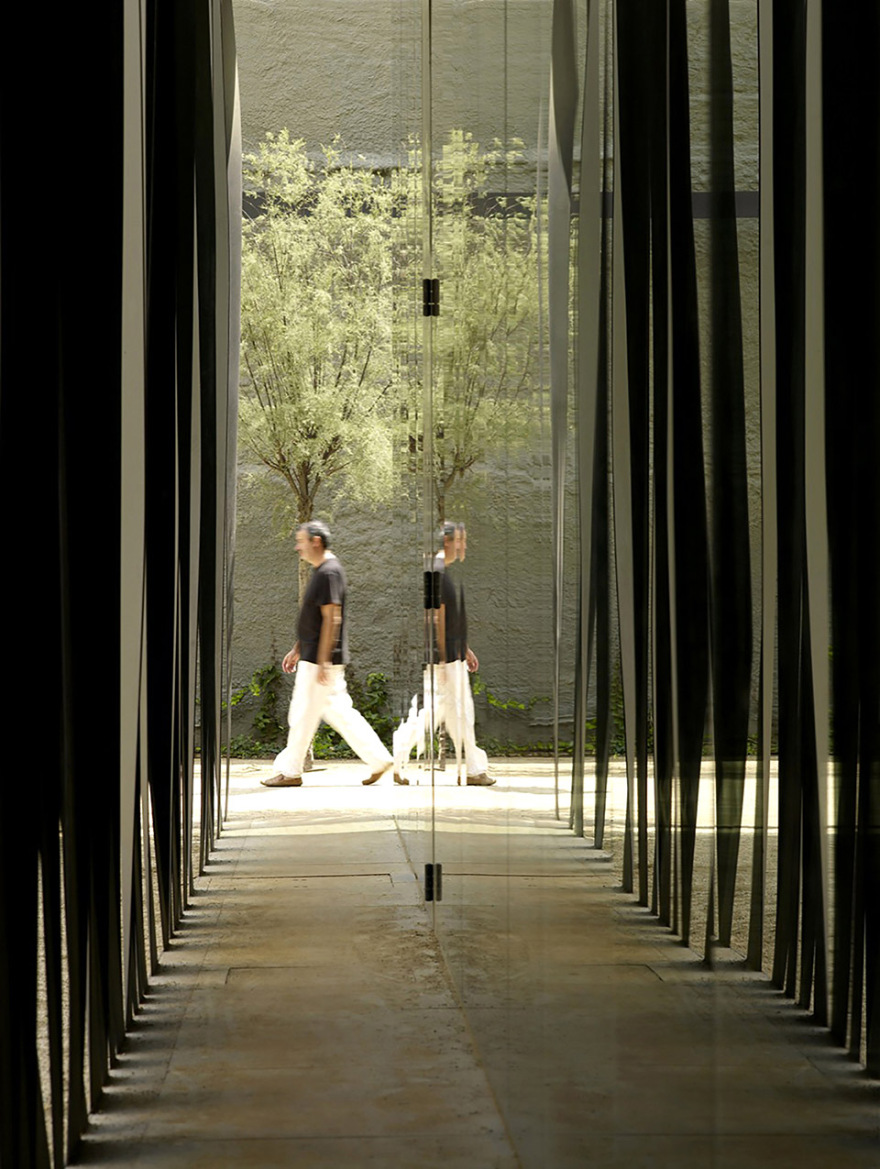
供私人酿酒品酒的葡萄酒窖坐落于葡萄园与树林之间,采用将建筑部分嵌入地下的设计手法,从而形成 一个景观和建筑的融合体。倾斜的回收钢板区隔出步道长廊,钢板之间留有狭缝,可将自然光线引入。 游客下行进入地下酒窖,大型由再生钢制成的大型葡萄酒罐、悬吊的橡木桶和布满酒瓶的葡萄酒架豁然 于眼前。漫步山脚下,一座教堂和一个小礼堂静静伫立于此。
这是一场感官的旅行。“听得到”的宁静,闻得到的酒香,摸得到的材料质感与温度变化,看得到的 婆娑光影。最后,再品尝一杯醉人的红酒。酒庄独特的外观得益于其几何造型和材料的选取-回收再 利用的钢材与天然石材-仿佛要将人们拥入怀中,将他们带到一个世外桃源,体验一段非比寻常的美 好时光。
Cellars for private wine production and tasting are located between the vineyards and the woods, and designed in such a way that part of it is underground, thus creating a union where landscape and buildings become one. A promenade is de ned by tilted recycled steel sheets with slits between them to allow natural light to penetrate. Visitors descend into the underground world of wine where there are large recycled steel vats, suspended barrels and bottles in racks. There is also a chapel at the foot of the slope and a small auditorium.
This is an experience for all the senses. The silence can be “heard”, the aroma of the wine can be perceived, the strength of the materials and the changes in temperature can be felt, the minimal light and shadows are experienced. Finally, there is the tasting of the wines. The winery’s unusual appearance is the result of its spatial geometry and the materials – recycled steel and stone – which embrace visitors and carry them to a concealed world where they can feel and taste a different time.
▼通往品酒室的酒庄内景。金属板将空气、光线和雨水引入室内,创造变化无穷的光影效果,View of the interior of the winery toward the tasting room. The slats allow air, light and rain to enter and create ever changing shadows.

自森林深处,山谷一直延伸向大海。葡萄园覆盖酒窖,折叠屋顶为实验空间和人行通道遮风挡雨,
From the forest, the valley extends towards the sea. The vineyards cover the cellar and the folded roof protects the laboratory and the walkways.

▼ 酒庄的实验空间之一。倾斜的墙壁和折叠的金属屋顶构建出一面开阔的景观窗口,
One of the laboratories of the winery. The folded metallic roof with the inclined walls creates a large window with views toward the forest.
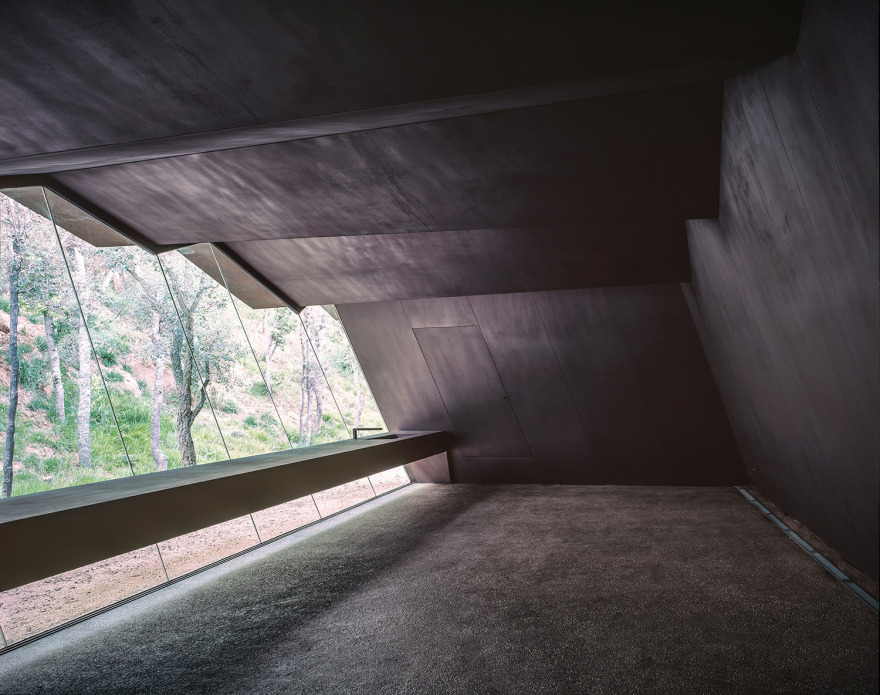
连接实验空间、工作区域,通往葡萄酒窖的室外连廊。在这里,游客可以欣赏森林美景。
A view to the exterior walkway that connects with laboratories and work areas on one side, and the wine cellar on the other. Here, visitors are able to contemplate the scenery of the forest.

苏拉吉博物馆 2014 罗德兹,法国 与G. Trégouët 合作 Soulages Museum, 2014, Rodez, France In collaboration with G. Trégouët Photo by Hisao Suzuki
“虚与实,密不可分,相辅相成。”

坐落于南法小镇罗德兹,开幕于2014年,这里悉数收藏着抽象艺术家皮埃尔·苏拉吉各式各样的作品,从彩绘玻璃窗及前期准备时的作品,到具象画作和其他早期作品,以及完整的作品副本。一个档案中心、临时展览空间、儿童创作室和贮藏室使得这里更显功能完备。该建筑与当地设计团队Passelac et Roques建筑事务所合作完成,由一系列立方体组成。只使用Cor-Ten耐候钢这一种材料,将建筑与景观紧密融合,随着时间推移缓慢变化。“博物馆和景观相互反馈彼此影响,如同画家与他的作品,展现出千丝万缕的联系,无法剥离,因为属于这个新创世界的一切都是与生俱来的。”
“一座为法国著名的‘光’之画家苏拉吉而建的博物馆,他启迪我们的灵感,引导我们的方向,从过去到现在,这里始终是一个值得珍藏的梦想。”
Located in the small southern French city of Rodez, and opened in 2014, it houses the diverse collection of works by the abstract artist, Pierre Soulage, from stained glass windows, preparatory works for the windows, gurative paintings and other early works, as well as complete printed works.
A document center, temporary exhibition space, children’s workshops and storage spaces complete the program. The building, realized in collaboration with local architects, Passelac et Roques Architects, is formed by a succession of cubes. Using just one material, Cor-Ten steel, the building and landscape merge together and will slowly change over time.
“Museum and landscape thus have a mutual feedback, like the painter and his work, displaying a wealth of relationships where nothing can be removed, because everything that belongs to this new created world is inherent.”
“A museum for Soulages, the French painter of “light” who has inspired us so often was –and still is– a cherished dream.”
▼ 开幕以来,临时展馆已展出苏拉吉的诸多作品。画廊的空间尺寸与照明条件可以满足各种不同类型的展览在此举办,
Since the opening, temporary exhibitions have displayed Soulage’s works. The dimensions and lighting of the gallery allow many different types of exhibitions to be hung in this space.

▼ 建筑入口方向,显示建筑物各部分与Cor-Ten耐候钢格栅之间的关系,
View towards the entrance showing the dialogue between the parts of the building and the slats of Cor-Ten steel.

▼ 博物馆内部空间与苏拉吉作品之间的关系,
View of the interior of the museum showing the relation between the space and the paintings of Soulages.

▼ 从市区一侧看到的博物馆,画廊如集装箱一般,阶梯小径将城市与公园有机联结,
View of the museum from the city side, showing the container-like galleries and the stepped path that makes a connection between the city and the park.

里拉剧院 户外公共空间 2011 里波尔,赫罗纳, 西班牙 与J. Puigcorbé 合作 La Lira Theater Public Open Space, 2011, Ripoll, Girona, Spain In collaboration with J. Puigcorbé Photo by Hisao Suzuki
里拉剧院的拆迁在赫罗纳省的里波利历史街区留下了一处城市空白,孤独俯瞰着特尔河。怀着对老剧院昔日规模与精神的追忆,且深刻了解到城市广场的重要性,三位建筑师创造出一个独特的覆顶式广场,适合多种类型的活动,同时室外空间可供居民享受休闲时光。广场下方,配有一间多功能地下室。
新里拉的建筑主体结构勾画出跨越河流的取景框,面向城镇的新区和身后的远山。走近由RCR设计的全新耐候钢步行桥,穿过河流,形成一条来往老城区的通道。
作为整个建筑中应用的主要材料,耐候钢似乎在唤起一段关于里波利冶金史的尘封往事。
然而,同一材质不一而足的使用方式 – 作为路面、侧壁上的网格、屋顶 – 导致随时光流逝呈现出不同的用途、纹理和色调。仅仅通过单一材料“包裹”整个空间,同时获得丰富感和连续性。光与影,日日流转,时时变化,而随着四季更迭的漫长岁月,让空间焕发出盎然生机 – 一个为里波利人而生的“舞台”新篇。
The demolition of La Lira Theater left an urban void in the historic district of Ripoll, a town in the province of Girona, overlooking the Ter River. With recollections of the scale and spirit of the former theater, and also understanding the importance of town squares, the architects have created a unique covered square, suitable for many types of activities and an outdoor space to be enjoyed informally by residents. Beneath this, there is an underground multi-purpose room.
The new Lira structure frames the view across the river toward the newer part of the town and the mountains beyond. When approaching by the new weathering steel footbridge, also designed by RCR, across the river, it forms a gateway to the old part of town.
Weathering steel, the predominant material used throughout, evokes the metallurgical past of Ripoll. However, the way it is employed – as pavement, latticework on the side walls, roof – results in a variety of uses, textures, and hues gained through the passing of time. Both a richness and continuity are gained by this “wrapping” of the space in just one material. Light and shadows, which are constantly changing throughout the day and with the passing seasons, enliven the space – a new “stage” for the people of Ripoll.
▼ 从屋顶下的内部空间望向特尔河对岸的景致,The covered square seen from the opposite bank of the Ter River.

由于横跨河流的40米步行桥,剧院旧址上的覆顶式广场俨然成为了一个来去自如的城市舞台和集会地点。The covered square, where a theater once stood, has become an accessible urban stage and meeting place, thanks to the 40-meter footbridge that crosses the river.

▼ 由特尔河对岸望向覆顶式广场,
View from inside the covered space looking toward the opposite bank of the Ter River.

El Petit Comte Kindergarten, 2010, Besalú, Girona, Spain In collaboration with J. Puigcorbé
Photo by Hisao Suzuki
“我们爱孩子和他们的世界。他们的玩具、多彩的盒子、他们抬头望向大人的目光。”
这座新建的公立学校占地1000平方米,有大约80个孩子,用以取代市里的旧园区。从外观看,近乎长方形的建筑看起来简单规矩。各种大小色彩不一的竖直管子(有些是结构柱)形成一个彩虹的外围,酷似巨大的彩色铅笔环绕着建筑。有些管子可以旋转,让孩子们自由触动玩耍。落地玻璃包围大部分的楼面,让彩色的自然光进入每个角落。
这个学校仅有一层,拥有一个开阔的中央庭院,孩子们的教室、睡觉区域和多功能厅围绕庭院而建。采光井为行政办公室、厨房和服务区域提供舒适的自然光。这样的设计,学校没有走廊、黑暗的角落或者其他多余的空间;每一个房间都能看到户外,而有了彩色管子,更多一份保护与安全。活动、幻想、流光溢彩下嬉戏玩闹的空间,为孩子和老师们呈献一个温暖亲切的氛围。
"We love children and their world. Their toys, their colored boxes, their raised heads seeking an adult’s gaze."
The new municipal school, built to free up the old site in the town, has approximately 80 children occupying its 1000 square meters. From the exterior, the almost rectangular building appears simple. Vertical tubes (some of them structural) of different diameters create a perimeter using a rainbow of colors, which some have likened to giant colored pencils surrounding the building. Some of the tubes rotate and invite the children to play.
Floor to ceiling glass is used to enclose much of the building, so that natural light full of color filters in. The one-story school has a courtyard or play area around which are the classrooms, sleeping areas and a multipurpose room. A light well provides natural light for the administrative offices and the kitchen, with its service area. With this arrangement, there are no corridors, dark corners or residual spaces; every room overlooks the outside, but is protected and secure, thanks to the colored tubes.
Interaction, fantasy and luminous play spaces make a welcoming environment for children and teachers alike.
▼ 孩子们在庭院玩耍,
Children playing on a porch area.

▼ 幼儿园全景,Overall view of the nursery school.
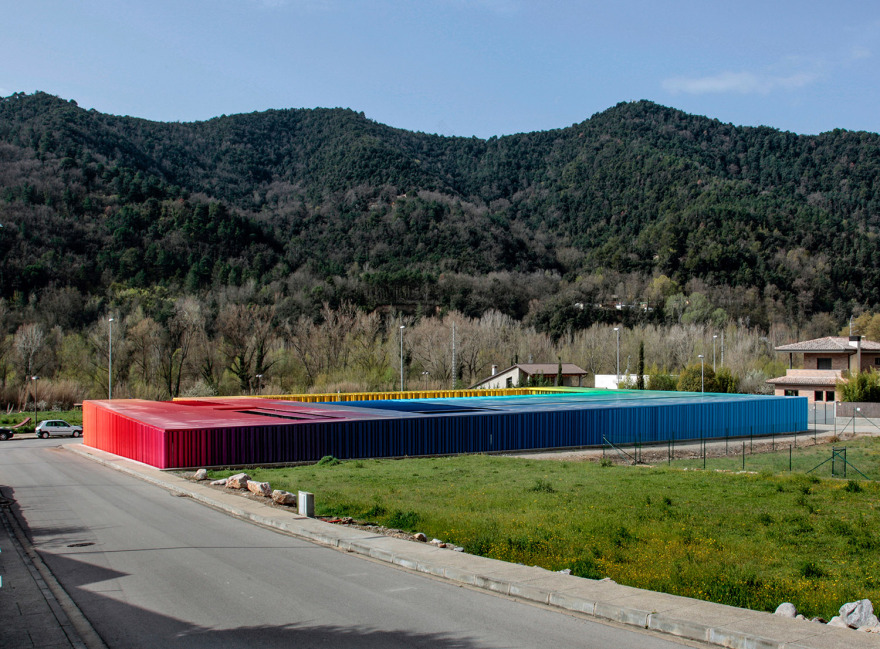
▼ 透过树脂玻璃的管子隔断,在教室就能看到庭院和远处的群山,
From the classrooms it’s possible to see the courtyard, with it’s steel and Plexiglas tubes, and the mountains beyond.

▼ 管子的光影,外面的街道和庭院之间的一道保护,
Detail of light and shade made by the tubes that protect the courtyard from the exterior street.

Les Cols餐厅 帐亭 2011 奥洛特 赫罗纳 西班牙 Les Cols Restaurant Marquee 2011 Olot, Girona, Spain Photo by Hisao Suzuki
活在庆典之中,为唤醒时光,为回归户外,为体验美食,为生活的本质与未来,尽情相聚此刻。”
为了重拾往日家庭与朋友乡村野餐的美好时光,RCR 为西班牙奥洛特市的Le Cols 餐厅创造了一个半开放的活动与宴会空间。依循地形掏空嵌入使得整个建筑不过分突出,同时让火山区乡村的美丽风景环绕四周。开掘过程中挖出的石头物尽其用,变为了场地的墙篱、路堤与路面。整个空间可以容纳上百人,屋顶采用轻盈透明的材料,却足以抵挡各种恶劣天气。钢制悬索支撑的屋顶宛如一幅“悬浮”空中的画面;同样,几乎隐形的亚克力材质家具让人、美食与乡村美景成为主角。
Living a celebration. A gathering for an event which evokes time, outdoor living, the culinary arts, the essential and the future.
Seeking to evoke family picnics in the countryside or outdoor gatherings with friends, of a bygone time, RCR has created a semi-open event and banqueting space near Le Cols restaurant in Olot, Spain. The terrain was hollowed out to be able to make the structure unobtrusive, but also allow for beautiful views of the surrounding volcanic countryside. The stone that was removed was returned to the site in the form of walls, embankments and pavements.
The whole space, which can accommodate hundreds of guests, is covered by a lightweight, transparent roof to protect against the elements. The steel catenaries supporting the roof give it an appearance of “floating”, while the acrylic, almost invisible furniture, allows the people, food and countryside to take center stage.
▼ 轻盈的屋顶由一系列管子排列而成,管子由于自身的重量而弯曲,沿着树林两侧的石墙支撑着整个屋顶。
View showing the lightweight roof made of tubes that curve due to their weight. They are supported by the walls of stone at each side, where trees have been planted.
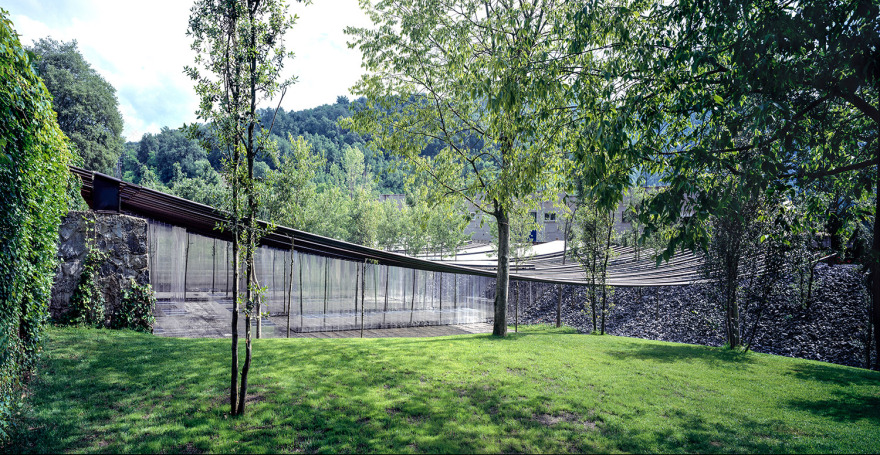
▼ 空间中随处可见透明的树脂玻璃桌椅,仿佛客人飘浮在空中,
The transparent Plexiglas tables and chairs are throughout space,
with guests who seem to be suspended in air.

▼ 由入口门厅纵观整个场地空间,右侧可以观摩建筑建构和塑料屋顶下的结构柱,
View of the event space from the entrance porch. At the right, the structure is visible as well as the first structural tubes covered by the plastic roof.

▼ 入口处可以看到透明的屋顶和竖直的塑料百叶帘,
The translucent roof and vertical plastic blinds as seen from the entrance porch.

Barberí 实验空间 2008 奥洛特, 赫罗纳, 西班牙 Barberí Laboratory 2008 Olot, Girona, Spain Photo by Hisao Suzuki
“让梦想成真:探索一个地方,可以在这里展开梦想、开会、讨论、交流、禅修、冥想,有花园,有历史,还有生活的气息。创造:建筑与景观。分享:为了自己和他人…一个我们安静工作的地方。”
始建于20世纪初的老Barberí 铸造厂于2004年被三位建筑师买下,并改造为他们的工作室,他们乐于称之为Barberí 实验空间。之前的建筑因为火灾留下被烟熏黑的墙壁、屋顶和地面。旧熔炉和烟囱本身的材质、呈现的颜色、散发的味道都为这个新项目提供了有力的启发。
办公室有三个主要区域,占据建筑一侧的是双层高顶的图书馆,建筑的第二个入口延伸至庭院,院中设有工作位,以及一个由铁管柱子支撑的全新玻璃大厅。原始的材料-木头、石头和陶瓷 -与新的材料钢和玻璃形成鲜明对比和互动对话,新材料为了原始建筑增添了新的功能和启发空间。内部庭院空间的树丛和植物既成为建筑与自然的分界,也是两者之间的桥梁纽带。
Making a dream come true: discovering a place to dream in, with meetings, debates, conversations, meditation, silence, the garden, history, and… smelling and breathing. Creating: architecture and landscape. Sharing: for us and many others…Quietly getting on with our work.
The old Barberí foundry, built at the beginning of the 20th century, was acquired by the architects in 2004 for their office, which they like to call Barberí Laboratory. The previous building had smoke-laden walls, ceilings, and floors from previous fires. The materials, colors, and smells of the old furnace and chimneys provided the powerful starting point for the new project.
There are three main parts to the office. The first is the double-height library which runs along the length of the building. The second is a separate building that opens onto the courtyard and houses workstations. Lastly, there is a new glass-enclosed pavilion supported by iron columns. The original materials – wood, stone, and ceramics – are in contrast and dialogue with the new steel and glass, which were added to make highly functional and inspirational spaces.
The trees and ferns in the interior courtyard spaces create both a divergence and a connection between architecture and nature.
The work space that Rafael, Carme and Ramon share is a library with a large table – appropriate for hours of long conversations amongst the three.

▼ 藏于花园中的大厅让内部和外部的边界在这里消失。中间的钢桌可以根据需要升高,亦可降低与地面融为一体,
A pavilion hidden in the garden is a space where the limits between interior and exterior disappear. The central steel table rises as needed and also lowers to become part of the floor.
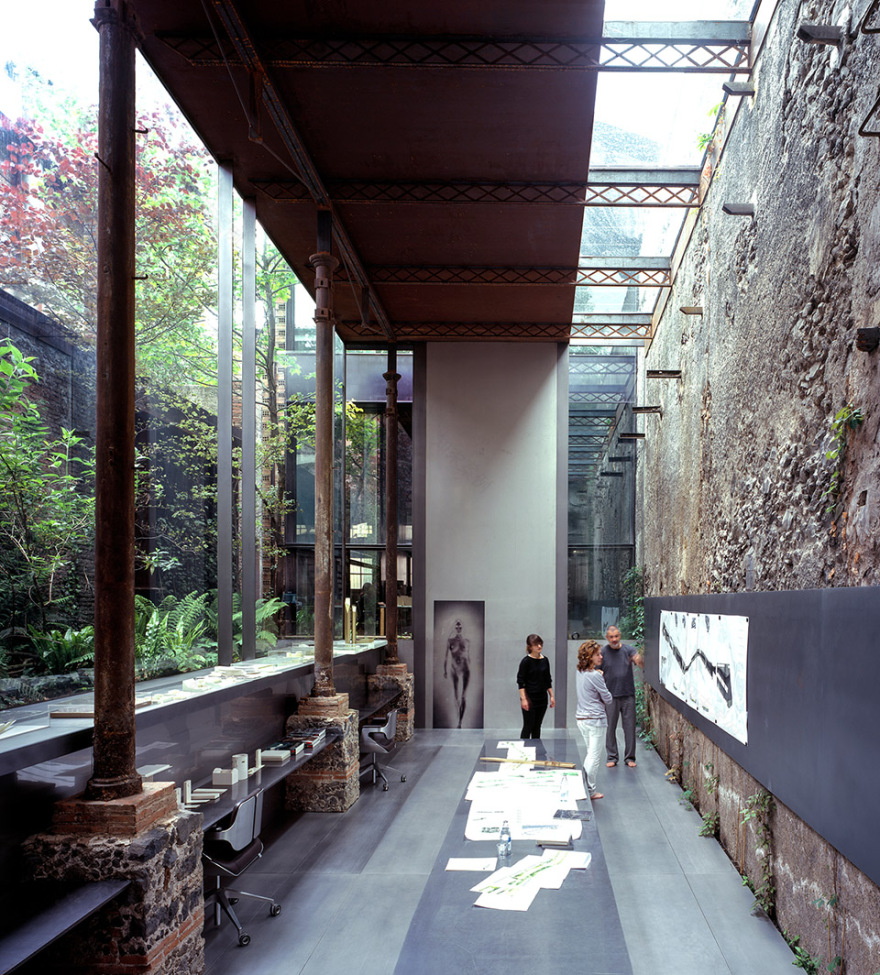
▼ RCR Lab.A 与RCR BUNKA 基金会在 Barberí 实验空间举办的夏季国际实习活动,Barberí Laboratory during the Summer International workshop, organized by RCR Lab.A and RCR BUNKA Foundation.

圣安东尼- 琼奥利弗 图书馆, 老年中心 与坎迪达 佩雷斯花 园 2007 巴塞罗那,西班牙 Sant Antoni – Joan Oliver Library, Senior Citizens Center and Cándida Pérez Gardens, 2007, Barcelona, Spain Photo by Eugeni Pons
为了向著名编剧和诗人琼·奥利弗致敬,图书馆特以他的名字命名,2005年RCR通过竞标赢得项目设计权。最初的招标仅仅是要求设计一栋行政大楼,当组委会了解到建筑师们对空间和社会责任的初衷,便同意在此建造更适合这一场地和有益社区的城市服务设施、图书馆和老年中心。
建筑师们希望设计能够为街区注入活力,将内庭打造为公共场所,并建立一个图书馆。由落地窗围合的中央阅读室设在图书馆两个主翼之间并抬升至空中,让自然光进入两侧,并形成一个公共区域的入口。庭院周边的花草树木、泥坯小径、坐席区域、游戏设施等,都成为了图书馆阅读室的自然延伸。老年中心沿着内部庭院的一侧延展扩张,成为新空间的框架。
The library, named in honor of playwright and poet Joan Oliver, came about through a competition won by RCR in 2005. The original competition merely called for the design of an administrative building. Once the spatial and social opportunities of the architects’ proposal were understood, the commissioning body agreed that urban amenities, a library and senior citizens center, would be more appropriate for the site and the neighborhood.
The architects sought to make the street more dynamic and to open up the inner courtyard for public use, as well as to create a library. The glass-enclosed main reading room is raised up and set between the two lateral wings of the library, which allow light to filter through from both sides, forming a gateway into the public space. This courtyard, with its trees, earthen paving, sitting areas, games, etc. can be understood as an extension of the library’s reading rooms.
The senior citizens center extends along a side of the interior patio further defining the reclaimed space.
▼ 五层楼的图书馆与从街边延伸至庭院的罗望子树,
View towards the five story library and the row of tamarind trees that extend from the street into the courtyard.

▼ 面向老年中心,光线由两侧的窗户投射进来,连接庭院与城市,
View toward the senior citizens center. Light filters through the windows from both sides, connecting the patio with the city beyond.

▼ 由庭院面向图书馆,老年中心位于右侧,
View from the courtyard towards the library with the senior citizens center to the right.

▼ 图书馆的钢质格栅和玻璃幕墙形成一个走廊,
A covered walkway is created between the steel slats and glass facade of the library.
Tossols-Basil 运动场 2000 奥洛特,赫罗纳,西班牙
Tossols-Basil Athletics Track 2000 Olot, Girona, Spain
Photo by Ramon Prat and Hisao Suzuki
依河傍水,这个称为Tossols-Basil的区域坐落于城市和自然保护区交界的边缘地带,专门规划用于休闲旅游项目。当有意在此加建一个体育场所时,建筑师们面临着两难之境: 一方面要清除大片生长缓慢的老橡树,另一方面是环保人士不想要任何改变的呼声。解决方案是将体育场建在一处森林中的空地上,这里曾经用于农业开发。最终的设计让自然和运动完美结合,跑步者的在森林跑道上的身影若隐若现,穿梭在自然景观之中。这一项目彰显了当地优美的自然景观优势,同时保留了原有的草木植被,景观随着四季自然变化。作为观众的看台巧妙利用周边的小型空地和路堤,顺应自然的地形坡度。修长的灯塔成为了地平线上的聚焦点。
2001年完成跑道之后,整个项目还增添了更多设施;包括一个足球场,以及RCR命名为2×1的入口大厅,并带有更衣场所。这一建筑拥有轻薄的屋顶,由两根立柱支撑,让整个结构更加通透。RCR再一次仅用单一材料——Cor-Ten耐候钢,重现了宛如天成的建筑与自然风景。
The area called Tossols-Basil, which is designated for leisure activities, is located at the edge of both a city and a natural park along a river. When contemplating adding sports facilities here, the architects faced a dilemma of either clearing large amounts of slow-growing oak trees or succumbing to environmentalists who wanted no change at all. The solution was to site the athletic track in a forest clearing, previously used for cultivation. Nature and sport are united and runners appear and disappear as they make their way around the track. The project highlights the beauty of the landscape and preserves the vegetation as a filter that changes with the seasons. The seating for observing the athletes is developed as small terraces or embankments between the clearings, often using the natural topography. The slender lighting towers become points of reference in the landscape.
After completing the track in 2001, other facilities have been added; a soccer field and an entrance pavilion with changing facilities, that RCR calls the 2×1 pavilion. This structure that acts as a gateway to the area has a thin roof supported by two volumes allowing multiple views through. Once again, RCR employs only one material-Cor-Ten steel-and the structure settles easily into its natural setting.
▼ 体育场的跑道设计可追溯至首届希腊奥运会,带来在大自然中奔跑的体验。The athletics track presents the act of running in the middle of nature, in the spirit of the first Olympic Games in Greece.

▼ 跑道秋色,旁边是公众可落座的小型看台,从树林中探出的巨大灯柱仿佛一棵弯曲的大树,
View of the track in autumn with the small terraces where the public can sit.
The lights protrude from the forest like large curved trees.

View of the athletic track in winter, surrounded by trees and the service pavilion in the background. The scenery of the sports field in winter is enhanced by the surrounding trees, with the service pavilion hidden in the background.

▼ 整个运动场的跑道不能一览无余,视线被保存原地的橡树和火山土堆所阻隔。The track is not seen in its entirety, but is filtered by the existing oak trees and volcanic mounds.

美食艺术中心 2014 内格雷佩利瑟,法国 La Cuisine Art Center 2014 Nègrepelisse, France Photo by Hisao Suzuki
十三世纪建于内格雷佩利瑟的军用城堡,坐落在法国西南部比利牛斯山脉中部的一个小村中,被改造为当地一个新的艺术和美食文化项目,RCR赢得了这个项目的公开竞标。通过围绕旧城堡构建新的设施让内部的中央庭院焕发新的功能,厨房、展览区域和教育空间分布在一侧,另一边则是儿童工坊、艺术家和表演者的空间以及行政区域。
建筑师运用极少的材料,大部分是钢和玻璃,把新的结构附加到现存的城堡墙体,不仅把对历史结构的影响降到最小,还实现了古老和现代之间的清晰对话。外立面通透的落地窗让自然光线进入,同时也能让庭院中间的活动往外扩展,创造出一个明亮和充满活力的空间。
A 13th century fort-like castle in Nègrepelisse, a village in the Midi-Pyrénées region of southwest France, was designated for a new cultural program focusing on arts and cuisine. The project, won by RCR through a competition, activates the inner courtyard by structuring the new facilities around the old castle: the kitchen, exhibition and educational spaces, are on one side, while the workshops for children, artists and performers, and the administration areas are on the other.
By using few materials, mostly steel and glass, and attaching the new construction to the existing castle walls, the architects have both minimized the impact on the historic structure and created a clear dialogue between old and new. The facades pierced by large windows, allow light inward and let the activities of the center ow outwards, creating a luminous and energized.
▼ 每个角落都矗立高塔的四边形城堡,限定出主要空间—中央庭院,The quadrangular castle with towers at each corner defines the principal space – the central courtyard.

▼ 厨房的尽头伸向一个展览区域,更远是一个小礼堂。窗外是连绵不绝的美景,
The kitchen leads to an exhibition space and at the small auditorium beyond. The window provides continuous views to the landscape.

▼ 望向建筑的北翼,树林的景色与玻璃反射的影像融合在一起,Looking towards the north wing, the view of the trees is mixed with the reflections in the glass.

排屋 2012 奥洛特,赫罗纳,西班牙 Row House 2012 Olot, Girona, Spain Photo by Hisao Suzuki
在这几位建筑师的家乡,一处既有建筑拆除后,一座新房子被嵌入到两侧墙体之间。出于保护文化遗产的目的,小镇要求保留主要的建筑外立面,新房子被设想为一个整体空间,内部通过不同标高的“悬浮”平台区隔出不同的居住空间。一些平台可充当座椅以及构建空间。
虽然整个空间几乎全部通透开放,通过视线的区隔依然保留了一些私密空间。两边的长廊延进深方向展开,延伸到天花板的钢制格栅,用来区隔楼梯、洗手间和多功能间。朝向后花园的外墙采用了玻璃的设计,融合外部和内部的景色。
贯穿整个项目的核心概念是回归家的本质,精简到只保留最必需的部分,重新思考家的定位,让生命能够自然本真的生活于其中。
In the architects’ home town, a new house was inserted into the space between two walls when an old house was removed. The main façade has been preserved, as required by the town for heritage purposes, and the new house is conceived as a single space with “floating” platforms at different levels to create the interior living spaces. Several of the platforms serve as seating benches and frame the space.
Although the space is almost entirely open, privacy is afforded by limiting views to some areas. There are two side corridors that run along the depth of the building, encased with steel slats extending to the ceiling that houses the staircases, bathrooms, and utility rooms. The wall towards the back garden is glass, fusing interior and exterior.
The idea pursued throughout the entire project is to return to what is essential to a home, reducing the number of parts to those that are absolutely necessary, and rethinking the nature of the house to allow the life inside to flow naturally.
▼ 从庭院里,就可以理解中央的整体空间是如何使用的,也能看到两侧的楼梯和服务设施。
From the patio, it is possible to understand the single central space and how it is used, and see the stairs and services located at each side.

▼ 排屋内部展现了如何利用错层来限定不同的空间。墙面以石材为主,而钢格栅用来分隔侧面服务区域、中部居住空间和平台,
The interior of the house showing how different levels create the different spaces. Stone is used for the walls, while steel is used to separate the lateral service areas from the central living spaces, as well as for the platforms.

▼ 从客厅的角度看到餐厅和厨房以及上一层的卧室,
View from the living room into the dining area and kitchen below, and a bedroom above.

南京喵熊网络科技有限公司 苏ICP备18050492号-4知末 © 2018—2020 . All photos and trademark graphics are copyrighted by their owners.增值电信业务经营许可证(ICP)苏B2-20201444 苏公网安备 32011302321234号
苏公网安备 32011302321234号客服
消息
收藏
下载
最近