

创作上传
VIP
收藏下载
登录 | 注册有礼
查看完整案例

收藏

下载

分享
项目概述 Project Description
圣十字学院 Prior 表演艺术中心位于美国马萨诸塞州伍斯特市,占地 8.4 万平方英尺(约 7804 平方米),是一个以表演和视觉艺术为基础的多学科学习孵化器,可供所有科系的学生使用。作为学校的文化中心,该项目提供同时适用于美术和表演艺术的场地,包括 400 座的音乐厅、200 座的灵活演播剧场以及新迁址的 Cantor 艺术画廊。
The 84,000 sf Prior Performing Arts Center for the College of the Holy Cross has been designed to be an incubator for multidisciplinary learning grounded in the performing and visual arts for students from all academic disciplines. Standing as the cultural center of the school—with venues for both fine arts and performing arts—the building houses the 400-seat concert hall, a 200-seat flexible studio theatre, and the relocated Cantor Art Gallery.
▼建筑西立面:公共入口和 Cantor 艺术画廊,West Elevation: Public Entry Marquee and Cantor Gallery ©Iwan Baan

Prior 表演艺术中心坐落在校园上区中心,将校内多条交通路径汇聚于其内部的标志性场所:“蜂巢”(Beehive)。围绕着这个中心空间,分布着四个主要的场馆,包括用于歌剧和音乐表演的多功能剧院、用于戏剧的演播剧场、艺术和媒体馆,以及实践和制作馆。
Anchoring the Upper District of campus, the Center gathers together existing vectors of campus circulation at its heart: the Beehive. Around this central space the programs are divided into four pavilions: the Multipurpose Theater for opera and music; the Studio Theater for drama; Art/Media; and Practice/Production.
▼西北立面,可以看见拱形入口、雕塑广场、大型排练室和 Cantor 画廊,Northwest Elevation with Arched Entry, Sculpture Court, Large Rehearsal Room and Cantor Gallery©Iwan Baan
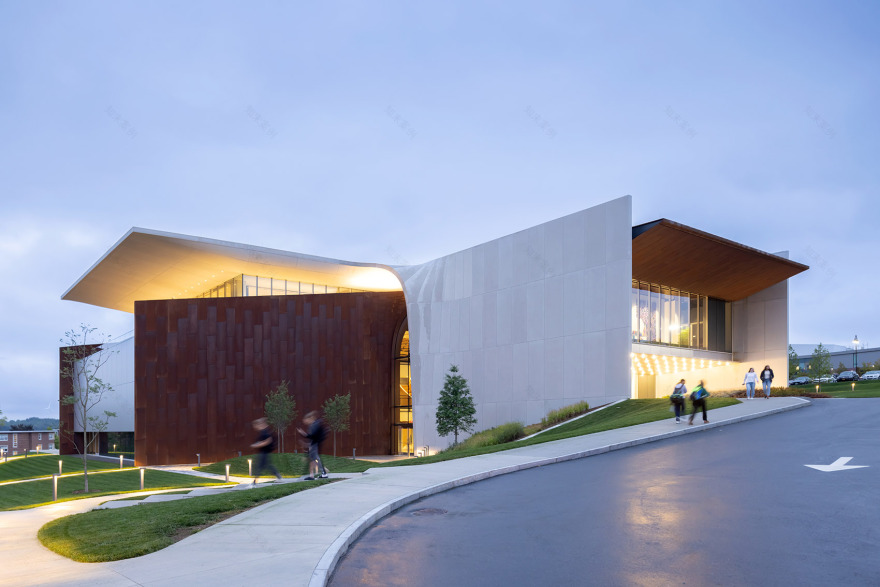
四个场馆分别被容纳在两组成对分布的墙壁内,这些墙壁相交形成一个九宫网格。网格的四角均设有独特的庭院空间,分别是小型露天剧场、户外教学和工作空间、冥想花园以及雕塑花园。成对的墙体呈扭曲、上升和交错状,其中一座场馆的墙壁成为了它旁边场馆的屋顶,从而创造出一道围绕着中心的“链条”,将多个带有拱顶的入口直接引入建筑的中心。对比鲜明的预制混凝土墙和耐候钢墙是对老校区砖墙和石灰石墙的重新诠释。利用场地的自然美景,艺术中心成为了其他校园建筑的一个具有特殊意义的“对照物”,它既凸显于校园的最高点,又与其周围环境建立了和谐的关系。
The four pavilions are contained within two pairs of walls that intersect to form a nine square grid. In each corner of the grid lies a unique courtyard garden: a small amphitheater, an outdoor teaching area and workspace, a meditative garden, and a sculpture garden. The paired walls twist, rise, and interlock, the wall of one pavilion becoming the roof of its neighbor, forming a chain around the center and creating arched entries directly into the heart of the building. The opposing precast concrete and weathering steel walls reinterpret the brick and limestone of the historic campus. Taking advantage of the site’s natural beauty, the Center’s design creates a meaningful counterpoint to the surrounding campus architecture, both fitting in and standing out on the highest point on campus.
▼由曲线型 GFRC 和耐候钢墙定义的拱形入口
Arched Entry with twisting GFRC and weathering steel©Iwan Baan

设计亮点 Major Features
蜂巢 | Beehive
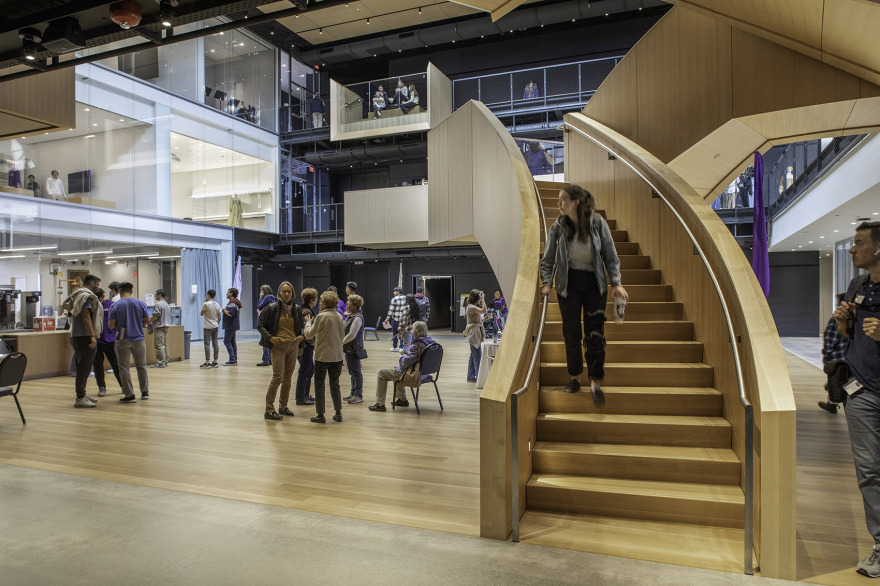
“蜂巢”被构想为公共功能与学生创作之间的可见“连接器”,能够让各种后台功能随时激活建筑空间。作为灵活的公共区域,“蜂巢”包含了支持创意性合作的咖啡馆、可进行作曲课程、录音、声音、视频和电影编辑的共享多媒体教学空间、协作办公空间以及多功能排练空间。这种非正式且可调节的功能使“蜂巢”成为了来自不同专业的所有学生的创意乐园。这里就像是一座舞台,以黑钢材料为主的技术基础设施区域环绕在其周围,兼具了原始与精致的观感,同时,钢铁材料与楼梯、吧台、座椅和学生合作区的丰富木材形成了对比。简约的“积木式”可移动家具为学生们创造了可以随时发起活动和表演的空间。
The Beehive acts as a visible connective tissue between the public program and the student productions, allowing back-of-house functions to activate the building at all times. A flexible space with a cafe that supports creative collaboration, the Beehive includes a shared multimedia teaching space for electronic music and musical composition courses, sound recording, sound editing, and video and film editing as well as collaborative work spaces and multipurpose rehearsal spaces. The informal, hackable nature of the Beehive turns it into a creative playground for study and performance for all students irrespective of their majors. Like a stage, the interior materials combine both the raw and refined: an exposed dark steel technical infrastructure zone rings the space. The steel stands in contrast with the rich woods for the stairs, bars, seating, and student collaboration zones. Simple “building-block” movable furniture allows students to create a performance space for spontaneous events.
▼“蜂巢”内的舞蹈表演,可以看见对面的演播剧场,Dance Performance in Beehive with View in Studio Theater© Brett Beyer

▼从一层望向“蜂巢”,可以看见布景车间和排练空间,Beehive view from Level 1 looking into Scene Shop and Rehearsal Spaces©Iwan Baan
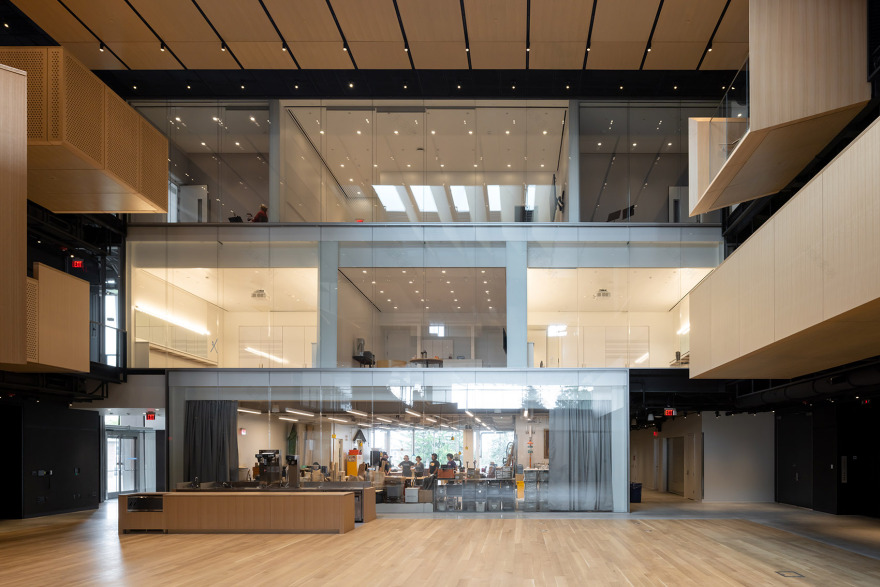
▼“蜂巢”二层的合唱表演,Choral Performance in Beehive’s Level 2 Bar© Brett Beyer

▼悬空楼梯和“蜂巢”三层空间,View of Flying Stair and Beehive’s Level 3 Overlook© Brett Beyer
▼从三层望向“蜂巢”,可以看见向 Cantor 艺术画廊和媒体实验室,Beehive view from Level 3 looking into Cantor Art Gallery and Media Lab©Iwan Baan

▼从三层望向“蜂巢”,View from Level 3 into Beehive©Iwan Baan

▼“蜂巢”内的悬空楼梯,Flying Staircase Detail in Beehive©Iwan Baan

Luth 音乐厅 | Luth Concert Hall
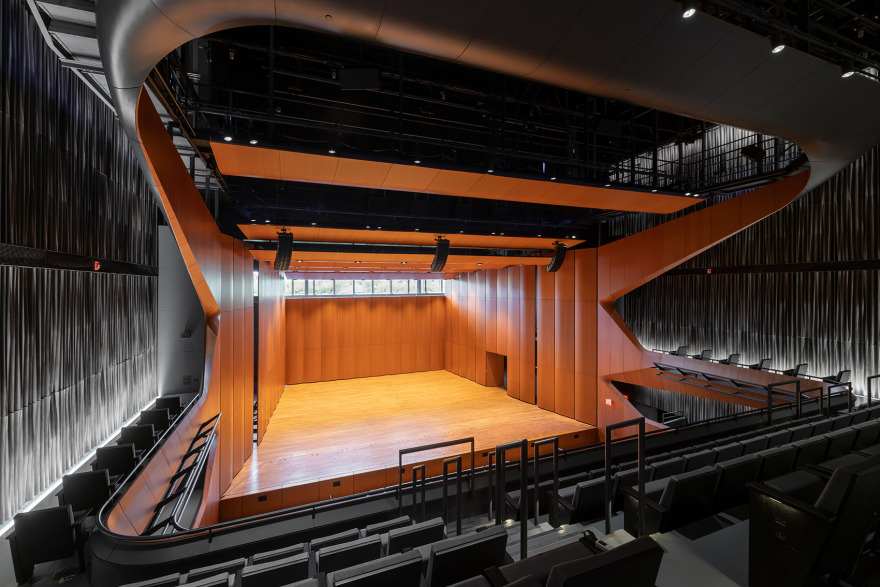
可转换功能的 400 座音乐厅以及带有全舞台塔的镜框式剧场,是学院举办交响乐、室内音乐、爵士乐、加麦兰以及歌剧、音乐剧和舞蹈表演的主要场所。礼堂的设计既能适应午间音乐会小群体观众的需求,亦适用于举办大型活动。礼堂墙壁采用了定制的参数化混凝土扩散板,由 DS+R 事务所与 Jaffe Holden 合作开发和测试,并为音乐表演进行了专门调整。
A 400-seat convertible concert hall and proscenium theatre with a full fly tower, serves as the College’s principle venue for symphonic music, chamber music, jazz, gamelan, as well as opera, musical theatre, and dance. The auditorium is designed to be intimate for both smaller audiences for lunch time concerts and larger audiences for premier events. The auditorium walls feature custom parametrically designed concrete diffusion panels developed and tested by DS+R in collaboration with Jaffe Holden, specifically tuned for musical performances.
▼Luth 音乐厅,Performance in Luth Concert Hall© Brett Beyer

▼Luth 音乐厅座位区,Luth Concert Hall Seating © Brett Beyer

▼墙壁采用定制混凝土扩散板,Luth Concert Hall seating and custom designed concrete diffusion panels©Iwan Baan

▼“舞台壳体”打开状态下的 Luth 音乐厅,Luth Concert Hall with Concert Shell deployed©Iwan Baan
Boroughs 剧场 | Boroughs Theater
Boroughs 是一个 200 座的完全灵活的演播剧场,拥有 52 英尺(约 16 米)的可操作墙壁,可以将剧场连接至“蜂巢”空间。
A 200-seat fully flexible studio theatre for drama features a 52 foot operable wall that connects the theater to the beehive.
▼演播剧场,Studio Theater©Iwan Baan

媒体实验室 | Media Lab
媒体实验室同样开放于“蜂巢”,为数字音乐制作、声音和视频编辑、电影、灯光和布景设计提供了一个共享的多媒体实验场和表演空间。
Opening onto the Beehive, a shared multimedia laboratory and performance space is provided for digital music, sound and video editing, film, lighting and set design.
▼可以看到“蜂巢”的媒体实验室,Media Lab with View into Beehive© Brett Beyer

▼媒体实验室,Media Lab©Iwan Baan

Cantor 艺术画廊 | Iris and B. Gerald Cantor Art Gallery
Cantor 艺术画廊由 O’Kane Hall 迁址而来并进行了扩建,如今可以容纳各类跨学科的展览,同时还配备了更充足的展览和储存空间。
The Cantor Art Gallery, relocated from its former location in O’Kane Hall, has been expanded to accommodate a variety of interdisciplinary exhibits and increased exhibition and storage space.
▼从 Cantor 艺术画廊望向“蜂巢”,Cantor Art Gallery with View into Beehive© Brett Beyer

排练室 | Rehearsal Rooms
用于排练的舞蹈室可以被重新配置为活动空间,并与享有伍斯特和黑石谷全景视野的屋顶露天活动空间相连接。此外还有一个小型的合奏排练及现场录音室。
A dance studio for rehearsal can be reconfigured as an event space that connects to an outdoor, rooftop event space with sweeping views of Worcester and The Blackstone Valley. A small ensemble rehearsal and live recording room.
▼大排练室和俯瞰城市的露天平台,Large Rehearsal Studio and Terrace Overlooking Worcester©Iwan Baan

创作空间 | Production Spaces
多种类型的创作空间包含布景车间、服装车间、录音室、灯光和布景设计车间以及多功能练习室等,它们分布在精心设计的表演空间和白盒子画廊旁,从“蜂巢”处可以清楚地看见。这些创作空间向校园社区展示了学生们产出艺术的过程,同时也确保了建筑能够随时处于活跃的状态。
From the vantage point of the Beehive, production spaces including a scene shop, costume shop, recording studio, lighting and set design study, and multi–use practice rooms are visible next to refined performance spaces and the white box gallery, revealing the process of artistic output to the campus community and ensuring that the house never goes dark.
▼布景车间,Scene Shop© Brett Beyer

▼布景车间,Scene Shop©Iwan Baan

技术特色 Technical Features
立面 | Façade
成对分布的 GFRC 和耐候钢墙壁通过参数化建模而实现了精确合理的曲线和面板造型。建筑物控制表面模型被用作与立面承包商合作开发的建造模型的基础。
The twists in the paired GFRC and weathering steel walls were parametrically modeled to rationalize the curves and panelization. The architectural control surface models were used as the base for the fabrication models in collaboration with the façade contractor.
▼建筑西立面:公共入口和 Cantor 艺术画廊,West Elevation: Public Entry Marquee and Cantor Gallery©Iwan Baan

可持续性 | Sustainability
Prior 表演艺术中心的设计体现了生态管理的理念。该建筑是按照 LEED 标准设计。鉴于学生和教职员会在大楼内长时间停留,因而在设计上特别强调了室内环境的质量,尤其是空气、光线、热舒适度和材料。所有空间(包括表演空间)都与外部建立了视觉联系,并允许自然光线的进入。
The Center has been designed to demonstrate ecological stewardship. The building is designed to LEED standards. Knowing that students and faculty will spend long hours in the building, a particular emphasis has been placed on the quality of the indoor environment—specifically air, light, thermal comfort, and materials. Each space has a visual connection to the exterior and allows in natural light, including the performance spaces.
▼主公共入口:望向 Cantor 艺术画廊,Main Public Entry: Marquee and Cantor Gallery© Brett Beyer

Location:Worcester, Massachusetts, United States
Owner:College of the Holy Cross
Architects:
Diller Scofidio + Renfro, Design Architect
Perry Dean Rogers, Executive Architect
Construction Cost:$110 Million
Milestones:
2014: Diller Scofidio + Renfro is selected to design Prior Performing Arts Center.
2019: Construction begins on site.
2020: Structure tops out.
2022: The PAC will be in active use as of the start of the Fall 2022 semester. An official dedication celebration will be held in December.
Design Team
Design Architect: Diller Scofidio + Renfro, (Partner-in-Charge: Charles Renfro)
Executive Architect: Perry Dean Rogers
Contractor: Dimeo Construction
Acoustics & Audio/Visual: Jaffe Holden
Civil Engineer: Nitsch Engineering
Code Consultant: Code Red Consultants
Cost Estimator: Dharam Consulting
Foodservice Consultant: Colburn & Guyette
Geotechnical: Haley Aldrich
Hardware Specifications: Campbell-McCabe, Inc.
IT/Security: Shen Milson & Wilke
Landscape Architect: Olin
Lighting: tillotson Design Associates
MEP/FP Engineer: Altieri Sebor Wieber
Specifications: Construction Specifications, Inc.
Structural Engineer: Robert Silman Associates
Sustainability: Transsolar
Theater Planning: Fisher Dachs Associates, Inc.
南京喵熊网络科技有限公司 苏ICP备18050492号-4知末 © 2018—2020 . All photos and trademark graphics are copyrighted by their owners.增值电信业务经营许可证(ICP)苏B2-20201444 苏公网安备 32011302321234号
苏公网安备 32011302321234号客服
消息
收藏
下载
最近