

创作上传
VIP
收藏下载
登录 | 注册有礼
查看完整案例

收藏

下载

分享

翻译
Architects:The BAD Studio
Area:6500ft²
Year:2021
Photographs:The Fishy Project,Noaidwin Studio
Manufacturers:Technal,Aluk,Ambuja Cement,D Décor,Daikin,Greenlam,HIK VISION,Hindware,Legrand,Radhe Krishna Bricks
Structural Consultant:Anil N Patel Structural Engg.
Horticulturist:Gurukrupa Nursery- Vimalbhai
Civil Contractor:UNITED CONSTRUCTIONS, Ashok Patel, Dhirubhai Mistry
Landscape Design:The BAD Studio,Proproots Design Studio
Electrical Consultant:Nutanvij Electricals, Nirav Desai
Interior Styling:Trend and Tone, Caroline Braganza
Principal Design:Boney K and Alak P
Project Architect:Taikhum Shaikh
Design Team:Marmik Mody, Nikunj Rajpara, Parth Gurnani
Graphics:Sagar Chotaliya, Priya Barot
Text Credits:Drishti Joshi
Brickwork Contractor:Bharatbhai
Plumbing Consultant:Nizambhai Mistry
Fabricator:Shyambhai, Jigneshbhai
Program / Use / Building Function:Weekend Home
City:Navsari
Country:India

Text description provided by the architects. On the edge of Aamri village, in the vicinity of the Purna River, 40 kilometers from Surat city, is a weekend getaway called The Weave House. The client had a specific vision of a home that exudes an organic lifestyle, with spaces specifically designed to be meditative and enveloped in verdant greenery. They sought an abode that radiates serenity, a Zen-like ambiance, and a persistent flow of energy. The concept evolved to seamlessly create a harmonious interweaving of the built environment and landscape. The spatial planning inspired by a traditional house is modernized with design elements and materials to constitute a contemporary home woven into a rural settlement. The architects sought to incorporate the client's lifestyle into the design and drew inspiration from his profession of textile weaving to inform the design of the space, integrating elements that are reflective of the craft throughout the house.

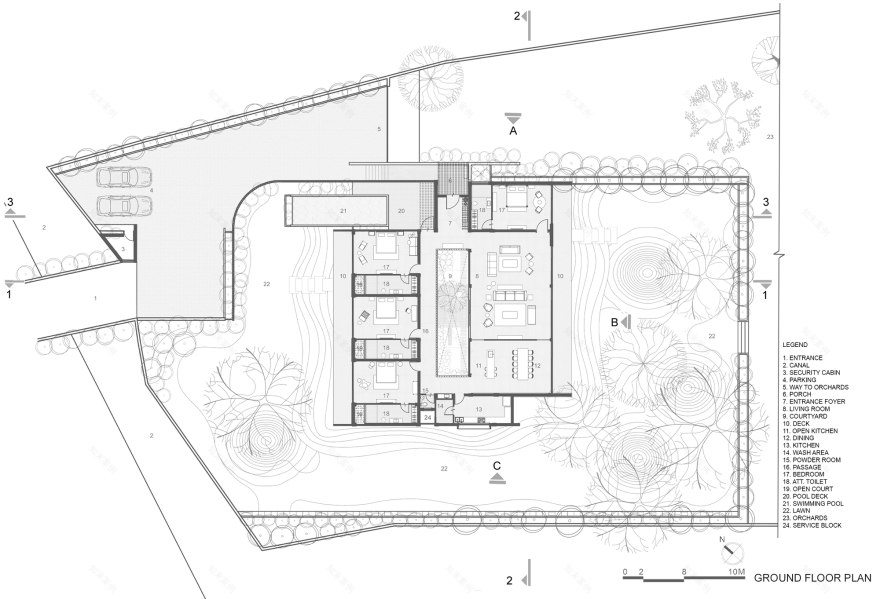


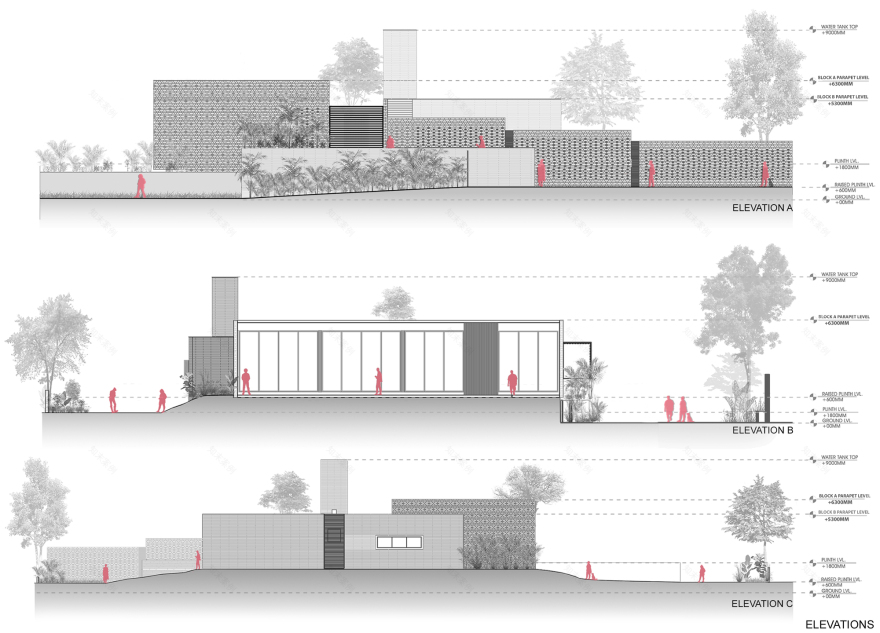
The distinctive boomerang-shaped farming site steered the design of the house that was proposed in the sparsely planted region at the front, hence retaining an extensive span of dense orchards at the back. The design concept was conceived from two rectangular blocks, allocated for private and public areas, one strategically oriented towards the secluded private front garden and the other towards the picturesque orchard. The infused central courtyard serves as a focal point and separates the public spaces from the private ones. Furthermore, the house is elevated from the ground level to counteract the potential waterlogging caused by the proximity of the river.


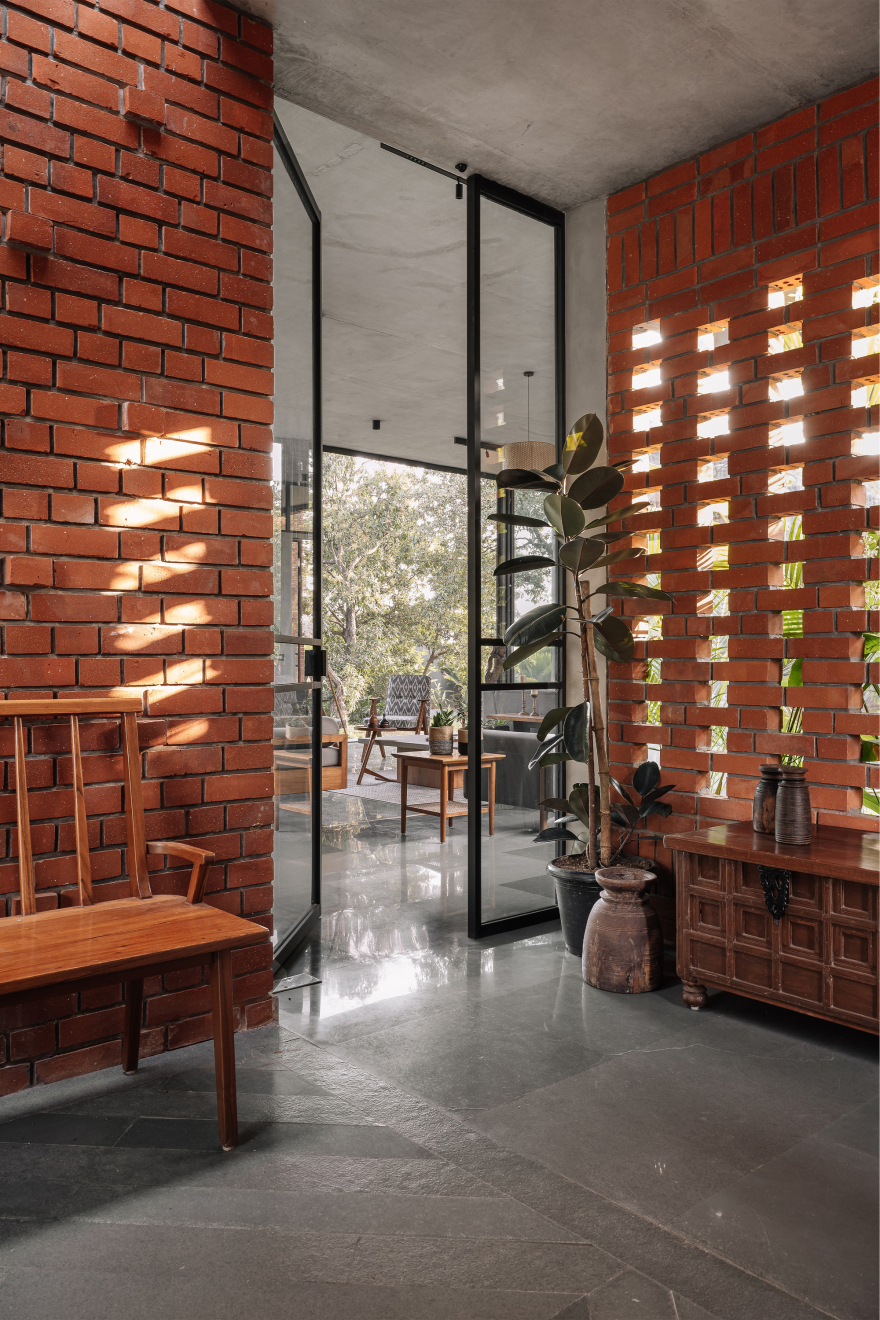
At the entrance, a cascading perforated brick wall provides privacy for the house and swimming pool while serving as an elegant backdrop for the surrounding flora, accentuating them as the design's protagonist. The entrance to the house is via an enclosed hallway ascending to the foyer leading to the main door, the house unfolds into a single, spacious area. Ample openings and courts allow for natural light and ventilation, which continually alter the space's dynamics throughout the day, feeding into the sense of liveliness. The functional zones of the house, including the family area, living room, dining room, and bedrooms, are all seamlessly connected to gardens, courtyards, and decks, fostering a harmonious connection between the interior and exterior spaces.

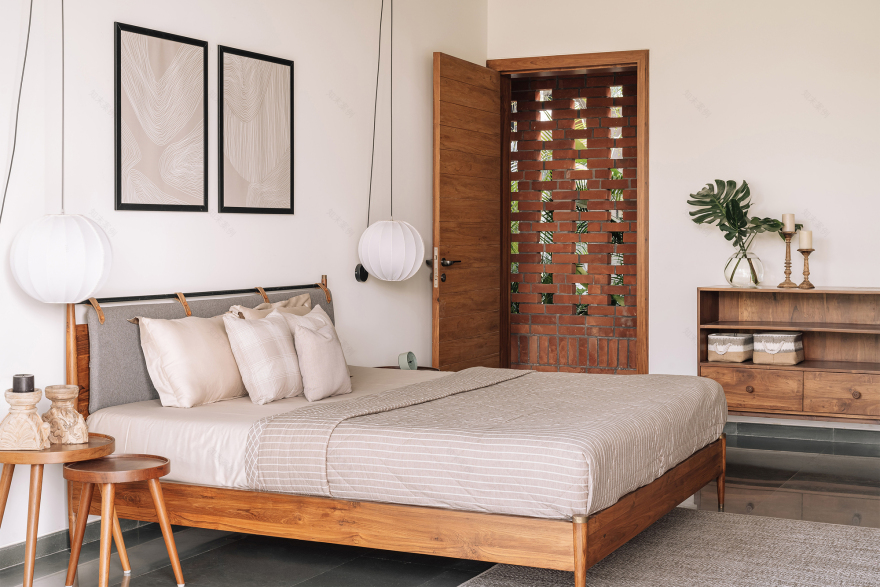
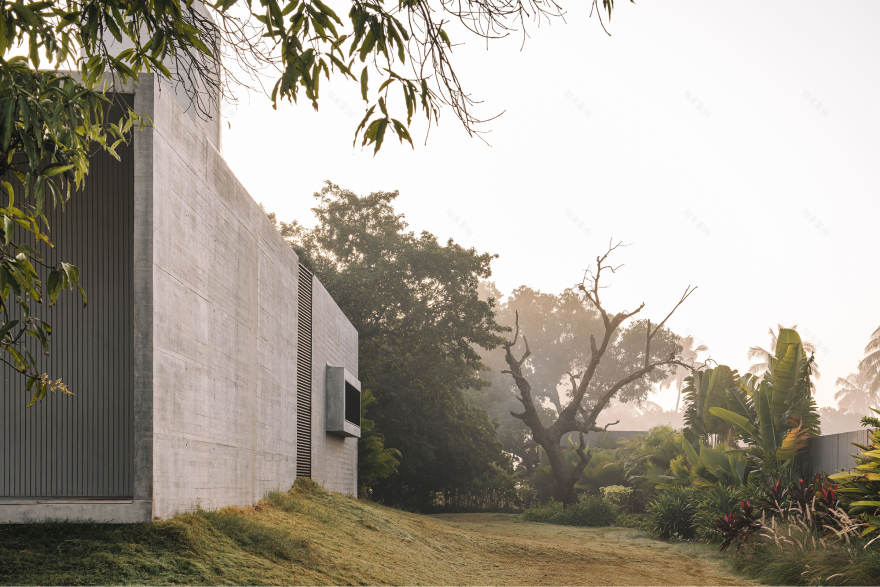
To highlight the craftsmanship and remove extraneous layers of cosmetics, each space is thoughtfully designed with minimal and flexible wooden furnishings, set against the raw and natural aesthetics of walls. True to the concept, small courts are introduced in the bathrooms to admit diffused daylight and preserve the indoor-outdoor connection. Exposed brick walls feature distinctive embossed brick and diamond patterns inspired by Ikat print patterns; the concrete walls exhibit a subtle interweaving of threads akin to those found in fabrics. The flooring is primarily composed of Kota stone, differentiated through the use of patterns and different finishes.


The house is also designed as a sustainable and self-sufficient entity, harnessing energy from solar panels recessed and hidden on the roof, while the implementation of percolation wells on the edges helps in preserving the groundwater level. The rainwater is harvested and utilized for the house’s multiple water demands. The home is built around the notion of coexisting with nature, allowing for smooth transitions and giving its occupants a tranquil retreat where they may unwind and connect with the outside world. The house weaves the built mass that embarks on Indian traditional elements and arts, creating balance and visual harmony. The spaces with this meditative nature are woven through an intricate fabric of green layers and materiality inside out, defining the house truly as an earth’s child.

Project gallery








南京喵熊网络科技有限公司 苏ICP备18050492号-4知末 © 2018—2020 . All photos and trademark graphics are copyrighted by their owners.增值电信业务经营许可证(ICP)苏B2-20201444 苏公网安备 32011302321234号
苏公网安备 32011302321234号客服
消息
收藏
下载
最近