

创作上传
VIP
收藏下载
登录 | 注册有礼
查看完整案例

收藏

下载

分享
As a channel for people to enter and exit their houses, alley is also a shared lifestyle through which people extend their living space from “inside”to “outside”, and from “Little House” to “Big Family”. The alleys inside the house also play a role in connecting each rooms, and creates a subtle interactive relationship between the inside and outside. Children shuttle and play in the alleys, and peep at each other among rooms. After meals, people can enjoy the cool under the eaves and tree. “The trees” has become an important component and symbol of life. The vertical grid wall connects both ends of the alleys, extending the visual height in the low space.
▼胡同般的室内空间,Hutong like interior space © ACT STUDIO

▼细部,Details © ACT STUDIO
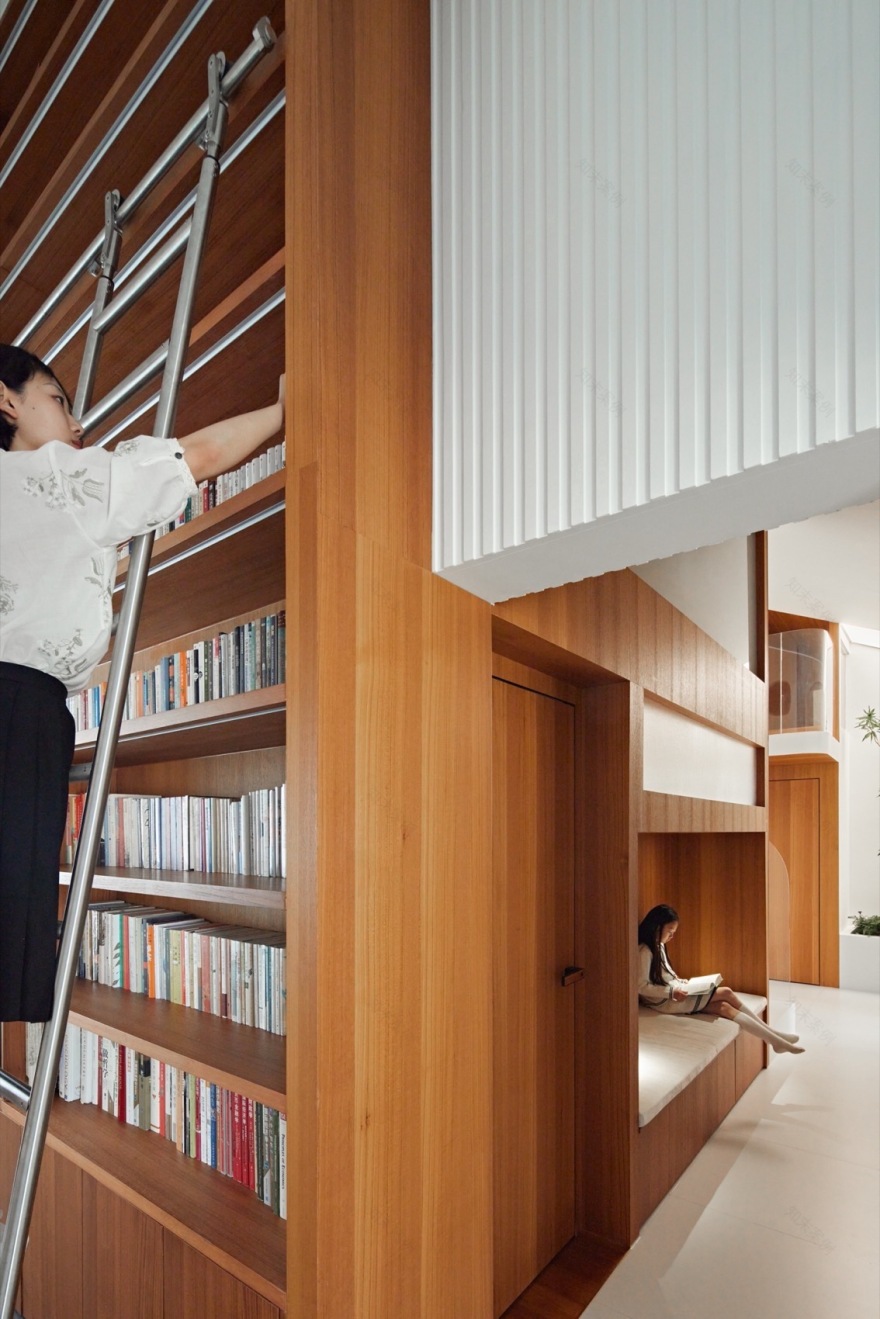
▼室内绿植,Indoor green plant © ACT STUDIO
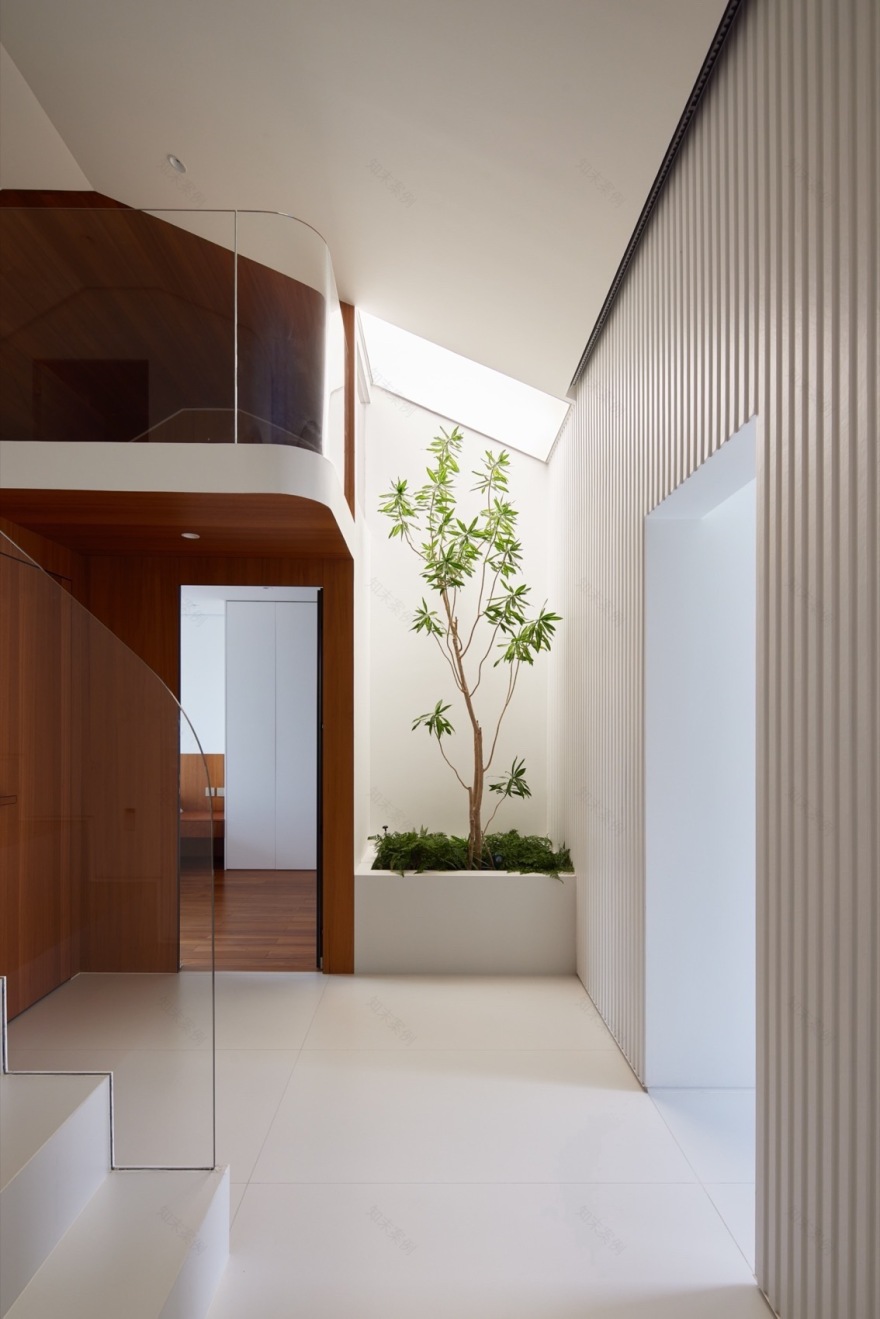
▼楼梯,The staircase © ACT STUDIO


走到街巷西侧尽头就可以看到的第二组建筑物,它是一个完整的房屋形体,也具有一定的封闭属性。建筑物左侧的通道犹如从房体建筑延伸出来断裂的夹缝,连接着街巷两端。房屋下的长椅形成了一个休憩和阅读的共享空间,人们利用这条通道互通有无。
At the end of the west side of the alley, the second group of buildings can be seen, which is a complete building form and also has a certain degree of enclosed properties. The passage on the left side of the building looks like a fractured gap extended from the building, and connects the two ends of the alley. The bench under the house forms a shared space for rest and reading. People can use this passage to communicate with each other.
▼休憩和阅读的共享空间,Shared space for rest and reading © ACT STUDIO


屋顶天台 Roof Terrace
通过西侧的曲折楼梯我们上到屋顶天台,这里也成为了街巷内第三组建筑物。从这里窥视你依然能找到儿时上房揭瓦的兴奋,眺望远处的建筑群,看着夕阳掠过树梢。这些传统的片段组成了一个既熟悉却又不曾体验过的空间。我们将这个空间赋予了儿童游戏区的功能属性,同时它还带有一定的开放性的延展。在探索当代北京人生活方式的原型伊始,新的室内胡同生活由此展开。
Through the winding staircase on the west side, we can climb up to the roof terrace, which forms the third group of buildings in the alley. Peering from here, you can still find the excitement of childhood when you went up to the housetop to uncover the tiles, can gaze at the distant buildings, and can watch the sunset sweep over the treetop. These traditional fragments form a space that is familiar but never experienced. We have endowed this space with the functional attributes of a children’s play area, which also has a certain degree of openness and extension. At the beginning of exploring the prototype of contemporary Beijing people’s lifestyle, a new life in an interior alley is unfolded.
▼屋顶天台,Roof Terrace © ACT STUDIO
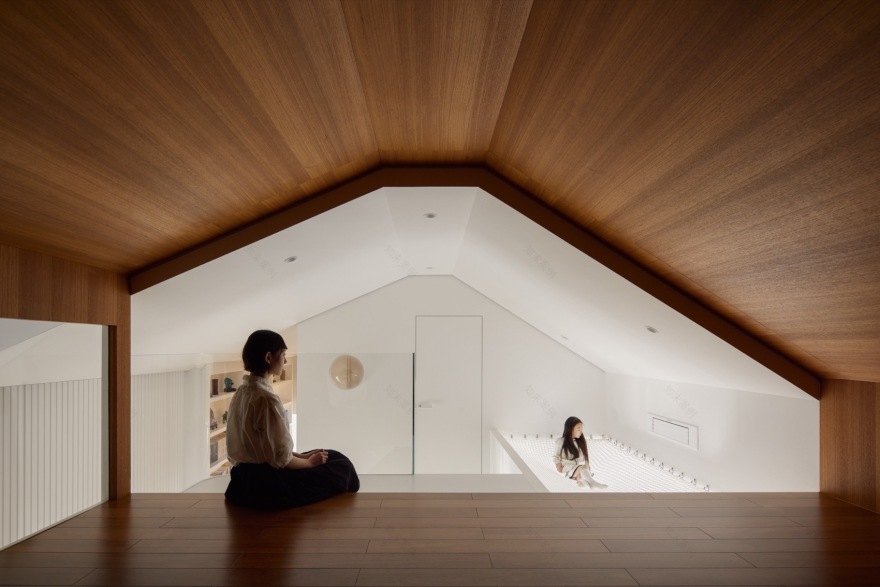
▼楼梯,The staircase © ACT STUDIO


▼儿童游戏区,Children’s play area © ACT STUDIO


▼俯瞰楼梯,Overlooking staircase © ACT STUDIO

游戏网连接着两组建筑屋之间,同时作为房间顶部覆盖,赋予了开放和互动的意义,让内与外更好的产生连接。同时在居住人口多的时候也可以临时封闭,改成一个单独的客房使用。
The game net connects two groups of buildings, and serves as the top cover for the room meanwhile, giving the house a meaning of openness and interaction, and forming a better connection between the inside and outside. Besides, when there is a large population living in the house, a temporarily closed space can be formed and used as a separate guest room.
▼游戏网,The game net © ACT STUDIO


内部空间组合 Combination of Internal Space
在房舍的内部,每个房间赋予了门户意义,不同房间的形式特征略有不同。在第二组房舍建筑物的内部空间,分为上下两个房间。利用空间的高差错层,形成了新的建构体系。上部分房间,需要通过半段楼梯进入其中,其空间特征为半封闭,内部通过两步台阶完成休憩动作,床铺恰好利用了房屋低矮部分,同时也是下部分房间的楼板。
Inside the house, each room is given a portal meaning, and the formal features of different rooms vary slightly. In the interior space of the second building group, there are two rooms, respectively arranged in the upper part and lower part. A new construction system has been formed by utilizing the height difference and staggered floor of the space. The room in the upper part needs to be accessed through half a staircase, with a spatial feature of being semi-closed. And people in the upper room can get to the rest area through climbing two steps. The bed of the upper room is precisely arranged under the low part of the house, which is also the floor slab of the room in the lower part.
▼每个房间都被赋予了门户意义,Each room is given a portal meaning © ACT STUDIO

▼内部通过两步台阶完成休憩动作, The rest area through climbing two steps © ACT STUDIO


▼床铺恰好利用了房屋低矮部分,The bed of the upper room is precisely arranged under the low part of the house © ACT STUDIO

下半部分是一个相对独立的儿童卧室。床铺的设计正好利用了上部分房间的楼板以下空间得以实现。圆形的旋转窗相互窥望为孩童之间留出了沟通和连接的可能,也为房间提供一定的通风和采光作用。
The lower part is designed as a relatively independent children’s bedroom. The space for the bed is perfectly designed by utilizing the space below the floor slab of the upper room. The circular rotating window allows children to peep at each other, making it possible for them to communicate and connect, as well as providing the functions of ventilation and lighting for the room.
▼儿童卧室,The children’s bedroom © ACT STUDIO

▼圆形的旋转窗相互窥望为孩童之间留出了沟通和连接的可能,The circular rotating window allows children to peep at each other © ACT STUDIO
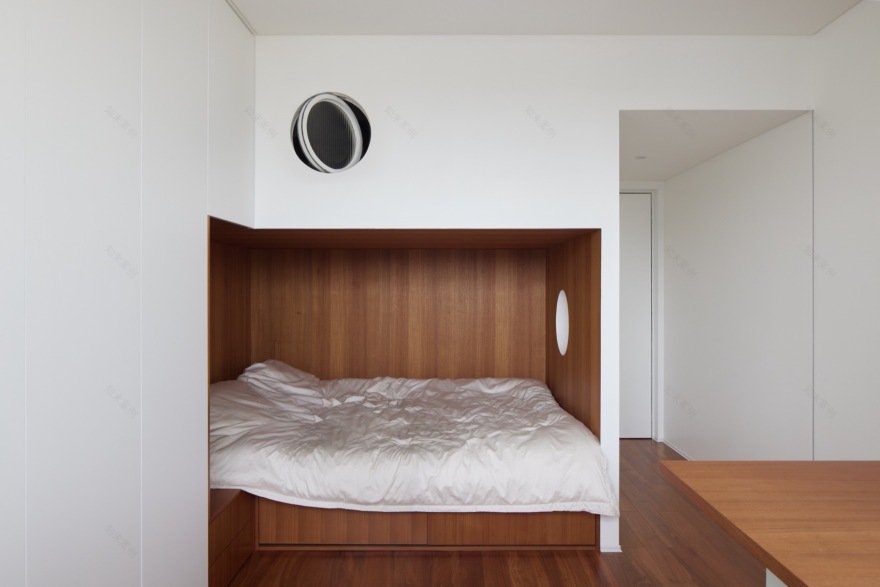
主卧空间 Master Bedroom Space
因考虑生活方式的代差,在东西两端分别设计了两个卧室,由街巷连接。也是第一组和第三组建筑物的内部空间,其空间特征为隐私和封闭。一侧为主卧套房另一侧作为老人房间使用。
Considering the generation difference in lifestyle, we design two bedrooms at the east and west ends, which are connected by alleys. The two bedrooms occupy the internal space of the first and third buildings groups, characterized by privacy and enclosure in space. On one side is the master bedroom suite, and on the other side is an elderly room.
▼主卧空间,Master bedroom space © ACT STUDIO


▼主卧空间细部,Master bedroom space details © ACT STUDIO

▼建造过程,Building process ©戏构建筑设计工作室

▼模型,Model ©戏构建筑设计工作室

▼一层平面图,First Floor Plan ©戏构建筑设计工作室

▼二层平面图,Second Floor Plan ©戏构建筑设计工作室

▼剖面图,Profile Chart ©戏构建筑设计工作室

项目名称|房舍巷子
项目地点|北京市西城区灵境胡同
项目面积|200㎡
竣工时间|2024年02月
设计机构|戏构建筑设计工作室 XIGO STUDIO
方案主创|刘阳
设计团队|王佳、于水骄
结构设计|张春侠
空间摄影|ACT STUDIO
项目施工|朱新贵
主要材料|水泥板、柚木饰面、柚木地板、瓷砖、乳胶漆、岩板
Project Name|The Alley House
Project Address|Lingjing Alley, Xicheng District, Beijing City
Project Area|200㎡
Completion Date|February, 2024
Design Company|XIGO STUDIO
Chief Designer|Liu Yang
Design Team|Wang Jia and Yu Shuijiao
Structure Designer|Zhang Chunxia Space
Photograph|ACT STUDIO
Project Construction Foreman| Zhu Xingui
Main Materials|Cement Board, Teak Veneer, Teak Floor, Ceramic Tiles, Latex Paint, and Rock Beam
本案位于北京·灵境胡同附近的一座顶跃住宅,业主是一对年轻夫妇。户型原始毛坯,高处为4.3米最低处为2.6米,房屋体类型空间。在寸土寸金的老城区里,200m²以上的坡屋顶住宅是较为少有的。业主也希望能够与流出更多生长的可能性,为多代同堂做充足准备。
The project is a two-story loft house near Lingjing Hutong, Beijing. The house owner is a young couple. The original house is roughcast, with a pitched roof; and in its interior space, the highest part is 4.3 meters, and its lowest part is 2.6 meters.In the old district, where even an inch of land is valuable, the house with a pitched roof of more than 200 m² is relatively rare. So, the house owners also prefer that there will be more growth possibility in the house so as to make an adequate preparation for the living of multi-generation.
▼项目概览,Overall of the project © ACT STUDIO

我们在思考房屋建构过程中,认为老北京胡同巷子是一个很好的建筑原型。一条街巷充满了各种错落有致的房舍,街巷与建筑群落相互依存,所以我们将这座住宅赋予一个全新内向化的城市概念。
▼设计过程,Design process ©戏构建筑设计工作室
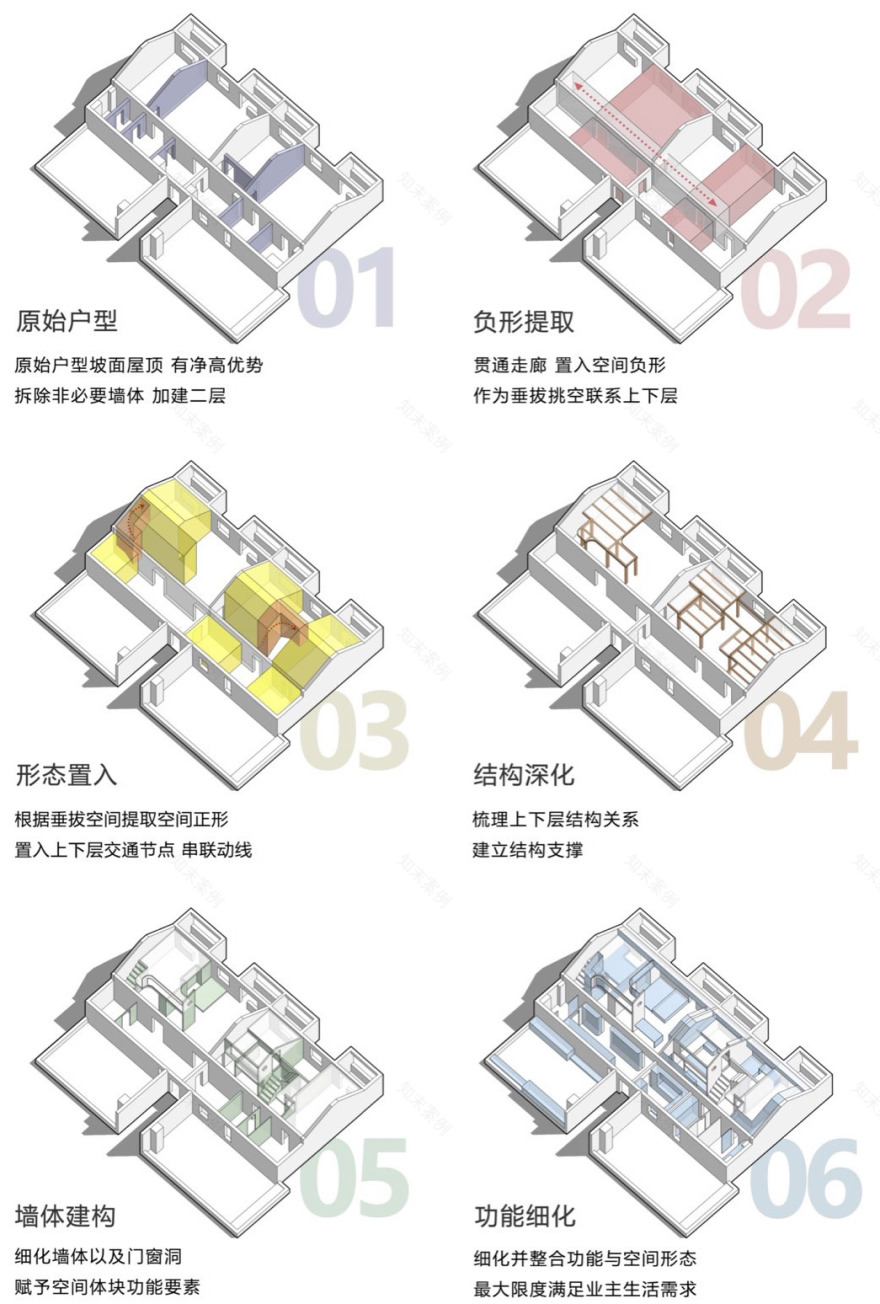
When thinking about the construction of the house, we believe that the hutongs and alleys in old Beijing are good construction archetype. In the street and alley there locate all sorts of well-arranged houses. Streets, alleys, and building groups are interdependent. So, we endow this house a new inward-looking urban concept.
▼客厅,Living area © ACT STUDIO


室内胡同 Indoor Alley
通过梳理功能、动线和类型后,在内向的房屋体空间中,顺势做了三组建筑群,分别赋予了不同的拓扑形变,形成丰富的场景组合。这像极了微缩的城市街道,也让它具有一定的地域性生活意向。比如在胡同里穿梭,在大树下乘凉,坐在长椅上看书,三五好友一起上房揭瓦,站在屋顶上眺望远方等。将北京胡同的生活特色,街坊邻里关系,内外关系,场所记忆都分别进行了现代性的空间转译。让城市记忆嵌套在这栋房子之中,同时赋予更适合当代人的生活方式。室内亦可以成为一个崭新的现代胡同。
▼轴测分析图,Axonometric analysis diagram ©戏构建筑设计工作室

After we sort out the functions, moving lines, and types, three groups of buildings will be built in the inward-looking space of the house. Each with different topological deformations, forming a rich combination of scenes. This design makes the house look very like a miniature urban street, and also gives the house a certain regional living preference. For example, shuttling through alleys, enjoying the cool under the big tree, sitting on bench and reading books, having three or five friends go up to the house together to uncover tiles, standing on the roof and gazing into the distance, and so on. The living characteristics, neighborhood relationships, internal and external relationships, and place memories of Beijing Hutong have been respectively spatially translated modernly, making the city memories nested into the house, and endowing it with a lifestyle more suitable for contemporary people as well.And the interior space can also be designed as a new modern alley.
▼走廊,Hallway © ACT STUDIO

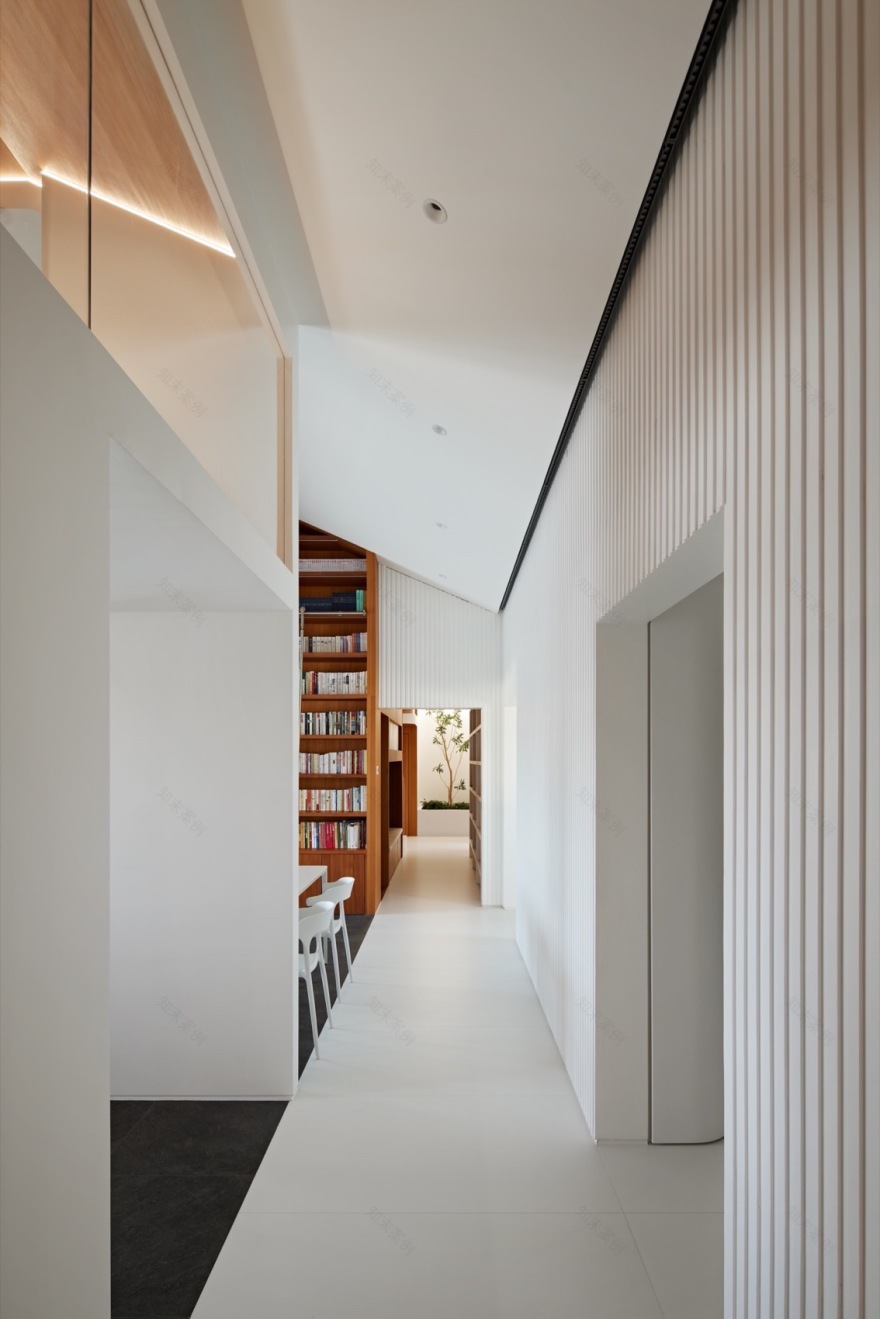
▼微缩的城市街道,Miniature city streets © ACT STUDIO


▼跃层,Two-Story Loft House © ACT STUDIO

广场与戏台 Square and Stage
进入空间看到第一组坡屋顶意向的建筑物,阁楼与客厅相连,是内化的城市广场。在中国传统巷弄里戏台通常伴随着广场、厅堂、露台的形式呈现。是民众生活的重要组成部分。在思考这栋内向建筑物的空间关系时,认为“舞台感”的呈现尤为重要,它可以形成整栋房子的精神核心。让看与被看,演者与听者之间的关系,更紧密的联系在一起。
Entering the space, habitants can see the first group of buildings with sloping roofs. The attic is connected to the living room, forming an internalized urban square. In traditional Chinese alleys, stages are usually presented along with squares, halls, and terraces. And alleys are the important components of people’s lives. When considering the spatial relationship of this inward-looking building, we believe that the presentation of “Sense of Stage”is particularly important as it can form the spiritual core of the entire house, which makes the relationships between seeing and being seen, performers and listeners, be more closely linked together.
▼阁楼与客厅相连,The attic is connected to the living room © ACT STUDIO
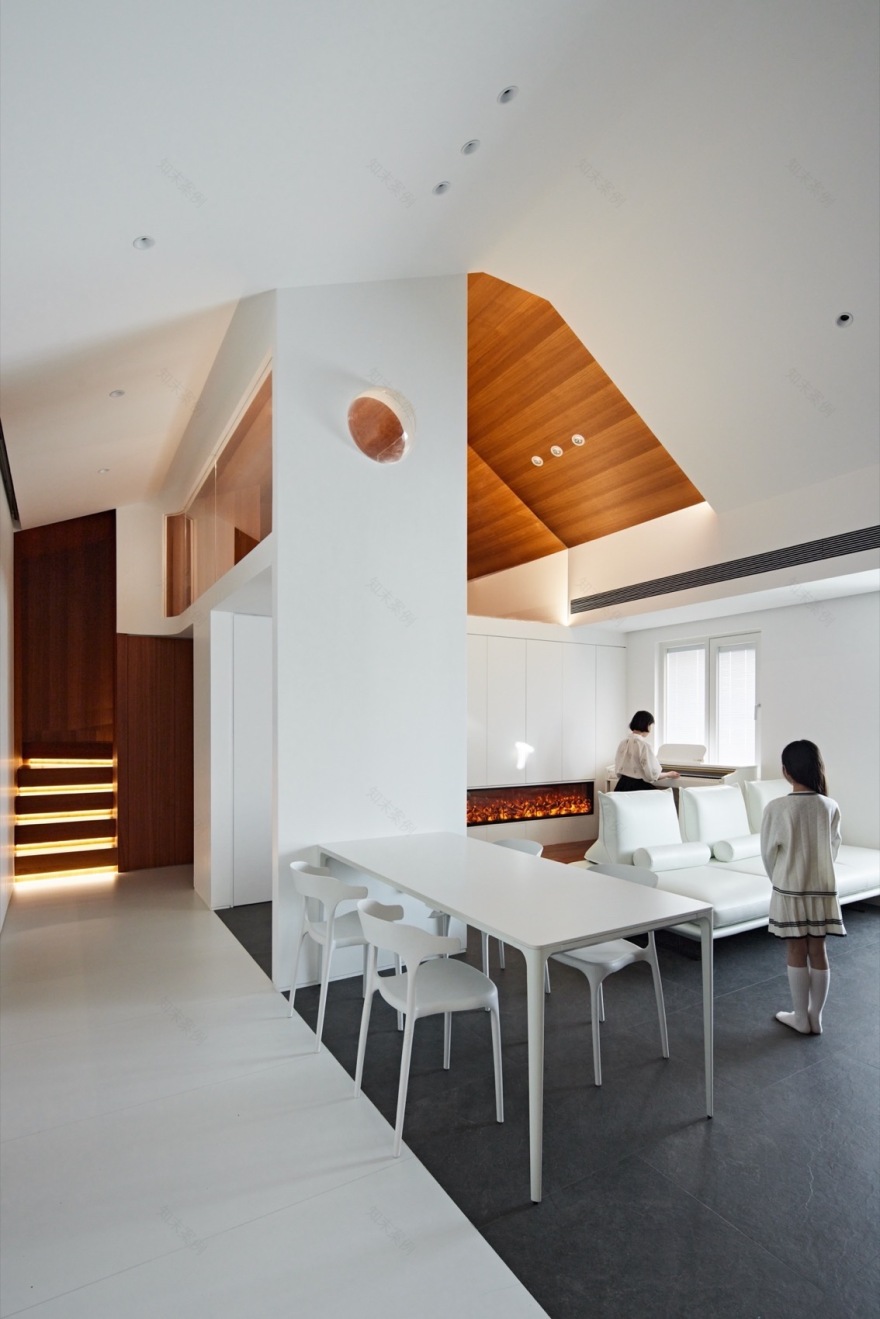
▼钢琴和壁炉融合为一个中心舞台, The piano and fireplace are combined as a central stage © ACT STUDIO


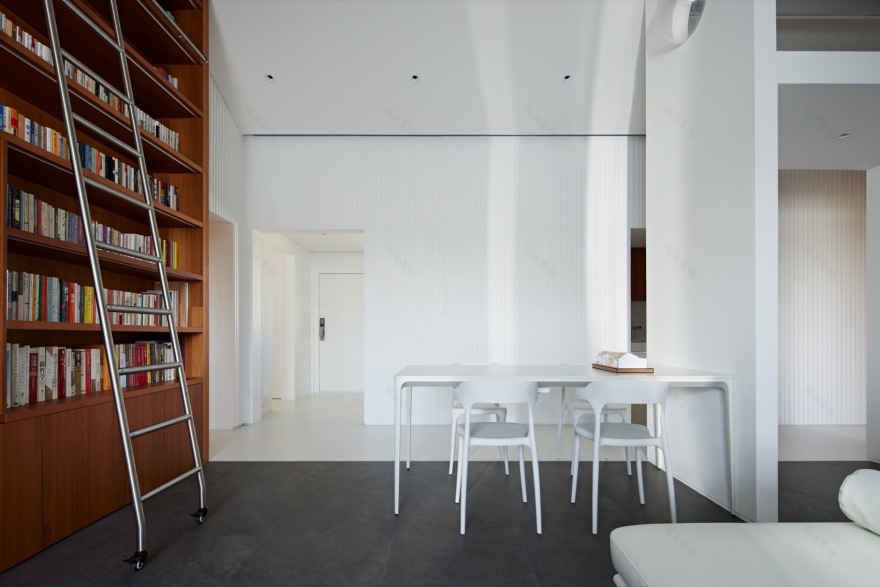
钢琴和壁炉融合为一个中心舞台,宁静悠扬的声音响彻周围。整体建筑空间组织围绕着舞台展开,舞台作为带动空间形态产生多种观看角度,环绕、俯视、框景、对望等,场景与场景之间相互渗,形成场所感。餐厅、客厅、舞台、书墙四个功能区沿着南侧光源方向一次排布,深灰色的地面砂岩,让户外粗旷的质感与内部纯净的界面形成对比。
The piano and fireplace are combined as a central stage, making the peaceful and dulcet melodies echo around the house. The organization of the overall architectural space is unfolded around the stage. As a driving force for the spatial form, stage can generate various viewing angles such as surround view, quarter view, frame view, staring view, and etc, making scenes permeate with each other, and forming a sense of place. The four functional areas, including the dining hall, living room, stage, and book wall are arranged in sequence along the direction of the south light source. The dark gray sandstone on the floor makes a contrast between the rough texture of the outdoor area and the pure interface of the interior space.
▼书墙,Bookshelves wall © ACT STUDIO

▼细部,Details © ACT STUDIO


向上的延展 Upward Extension
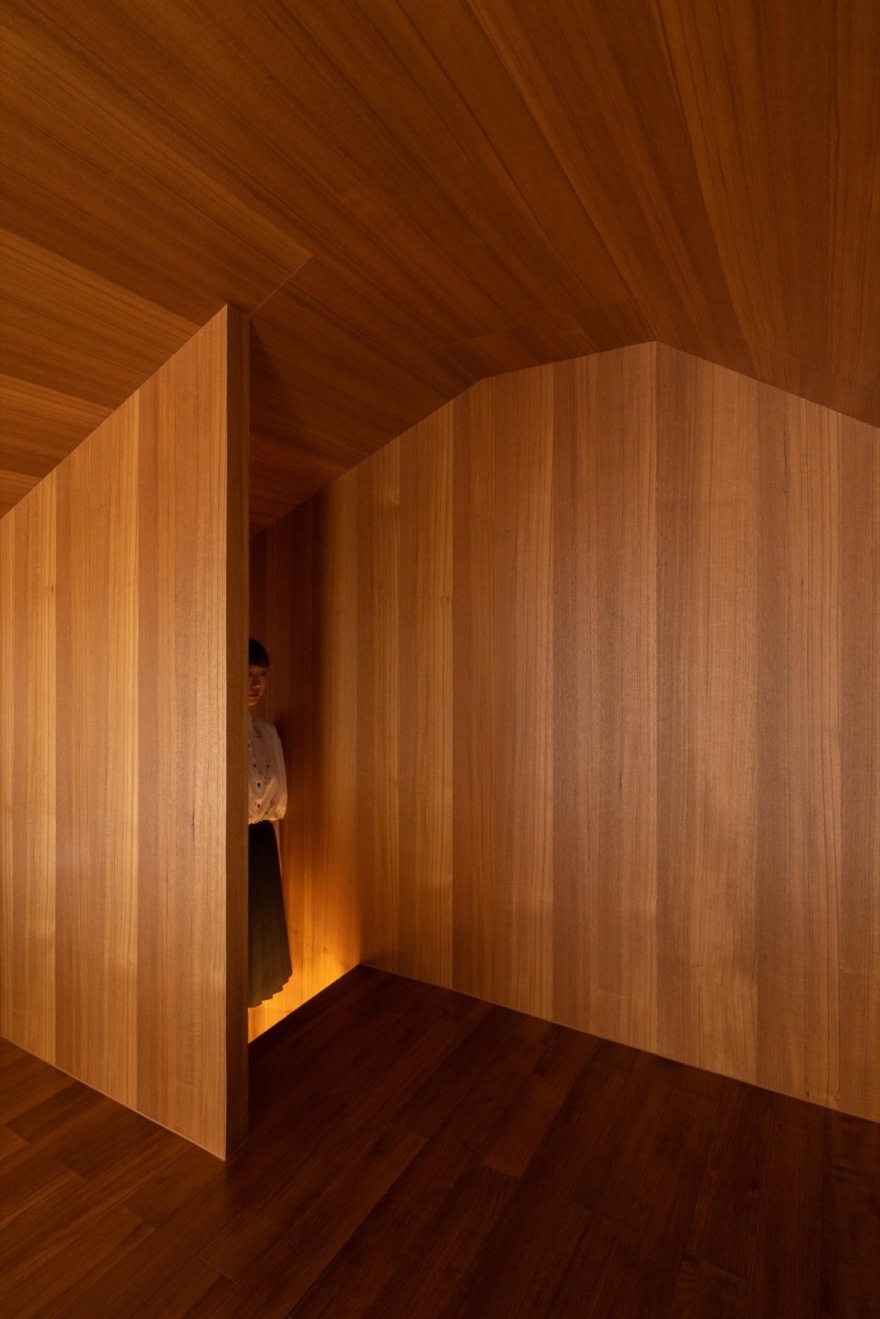
楼梯是胡同的尽头,也是进入屋顶阁楼的向上通道。柚木饰面完全包裹,延伸到顶部,营造出小木屋的结构形态。楼梯内是L型的拐角空间,光悬浮于踏步之间,通过空间的挤压收缩后,人们进入带有神秘感的阁楼空间。
The staircase is the end of the alley, and also the upward passage into the rooftop attic. The teak veneer wraps the staircase completely, and extends to the top, creating the structural form of a small wooden house. Inside the staircase is an L-shaped corner space. Light strips are installed between the stair steps. Through the compression and contraction of space, people are led into the mysterious attic space.
▼楼梯,The staircase © ACT STUDIO


房阁 House Attic
阁作为中国传统建筑形式之一,以游憩、远眺、观景之用。上到第一组建筑物的阁楼空间,是一个相对低矮尺度的。木屋顶与木地板材质遥相呼应,人在自然中悠然休憩。而映入眼帘的却是极为现代的玻璃曲线,光勾勒着结构清晰可见。圆洞气泡窗,连接着内部与外部,充满趣味和活力,亦可远眺互观。
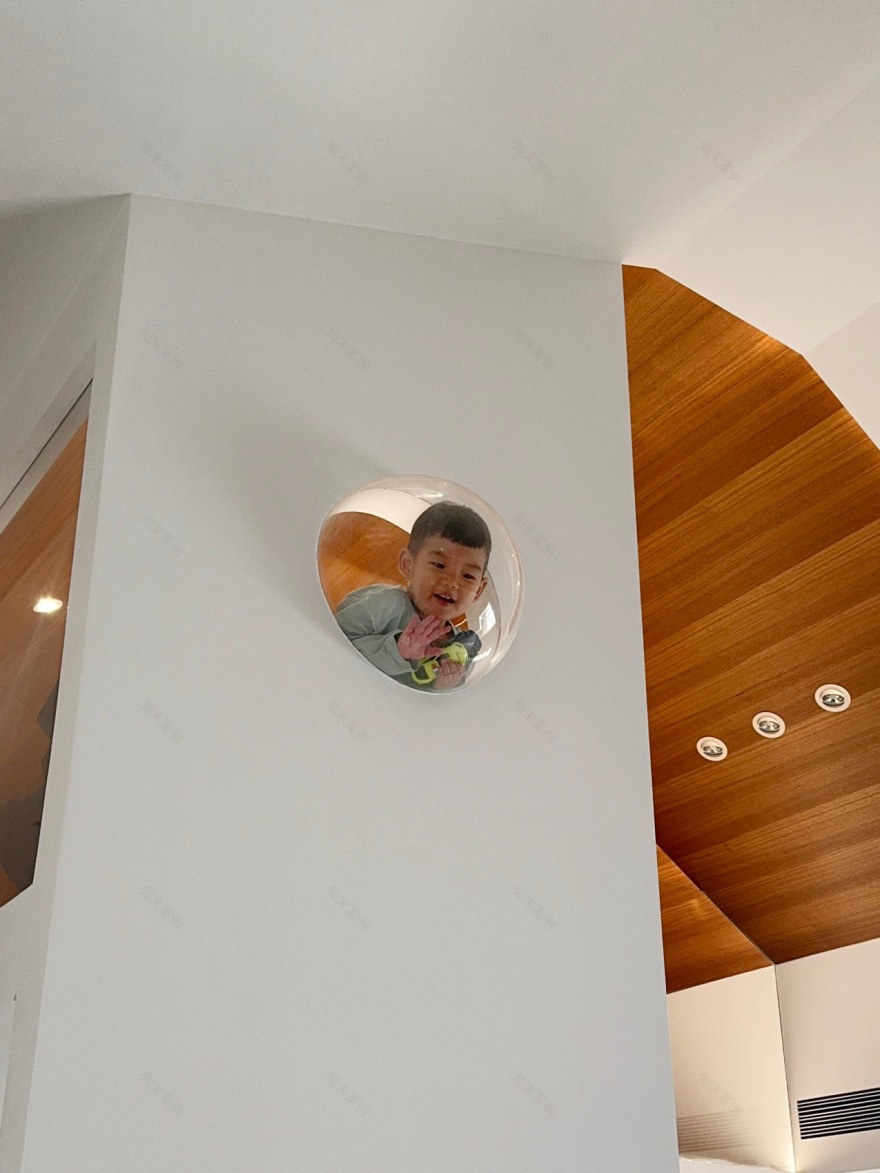
As one of the traditional forms of Chinese architectures, attic is used for recreation, distant viewing, and sightseeing. In the attic space of the first building group, there is a relatively low storey height.The wooden roof and wooden floor materials complement each other, allowing habitants to rest leisurely and naturally.When habitants enter into the attic, what catches their eye is the extremely modern glass curve, whose structure is clearly visible under the light. The bubble window with the shape of a round hole connects the interior space and exterior space, which fills the attic with fun and vitality, and makes it possible for habitants to look into the distance, and go sightseeing.
▼阁作,The attic © ACT STUDIO

▼阁楼与客厅空间联系紧密, The attic is closely linked to the living room space © ACT STUDIO


▼无边框曲面玻璃扶手,Bezel-free curved glass handrails © ACT STUDIO

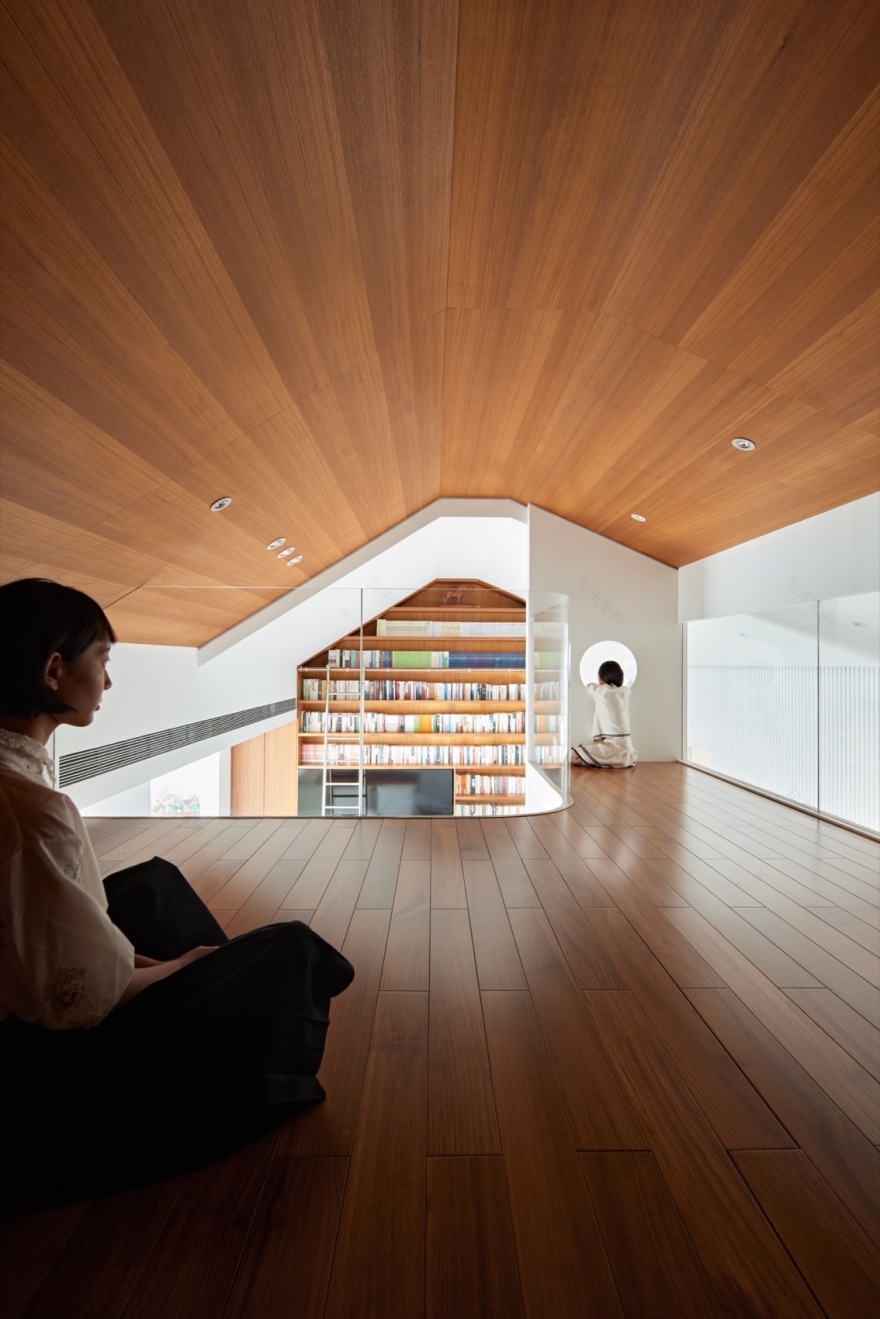
▼灯光效果,Lighting design © ACT STUDIO

▼圆洞气泡窗,The bubble window with the shape of a round hole © ACT STUDIO
树和长椅 Tree and Bench
胡同作百姓们出入家门的通道,也是人们将生活空间由“屋内”延展到“屋外”,从“小家”延伸到“大家”,的一种共享的生活模式。室内中的胡同也同样起到了各房间联通的作用,在内与外之间产生着微妙的互动关系。孩童们其中穿梭嬉戏,房间与房间之间相互窥望。饭后人们在屋檐和树下纳凉,“树”成为了生活中重要的组成部分和符号象征。通过纵向的格栅墙贯通街巷两端,起到了低空间延展视觉高度的作用。
南京喵熊网络科技有限公司 苏ICP备18050492号-4知末 © 2018—2020 . All photos and trademark graphics are copyrighted by their owners.增值电信业务经营许可证(ICP)苏B2-20201444 苏公网安备 32011302321234号
苏公网安备 32011302321234号客服
消息
收藏
下载
最近