

创作上传
VIP
收藏下载
登录 | 注册有礼
查看完整案例

收藏

下载

分享
该场地位于日本静冈县富士宫市,原计划用作起重机工厂工人的休息场所和办公室。在晴朗的日子里,富士山的美景尽收眼底,但散落的房屋遮挡了富士山的全景。站在场地上环顾四周,可以看到场地位于城市化区域,周围是工厂、起重机、停车场、邻近的房屋及其田地和其他杂物。
The site is located in Fujinomiya, Shizuoka Prefecture. The site was intended to serve as a resting place and office for the workers of a crane factory. Fuji on a clear day, but the scattered houses blocked the panoramic view of the mountain. Standing on the site and looking around, one can see that the site is located in an urbanization control area and is surrounded by factories, cranes, parking lots, neighboring houses and their fields, and other clutter.
▼项目及后方的富士山,project and fuji mountain©Naoki Masumoto

工厂、起重机、停车场、邻近的房屋及其田地等等,杂乱无章,难以捉摸。在参观过几次场地之后,建筑师了解了这片区域的特征以及现有的办公空间是如何被使用的。在与客户和在这里工作的人们的对话中,建筑师决定了一系列政策,以决定在这里建造什么样的建筑。
・ 从危险的工厂环境中解脱出来,创造一个明亮柔和的场所。
・ 在更广阔的环境中,让人感受到自己身处什么样的地方。
・ 在面积有限的情况下,创造一个既有个人空间又有聚会空间的环境。
・ 最大限度地利用朝西的开口。
・ 充分利用客户在外立面设计方面的技能。
▼草图,sketches©Fukei


The view is cluttered and elusive, with factories, cranes, parking lots, neighboring houses and their fields, and so on. After visiting the site several times, we learned a lot about the character of this place and and how the existing office space is used. In dialogue with the client and the people who work there, we decided on a number of policies to guide us in deciding what kind of architecture should be built here.
・To create a place with a bright and soft texture, detached from the hazardous factory environment.
・To create a sense of what kind of place you are in, in a wider environment.
・To create an environment that allows for both individual space and gathering space, even with limited floor space.
・Maximize the use of the west-facing opening.
・To utilize the client’s skills in the design of the facade.
▼项目外观,project exterior©Naoki Masumoto
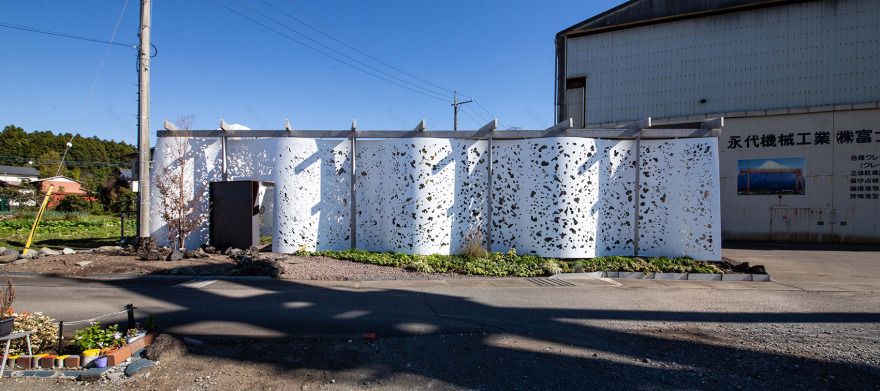
设计的目的是创造一处场所,在这里工人们可以短暂的放松身心,同时让光线进入室内,与周围环境断绝联系,重新与富士山的空气建立联系。
We aimed to create a place where craftsmen could relax their bodies and minds for a moment, while letting in light, disconnecting from the surrounding environment, and reconnecting with the air of Fuji.
▼让光线进入室内,letting in light©Naoki Masumoto
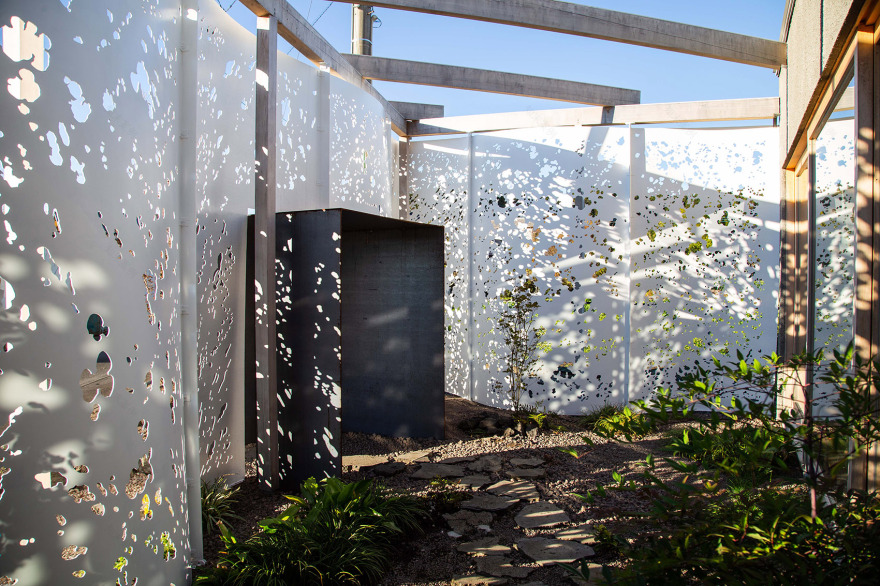
切断视野改变光线
Cutting off the view and changing the light
由于场地位于受控制的城市化区域,在规划时,该建筑的重建规模必须与原建筑相同。由此建筑师设计了一个合理的长方形平面,在场地前和道路中间的西侧三角形地块被改造成一块花园。花园由凉棚和多孔玻璃钢板围成,最大限度地增加了采光,同时将花园与杂乱的景观隔开。室内的区域被分成渐进的条状,从花园到休息区,办公室,运输线路到后院。除了落地窗和天窗,唯一的开口是用于从办公空间向工匠传递工具和其他物品的小窗,从室内向外望的视野也是经过精心挑选的。由于西侧的花园和天窗,进入室内空间的光线全天都在变化。在早晨, 光线从天窗的角度射入,下午,光线穿过面板射入室内。
Because of its location in an urbanization control area, the building was planned under the restriction that it be reconstructed on the same scale as the original. A rational rectangular plan was planned, and the western triangle between the front of the site and the road was made into a garden. The garden is enclosed by a pergola and porous FRP panels to maximize light while separating it from the cluttered landscape. The interior zoning is arranged in a gradational strip shape, from the garden to the break area, the office, the traffic line, and the back yard. The only openings other than the full-length windows and the top light are the small windows for passing tools and other items from the office space to the craftsmen, and the views from the interior were carefully selected. The light entering the interior space changes throughout the day due to the west-facing garden and the top light. In the morning, the light comes in at an angle from the top light, and in the afternoon, light passing through the panels comes into the interior.
▼建筑入口,building entrance ©Naoki Masumoto

▼临街界面,street level interface ©Naoki Masumoto

▼内部空间,interior space ©Naoki Masumoto

▼天窗及落地窗,skylight and picture window ©Naoki Masumoto

▼天窗引入自然光线,skylight bring the light in ©Naoki Masumoto
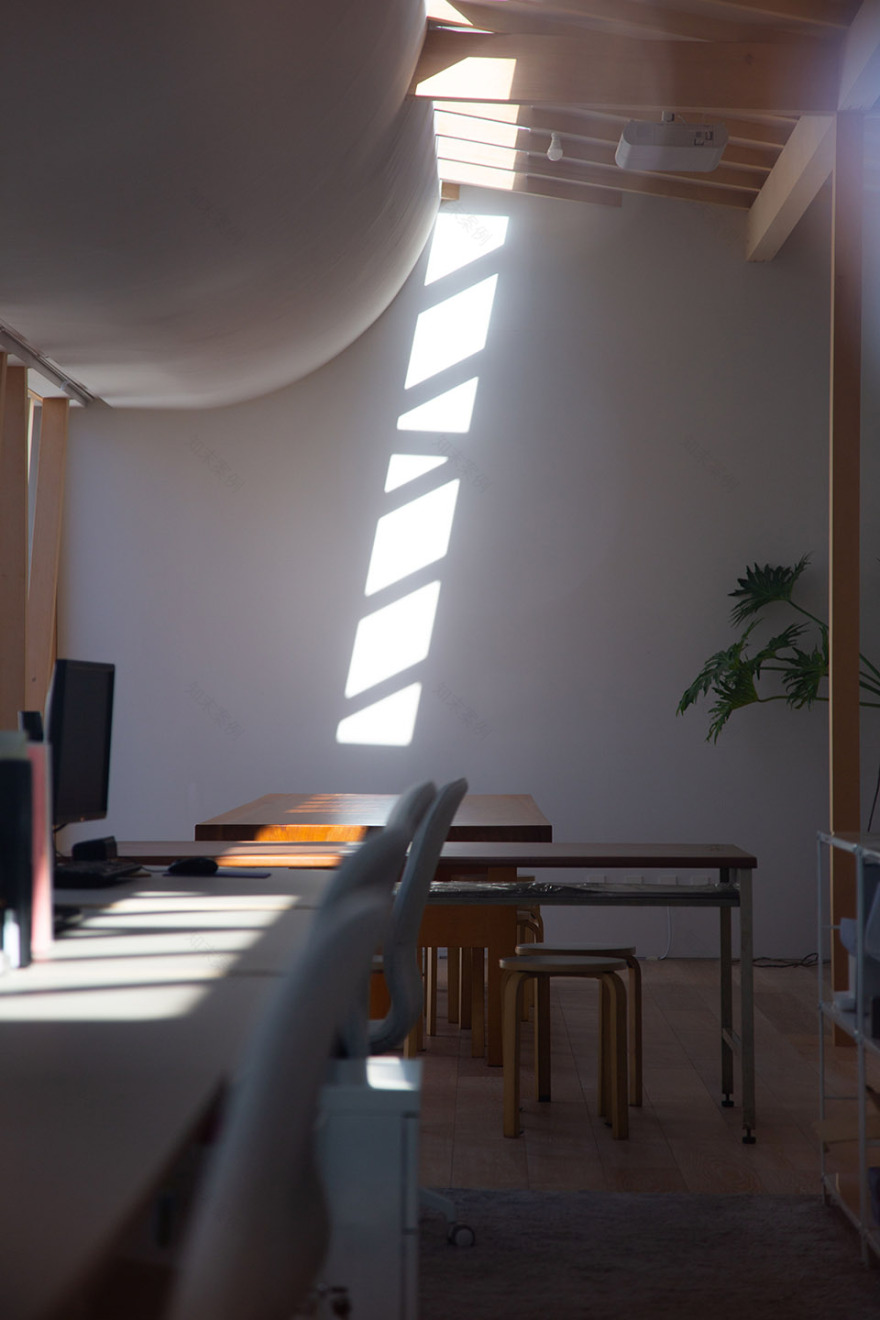

▼天窗细部,skylight detail ©Naoki Masumoto

富士山脚下的建筑
Architecture at the foot of Mt.Fuji
当环绕场地时,建筑师注意到一堆黑色的石头杂乱无章地堆在一个废木料场里。环顾四周,建筑师发现在周围的建筑庭院中躺着类似的石头,它是 300 多年前富士山熔岩冷却后凝固而成的。
While walking around the site, we noticed a pile of pitch-black rocks haphazardly piled up in a scrap wood yard. Looking around, we found similar rocks lying in the yards of the surrounding houses, which had been solidified by the cooling of Fuji’s lava over 300 years ago.
▼内部空间的光影效果,light and shadow effects in interior spaces©Naoki Masumoto

当建筑师将石头砸开时发现,在美丽的蓝灰色表面上有一个冷却硬化的气泡图案。该图案充满变化且非常生动:一些看起来像是在奔流,还有一些就像大量气泡升起并释放到空气中的瞬间,还有一些就像大大小小的气泡散落一地。建筑师被这些图案深深吸引,它们似乎仍蕴含着岩浆的生命力。
When we cracked it open, we found a pattern of bubbles that had cooled and hardened on a beautiful bluish-gray surface. The patterns were very varied and telling: some seemed to flow vigorously, others were like the moment when a large number of bubbles rose up and were released into the atmosphere, and still others were like a scattering of bubbles large and small. We were fascinated by the patterns, which seemed to contain the life force of the magma.
▼来自火山岩内部结构的灵感,inspired by the rock pattern ©Naoki Masumoto

▼光影细部,light and shadow detail ©Naoki Masumoto

花园被圆角的玻璃纤维钢板(FRP )包围。客户不仅拥有起重机,还掌握了特殊的玻璃钢成型技术,通过将一个上下两面具有不同弧度的模具组合在一起并将其翻转,实现了类似裙摆的形状。玻璃钢面板是通过使用熔岩横截面制作的模板,在现场将几种图案组合在一起安装到面板上的。工厂工人在工作间隙根据图纸钻孔。他们在钢材上的工作通常都非常精确,因此在玻璃钢上按图钻孔也不成问题,不会出现任何偏差。破碎的石头成了花园里的垫脚石。封闭式花园的内部种植了当地的山石、蕨类植物、松树和其他自古以来就生长在富士山上的植物,力图打造一个移植富士山环境的花园。朝西的花园在午后会受到强烈的光照,但通过这些多孔板,花园和窗边就会形成柔和的光池,就像阳光透过树木一样。当无数的熔岩光粒洒满整个空间时,这里将再次成为富士山的一部分。
The garden is surrounded by FRP panels with cubic curves. The client has not only a crane but also special FRP molding skills, and the skirt drape-like shape was realized by combining one mold with different curvatures on the upper and lower sides and flipping it upside down. The FRP panels were fitted to the panels by combining several patterns on site, using a template made from a cross-section of the lava rock. The factory workers drilled the holes in between jobs according to the drafts. They usually work with great precision on steel, so it was no problem for them to drill holes in the FRP according to the draft without any deviations. The broken rocks became stepping stones in the garden. The interior of the enclosed garden was planted with local mountain gravel, ferns, pine trees, and other plants that have been native to Fuji since ancient times, in an attempt to create a garden that is a transplant of the Fuji environment. The west-facing garden receives strong light in the afternoon, but through these porous panels, soft pools of light like sunlight filtering through trees are created in the garden and by the windows. When countless grains of lava light fill the space, this place will once again become a part of the foot of Mt.Fuji.
▼夜景,night view©Naoki Masumoto

▼场地区位,site map©Fukei

▼场地平面,site plan©Fukei

▼平面,plan©Fukei

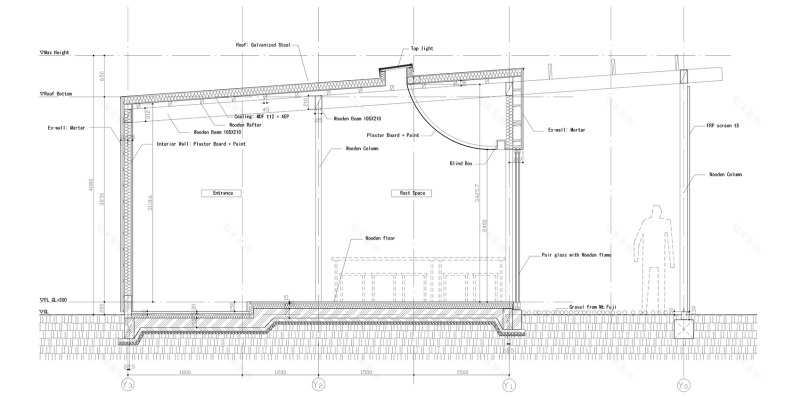
▼剖面图,section ©Fukei
▼爆炸图,exploded drawing©Fukei

Project Name: 富士山脚花园 Fuji Skirt
Place: Fujinomiya. Shizuoka, Japan
Project duration: 2019 – 2021
GFA: 96 ㎡
Firm: 景观研究所 Fukei
Lead architect: 大島碧 Midori Oshima, 小松大祐 Daisuke Komatsu
Structure Designer:MOF
Landscape architect: AOI Landscape
Photo credit: Naoki Masumoto


南京喵熊网络科技有限公司 苏ICP备18050492号-4知末 © 2018—2020 . All photos and trademark graphics are copyrighted by their owners.增值电信业务经营许可证(ICP)苏B2-20201444 苏公网安备 32011302321234号
苏公网安备 32011302321234号客服
消息
收藏
下载
最近