

创作上传
VIP
收藏下载
登录 | 注册有礼
查看完整案例

收藏

下载

分享
住宅E项目包括一栋住宅和一个凉亭,凉亭以前是私人的办公空间。两栋立方体的建筑通过地下的隧道连接,创造了一个迷人的建筑群。
House E consists of a residential building and a pavilion, which is used as a private office area. The cubic buildings are connected to one another by an underground tunnel and create a charming ensemble.
▼项目概览,overview of the project ©Thomas Herrman

该建筑从邻近的街道拔地而起,高约3 米,形成了一个花园台地,建筑物就位于该台地上。建筑之间的位置关系分割了台地上的室外空间,并确定了清晰的边缘。
The property rises up 3 meters from the adjacent street and forms a garden plateau, on which the buildings have been positioned. The position of the buildings in relation to one another divides up the outdoor spaces on the plateau and defines clear edges.
▼周围环境,surroundings ©Thomas Herrmann
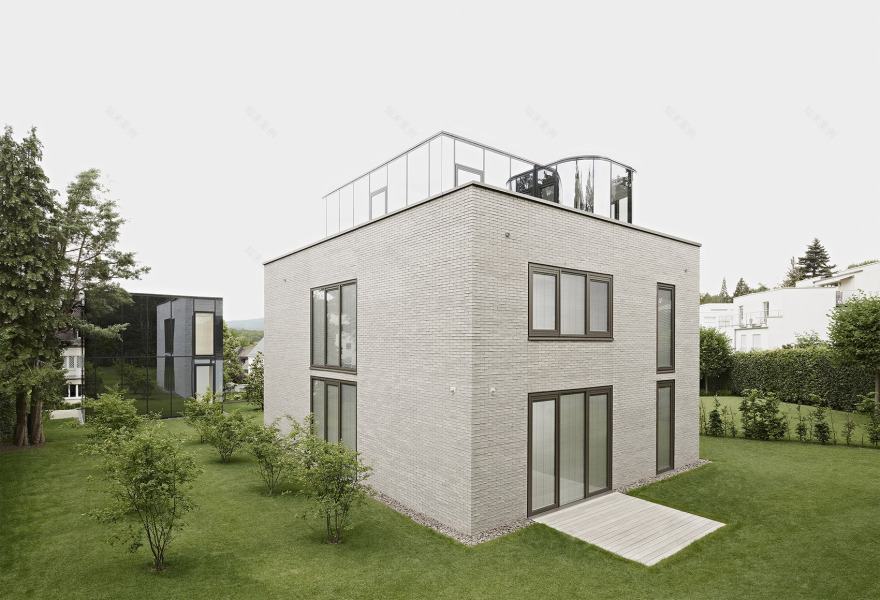
▼景观台地,landscape plateau©Thomas Herrmann

住宅建筑的外立面由浅灰色的砖块构成,而凉亭的整个体量都被玻璃包裹。引人注目的玻璃立方体表面吸收了天空中不断变化的光线和周围的环境。根据人视角的变化、时间和天气条件,玻璃立面不断发生改变,对周围的环境作出反应。就像住宅顶层的镜面体量,也因反射与天空融为一体。
The residential building has a façade of bricks in a muted grey colour, and the pavilion is mirrored over its full surface. The striking glass cube absorbs the changing light of the sky and the surrounding area. Depending on your perspective, the time of day and the weather conditions, it changes its appearance, and its façade reacts to its surroundings. Just like the mirrored top floor of the residential building, which merges with the sky due to the reflections.
▼建筑外观,building exterior ©Thomas Herrmann

对于天然材料的使用,如砖块、木材和天然石材,则与玻璃的反射外立面形成一种令人惊叹的对比。
The use of natural materials such as bricks, wood and natural stone creates an exciting contrast with the reflective glass surfaces.
▼形成鲜明对比的材料运用,the exciting contrast between materials ©Thomas Herrmann

▼顶层的镜面外立面,reflective glass surfaces on the top floor ©Thomas Herrmann

住宅建筑的内部空间通过清晰的视觉轴线和居住者的活动流线界定。建筑的核心是带中央楼梯的入口大厅。客厅位于大厅的一侧。顶层为休息区域,开放的卫生间和更衣室。顶层通过独立的半旋转楼梯进入,这意味着该区域被视为“屋中屋”,具有很高的私密性。反光立面的主题也延续进顶楼的室内。橱柜和房间门的镜面材质使空间看起来更大更宽敞。
The interior of the residential building is defined by a clear guidance of visual axes and axes of movement. In the centre of the building is the entrance hall with a centrally positioned staircase.
The living spaces are located to the side of the hall. The sleeping area, with an open-plan bathroom and a dressing room, is on the top floor. The top floor is accessed via a separate half-spiral staircase, which means that this area is experienced as a “house in the house” and has a high degree of intimacy. The theme of the reflective surfaces is also consistently continued inside the top floor. Mirroring over the full surface of the cupboard and room doors makes the rooms appear large and spacious.
▼入口大厅,entrance hall©Thomas Herrmann

▼入口大厅的中央楼梯,the central staircase in the entrance hall ©Thomas Herrmann

▼走廊,corridor ©Thomas Herrmann

▼工作室,workshop ©Thomas Herrmann


▼洗手台,vanity unit ©Thomas Herrmann

▼半旋转楼梯,half-spiral staircase ©Thomas Herrmann
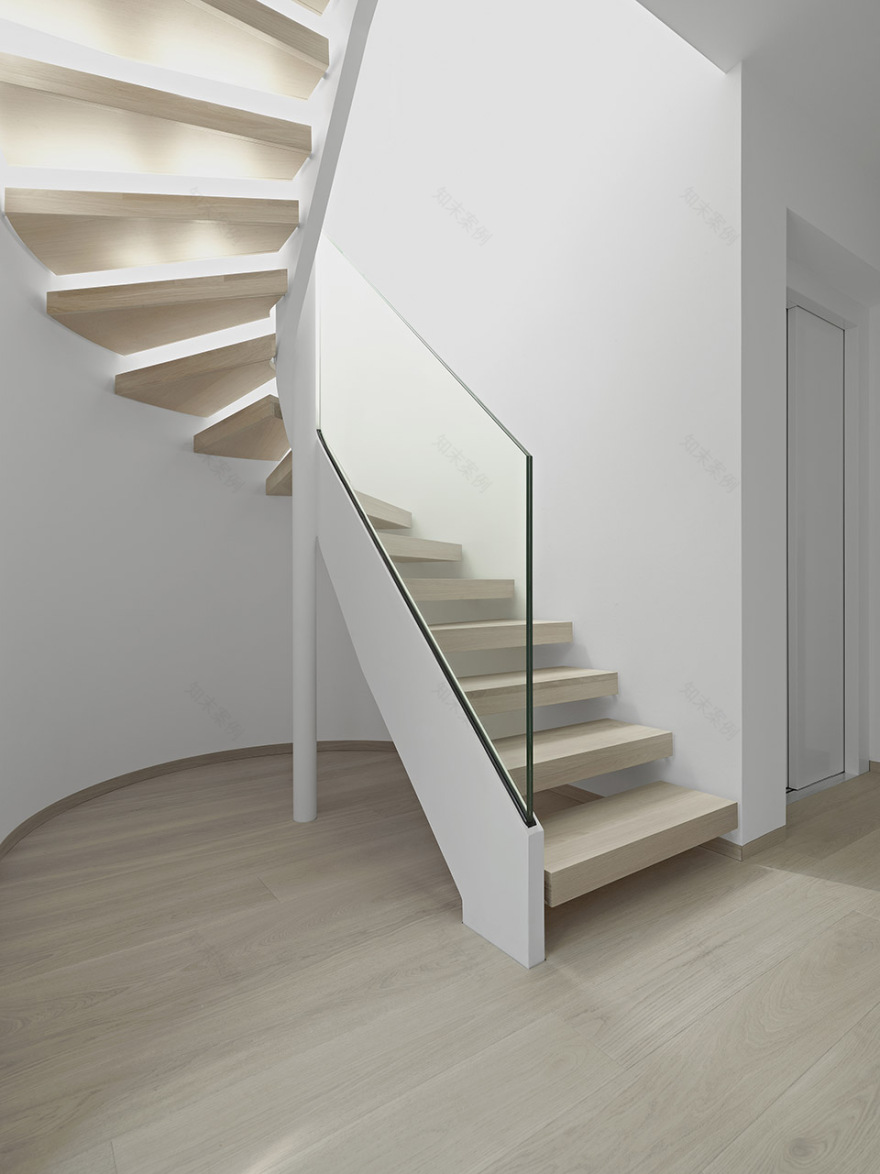
▼地下走廊,underground hallway ©Thomas Herrmann

这栋建筑特意展现了室内流线,建筑内外的景观,视觉轴线和镜面效果。
The buildings deliberately showcase internal routes, views through the building and to the outside, visual axes and mirror effects.
▼夜景,night view ©Thomas Herrmann

▼剖面,section ©CHRIST.CHRIST. associated architects GmbH

Project Name:House E
Architecture Firm: CHRIST.CHRIST. associated architects GmbH
Website:
Firm Location: Parkstraße 75 | 65191 Wiesbaden
Photography:Thomas Herrmann | Stuttgart
Client:private
Project Location:Wiesbaden | Germany
Procedure Type:Direct Commission
Team:Roger Christ I Christiane Bolesta
Plot size:1.148 m²
Living area:447 m²
Built area:726 m²
Project start: 2015
Completion: 2019
Materials and surfaces:muted grey colored brick | mirrored glass | wood
Awards:The International Architecture Award 2020 | Iconic Awards 2020 – Selection
南京喵熊网络科技有限公司 苏ICP备18050492号-4知末 © 2018—2020 . All photos and trademark graphics are copyrighted by their owners.增值电信业务经营许可证(ICP)苏B2-20201444 苏公网安备 32011302321234号
苏公网安备 32011302321234号客服
消息
收藏
下载
最近