

创作上传
VIP
收藏下载
登录 | 注册有礼
查看完整案例

收藏

下载

分享
期待做得更好,期待助您一臂之力。
(the interview is only in Chinese)
▼项目概览 – 资江边的几何大地景观,Overall of the project – Geometric Geodesic Landscapes by the Zi River © 存在建筑

▼自然风景,植物,空间,材料形成一个整体,Natural landscapes, plants, spaces, and materials form a whole. © 存在建筑

▼文化形式作为“空间材料”, Cultural forms as “spatial materials” © 存在建筑

▼朝向自然与城市空间的聚落入口,Entrance of the settlement towards nature and urban space © 存在建筑

▼巨大的混凝土体插入建筑聚落,Huge concrete bodies inserted into building colonies © 存在建筑

设计师会员回访
1.从接到项目到完成设计概念,再到项目实际落成共用了多长时间?在之前的采访中,您们提到会在施工中对材料的地域化做法进行调整,具体做了哪些调整?
对于材料,一开始我们并没有特别的选择,但在考察的过程中,业主对我们提出了希望以原始的材料表达茶庄氛围的诉求。因此,我们将这些诉求考虑到了设计中,不同材料结合在一起,与当地的感觉和谐相融,并带来了勃勃生机。此外,不同材料斑驳的拼接痕迹最终也带来了自然的视觉效果,反而使建筑与环境融合。茶叶元素、当地文化,以及当地的地质特征,在建筑中有所反映,我们自己从中也得到了新的启发。项目的场地不在城市里,但也不是纯粹的乡村,我们的设计准确的表达了这种乡土和城市共存的气质。
李汶翰:从材料的角度上来说,这个项目对我们来说是一次挺好的学习,也吸收了很多甲方的想法。开始的时候我们用的材料比较常规,更保险、克制一些。在现场,甲方给我们讲述了好多茶的工艺,也看到了很多乡土的材料,因此我们的心态也更放开了一些。比如,一开始我们担心“茶砖”可能会有点太装饰化了,后来我们去到当地看到很多民间的房子也会用到很多跟茶叶有关的材料,这是挺有意思的一件事。
常可:最早我们希望整个建筑都采用水磨石,然后针对每个馆对茶的特色进行诠释,但后来发现当地的工艺无法达到我们理想中的状态。反而一些我们曾经觉得很廉价的建筑材料,比如蘑菇石等,最终却意外地达到了一种新的、很好的效果。
这给了我们一个启发,就是:有的时候甲方提了一些要求,也不一定都是坏事,他可能对当地的工艺和民俗更加了解。与其强制他,必须按你的想法去做,不如将大家的想法融合变通,探索出一种更有意思的方式。将业主的需求,内化到建筑里,然后再把它表达出来,这是我们在该项目中比较核心的设计策略。
2.与2021年相比,在项目落成后,您们对于“生产性的景观”的理解有什么拓展?总结出了什么经验?
常可:项目的初衷是建造一座具有展览性质的茶厂。在和业主的探讨中,他也表达了他想做的东西就不是一个真正的生产性的茶厂,而是将生产过程、包装过程,到最后成品都展示在人们眼前,挖掘出茶在整个生产过程中的全部价值,体现出真正的茶文化。
因此,我们也希望用建筑空间的形式。把这种生产性文化价值表达出来,并让它成为城市当中的景观。“生产性的景观”,表达的是如何将工厂做成城市当中的文化建筑的理念,所以落成后的茶厂更像一座城市当中的博物馆,或者文化中心,但同时它还是一个真正生产进行茶叶包装制作的工厂。将生产、文化、景观,以及城市放在同一个项目当中探讨,对我们自己来讲也特别有意思。通过不同功能之间的杂交与演化,产生新的模式,这也是我们事务所一贯想要探索的。
在工业用地上,以工厂的形式为城市或区域贡献一处大尺度景观或者更具有城市价值的东西,这是很有意义的。现在很多工厂也都具有这种去挖掘其城市性意义的潜力,同样能够为人们带来文化体验。我们也希望能够看到社会中这种更自由、民主化的文化融合。
3.这个项目在设计阶段和施工阶段都遇到过哪些挑战?项目落成后的效果与团队最初预想的是否一致?
李汶翰:项目之初,我们就被这种先进的理念所打动。与典型的博物馆相比,茶博物馆工厂的模式完全不同,这种动态模式也激发了我们的设计灵感。当地几乎家家户户都生产茶叶,展示的意愿也很强烈,所有的茶农都欢迎人们来品茶,告诉人们茶的味道为什么是这样的,是怎么生产出来的。
所以我们相当于把他们习以为常的东西以更建筑学的方式展示出来,以展览将工厂围在中间,人们在参观的过程当中,可以看到茶的生产过程,从视觉、听觉、嗅觉等全方位对安化的黑茶进行了展示。这种核心概念贯穿始终,当然,这个过程当中也融合了甲方一些新的想法,并碰撞出新的火花。
以景观的方式去营造这么一个生产性的场所,也面临了很多挑战。比如对于当地工人来说,这种博物馆级别的建筑中的很多做法并不是常规。在这个过程当中,我们也想了很多方式去配合去施工,除了频繁勘场外,我们还在当地招募了驻场实习生,并尽量去结合当地的工艺,最终得以将我们的想法以及甲方的预期融合在一起,完整地呈现出来。
4.与甲方在项目设计过程中和施工过程中的沟通模式是怎样的,在此期间是否遇到过一些不一样的问题,双方是如何沟通解决的?
常可:在方案的阶段,我们先和甲方深入了解了他对整个项目的需求。因为这个项目是一个完全新的理念,没有任何参考。场地位于安化国家茶叶开发区,紧邻资江江畔,有山有水风景特别好。业主就希望将项目打造成集茶的生产、展示、售卖于一体的工厂,同时兼顾当地的旅游资源,将全部的功能与价值都融合到当中去。
在勘查场地的过程中,业主带我们参观了当地的百年茶厂,将茶产业全部了解了一遍,希望能够通过这个过程启发我们的理解。回程后,我们很快就有了想法,希望将其以艺术化的、巨大的几何体的形式表达出来,以将场地,环境,功能,以及景观视野等诸多的因素综合到表达之中。这也是我们首次对项目进行如此夸张的诠释,业主也觉得这个方案特别好,因此前期非常顺利,之后的深化进程也非常迅速。
场地形态不规则且地形复杂,同时需要融合的功能也非常多,我们在如何使建筑既是一个单体,又能呈现出群落状态上下了很多功夫。方案成型后,后面的施工图阶段也很顺利。
李汶翰:在与甲方沟通方面,我们有一些心得。在前期,建筑师还是需要与甲方进行充分的沟通,面对甲方给出的片段式的意向,建筑师们需要去分析出他内心的需求。
在效果呈现方面,我们认为更直观的呈现方式才能够让甲方更好地理解你的设计。于是我们就构想了新的方式,比如以小动画的形式模拟人在建筑行走的视角,为甲方带来体验感,这样他对设计本身的理解会加深很多。后来我们又引入了 VR设备,将空间的尺度与光线条件真实地模拟出来,进而在前期避免了很多甲方对设计的误解。
常可:总体上我们给甲方呈现的材料是形象而直观的,但实际上我们给他讲的是如何通过流线等要素去实现功能、达成目的,所以甲方的接受度就会比较高,我们想营造的大地景观的理念也融入到了这个过程当中。与业主之间的交流,不仅是一个设计策略,更是一种沟通策略,它可能很大程度上决定了项目最终的呈现。
遇到冲突的时候,我们会从业主的角度,向他讲解我们的宏观目标以及如何在细节上实现这个目标。只有在大目标上达成一直,设计才能顺利进行。很多时候,整体目标不一定是单一的,业主很会有很多不同的目标都要结合进来,这个时候我们就需要做出调整。
以安茶博物馆工场为例,因为建筑本身就呈现出一种比较松散的聚落状态,因此局部的微调,并不会对大目标产生根本性的颠覆,同时也能够吸纳很多不一样的东西进来。这也是业主本来的诉求,他认为黑茶文化本身就是多元的,这种多元性也应该呈现在建筑的设计当中。我们也考虑到了项目未来的发展,使整个结构能够在现有的基础上继续生长。使新结合进来的目标与初始目标达成某种融洽的状态,在实际项目中是非常重要的。在不断的决策与干预过程中,项目在不断进行生长,融入新的可能,这样体现了我们认为的中国建筑的哲学。
5.从设计方的角度来讲,您对本次项目对接的评价如何?
就安茶博物馆工场项目本身而言,我们一直觉虽然由于外部因素的影响,整个项目做的时间比较长,但对于我们来说是一次很好的机会。对于任何一个设计师来说,碰到这样的一个项目,都会觉得它是一种很理想的状态,可以在一个充满茶氛围的环境中去设计一个跟茶有关的建筑。
业主回访
A.您认为本次项目对接最终的成果如何?是否达到了您的预期?期间发生了哪些让您印象深刻的事情?
我觉得整体的感觉还是蛮好的,这个作品的完成度也还算比较高的,可以说成为了我们当地县里面一个小型的地标建筑。整个施工期间,从打桩一直到完善,包括后期装修,我基本上都在工地上。我看到普罗团队是非常负责的,尤其是常可为项目注入了很多心血。安化茶文化艺术馆,整体来说接近了我想要的效果,但是由于建筑的功能分区比较多,最大的遗憾就是没有一个大型的多功能厅。
我们在建筑外观上面的争议还是蛮大的,第一就是我希望在户外平台上增加一个品茶室。第二就是关于外立面,虽然最后施工采用了水刷石,但基本上还原了最初设计图中的效果。第三在内饰上面,内部空间有很多挑高,在材料的衔接设计上还是比较新颖,但是这也增加了我们的成本,后期装修的难度也很大。当然我们也在成本与最终效果中做出了取舍。
假如我还有下一个项目的话,我还是愿意选择普罗。因为,建筑本来就是一门遗憾的艺术,沟通当中会存在争议。设计师可能想要表达建筑的完整性,而作为业主来说,使用功能的科学性可能要大于外观。
项目展示
Project Description
安茶博物馆工场,湖南 / 普罗建筑
ANCHA MUSEUM FACTORY, China by office PROJECT
城市“聚落”
产业能否成为城市文化的新公共空间?
Urban “settlements”
Can industry become a new public space for urban culture?
在中国的县域地带,存在着一种“中间化”的城乡结构。它既不同于以新技术产业作为文化驱动力的大型城市,也不同于纯粹以农业景观作为缓冲区的乡村田野。在这样的区域,大量存在着更为粗暴的城市化现象,其所希望构建的现代城市结构意向,往往无法被相对原始的产业所承载与消化,从而演变成各种具有冲突性的城乡奇观。这种“奇观”,一方面构成了“真实城市”的有趣性,另一方面,这种“中间化”也造成了城市空间发展的不可延续性,阻碍了”具有延续性的地域文化”的形成,从而不断构成无法定义的,空洞化的“千城一面”现象。湖南安化就是这样一个典型的“产业驱动”的县级城市。
In China’s counties, there exists an “intermediate” urban-rural structure. It is different from the large cities with new technology industries as cultural drivers, and from the rural fields with purely agricultural landscapes as buffer zones. In such a region, there is a large number of more brutal urbanization phenomena, and the intention of the modern urban structure it wishes to build is often not carried and digested by the relatively primitive industries, thus evolving into a variety of conflicting urban and rural wonders. This kind of “spectacle”, on the one hand, constitutes the interestingness of the “real city”, on the other hand, this kind of “intermediation” also creates the discontinuity of the urban space development, hindering the “continuity of the territory” and the “continuity of the territory”. On the other hand, this “intermediation” also creates discontinuity in the development of urban space, which hinders the formation of a “regional culture with continuity” and thus constitutes the phenomenon of an undefinable and hollowed-out “one-side-of-a-thousand-cities”. Hunan Anhua is a typical “industry-driven” county-level city.
▼与自然风土融合的建筑界面,An architectural interface that blends with the natural local conditions © 存在建筑

安化县地处资水沿岸,其以安化黑茶而闻名全国,整个县城随着黑茶产业资本的兴盛,城市建设得到长足发展。在县城中心地带,很多高层住宅沿着资江两岸拔地而起,其过去由地域自然山水形势发展出来的城市空间体系慢慢被抹去,形成“无差别”的钢铁森林,过往的城市特点在慢慢消失。
▼安化县的城市现状与产业空间现状,The current status of the city and industrial space in Anhua County © 图片来自于网络

Anhua County is located along the Zishui River, which is famous for its Anhua black tea, the entire county with the flourishing of the black tea industry capital, urban construction has been greatly developed. In the center of the county, a lot of high-rise housing along the banks of the Zijiang River, the past by the region’s natural landscape situation developed by the urban spatial system is slowly being erased, forming a “non-discriminatory” iron and steel forests, the past characteristics of the city is slowly disappearing.
▼错落随机的空间融入自然的城市环境,Staggered and randomized spaces blend into the natural urban environment/photographed by the owner © 业主拍摄

另一方面,在县城与乡镇的交界区域,更多的新开发区,尤其是各种巨大的茶厂在资水边无序生长,有的复制着粗略的文化符号,做成“仿古街”,或者“象形符号”,但是更多的是在珍贵的自然环境中,形成毫无特点的厂房与园区,粗暴的侵蚀着地域空间与文化。这种产业空间形态,亟需得到升级。
On the other hand, in the border area between the county and the township, more new development zones, especially all kinds of huge tea factories are growing in an unorganized way along the Zishui River, and some of them copy the rough cultural symbols and make “imitation of ancient streets” or “hieroglyphic symbols”, but more are in the precious natural environment, forming featureless factories and parks. But more often in the precious natural environment, the formation of featureless factories and parks, rough erosion of regional space and culture. This kind of industrial space pattern needs to be upgraded urgently.
▼生长的自然聚落聚落,Growing natural settlements © 存在建筑

▼利用千两茶的竹编外壳形成震撼的千两茶展示空间,仿佛漫步在一个巨大的千两茶内部,Utilizing the bamboo weaving shell of Thousand-kilo tea to form a stunning Thousand-kilo tea display space, as if walking inside a giant Thousand-kilo tea shell. © 存在建筑
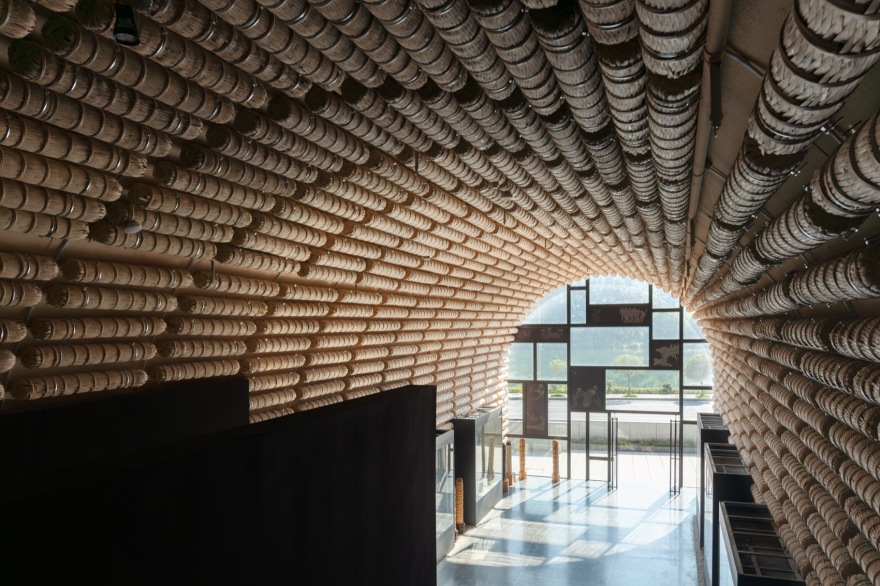
2020年,安化黑茶协会秘书长徐总找到我们,邀请我们在安化黑茶产业园的门户位置,策划并设计一座新型的“博物馆式茶厂”。他希望这座茶厂,不同于传统单一的茶叶生产空间,而是将黑茶的文化,从生产,制作,包装,展示,旅游,教育各个维度,综合起来呈现给社会,形成一种新的空间与社会商业模式。我们一拍即合,接下了这个很特别的项目,并且通过四年时间,从一个概念,落成了一座惊人的建筑,我们将其命名为-安茶博物馆工场。
In 2020, Mr. Xu, the Secretary General of Anhua Black Tea Association, approached us and invited us to plan and design a new type of “museum-style tea factory” at the gateway of Anhua Black Tea Industrial Park. He hoped that this tea factory, unlike the traditional single tea production space, would synthesize the culture of black tea from production, manufacturing, packaging, display, tourism, education, and present it to the society, forming a new space and social business model. We took on this very special project right away, and in four years, from a concept to an amazing building, which we named – An Tea Museum Workshop.
▼场地在地理上与资水的形势关系,Geography of the site in relation to the situation of the capital water © 存在建筑

安茶博物馆工厂基地位于安化黑茶产业开发区的最前端位置,紧邻资水。在这里,震撼的自然山水景观与巨大封闭的产业区形成了鲜明的对比与割裂。
The factory base of Ancha Museum is located in the forefront position of Anhua Black Tea Industrial Development Zone, close to Zishui. Here, the shocking natural landscape and the huge closed industrial area form a sharp contrast and cut-off.
▼山谷中的黑茶产业区-地标门户,Black Tea Industrial Zone in the Valley-Landmark Portal © 存在建筑

产业具有巨大的能量,它吸引了资源与人形成新的聚集场所,对于整个安化的黑茶产业布局来说,安茶博物馆工场的姿态与属性将决定一种新的城市空间文化的建立,将代表当地产业空间设计的一个发展方向。
如何将这种乡镇过去粗暴的产业工业化发展模式进行优化改良?探讨,并建立一个既延续本地风土文化,又适应大型产业落地性发展的“模型样板”,并最终推动本地产业空间的文化性演进,成为这个项目最重要的出发点。
将工厂变成一个“城市聚落”,就能将巨大的产业建筑与自然之势融合,再次重塑当地空间文化肌理,对于整个安化的产业空间转型带来巨大的示范作用。
The industry has great energy, which attracts resources and people to form a new gathering place. For the entire black tea industry layout of Anhua, the posture and attributes of the Ancha Museum Workshop will determine the establishment of a new urban spatial culture, and will represent a development direction of the local industrial spatial design.
How to optimize and improve the rough industrial development mode of the township in the past? The most important starting point of this project is to explore and establish a “model” that not only continues the local local culture, but also adapts to the development of large-scale industries on the ground, and ultimately promotes the cultural evolution of the local industrial space.
By turning the factory into an “urban settlements”, the huge industrial building can be integrated with the natural trend, reshaping the local spatial and cultural texture, and bringing a great demonstration effect to the transformation of the industrial space of Anhua as a whole.
▼聚落的自然形成,Natural formation of settlements © 普罗建筑
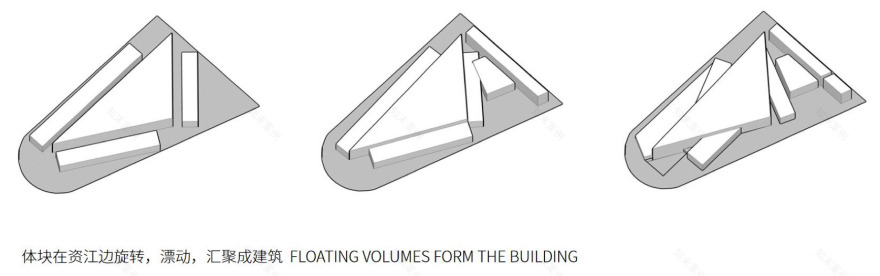
▼漂流的群岛-无序中的有序,The Drifting Archipelago-Order in Disorder © 普罗建筑

▼模型-碰撞的群岛,Model-Collision of the Archipelago © 常可

▼模型-层叠的聚落,Model – Cascading Clusters © 常可

当工厂不再被理解为一个巨大的功能单体,而是多个在江上漂流的异形石块,最终在此汇聚和碰撞,慢慢形成稳固的整体,从“工厂”成为“工场”。其不同部分彼此之间产生的随机的复杂关系,成为城市公共空间与自然景观空间的渗透缝隙,最终成为江边一个开放的城市聚落。
When the factory is no longer understood as a huge functional monolith, but a number of shaped stones drifting on the river, eventually converging and colliding here, slowly forming a solid whole, from “factory” to “workshop”. The random and complex relationship between the different parts of the building becomes a gap between the urban public space and the natural landscape space, and finally becomes an open urban settlement by the river.
▼城市中的自然聚落,Natural settlements in the city © 存在建筑

在这个新聚落中,文化,自然,场所,知识,物流,情绪,形成一个活跃的流动关系,重塑了茶产业核心的人文价值,并使这种价值在城市空间的体验中得以传达和释放。同时,茶厂建筑本身成为资江边上一个新的大地艺术景观,成为一座人造的“灯塔”。
In this new colony, culture, nature, place, knowledge, logistics, and emotions form an active fluid relationship that reshapes the core humanistic value of the tea industry and allows this value to be conveyed and released in the experience of urban space. At the same time, the tea factory building itself becomes a new landscape of earth art along the Zijiang River, a man-made “lighthouse”.
▼复杂多义的形象, Complex and multifaceted image © 存在建筑

▼资水边的“灯塔”,”Lighthouse” at the edge of the Zishui River © 存在建筑

文化的聚落
文旅,制造与公共空间的新融合
Cultural “colonies”
Cultural tourism, a new fusion of manufacturing and public space
传统工厂空间追求资源效率的最大化,是完全的“私人领域”和“物品聚集地”。其通常需要与人活动的场所,城市公共交往的场所,做刻意的隔离与阻断。
The traditional factory space seeks to maximize resource efficiency, and is a completely “private domain” and “gathering place of goods”. It usually needs to be deliberately isolated and blocked from places of human activities and urban public interaction.
▼地理与文化碰撞的隐喻,Metaphors for the Collision of Geography and Culture © 存在建筑

而安茶博物馆工场不同于传统的产品生产工厂。黑茶的生产与包装过程,是一种“非物质文化遗产 ”。通过重新认识黑茶这种“产品”与地域文化,自然环境深度结合的产品,我们希望重新策划一种新的工厂,将手工黑茶产品的制作包装,存储,与展示,售卖,文化交流这全流程通过“博物馆工厂”这样一种空间组织模型给呈现出来。通过将三种黑茶的展示文化空间对中央工厂(非遗手作包装)的包裹,形成一个现代的黑茶文化的“新聚落”。
▼由传统工厂到博物馆工厂,From traditional factory to museum factory © 普罗建筑
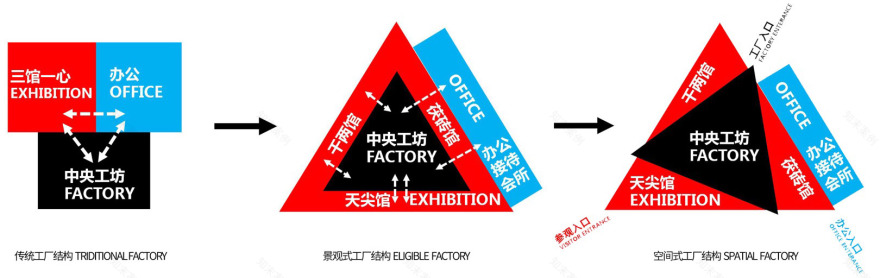
在这几个功能之上,植入一个巨大的三角形混凝土体,一个“环廊”,将周围的自然环境吸纳到各个聚落的缝隙之中,使其成为一个空中风景游廊,成为一个工厂中新的城市公共空间,或者说,在城市游走空间中,置入一个工厂。游廊在建筑室内外穿梭,形成工厂采光,通风的重要建筑架构。在环廊三边的每个边上,是分别为三种不同黑茶所设立的展示馆。根据千两茶,天尖茶,茯砖茶不同的特点特性,呈现三种不同的空间状态。
▼模型-工厂聚落中的城市游廊,Model – Urban Corridor in a Factory Settlement © 普罗建筑

▼施工中的三角混凝土环廊,Triangular concrete wrap-around corridor under construction © 业主拍摄

The Ancha Museum factory is different from a traditional product manufacturing factory. The production and packaging process of black tea is an “intangible cultural heritage”. By re-conceptualizing black tea as a “product” that is deeply integrated with regional culture and the natural environment, we hope to re-plan a new factory that will produce and package handmade black tea products, store them, display them, sell them, and communicate with them culturally. The whole process of handmade black tea products production, packaging, storage, display, sales and cultural exchange is presented through the “museum factory”, which is a spatial organization model. By wrapping the central factory (non-heritage handmade packaging) with three kinds of black tea exhibition and cultural spaces, a modern “new colony” of black tea culture will be formed.
▼三角游廊创造出的巨大室内中庭空间,Huge indoor atrium space created by the triangular veranda © 存在建筑

▼三角游廊将光线视线引入建筑,Triangular corridors bring light and vision into the building © 存在建筑

▼交错吊下的巨大“天尖茶篓”展示空间,A huge “Tien Chien Tea Basket” display space under the interlocking hangings. © 存在建筑

生长的聚落
风景,空间,材料的汇聚
Growing Colonies
Convergence of Landscapes, Spaces, and Materials
如何将周边与场地内的自然吸纳到建筑的内部,是建筑形成自然聚落的关键点。通过“游廊”“窗口”“狭缝”等结构,使资江与群山的风景成为聚落的一部分。同时,在聚落内部,通过让植物完全与建筑生长在一起,形成“野生”感的“人造之山”,建筑自身复杂的缝隙与错落成为植物融合的场所,是人们感觉到自然在建筑中那强盛的生长感。
How to absorb the nature of the surrounding area and the site into the interior of the building is the key point for the building to form a natural community. Through structures such as “corridors,” “windows,” and “slits,” the landscape of the Zijiang River and the mountains becomes part of the community. At the same time, inside the settlement, the plants grow completely with the building, creating a “wild” sense of “man-made mountains,” and the complex gaps and staggers of the building itself become a place for the plants to merge and for people to feel the strong sense of growth of nature in the building.
▼与城市空间的叠落贯通,Stacking and connecting with the urban space © 存在建筑

▼开放的城市入口,Open City Entrance © 存在建筑

▼三角游廊与建筑的“轻触”,The triangular promenade and the “light touch” of the building © 存在建筑

▼天井与游廊,Patio and veranda © 存在建筑
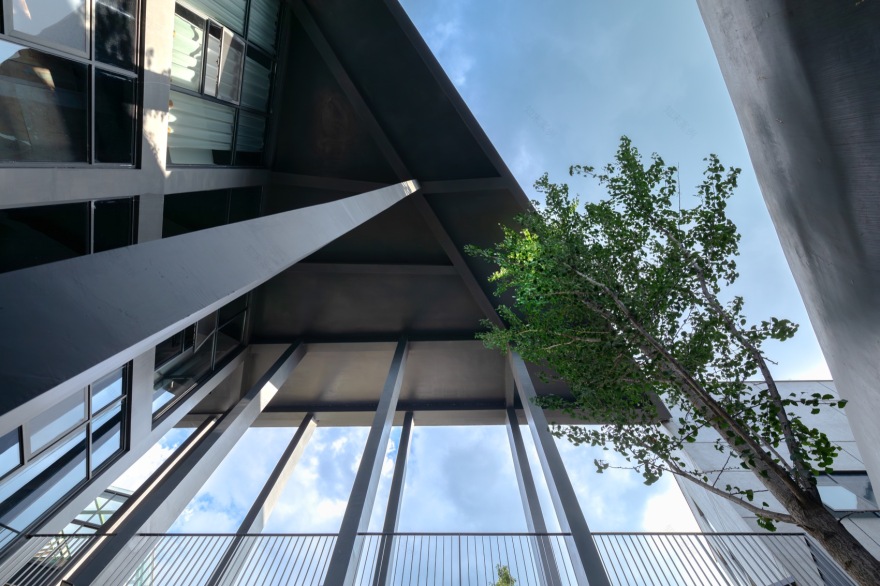
▼为了观赏震撼的资水大拐弯所打开的景观平台,Landscape platform opened to view the stunning Zishui Big-Turn © 存在建筑
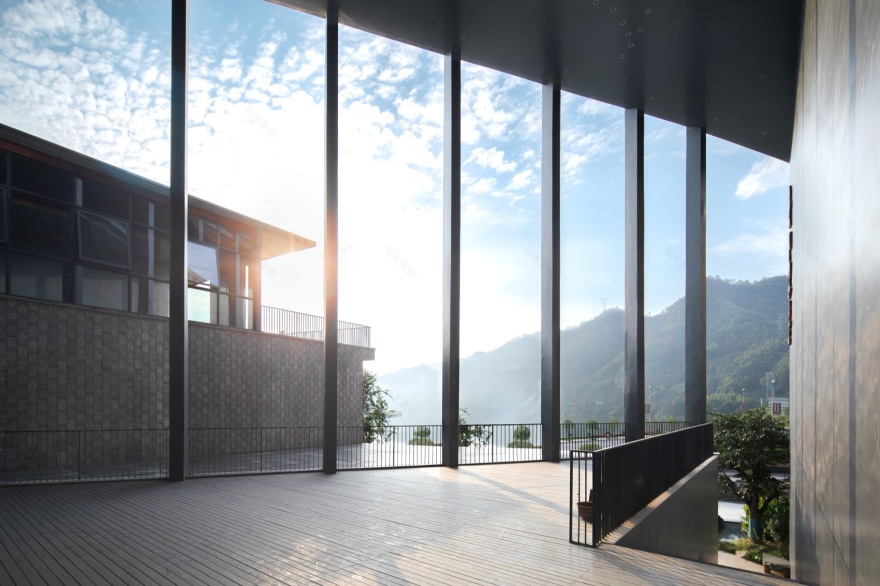
▼水上之台,terrace above water © 存在建筑
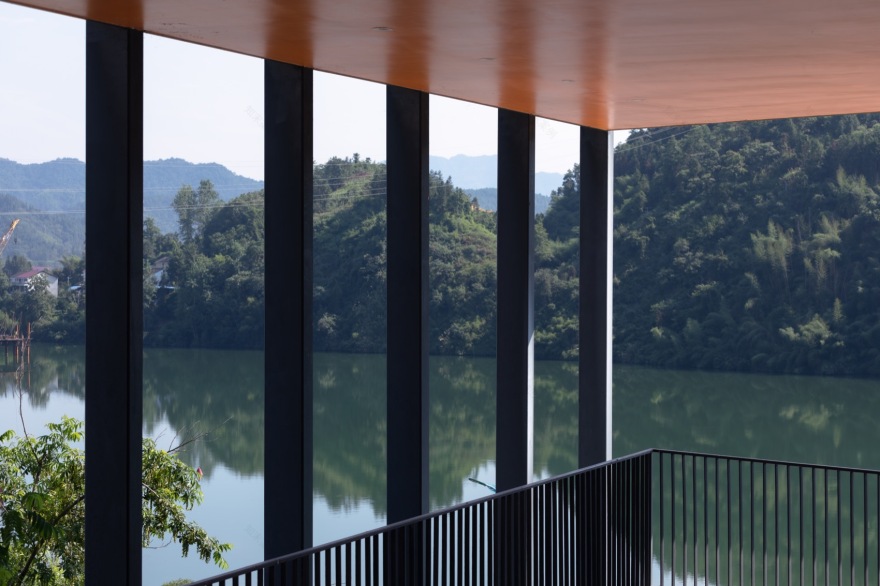
▼巨大的三角形遮盖将景观纳入,A large triangular cover incorporates the landscape © 存在建筑
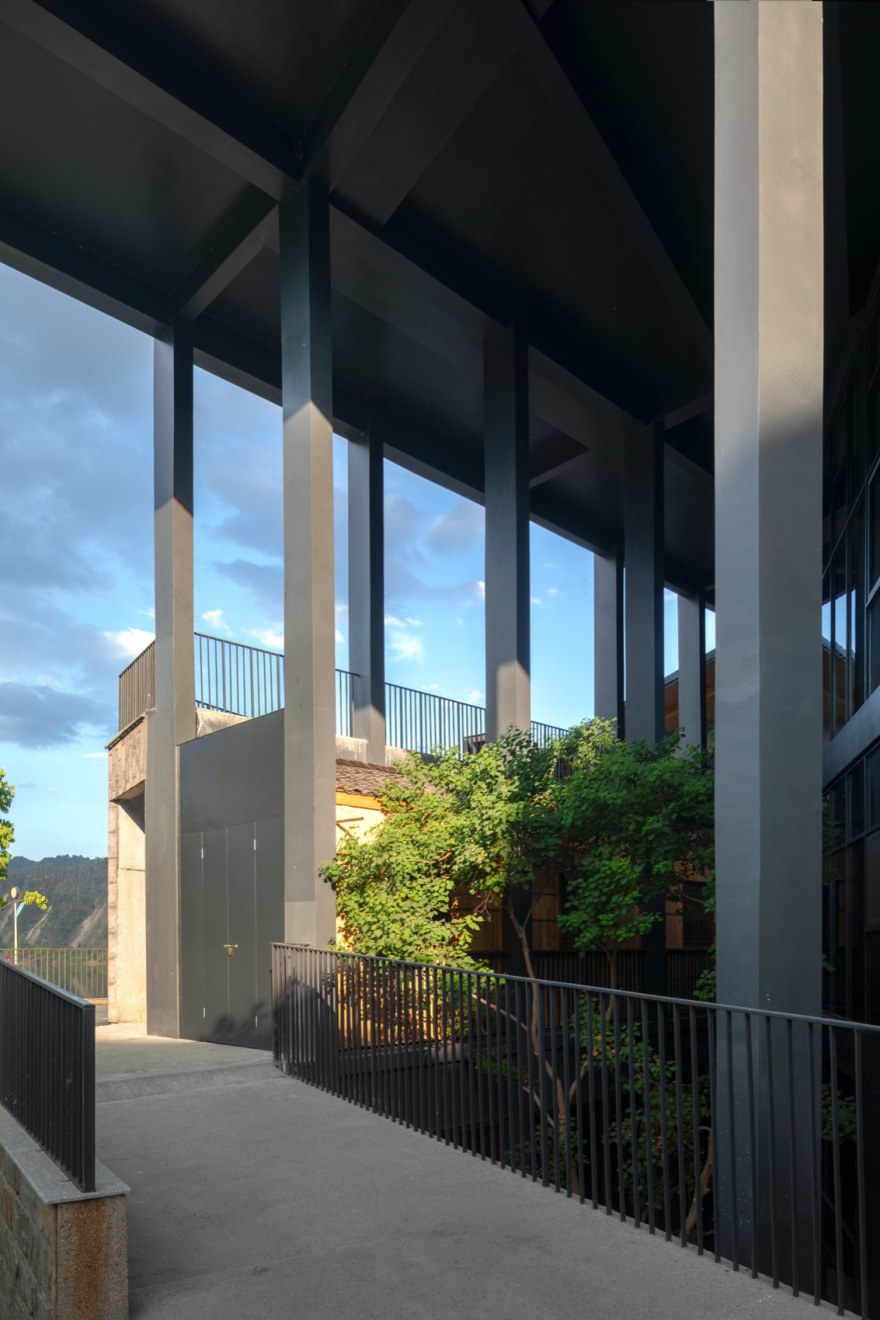
▼空中游廊穿插,Air corridors interspersed © 存在建筑

安茶博物馆工厂希望体现黑茶文化里地域文化为茶叶制作所带来的灵魂。在整个建筑的室内外材料运用上,完全遵循利用本地材料这一原则。通过安化本地的蘑菇石,资江边上的碎石所打造的石笼,茯砖茶脱模而出的混凝土砖块,天尖茶的竹编工艺,千两茶本身的捆绑容器等,来构造起整个聚落的地域气质。在这种策略的引导下,建筑本身可以渐渐脱离建筑师理想的“纯建筑”领域,真正成为使用中满足当地文化与需求的不断进化与生长的房子。实际上,经过业主根据新的需求的不断加建,如屋顶晒茶场等新的功能体,聚落本身越来越丰富,多样,成为“活着的聚落”。
The An Tea Museum Factory wishes to reflect the soul of the black tea culture that the local culture brings to the tea production. The indoor and outdoor materials used in the whole building follow the principle of utilizing local materials. The local mushroom stone of Anhua, the stone cage made from the crushed stone of the Zijiang River, the concrete bricks made from Por Brick Tea, the bamboo weaving of Tianjian Tea, and the binding containers of Thousand Liang Tea, etc., are all used to build up the regional atmosphere of the entire settlement. Under the guidance of this strategy, the building itself can gradually depart from the architect’s ideal of “pure architecture”, and really become a house that evolves and grows to meet the local culture and needs in use. In fact, through the owner’s continuous additions according to new needs, such as the rooftop tea plantation and other new functional bodies, the community itself is becoming more and more rich and diverse, and has become a “living community”.
▼取自资水边的石子制作的石笼带来土地的气息,A gabion made from stones taken from the edge of the capital water brings the flavor of the land. © 存在建筑

▼石笼形成报告厅的遮阳墙壁,Gabions form shade walls in the lecture halls @Exist Architecture© 存在建筑

▼石笼 ,Gabions © 存在建筑

▼由真实茯砖茶的单砖倒模形成的“砖茶墙”,A “brick tea wall” formed by inverted molds of real black tea bricks. © 存在建筑

延伸
走向城市与乡村的中间
Extended reflection
Go to the middle of the city and the countryside
在当下,标志性建筑,网红店,城市更新,乡村振兴,正成为建筑师对生活空间环境进行提升与优化的主战场。而在更广大的“中间地带”,在摩登城市与田园牧歌的中间,大量的“产业空间”正在悄然无序侵入,形成“非城非乡”的环境黑洞。而这些无法进入城市规划与建筑师工作体系的场所,事实上更广泛地塑造着我们的生活文脉。
安化的这一案例,非常典型。这种巨大的产业空间,如何能与地域的空间文化发展相结合,与自然环境对话,同时能够从文化上反映产业对于地方空间建设所带来积极影响与长远贡献,并将其转化为建筑的创新语言,不仅是从设计角度,更是从一个社会发展的角度切入的重要课题。
安茶博物馆工场,一座博物馆式的工厂,一座工厂式的聚落,一座聚落式的公园。我们认为,当一座建筑具备足够的包容性,它自己就可以成为城市。而当它的态度足够明确与笃定,它最终将融为自然。
Nowadays, iconic buildings, Netflix stores, urban renewal and rural revitalization have become the main battlefield for architects to enhance and optimize the living space environment. But in the wider “middle zone”, in the middle of the modern city and the idyllic pastoral, a large number of “industrial spaces” are quietly and disorderly intruding into the environment, forming an environmental black hole of “neither city nor countryside”. The black hole of “non-urban, non-rural” environment is formed. These places, which cannot enter the work system of urban planners and architects, are in fact shaping our life culture more widely.
The case of Anhua is very typical. How to combine this huge industrial space with the spatial and cultural development of the region, dialog with the natural environment, and at the same time culturally reflect the positive impact and long-term contribution of the industry to the construction of the local space, and transform it into an innovative language of architecture, is not only from the design point of view, but also from the point of view of the development of a society to cut into the important issues.
Ancha Museum Workshop is a museum-style factory, a factory-style neighborhood, and a neighborhood-style park. We believe that when a building is inclusive enough, it can become a city by itself. And when its attitude is clear and certain enough, it will eventually melt into nature.
▼神秘的聚落,Mysterious Settlement © 存在建筑

▼360度向城市打开的多重入口,Multiple entrances that open up to the city in 360 degrees © 存在建筑
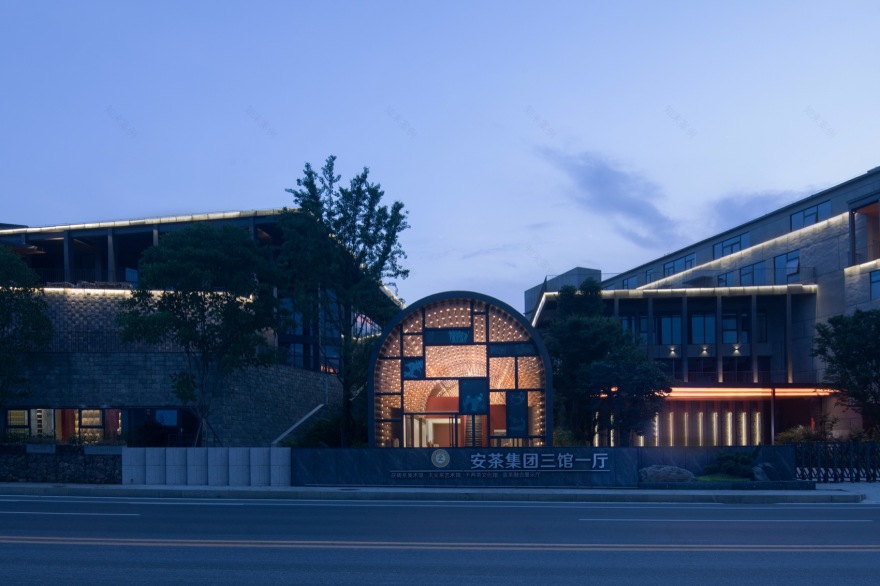
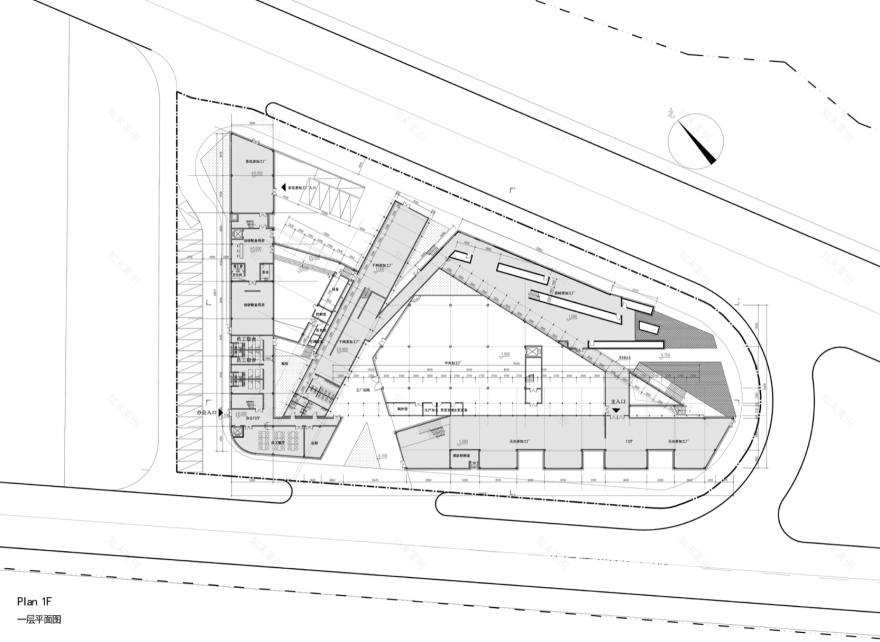
▼一层平面图,1F plan © 普罗建筑
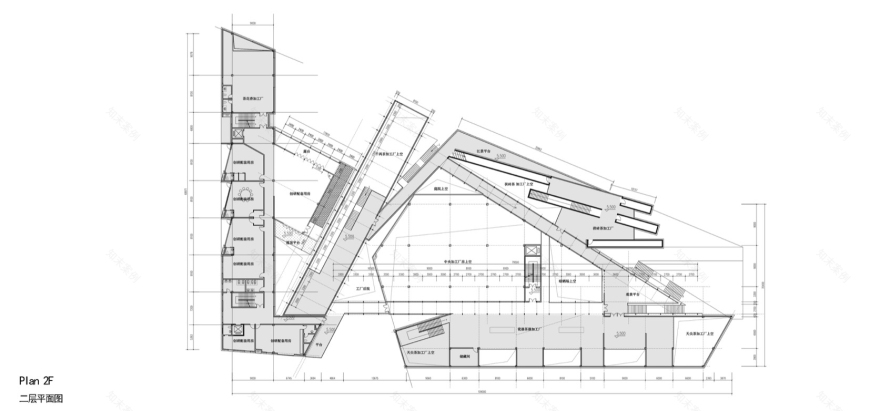
▼二层平面图,2F plan © 普罗建筑
▼剖面示意图,Sections © 普罗建筑

项目地点:湖南省安化县
项目性质:工厂/展览馆/文化中心/市民中心
设计周期: 2020-2023
建造周期:2020-2024
建筑面积:10000平方米
设计单位:普罗建筑 officePROJECT
主持设计师:常可、李汶翰、
设计团队:赵建伟、姜宏辉、张昊、冯攀遨、袁博, 陈纪元
施工图设计单位:友谊设计集团
摄影:存在建筑、常可,业主


南京喵熊网络科技有限公司 苏ICP备18050492号-4知末 © 2018—2020 . All photos and trademark graphics are copyrighted by their owners.增值电信业务经营许可证(ICP)苏B2-20201444 苏公网安备 32011302321234号
苏公网安备 32011302321234号客服
消息
收藏
下载
最近