

创作上传
VIP
收藏下载
登录 | 注册有礼
查看完整案例

收藏

下载

分享
我坐在窗旁,风有点凉,人群走过。望了望,有一位工匠,握一只茶杯,坐靠方窗。有一扇方窗,伴一片白墙,立身街坊。有一处街坊,择一条小河,安躺城市。有一座城市,居一位过客,耽于想象。有一场想象,随一阵轻风,萦绕工匠。忘了忘,人群已去,天下起雨。我坐在窗旁。——朱浪进 “传统是一条小河,生活的小河,静静流淌。现代与传统并非敌对,恰恰相反,现代就是传统,或者说是传统延续下去的唯一途径。建筑的过程不是实验,是理解后的小心探索。所以形式的表达不应是形式自身的创新或者其他标榜,而应是对于当下生活的关心与热爱,即是对传统的尊重和传承。”——朱浪进
© 朱雨蒙
河边的房子
House by the river
小河茶馆位于杭州小河直街历史保护街区的一片民宅内,街区位于杭州北部,地处京杭大运河、小河、余杭塘河三河交汇处。街区的历史可追溯到南宋,这里曾经是河陆转运的重要物资集散地,由此形成了运河商埠文化和下店上宅的水乡民居形式。
The “Xiaohe Teahouse” is located in Xiaohe Street Historic Block in Hangzhou, within a residential area. The district is situated in the northern part of Hangzhou, at the conjunction of the Beijing-Hangzhou Grand Canal, the Xiaohe River, and the Yuhang Tang River. Its history dates back to the Southern Song Dynasty, when it served as a hub for the transportation of goods by land and water, thus forming the canal port culture and the architectural style of homes with commercial below and residences above in the water town.
▼区位分析图,site plan© 房子和诗

▼京杭大运河的运河船队,canal fleet on the grand canal © 图片源自《杭州运河风俗》

小河民居作为清末民初所建典型的受商埠文化影响的水乡民居,呈现一河两街格局。面向街道,一楼为商铺,二楼为居住。这些民居沿小河东南至河港交汇处布局,是一整片木结构建筑。主街长约 300 米,还有狭街窄巷夹于住宅之间。
The Xiaohe residential houses, typical of the late Qing and early Republican period, affected by the culture of canal-side market towns. They follow a layout of one river divided into two streets, with commercial shops on the ground floor facing the street and living quarters on the second floor, representing the typical pattern of shops below, residences above. These houses are located on both sides of Xiaohe Street, extending southeast along the Xiaohe River to its junction with the river port. There is a row of large wooden structures, about 300 meters long, with narrow lanes and alleys interspersed between them.
▼场地分析图,site analysis © 房子和诗

小河茶馆坐落其中,西南侧朝向小河,东北侧朝向街道。茶馆一侧有一条小路,可以直接从街道走到茶馆的院子里。整个建筑占地面积很小,只有 30 平方米,虽然处在景致之中,但如何最大化地利用空间、引入景致,是我们最初思考的问题。
Xiaohe Tea House is nestled within it, with its southwest side facing the stream and the northeast side facing the street. On one side of the tea house, there is a small path that leads directly from the street to the courtyard of the tea house. The entire building occupies a very small area, only 30 square meters. Despite being in a scenic setting, maximizing the use of space and incorporating the scenery was our initial consideration.
▼小河茶馆前的街道,The street in front of the teahouse © 朱雨蒙
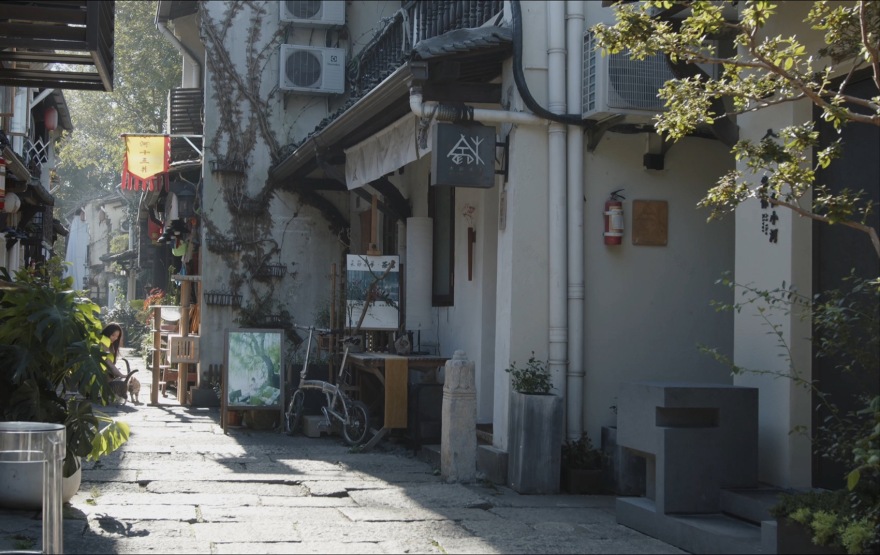
▼小河茶馆河边景色,Riverside scenery © 朱雨蒙

小河“山居”
Xiaohe “Mountain Dwelling”
谢灵运在《山居赋》中写到:“古巢居穴处曰岩栖,栋宇居山曰山居。”山居在中国文化中,最早代表山中居住的意思,之后代表一种人与自然在精神和审美上的和谐相处关系。进而山居渐渐成为了中国文人对居住的最高要求体现,其中最直接的表现即是中国古典园林的出现,形成了如“先抑后扬”“虽有人作,宛自天开”等造园理念。
小河茶馆坐落于河畔绿柳茵茵处,又紧邻热闹的小尺度街道,且小河直街保留着传统的人文居住氛围。我们很自然的想到要在这里“造个园”。造园须有山、水、草木、建筑等,小河水景以及河边的柳岸成荫是最自然的景观,也在茶馆后院处。我们将其设为观景造园的高潮,并在其他处依次借“造园”的思路设置空间与场景。
▼钱选山居图卷(局部),ancient paintings© 图像源自故宫博物院

Lingyun Xie said in “Mountain Dwelling”: “In ancient times, human habitation in nests and caves for shelter was called “岩栖’ (Yanqi), while houses built on mountains were called ‘山居’ (Shanjū).” “In Chinese culture, “Shanjū” originally referred to dwellings in mountainous areas, but it gradually evolved into a lifestyle that emphasizes harmonious coexistence with nature, fulfilling spiritual and aesthetic needs. The philosophy of “Shanjū” has influenced Chinese perceptions of living environments, advocating for seclusion and closeness to nature, which has led to specific techniques in residence and garden design, such as the concept of “Fall-rise pattern” and the idea that “although man intervenes, it appears as natural.”
The Xiaohe Tea House is situated along the lush green willows by the riverbank, adjacent to the lively narrow streets, preserving the traditional cultural and residential atmosphere of Xiaohe Straight Street. It naturally inspired us to "create a garden" here. A traditional Chinese garden typically includes elements like mountains, water, plants, and architecture. The natural landscape of the river and the shady willow river bank serve as the most natural scenery. We have designated the backyard behind the tea house as the highlight of the house, and sequentially arranged other spaces and scenes following the concept of "creating a garden".
▼小河茶馆剖透视插画,cutaway perspective illustration © 齐玥

模山障景
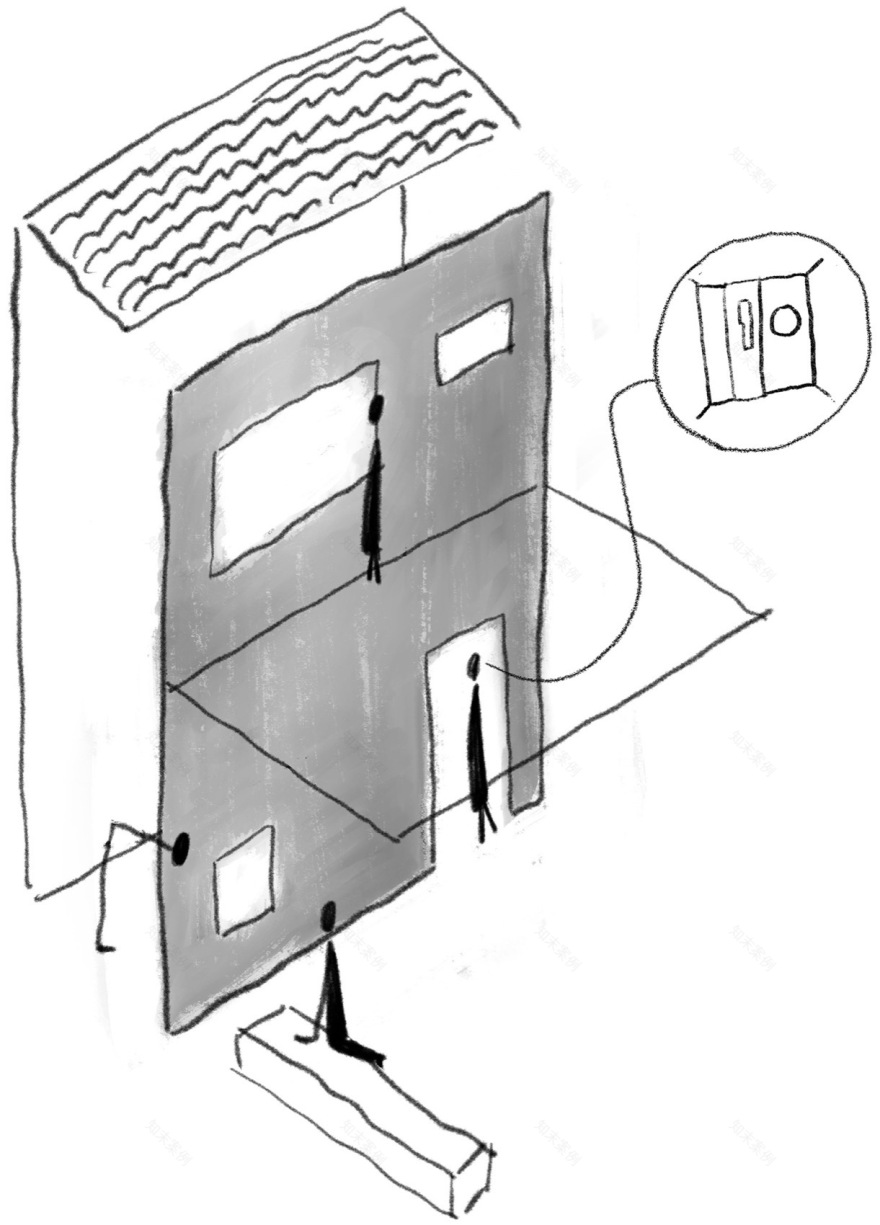
Imitating mountains and obscuring scenery Entrance Traditional gardens borrow the scenery of mountains and trees or use windows to hide the inner world. The entrance of the teahouse faces the bustling street, although it is located in the bustling market, it is secluded in the city. Therefore, we set up a relatively closed entrance and two small windows, and people passing by need to stop and stand or deliberately lower their heads to get a glimpse of the indoor scene.
▼小河茶馆视线设计分析图,sightline design analysis diagram © 房子和诗

Traditional garden entrances often use rocks, trees, or strategically placed windows to create a sense of hidden beauty within the garden. The entrance of the tea house faces the bustling street, yet it retains a sense of seclusion within the city. Therefore, we designed a relatively enclosed entrance with two small windows. Passersby need to stop and peer inside or deliberately lower their heads to catch a glimpse of the interior.
▼小河茶馆东北立面,Northeast facade © 朱雨蒙

▼从街边望向小河茶馆,Looking towards the Xiaohe Teahouse from the street © 朱雨蒙

门前的踏步和景观成为了“第二层立面”,野生杜鹃高度延至屋檐,恰好给小窗进行了二次遮挡。石台形式取自太湖石,也是我们“模山障景”的第一处,与几何形的石阶景观共同构成了入口的屏障,也是街道与室内空间的过渡之处。功能上,门口的石台是物品展示和台阶结合的结果。
The steps and landscaping in front of the door serve as a “second facade.” The wild azaleas extend up to the eaves, providing additional screening for the small windows. The stone platform, inspired by Taihu stones, serves as the first element of our ‘simulated mountain and hidden scenery’ concept. Together with the geometric stone steps, it forms a barrier at the entrance and serves as a transition between the street and the interior space. In terms of functionality, the stone platform serves as a combination of item display and steps.
▼入口处的台面及局部,The entrance countertop and details © 朱雨蒙

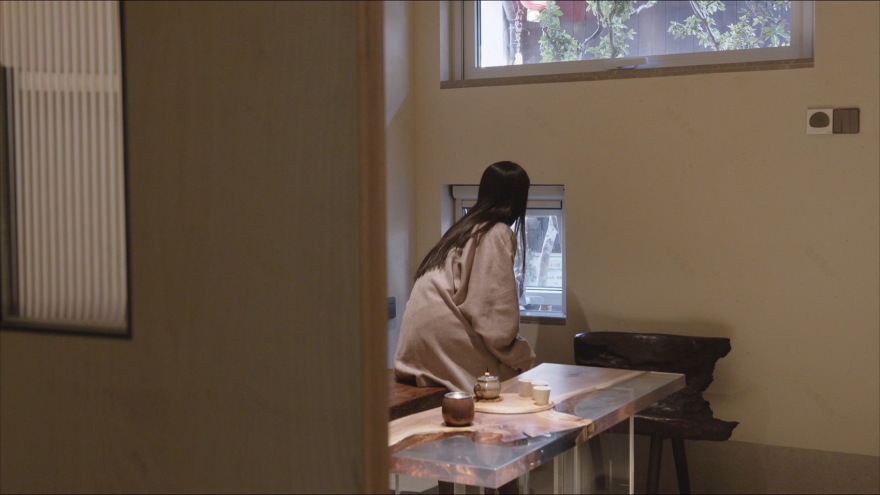
一楼立面上部的长窗高于人们站立的视线,给临街茶室提供必要的采光,透过长窗也可以望向对街的老房子。下侧正方形的小窗与人端坐后的视线平齐。坐在小窗旁,可以无意一瞥经过的游客,再回头静静品茶,和两三好友谈天。而窗户外又借用景观进行了二次遮挡,让室内和路人保持一种恰好的距离感。
The long window at the upper part of the first-floor facade is higher than the eye level of people standing,providing necessary daylight for the street-side tea room. Sitting indoors,one can also look across the street at the old houses through the top long window.The square-shaped small windows at the lower part align with the seated person’s sight. Sitting by the small window,one can casually glance at passerby and then turn back to quietly enjoy tea and chat with some friends. The landscape outside the window as soft barrier,maintaining a just-right distance between indoors and passersby.
从室内小窗望向街边,Looking out from the small window to the street© 朱雨蒙
茶室空间
Tea room space
造园常常讲究“抑景”与“障景”,在空间设置上最忌讳“一览无余”,总是“先藏后漏”,“欲扬先抑”,让人有“柳暗花明又一村”的惊奇。
我们通过门窗的虚实处理对空间进行视线分隔,从而达到景观的视觉转换。
▼拙政园三十一景图(其一),Thirty-one Scenes of the Humble Administrator’s Garden © 文征明作

▼室内场景画,interior scene painting © 齐玥

Garden design often emphasizes “suppressing scenes” and “screening scenes.” In spatial arrangement, it is most taboo to have “no secrets left” and always follows the principle of “concealment before revelation” and “revealing after suppressing,” creating a sense of surprise akin to “After the darkness, comes light, and another village.” We use the virtual and solid treatment of doors and windows to visually separate the space to achieve visual transformation of the landscape.
▼从入口处望向室内,View from the entrance to the interior © 朱雨蒙

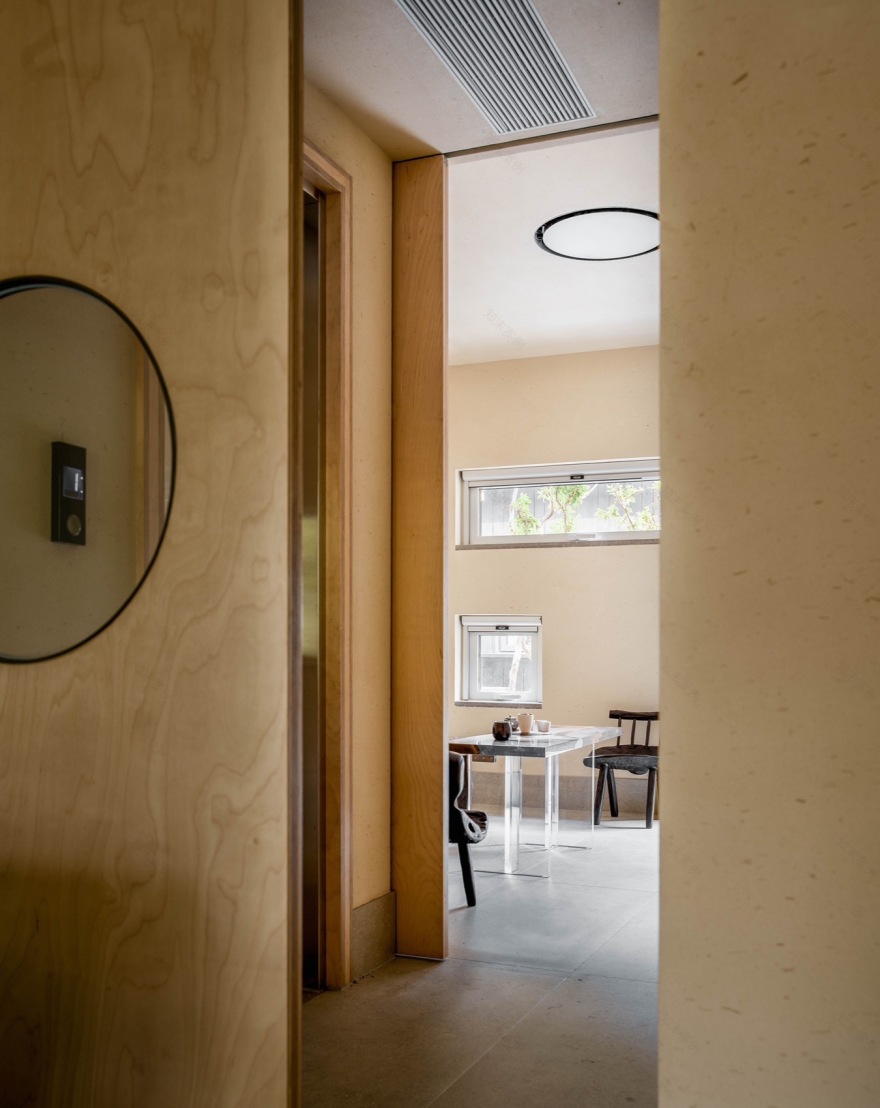
在中部服务空间两侧,我们分别设置了两道木质移门。从正门延入茶室,第一道移门嵌有一扇形似“太湖石”的窗,其材质采用半透明的长虹玻璃。视觉上,观者透过朦胧的“太湖石”窗,虽不能看清真切的精致,但依稀婆娑的光,却分明暗示着门后别有洞天。
In the middle of the service area, we have installed two wooden sliding doors. Upon entering from the entrance to the tea room, the first sliding door is equipped with a window in the shape of “Taihu Stone”, using semi-transparent fluted glass. Visually, observers cannot see the actual scenery through the semi-transparent “Taihu Stone” window. However, through the faint and swaying light and shadow, viewers faintly perceive that there is another world behind the door.
▼望向河边(两扇移门同时打开), Looking towards the river © 朱雨蒙

▼移门上两个不同透明度的洞口,Two holes of different transparency on the sliding door © 朱雨蒙

推开第一扇移门后,便马上可以看到另一侧的移门,上面是一个透明的圆洞窗,透过圆窗,一眼便可以看到隔壁茶室的一静一动。操作区随着圆洞窗透入的光线变得明亮,也可以随时观察客人需求。当两扇移门一同推开时,观者进门便可以直接看到河边院落的杨柳依依。
After pushing open the first sliding door, you can immediately see the other side’s sliding door, which has a transparent circular window. Through this window, you can easily observe the quiet and lively scenes of the tea room next door. The operating area becomes brighter with the light coming through the circular window, allowing for easy observation of customer needs. When both sliding doors are pushed open together, visitors can directly see the willow trees swaying in the courtyard by the river.
▼从茶室回望操作区,Looking back at the operation area from the tea room© 朱雨蒙

▼从茶室回望入口区,Looking back at the entrance area from the tea room © 朱雨蒙
两扇移门之间是操作空间以及电梯空间。电梯的位置起初曾是原始的楼梯空间,应业主要求,将一层到二层的楼梯改为电梯,并在二楼增加了疏散洞口。操作台由白色整体台面制成,上方是不锈钢的置物架。交通及服务空间居中设置,在功能上,它将最好的景致留给了茶室与客厅。当移门关闭时,也可以满足茶空间或客厅所需要的独立性与私密性。
In the middle of the two sliding doors are the operating space and elevator space. The elevator space was originally the staircase space, but at the owner’s request, the staircase from the first floor to the second floor was removed and replaced with an elevator, with an added evacuation opening on the second floor. Below the console, which is made of white solid surface, are stainless steel shelves. The circulation and service space are centrally located, functionally leaving the best views for the tea room and living room. When the sliding doors are closed, they can also satisfy the independence and privacy required by the tea space or living room.
▼移门旁的置物空间局部,Part of the storage space next to the sliding door © 朱雨蒙

移门右侧设置了一处置物空间,点缀山石小景。关上移门,置物柜被遮挡在门后。
On the right side of the sliding door, there is a storage space adorned with a small landscape of rocks. When the door is closed, the storage cabinet is concealed behind the door.
▼入口区左侧的台面,Countertop on the left side of the entrance area© 朱雨蒙

我们在入口处左侧墙体上方的配电箱外侧做了一个内嵌式的壁龛,可拆卸的金属壁龛既可以遮挡配电箱,又形成了一处局部小景。为了使突出的部分不那么生硬,我们用弧形线条过渡。壁龛下方安装了一个小射灯,夜晚降临,射灯可以照亮下方承板上的小物件。
We created a recessed niche on the upper side of the left wall at the entrance, outside the distribution box. The removable metal niche conceal the distribution box while forming a partial small scene. To soften the prominent part, we used curved lines for transition. Below the niche, a small spotlight is installed. At night, the spotlight can illuminate the small objects on the panel below.
▼入口区左侧的壁龛,Alcove to the left of the entrance area © 朱雨蒙

河边庭院,宁静而优雅,是城市喧嚣中的一片绿洲。庭院紧邻河边,绿树成荫,鲜花盛开,四季更替,景色宜人。漫步在庭院小径上,闻着花香,听着鸟鸣,感受着大自然的气息,让人心情愉悦,疲劳尽消。河边庭院是一个放松身心的好地方,也是一个与家人和朋友共度美好时光的好去处。
Riverbank Courtyard After passing through the second sliding door, the tea room and the riverside courtyard unfold before you. To better introduce natural light, we use motorized glass sliding doors for large area of the house that facing the river. When these doors are opened, it becomes a natural tea room space.
▼从服务空间望向茶室,View from the service area to the tea room © 朱雨蒙

▼从茶室回望入口,Looking back at the entrance from the tea room © 朱雨蒙

▼从茶室望向河边庭院,Looking towards the riverside garden from the tea room © 朱雨蒙

从小河回望,透过移门缝隙可以瞥见远处街上的路人。功能上,移门可以灵活地控制三个空间的边界,利用景色的渗透引导观者的行进。将两扇移门移动至不同的位置,可以形成丰富的变化组合,从而使观者欣赏到多种不同的风景。极大丰富了空间中的视觉体验,也是“借景”及“障景”的意趣之处。
Looking back from the riverside, through the gaps in the sliding doors, you can catch a glimpse of pedestrians on the far street. Functionally, the sliding doors can flexibly control the boundaries of three-dimensional spaces and guide the viewer’s movement with the permeation of the scenery. The different open & close postures of the two sliding doors allow people to see various landscapes, greatly enriching the audience’s visual experience in the space. This also adds to the charm of "borrowed scenery" and "screened scenery".
▼ 从巷子望向户外庭院,View from the alley to the outdoor courtyard © 朱雨蒙
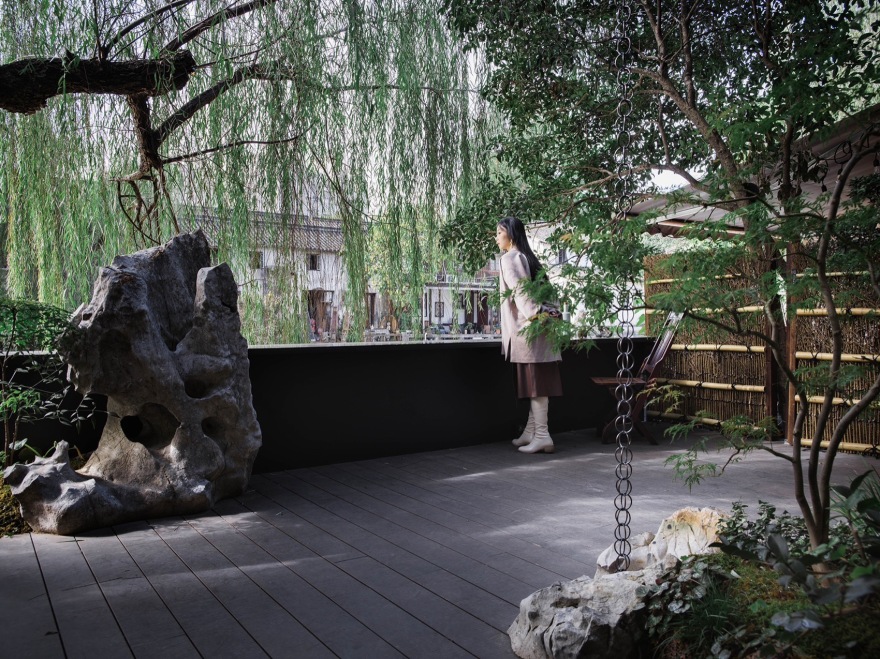
我们在平台设置了沿河茶桌,人们可以在此处停留、眺望,也可以沏一壶茶和三两好友聊天。我们利用太湖石造景,太湖石一分为二,上部的太湖石主体伫立在茶桌旁,茶桌部分嵌入石内,融为一体,太湖石景似乎成为了茶桌的一部分。
We’ve set up a tea table along the riverside platform where people can stop, admire the view, brew a pot of tea, and chat with friends. We’ve utilized Taihu stones to create a scenic setting. The Taihu stone is split into two parts, with the main body of the Taihu stone standing beside the tea table. The tea table is partially embedded within the stone, seamlessly integrating with it. The Taihu stone scenery seems to become a part of the tea table itself.
▼户外平台局部,Outdoor deck © 朱雨蒙

岸边的茶台采用黑色烤漆玻璃材料,将岸边的绿意都映照在了台面上,绵延了景色的边界。而黑色的反射材料也可以很好地融入在环境之中。
The tea table on the bank is made of black painted glass material, reflecting the greenery on the bank onto the tabletop, extending the boundary of the scenery. The black reflective material also blends well with the surroundings.
▼后院入口景观及局部,Backyard entrance landscape © 朱雨蒙

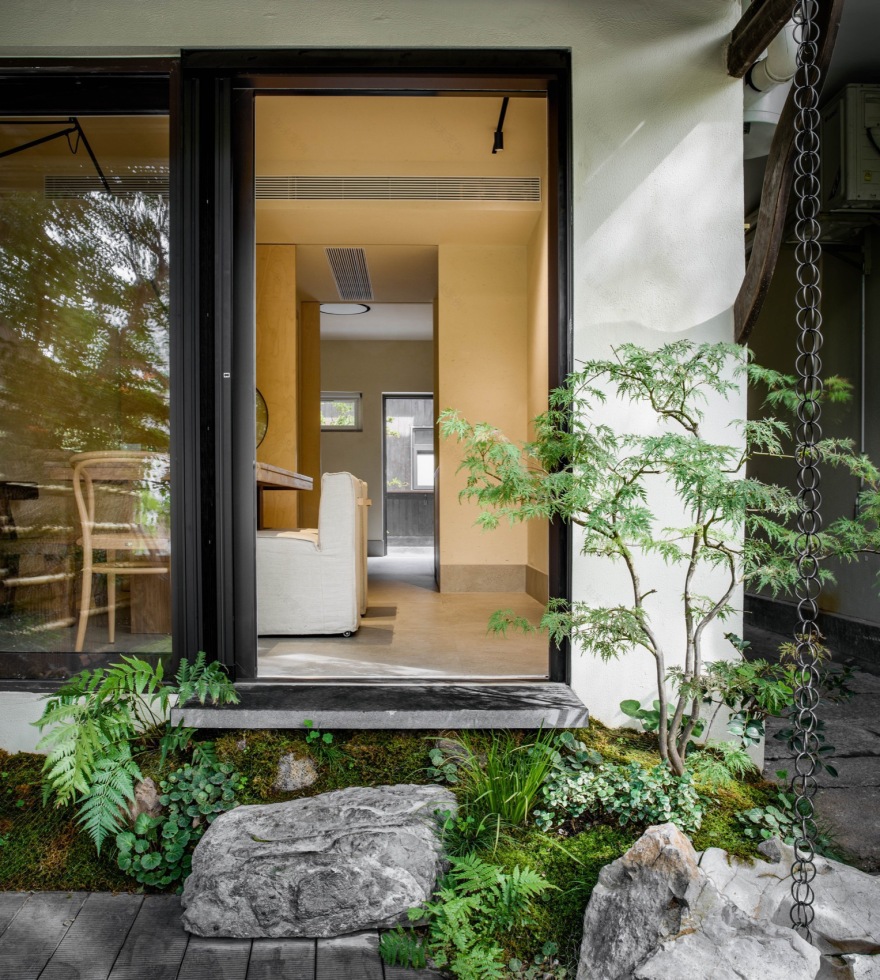
太湖石的另一小半被用作落雨链下的承接石。台阶是用自然石头形成的云步踏跺。整个户外平台的景观选用自然的石头搭配植物造景,呼应入口处景观,同时也连接了小河的自然景观,是造园景观的高潮处。
The other half of the Taihu stone is used to receive the rain. The steps are made of natural stones forming a cloud-like pattern. The entire outdoor platform features natural stones paired with plants, matching the entrance landscape while also connecting with the natural scenery of the river, serving as the highlight of the garden landscape.
▼后院小动物出没,Small animals appear © 朱雨蒙

造一个“石头”窗户
Make a “Stone” window
Taihu stone is a commonly used garden stone in classical Chinese gardens. Ancient literati created many famous poems or paintings about Taihu stones. In the painting “The Garden of Cultivated Leisure” painted by Zhou Wenju in the Five Dynasties, there is a scene of several scholars gathering under a pine tree, and one of the scholars is leaning against a black Taihu stone, holding a brush and thinking.
▼《文苑图》周文矩作,《Wenyuantu》© 图片源自故宫博物院

除了入口处太湖石形的石阶及庭院内直接使用的一块太湖石造景外,我们还造了一个“石头”窗户。“石窗”的形式取自太湖石的造型,意在汲取古代文人对石头和园林之美的意趣。我们并没有将石头原样临摹,而是更希望通过抽象的形态来体现意趣的精神。
In addition to using Taihu stones for the staircase at the entrance and directly incorporating them into the outdoor platform’s landscaping, we also created a “stone” window. The design of the “stone window” is inspired by the form of Taihu stones, aiming to capture the aesthetic fascination ancient scholar had with stones and gardens. Rather than simply replicating the appearance of stones, we aimed to embody the spirit of aesthetic appreciation through abstract forms.
▼移门上的太湖石窗,Stone window © 朱雨蒙

造一个“石头”家具
Creating a “stone” piece of furniture
The second-floor space serves as the homeowner’s personal tea room and space to host the guest. To maximize the usable space indoors, the large concrete columns in the space were replaced with one steel column, which was integrated with the necessary storage spaces. We used marine plywood to mimic the shape of Taihu stones and crafted them into shelving units. At the bottom of the shelving units, the bases of the steel columns are exposed, revealing the true structural arrangement inside. The Taihu stone-shaped shelving units can not only display items, but also provide a place for people to sit and relax.
▼二层起居室望向操作台,Second floor living room looking towards the operating table © 朱雨蒙

▼二层起居室望向三层榻榻米卧室,The second floor living room looks towards the third floor tatami bedroom © 朱雨蒙

▼二层起居室柜子局部,Part of the second floor living room cabinet © 朱雨蒙

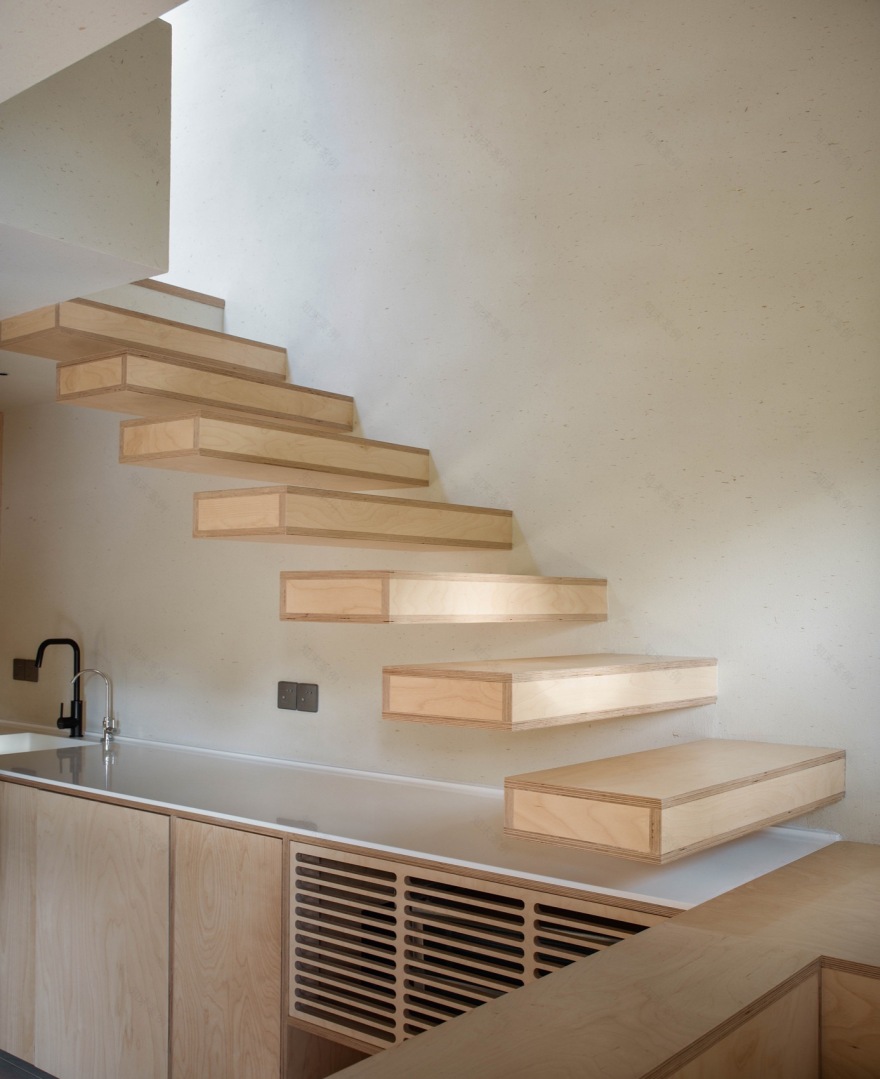
我们将操作台上方的空间有效利用,设计了悬挑式楼梯踏步。空调内机藏在了台面下的柜体内,确保建筑主体空间上方的完整性,出风口采用海洋板特别定制而成。
▼悬挑式踏步节点做法,Cantilever step node © 房子和诗

We effectively utilized the space above the operational counter by designing cantilevered staircase steps. The air conditioning unit is concealed within cabinets beneath the countertop, ensuring the integrity of the main space above. The air outlet is custom-made from marine plywood to blend seamlessly with the design.
▼通向阁楼的楼梯,Stairs leading to the attic © 朱雨蒙

▼从圆窗望向室外, © 朱雨蒙 Looking outside from the round window。


楼梯临河墙面上的一处圆窗,采光与框景的同时,还呼应了一楼移门上的圆窗。当人们经过此处,不由地低下头俯身观察窗外的景色。
The circular window on the wall beside the staircase overlooking the river not only to provide light and frame the scenery but also match to the circular window on the first-floor sliding door. When people pass by this area, they naturally lower their heads and lean over to observe the scenery outside the window.
▼二层茶室空间,Second floor tea room © 朱雨蒙

▼二层业主卫生间,Second floor owner’s bathroom © 朱雨蒙

透过二楼茶室空间的窗,恰好可以看到对面民居的屋顶与一扇老虎窗。这里不时会上演各种有趣的景象,或见邻居开窗,或见小鸟停驻,或见散步的小猫。一切皆是生活。
Through the windows of the second-floor tea room space, one can conveniently observe the rooftops of neighbouring houses and even catch a glimpse of an old-style lattice window. This area often presents various interesting scenes, such as when neighbors open their windows, birds perching, or cats strolling by. Everything is part of life.
▼二层起居室,Second floor living room © 朱雨蒙

阁楼空间被我们设计成为主人休憩的私密一角。为适应电梯井道高度而自然形成的突出被设计成榻榻米,可以在此休憩、喝茶。天窗的加入,让阁楼更加明亮舒适,夜晚可观星。
The attic space has been designed as a private retreat for the homeowner to relax. The adaption to fit the height of the elevator shaft naturally formed a protrusion, which has been designed as a tatami area where one can rest and enjoy tea. The addition of skylights makes the attic brighter and more comfortable, allowing for star watching on clear nights.
▼阁楼空间,Attic © 朱雨蒙

空间秩序
Order of the space
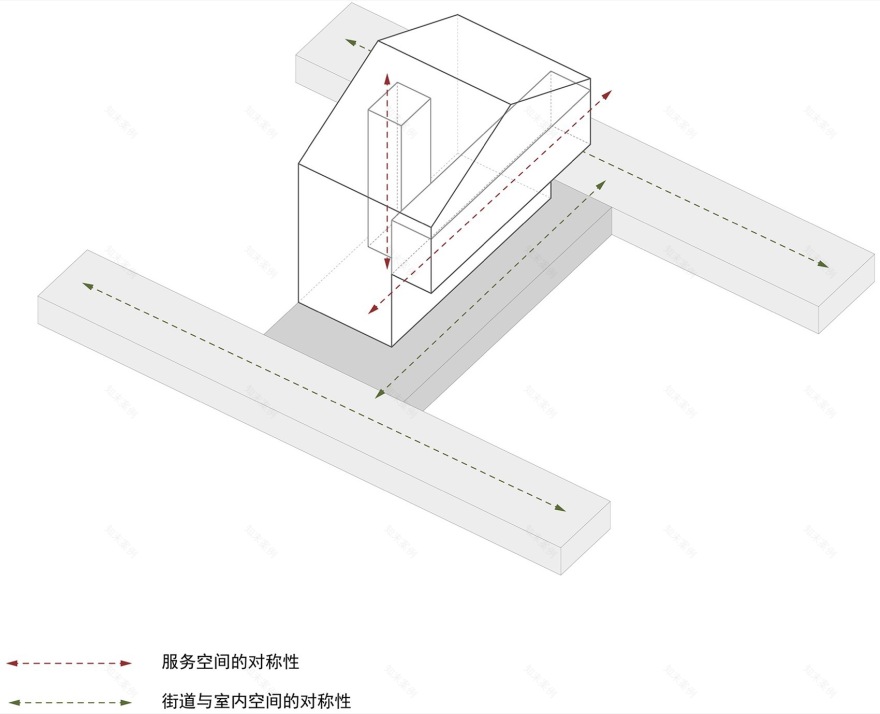
“Symmetry” of the space
The Xiaohe Tea House is renovated based on the original old house, where the elevator and tea room operation space are arranged in the middle between the first and second floors. The staircase leading to the attic makes use of the space above the operational counter on the second floor. The tea room, relaxation area, and other spaces occupy the positions at both ends with the best views and lighting.
The central placement of the elevator and tea room operation space makes the Xiaohe Tea House present a symmetrical order relationship in both function and space. Moreover, the street and the small river, as well as the indoor vertical transportation service space and the second-floor horizontal transportation service space, correspondingly form two sets of symmetrical and balanced spatial states.
▼小河茶馆功能和空间分析图,functional and spatial analysis diagram © 房子和诗

与此同时,一楼入口处的抽象“石头”台面与庭院的自然石头,一楼移门上的圆窗与二楼楼梯旁的圆窗,一楼的“石头窗”与二楼“石头”置物架都彼此呼应,呈现某种内在的秩序关系。而空间与符号的成组秩序关系使得小河茶馆更整体和统一。
The central placement of the elevator and tea room operation space creates a symmetrical order in both function and space for the Xiaohe Tea House. Additionally, the street and the river, as well as the vertical circulation space on the ground floor and the horizontal circulation space on the second floor, form two sets of symmetrical and balanced spaces correspondingly. At the same time, the abstract “stone” countertop at the entrance of the ground floor and the natural stones in the courtyard, the circular window on the sliding door of the ground floor and the circular window next to the staircase on the second floor, the “stone” window on the ground floor and the “stone” shelving unit on the second floor all relate to each other. This presents a certain intrinsic order, and the grouping order of space and symbols makes the Xiaohe Tea House more cohesive and unified.
▼空间“对称”分析图,spatial “symmetry” analysis diagram © 房子和诗
材料与照明
Materials and lighting
The Xiaohe Tea House embodies a Song Dynasty aesthetic. In terms of material selection, we chose with an overall unified light yellow tone. The walls are coated with a creamy white microcement material, with interspersed straw not only paying tribute to traditional craftsmanship but also enhancing the durability of the wall material and softening the color palette.
▼楼梯局部,Stairs details© 朱雨蒙
在灯光设计中,为了更好地展现空间本身的特质,我们取消了常规的主灯,转而采用大量磁吸轨道灯及小射灯来点缀空间,再辅以若干可移动的氛围灯,补充照明。
In the lighting design, traditional flood lights were omitted to better showcase the inherent qualities of the space. Instead, magnetic track lights and small spotlights are predominantly used to embellish the space, supplemented by movable ambient lights to complement the illumination.
▼傍晚茶馆里的灯光,Evening lights in the teahouse © 朱雨蒙

工艺与细节
Craftsmanship and Details
In ensuring construction quality, we wish to emphasize the beauty of craftsmanship. The wooden products in the space, including sliding doors, shelves, cabinets, racks, and door casings, are all made of birch marine plywood and handcrafted on-site by experienced carpenters. Then, through the careful polishing, painting, and re-polishing by painters, the smoothness of the wooden surface is ensured while retaining the original texture and style of the birch plywood.
For the birch marine plywood, we chose a higher grade with a initiallyperfect, blemish-free surface. However, during actual construction, a carpenter accidentally placed a door with blemishes side facing outward. When we discovered this, we decided to retain this mistake because it made us realize that we should allow people to see the most authentic situation in some local areas. This seemingly "performance" was not intentional, but it made it more interesting instead.
▼白天小河茶馆街边,Day view© 朱雨蒙

▼外观夜览,Exterior night view© 朱雨蒙

结语 Conclusion 小河茶馆有别于现代建筑改造。我们尝试将“山居”思想运用于现代建筑空间营造,借助传统造园手法,如“借景”“障景”“模山造石”,打造多层次立面。以盆栽、石头、花器等点缀空间,此亦为造园之用心所在。最终,通过空间逐步展开,拉开序幕,又缓缓收尾,皆是我们于小空间内所能缔造的丰富空间序列。小河茶馆亦是我们首次以“模山造石”这一具像形式手法回应中国传统建筑与文化。我们期望更多地参与当代中国建筑的探索与实践,始终保持对中国传统文化的学习,以及对传统如何回归当下的传承性思考。尤为特别的是,在项目施工收尾阶段,业主期望此处除作茶室外,未来亦可满足居住功能。为使茶室与住宅能良好兼容,我们设计了两种状态下的家具摆放方案。在设计风格上,我们力求减少过多装饰,不刻意强调空间属性,从而增强空间自身的可变性、包容性与前瞻性。未来,业主若需长期居住于此,仅需简单调整家具,住宅空间与茶室空间便可相互转换。此刻,建筑是生活的容器,住宅和茶馆仅是生活的不同呈现。
The Xiaohe Tea House distinguishes itself among modern architectural renovations. We endeavored to infuse the "mountain dwelling" notion into the creation of contemporary architectural space. We employed traditional garden-making methods like "borrowing scenery," "screening scenery," and "imitation mountain&stone" to construct multi-layered facades. We decorated the space with potted plants, stone objects, and flower vases, reflecting the essence of garden-making. Ultimately, through the gradual unfolding and gentle conclusion of the space, we crafted a rich spatial sequence within a restricted area. The Xiaohe Tea House signifies our first endeavor to respond to Chinese traditional architecture and culture via the tangible technique of "imitation mountain&stone." We aspire to contribute to the exploration of contemporary architectural expression in China, and continuously learn about traditional Chinese culture and ponder on how to bring tradition into the present. Of particular note, in the final phases of the project, the owner expressed a wish for the space to function not only as a tea house but also as a residence in the future. To ensure seamless compatibility between the tea house and the residence, we designed furniture placement plans for both scenarios. In terms of style, we aim to minimize excessive decoration and refrain from overly emphasizing the attributes of the space, thereby enhancing the space’s versatility, inclusivity, and futuristic nature. In the future, if the owner desires to reside here for an extended period, they merely need to make straightforward adjustments to the furniture, and the residential space can be converted into a tea room space, and vice versa. At this juncture, the building serves as a container for life, and the residence and tea house are merely distinct manifestations of life.
▼一层家具转换图,1F furniture conversion diagram © 房子和诗

▼二层家具转换图,2Ffurniture conversion diagram © 房子和诗

▼一层平面图,1F plan © 房子和诗

▼二层平面图 2F plan © 房子和诗

▼ 三层平面图,3F plan© 房子和诗
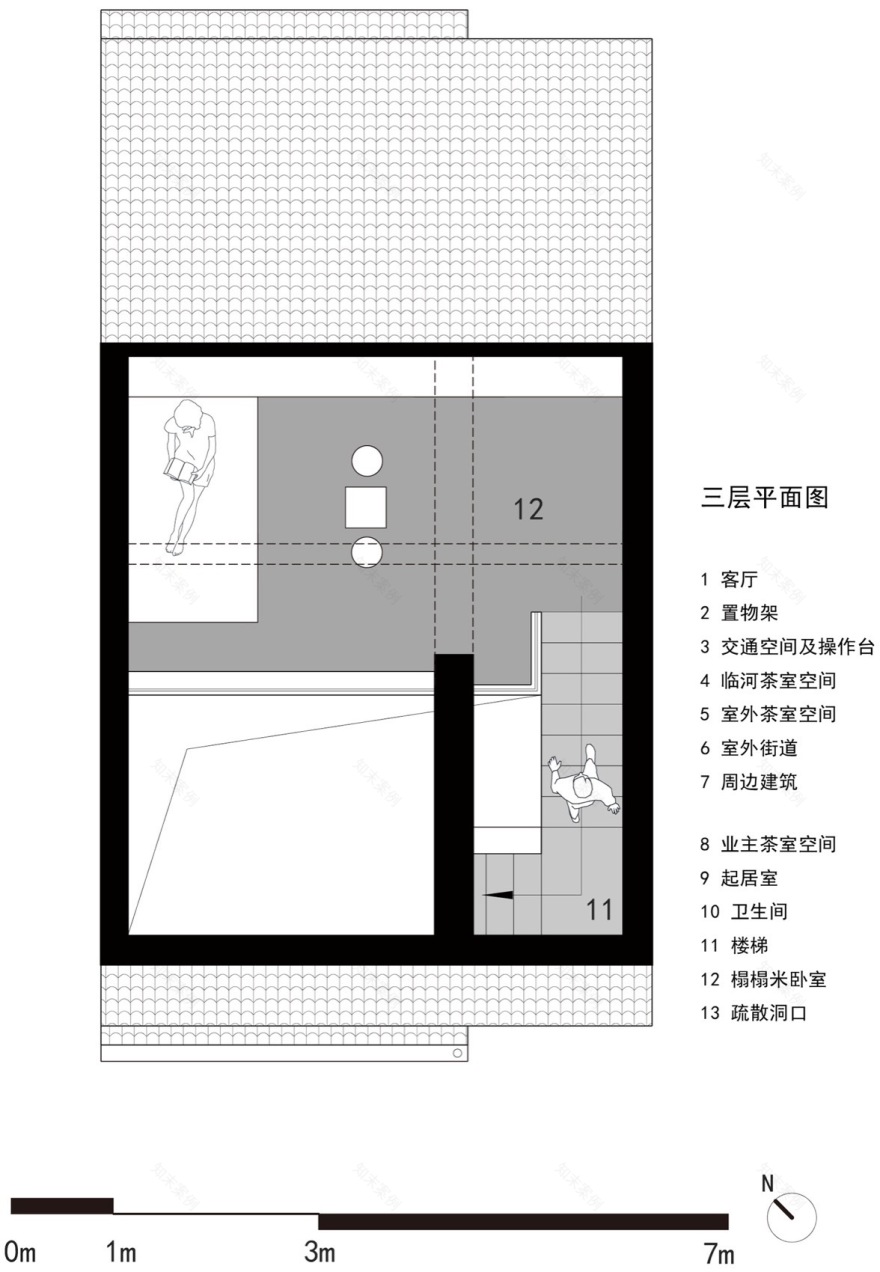
▼屋顶层平面图,roof top plan© 房子和诗

▼东北立面图,northeast elevation© 房子和诗

▼西南立面图,southwest elevation© 房子和诗


▼A-A 剖面图,A-A section© 房子和诗

▼B-B 剖面,B-B section© 房子和诗

项目信息
Project Information
项目位置:浙江杭州
建筑及室内设计:房子和诗建筑工作室
主持建筑师:朱浪进
项目成员:朱浪进、金新如、赵诗雯、齐玥、牛新佳
景观设计:山山园林
业主方:私人业主
建筑及室内施工:杭州极物装饰工程有限公司
景观施工:山山园林
建筑结构:砖混结构、钢结构
建筑材料:海洋板,微水泥、黑色花岗岩、人造石台面、水磨石地砖、长虹玻璃、黑色烤漆玻璃、实木多层木地板等
材料品牌:SVEZA 海洋板、杜邦可丽耐台面,菲罗娜地砖,术木地板,蒂森克虏伯电梯,FLOS 灯具,Cassina 家具,U+家具、旭格铝合金门窗,威卢克斯天窗等
建筑面积:80 平方米
建筑占地面积:30 平方米
景观面积:22 平方米
设计时间:2020 年 8 月-2020 年 10 月
建设时间:2020 年 10 月-2021 年 9 月
撰文 | 朱浪进 齐玥。文字校对 | 操拓。摄影 | 朱雨蒙。插画 | 齐玥。文章来源参考:《杭州运河风俗》——顾希佳;《山居赋》——谢灵运。
Project Location: Hangzhou, Zhejiang Province, China
Architectural and Interior Design: Archipoetry Studio
Lead Architect: Zhu Langjin
Project Team: Zhu Langjin, Jin Xinru, Zhao Shiwen, Qi Yue, Niu Xinjia
Landscape Design: Shan Shan Landscape Design
Client: Private owner
Architectural and Interior Construction: Hangzhou Jiwu Decoration Engineering Pte.Ltd.
Landscape Construction: Shan Shan Landscape Design
Building Structure: Reinforced brick structure, steel structure
Building Materials: Marine Plywood, microcement, black granite, synthetic
stone countertops, terrazzo floor tiles, fluted glass, black back painted
glass, engineer wood floor, etc.
Material Brands: SVEZA marine plywood, DuPont Corian countertops,
Fiorentina tiles, Artwood flooring, ThyssenKrupp elevators, FLOS
lighting fixtures, Cassina furniture, U+ furniture, Xugel aluminum doors
and windows, Velux skylights, etc.
Building area: 80 square meters
Building footprint: 30 square meters
Landscape area: 22 square meters
Design stage: August 2020 – October 2020
Construction stage: October 2020 – September 2021
Text Editing | Zhu Langjin, Qi Yue
Photography and Videography | Zhu Yumeng
Illustrations | Qi Yue
Video Appearance | Chen Xi Yue
References:
《杭州运河风俗》——顾希佳
《山居赋》——谢灵运
南京喵熊网络科技有限公司 苏ICP备18050492号-4知末 © 2018—2020 . All photos and trademark graphics are copyrighted by their owners.增值电信业务经营许可证(ICP)苏B2-20201444 苏公网安备 32011302321234号
苏公网安备 32011302321234号客服
消息
收藏
下载
最近