

创作上传
VIP
收藏下载
登录 | 注册有礼
查看完整案例

收藏

下载

分享
出品人:向玲 / Producer: Xiang Ling
编辑:石安,亓慧、庞任飞,宋林晨,张笑然 / Editor: Shi An, Qi Hui, Pang Renfei, Song Linchen, Zhang Xiaoran
________
何为“高目”
About GOM
1. “高目”,源于围棋中的术语,您以此作为事务所的名称是希望表达哪些理念和想法呢?
“高目,” originating from the terminology of the game of Go, what concepts and ideas do you wish to convey by choosing this as the name of studio?
我与创始合伙人都爱下围棋,我们就找了棋盘上“高目”这个位置为工作室命名。高目可以理解为高瞻远瞩,在围棋中也代表了不重眼前利益,我们希望以一种较高的目光去看待这个世界和这个行业。高目的英文名是 GOM, GOM 在藏语中又恰巧是修行的意思,Keep Gom 就是保持修行。所以我觉得经过这么多年的重新解读,“高目”这个词比较符合我们发展的历程。
▼高目 logo,GOM logo

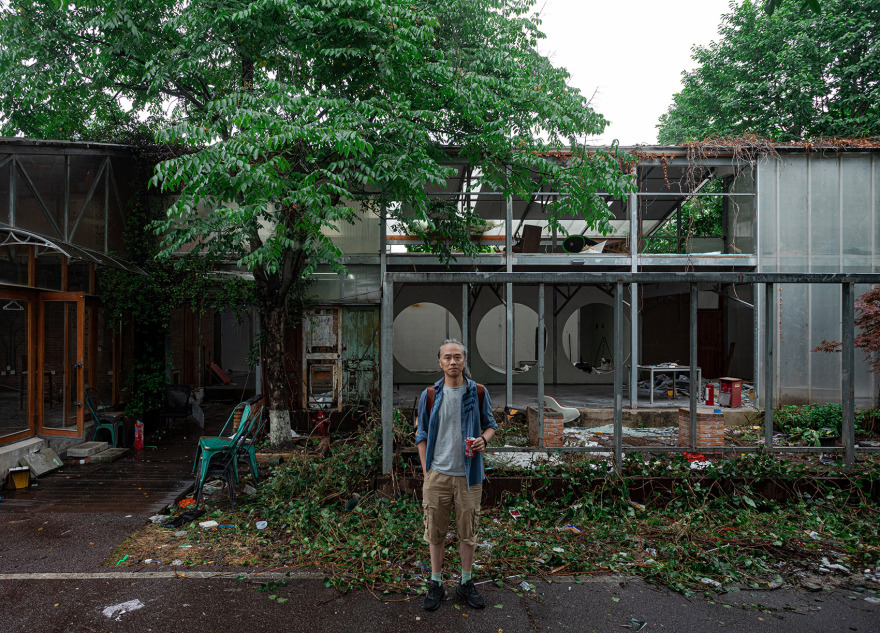
▼离开目外工作室前张佳晶老师于工作室外的照片
Zhang Jiajing in front of the site before leaving the MOA studio
2. 自事务所成立至今已有 25 年,您如何定义这 25 年间高目的发展阶段?每个阶段有什么样的特点,如何体现事务所设计理念的发展与演变?
How would you define the development stages of GOM over these 25 years? What are the characteristics of each stage, and how do they reflect the development and evolution of your design philosophy?
25 这个数字是跟我们比较有缘,因为我们创立事务所的时候就是 25 岁。事务所的发展阶段与我们办公空间的演变阶段十分一致。
第一个阶段:创业阶段。我们当时在写字楼里租了一间很小的办公室,那个时候做了 96 年国际竞赛,三鑫花园等一系列住宅的项目,跟房地产的关系也是非常密切的,所以也就界定了我们当时的发展路径。
The number 25 has a special connection with us because we were 25 years old when we founded GOM. The development stages align closely with the stages of our office space evolution.
First Stage: The Startup Phase. At that time, we rented a very small office in an office building. During this period, we participated in the 1996 international competition and undertook several residential projects such as Sanxin Garden. Our relationship with the real estate sector was very close, which defined our development path at that time.
▼96 年国际竞赛(上)与三鑫花园(下)图纸模型,1996 International competition (above) & Sanxin Garden (below) drawing and model

第二阶段:华山路阶段。华山路阶段以 2010 年为界也可以分成前后两个小阶段。2010 年我们搬到了华山路老洋房的工作室,这个时候我们开始接触了一些重要项目,比如德富路中学、龙南佳苑等项目,以及开启了聊宅志异的研究,包括很多其他项目都是在这个阶段完成的,所以这是高目最重要的一个阶段。这间工作室不但促成了我对城市、社区、自然的看法和态度的转变,同时也承载了很多当今建筑师们的集体回忆。
Second Stage: Huashan Road Stage. The Huashan Road stage can be divided into two sub-stages, with 2010 as the dividing line. In 2010, we moved to a studio in an old villa on Huashan Road. During this period, we started working on some significant projects such as Defu Junior High School and Longnan Garden Social Housing Estate. We also began the research project “Liaozhai Zhiyi (house chatting)” and completed many other projects in this stage. This was the most important stage for GOM. This studio not only facilitated a shift in my views and attitudes towards the city, community, and nature, but also holds many collective memories for contemporary architects.
▼华山路老洋房工作室,office environment of GOM in the villa of Huashan Road

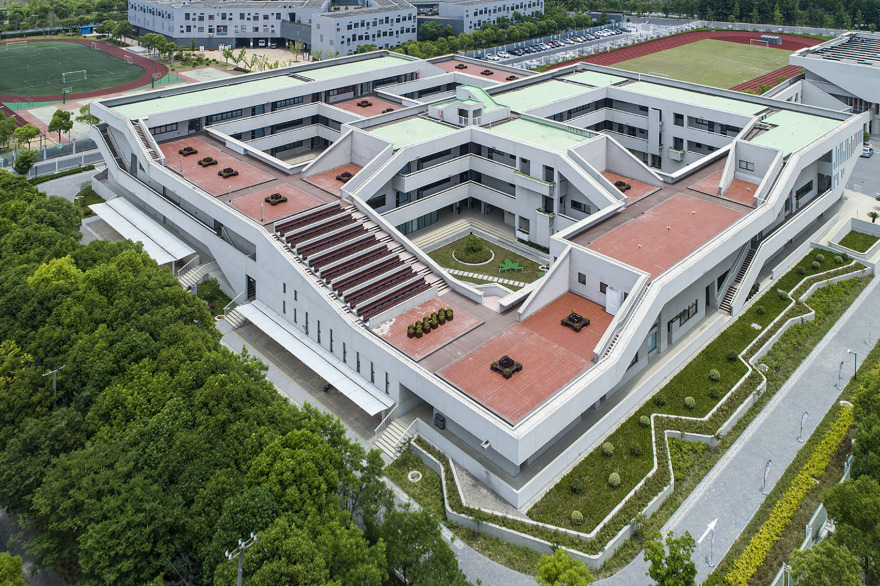
▼德富路中学、龙南佳苑,Defu Junior High School and Longnan Garden Social Housing Estate in Shanghai

第三个阶段:西岸目外工作室阶段,从 2018 年开始到现在,我们在这里办公 6 年了。18 年之后,正好也是后龙南佳苑阶段。龙南佳苑是高目的里程碑项目,2018 年投入使用。它背负了很多意义,也背负了很多骂声,有很多值得我们反省的东西。之后我们做了著名的网红项目“犬舍”,以及西岸江边的河图洛书亭,我们的公租房 2.0/3.0/4.0 也都陆续落成和开始设计。
Third Stage: MOA Studio Stage. From 2018 to the present, we have been working here for six years. This period follows the Longnan Garden Social Housing Estate stage. Longnan Garden Social Housing Estate, which became operational in 2018, is a milestone project for GOM. It carries a lot of significance and has also faced a lot of criticism, providing us with many things to reflect on. After that, we completed the famous viral project “The Kennels” and the Hetu Luoshu Pavilion on the bank of Huangpu River. Our public rental housing projects 2.0, 3.0, and 4.0 have also been completed or are in the design phase.
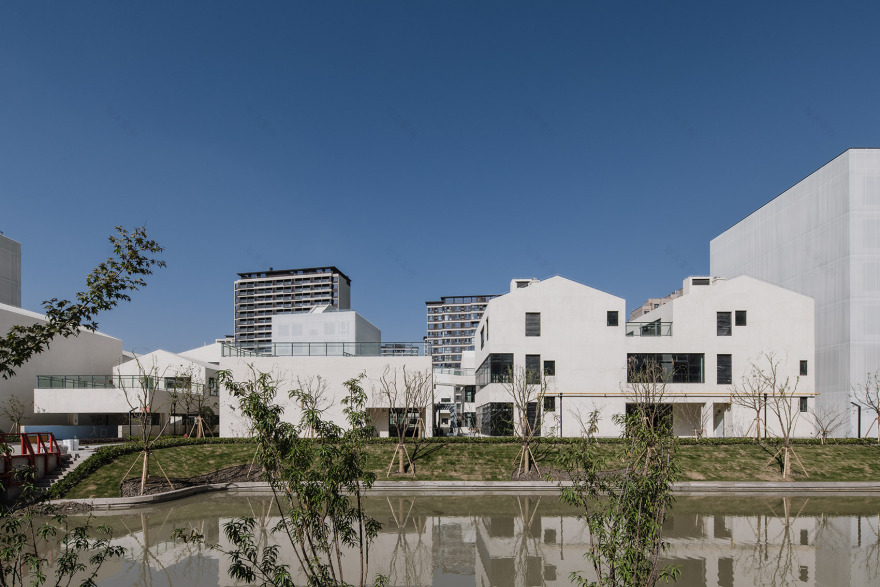
▼上海目外工作室,MOA Studio By Atelier GOM

▼“犬舍”+ 洛书亭+公租房 2.0/3.0/4.0,The Kennels & Hetu Luoshu Pavilion + Dade Pavilion & Apartment 2.0/3.0/4.0

我们第一阶段是在积累,第二阶段开始了我们的爆发,第三阶段我们拥有一些相对著名的作品之后,发力没有那么猛了,也在享受一些抗争之外的乐趣。公租房、社会住宅项目其实都是在跟社会、制度在抗争。
In the first stage, we were accumulating experience. The second stage marked the beginning of our breakthrough. In the third stage, after having some relatively well-known works, our efforts became less intense, and we began to enjoy some pleasures beyond the struggle. Public rental housing and social housing projects, in particular, involve a resist against society and system.
▼高目部分代表作品,Part of the projects by GOM

突破与抗争
Breakthrough and Struggle
3.
犬舍旅馆通体采用清水混凝土现浇工艺,其余材质也采用统一的灰色,在营造空间氛围方面,您们是如何考虑的?“不对齐的结构体系”是否会在之后运用到其他项目的设计中?作为您对爱犬的献礼,本项目在设计过程中有什么令您印象审核的故事可以与我们分享?
How did you consider the atmosphere and materials in The Kennels project? Will the “misaligned structural system” be applied to other projects in the future? As a tribute to your beloved dog, are there any memorable stories from the design process that you can share with us?
在犬舍开始的时候,我们并没有一定要用清水混凝土。随着正式方案的确定,再加上结构的特殊性,现浇混凝土就已经成为了必然。当时我也做了一些思想准备,清水混凝土如果浇得很差,我们宁愿给它刷上涂料,所以它并不是最开始就设定好的。
犬舍采用了一种结构主义的设计方式,就是把基本单元重组。我们的设计归纳起来有一个比较共通的方法,就是我们喜欢回溯到原点,就是打破约定俗成的构成方式,把建筑的最基本单元重新组合成新的形式,只有去重新回溯设计的起点,才能让形式的边界无限拓展。
犬舍中最重要的关系是处理狗和狗的关系,如果遇到一些爱叫的狗或者是爱打闹的狗就会非常麻烦,所以我们在犬舍旁边做了一大片草坪让它们去玩,但是在入住的流线中,希望尽量减少狗狗对于人和它们互相之间的干扰,所以才会产生现在上下错开的形式。
我带着呆萌开了 1400 公里,从上海去住犬舍的这个经历是终生难忘的,整个过程中都发生了很多有趣的故事。同时欧悦导演也跟拍了犬舍的纪录片,算是给我当年 50 周岁生日的礼物。
▼犬舍纪录片,Documentary of The Kennels
At the beginning of The Kennels project, we did not have a fixed decision to use exposed concrete. As the final design was confirmed and considering the structural particularity, cast-in-place concrete became inevitable. I also prepared myself mentally for this; if the exposed concrete turned out poorly, we would have painted over it. So, it was not predetermined from the start.
Of course, some people might ask why we designed it to look so cold. Actually, I think people’s perceptions of coldness can be different because warmth is sometimes conveyed through the atmosphere of a space. We are quite satisfied with the result of this project. I often see feedback from users, visitors, and even architects on social media, which moves me greatly.
The Kennels adopts a structuralist design approach by reorganizing basic units. A common method in our design is to trace back to the origin, breaking conventional composition methods and reassembling the most basic architectural units into new forms. Only by revisiting the starting point of the design can the boundaries of form be infinitely expanded.
The most important relationship in The Kennels is managing interactions between dogs. It can be very troublesome if you encounter barking or playful dogs. Therefore, we created a large lawn next to The Kennels for them to play on, but during the check-in process, we wanted to minimize disturbances between the dogs and among dogs and people. This led to the current design with staggered levels.
Driving 1,400 kilometers from Shanghai to stay at The Kennels with my dog, was an unforgettable experience, filled with many interesting stories. Additionally, Director Ou Yue filmed a documentary about The Kennels, which was a gift for my 50th birthday.
▼阿那亚犬舍,The Kennels© 清筑影像
点击这里查看更多,Click HERE for details

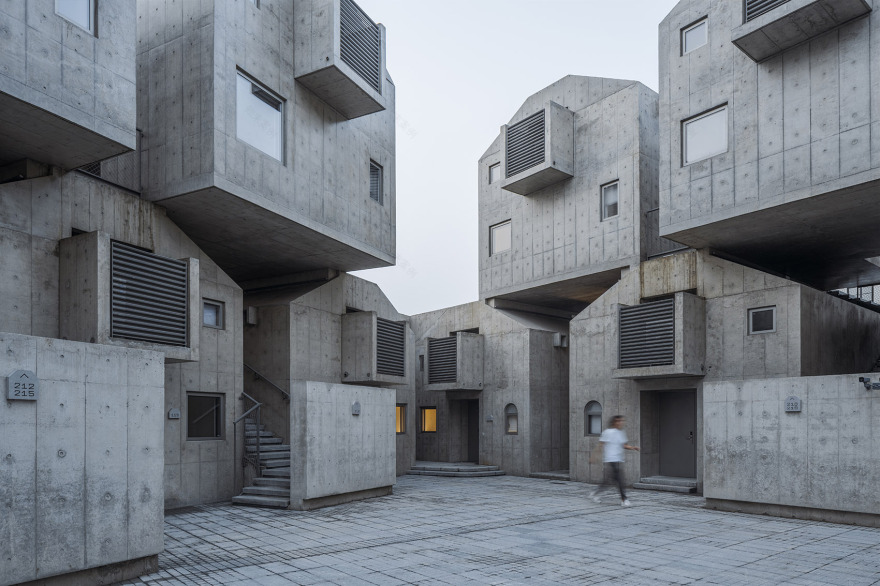
▼人与狗狗在犬舍中的互动,Human-dog interaction in the Kennel © 清筑影像


▼犬舍客房内景,Guest room interior view© 清筑影像

4. 河图洛书亭和达德亭分别采用了不同的结构设计和建造方式,这设计选择背后的考虑是什么?在设计河图洛书亭时,您提到了与甲方的博弈过程,最终导致了一些设计上的变化。您认为这种博弈对最终建筑的形态和实用性有何影响?
What were the considerations behind Hetu Luoshu Pavilion and Dade Pavilion? You mentioned a game of negotiation with the client during the design. How do you think this negotiation impacted the final form and usability of the building?
河图洛书亭是一个比较自由的命题,也没有确定功能,所以我当时就做了一个完形的九宫格,九宫格是我尝试很多年的一种设计方法,这个方法终于完整的一次性用在了一个项目中。但达德亭不一样,达德亭最初的基地是三角形的,因此被设计为三角形的形式。两个亭子结构的基本类型是比较接近的,都是用非常细的柱子以及巧妙的结构方式撑起自身的结构,区别就是河图洛书亭立面钢板是装饰,而达德亭三角型的钢板是结构。
对于河图洛书亭,我在最开始的时候就希望它是开敞的,24 小时通畅的、不需要人来管理的空间,这类空间的使用效率是最高的。因为大量去江边的人,大部分的时间都是在散步,就会有这样的需求。但是甲方一般还是会倾向于封闭起来。我屈服于甲方之后,就设计了这样的九宫格,一个格子是院子,四个格子封闭,四个格子打开。
因为这个项目的钢结构特别精细,对铝合金门窗的要求就很高,由于预算的原因,最终导致窗没装,这恰好符合了我最初的意图。意外直接导向了我最想要的结果,也非常有意思。我们 SUSAS 策展人之一张峰给我们反馈说,河图洛书亭晚上非常热闹,人都是坐满的,旁边还有打篮球的,还有老头老太。人在这样的空间下,自然有一种安全感,同时这个空间也特别适合小孩玩,能够为孩子们提供非常有意思的穿梭体验。
The Hetu Luoshu Pavilion was a relatively free proposition without a defined function, so I designed a complete nine-square grid, a method I had experimented with for many years, and finally applied comprehensively in this project. The Dade Pavilion, however, was different. Its initial site was triangular, so it was designed in a triangular form. The basic structural types of both pavilions are quite similar, using very thin columns and clever structural methods to support themselves. The difference is that the steel plates on the façade of the Hetu Luoshu Pavilion are decorative, while the triangular steel plates of the Dade Pavilion are structural.
For the Hetu Luoshu Pavilion, I initially wanted it to be open, accessible 24 hours a day, and not requiring management. Such spaces have the highest usage efficiency. Given the large number of people walking by the river, there is a need for such a space. However, clients typically prefer enclosed spaces. After yielding to the client’s wishes, I designed the nine-square grid, where one cell is a courtyard, four cells are enclosed, and four are open.
Due to the precision required for the steel structure, the aluminum doors and windows had to meet high standards. Budget constraints ultimately led to the windows not being installed, which ironically aligned perfectly with my original intention. This unexpected outcome directly led to the result I wanted, which was quite interesting. Zhang Feng, one of the curators of SUSAS, gave us feedback that the Hetu Luoshu Pavilion is very lively at night, filled with people, with basketball being played nearby and elderly people around. In such a space, people naturally feel safe. This space is also particularly suitable for children, providing them with a very interesting experience of weaving in and out.
▼河图洛书亭,Hetu Luoshu Pavilion©何威/安图摄影
点击这里查看更多,Click HERE for details


▼达德亭,Dade Pavilion©何威/安图摄影
点击这里查看更多,Click HERE for details

5. 在上海德富路初中项目中,您们提到了“建筑习惯突破后带来的乐趣”,您能否具体给我们解读一下这句话?以及您们是如何突破的?
In the Shanghai Defu Junior High School project, you mentioned “the pleasure following breaking some architectural paradigms.” Could you explain this statement in detail and how you achieved this breakthrough?
德富路中学是我们多年对传统规范抗争的开始,它的设计比较偏激。其实我也在思考这么多年我为什么做设计的时候,尤其在做教育建筑的时候跟别人都不一样,后来我才明白,我一直追求的是在一个条件下寻找出公式,而大部分人是做应用题,在这种情况下,不同语境是很难沟通的。德福路中学就是我在上海 0.5 容积率条件下求得的一个公式。
学校建筑对朝向日照有严苛的规定,既要满足规范,又不按传统的习惯,这才是求公式的方法。面对日照、朝向、间距作为三大前提,我们采用了田字形满足了包括交通、间距、楼梯的疏散、消防,教室的采光系数等所有规范的要求,但又跟平常的那种行列式有本质的不同,这种突破最后带来了很多的乐趣。
德富路中学是一个交互性非常强的校园,孩子们在田字型的每个内院里面奔跑互相观看,包括莫比乌斯圈一样的起伏屋面,以及一些半地下的食堂和风雨操场的无障碍坡道,都是非常有乐趣的空间。
当时我一直强调我没有突破规范,我只是突破了习惯。当然之后教育建筑得到了极大的发展,尤其深圳新校园拓展了全国教育建筑的视野,现在大家看这件事情就不一样了,所以时代是在进步的,设计习惯可说是大家创新的一个羁绊。
The Defu Junior High School marked the beginning of our many years of challenging traditional norms. Its design is quite radical. Over the years, I’ve reflected on why my approach to design, especially in educational buildings, differs from others. I eventually realized that I’ve always sought to find a formula within a given set of conditions, whereas most people solve applied problems. In this context, it’s difficult to communicate across different paradigms. Defu Junior High School is a formula I derived under the 0.5 floor area ratio condition in Shanghai.
School buildings have strict requirements regarding orientation and sunlight. The challenge is to meet these regulations without following traditional habits, which is the essence of finding a formula. Given the three main premises of sunlight, orientation, and spacing, we adopted a grid pattern that met all the regulatory requirements, including traffic flow, spacing, stairway evacuation, fire safety, and classroom lighting coefficients. However, it fundamentally differed from the usual row-and-column arrangement. This breakthrough ultimately brought a lot of joy.
Defu Junior High School is a highly interactive campus. Children run and watch each other in the courtyard of each grid, including the undulating roofs resembling a Möbius strip, as well as the semi-underground canteen and barrier-free ramp to the indoor playground, all of which are very enjoyable spaces.
At that time, I kept emphasizing that I didn’t break the regulations; I only broke the habits. Educational architecture has greatly developed since then, especially with new campuses in Shenzhen broadening the national perspective on educational buildings. Nowadays, people view this matter differently, reflecting progress over time. Design habits can be considered a barrier on everyone’s innovation.
▼上海德富路初中,Defu Junior High School©何威/苏圣亮
点击这里查看更多,Click HERE for details


6. 在您的作品当中哪些项目让你感到幸福?
Which projects make you feel the happiest?
让我感到最幸福的项目其实有 4 个:第一个是德富路中学,第二个是龙南佳苑,我每次走到龙南佳苑广场,上二楼楼梯的时候,空间的尺度,以及空间带来的感受是让人非常舒心的。第三个是犬舍,我偶尔会去看一下,看到有人在那拍照,有人牵着狗玩耍,尤其当我带着呆萌住在犬舍里时,幸福感爆棚。第四个就是目外工作室,它也是我迄今为止设计过的、最喜欢的房子。因为它完全是一种内在的外化,我是什么样的人,就做了什么样的房子。它所有的细节,所有的过程,所有经历的故事,它未来的生死都跟我内心的情绪、性格、喜好,甚至我的那个时候的状态都直接相关。所以现在要走了之后,我心里还是有点舍不得,但是我们也做了充分的准备,每年都会有非常详细的记录。
There are actually four projects that make me feel the happiest. The first is the Defu Junior High School. The second is Longnan Garden Social Housing Estate; every time I walk to the plaza of it and up the stairs to the second floor, the scale of the space and the feeling it evokes are very comforting. The third is The Kennels. I occasionally visit it and see people taking photos or playing with their dogs. Especially when I stayed there with my dog, the sense of happiness was overwhelming. The fourth is the MOA Studio, which is still my favorite building that I’ve designed. It is a complete externalization of my inner self. The building reflects who I am, encompassing every detail, every process, every story experienced, and its future life or death is directly related to my inner emotions, personality, preferences, and even my state of mind at that time. So now that we are leaving, I feel a bit reluctant, but we have made thorough preparations, with very detailed records kept every year.
▼上海目外工作室,MOA Studio of Atelier GOM© 陈颢/张佳晶
点击这里查看更多,Click HERE for details


“聊宅志异”
Liaozhai Zhiyi (house chatting)
7.
聊宅志异“青年保障性住房”,您一直都用批判性的眼光反思一些规范,从居住最基本的需求出发,不断的对一些规范发起挑战,您的 apartment 2.6 构想有更新吗?您早期对“新古典主义”和‘现代主义“住宅的探索对后期住宅项目的设计有何影响?
“Youth Affordable Housing” has been one of your key focuses, where you’ve consistently used a critical perspective to reflect on various norms. Has there been any update to your Apartment 2.6 concept? How did your early exploration of “Neoclassicism” and “Modernism” in residential design influence later residential projects?
“聊宅志异”是我最重要的标签之一,它体现了我 20 来年从研究、到实践、再到反思和理论化的一个过程。想破坏规则的人一定是最懂规则的人。我是一个最懂住宅设计规则的人,才对规则产生了质疑。
做了那么多年住宅,我发现我们的城市规划领域,建筑规范领域都有很多无聊的甚至错误的规定,这些规定成为了一种通用算法席卷中国之后,就会形成一个非常恐怖的结果。当时我对这些痛点是非常敏感的。
在房地产项目中,我当时就有前瞻意识做了一些规划层面的小组团研究实践。做了几年之后,出于对房地产的厌倦,09 年的永业公寓做好之后,我再也没有做过任何一个房地产住宅,然后就开始了聊宅志异的第二个阶段。
当时国内是没有对住宅的细化分类的,所以我们就自己研究,“聊宅志异”这个名字就产生了。市中心大户型的开发模式已经不符合社会的需求,大量租房的青年人在这样的住房模式下失去了应有的自由。我们就想能不能基于现行的规范,设计一个青年保障住宅,来保障青年人的居住权。
当时采用的办法就是利用小户型与高容积率,来化解地价、控制总价,让年轻人能租到一个相对有尊严的、相对独立的生活空间。后来这个趋势就一发不可收拾,我的研究也从“聊住宅”,不知不觉地偏向了城市研究,然后就开始了后期的城市填空研究,城市缝合研究,包括老石库门风貌的一些研究。研究住宅就势必会导向对规范以及城市相关方面的研究,这种演变很有意思。
21 年,我曾经在同济的一个讲座上宣布了聊宅志异的结束,其实我现在还在做一些研究,我们称之为后聊宅志异阶段。宣布结束也是无奈之举,因为上海新的保障性住房规范的很多条款都跟我们这些成果有关,但是前两年另一条规范出来又把它改回去了,这些反复证明我们的努力还要再继续,因为没有完全成功。
我在职业生涯初期先经历了古典主义的训练,在后期又渐渐地由现代的萌芽转向现代主义。但是再往后其实发现古典主义对我的滋润是有巨大好处的,比如我最近设计万科理想之地的未来城市,在打造街区的时候才发现我对街区的认识就会强于纯粹的现代主义建筑师,我会不惜做一些混合的东西,如同欧洲城市那样,舒适典雅的古典背景下点缀着一部分特别精彩的现代建筑,我们在打造街区时也有这种意识,在这个项目里我的古典训练加现代主义训练的融合就发挥得淋漓尽致。我可以设计非常现代的玻璃盒子,也可以做古典的骑楼。这种心态是对城市的整体认知的结果。能把古典设计好,其实也不是一件很容易的事情。
“Liaozhai Zhiyi (house chatting)”: Youth Affordable Housing” has been one of my most important labels, reflecting a process of research, practice, reflection, and theorization over the past 20 years. Those who seek to disobey rules must understand them deeply. I am someone who understands residential design specification thoroughly, which is why I question them.
After so many years in residential design, I’ve found many mundane and even erroneous regulations in urban planning and architectural standards. These regulations, once they become universal algorithms sweeping across China, can lead to terrifying consequences. I was very sensitive to these pain points at that time.
In real estate projects, I had a forward-looking consciousness and conducted small-cluster research and practice at the planning level. After several years, due to my disillusionment with real estate, I haven’t worked on any real estate residential projects since completing the Yongye Apartment in 2009. This marked the beginning of the second phase of “Liaozhai Zhiyi(house chatting).”
Back then, there was no detailed classification of residential types in China, so we conducted our own research, leading to the creation of the name “Liaozhai Zhiyi(house chatting).” The development model of large apartments in city centers no longer met societal needs, causing many young people renting apartments to lose their rightful freedom. We wondered if, based on current regulations, we could design youth affordable housing to safeguard young people’s right to housing.
The method we used at that time was to use small apartment sizes with high floor area ratios to mitigate land prices and control total costs, allowing young people to rent relatively dignified and independent living spaces. This trend quickly gained momentum, and my research, from “housing”, unconsciously shifted toward urban studies, leading to research on urban infill, urban stitching, and even the preservation of the old Shikumen style. Researching residential design inevitably leads to research on regulations and urban-related aspects, which is quite interesting.
In 2021, I announced the end of “Liaozhai Zhiyi(house chatting)” during a lecture at TJAD. However, I am still conducting some research, which we refer to as the post-“Liaozhai Zhiyi(house chatting)” phase. This announcement was also a reluctant move because many clauses in Shanghai’s new affordable housing regulations are related to our findings. However, another regulation in the past two years has reversed some changes, proving that our efforts must continue because we haven’t fully succeeded yet.
Early in my career, I underwent training in Neoclassicism and gradually transitioned from modern beginnings to Modernism. However, I later discovered that Neoclassicism had enormous benefits for me. For example, in my recent design of Vanke Ideal Land’s future city, I found that my understanding of urban blocks was stronger than that of purely Modernist architects. I am willing to create mixed-use developments, similar to European cities, with a comfortable, elegant classical backdrop adorned with particularly striking modern buildings. This mindset is a result of my comprehensive understanding of the city. Designing classical architecture well is also not an easy task.
▼龙南佳苑,Longnan Garden Social Housing Estate©CreatAR
点击这里查看更多,Click HERE for details

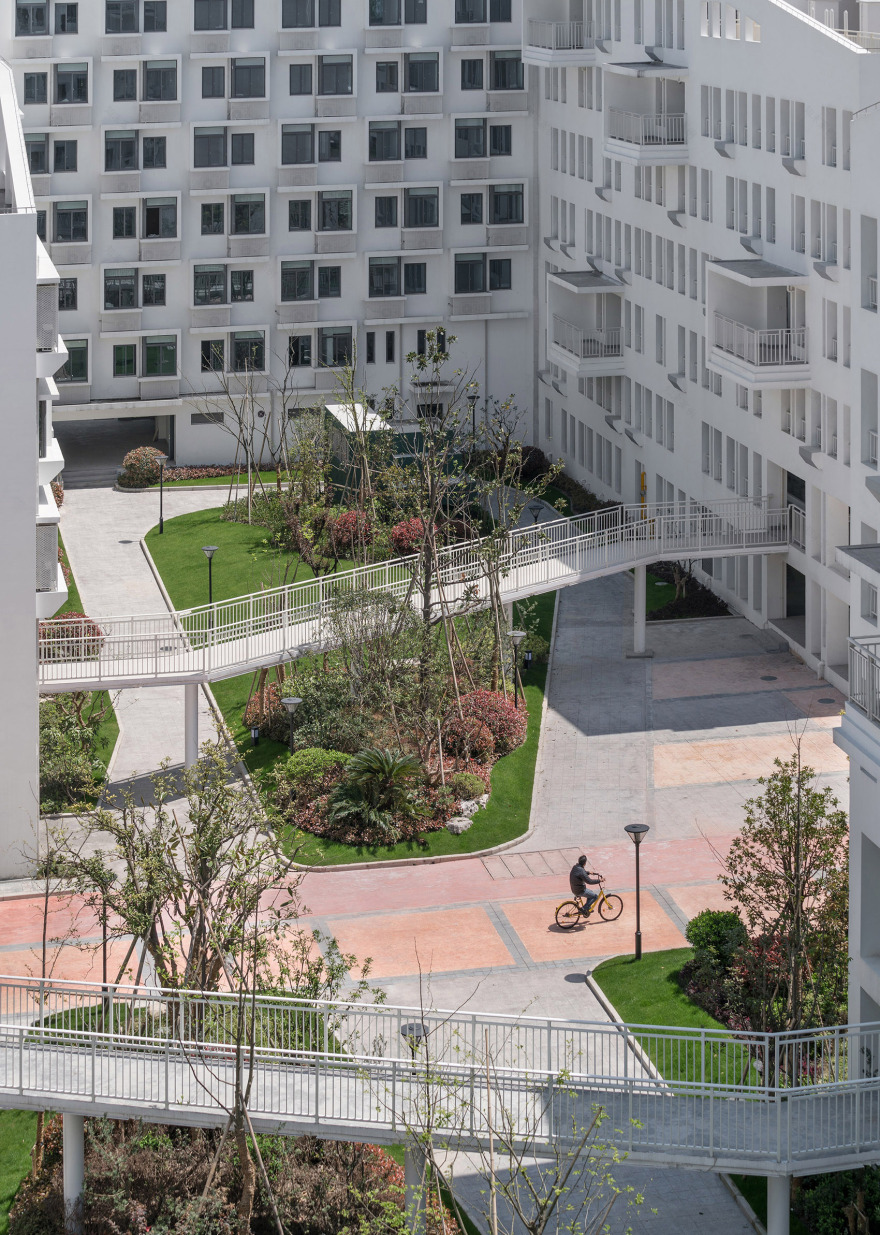

▼临港双限房,Lingang Price-fixed Housing Project©清筑影像
点击这里查看更多,Click HERE for details
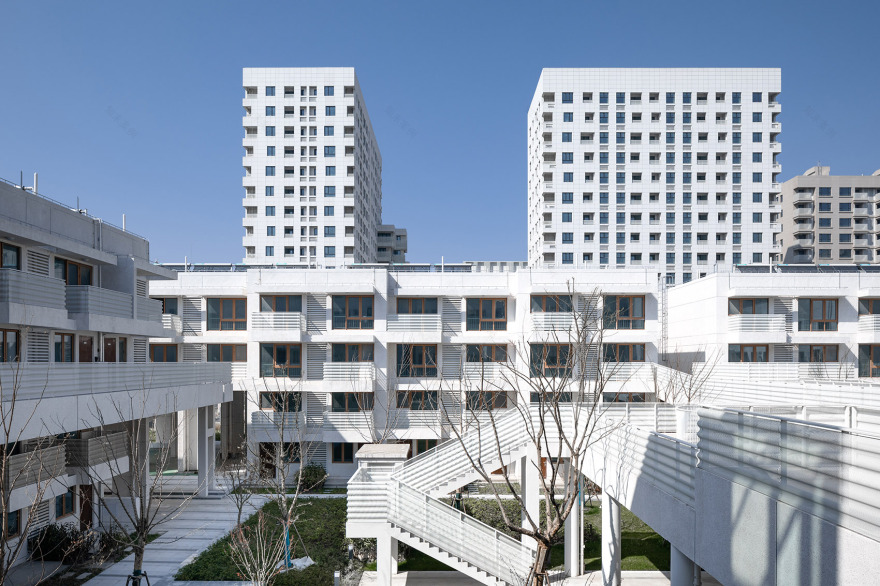
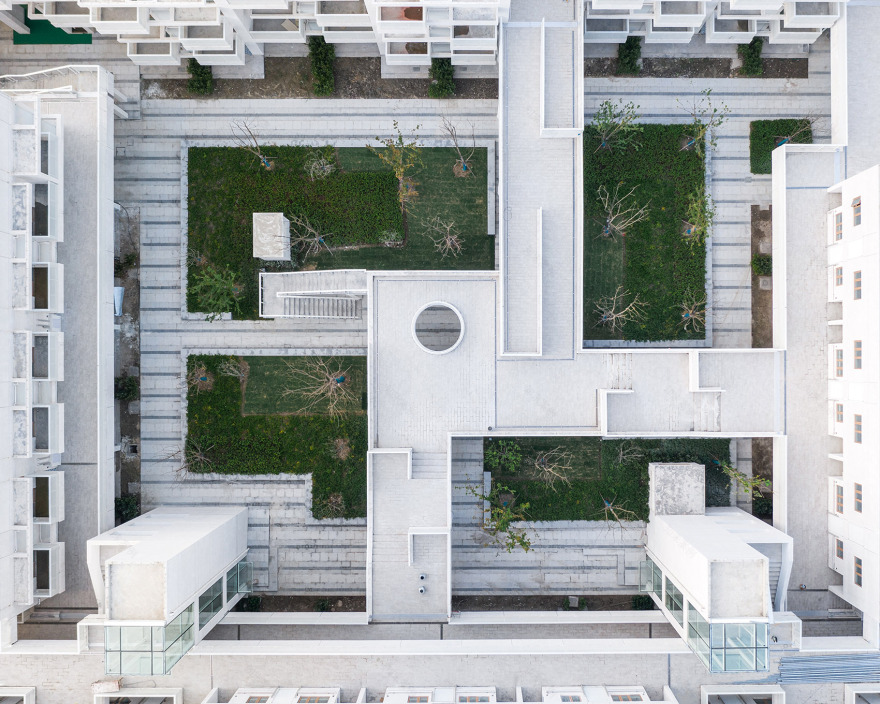
从社区到城市
From Community to City
8. 奉贤老年大学的空间秩序,立面开洞和材质肌理搭配形成了典雅的建筑语汇,在该项目中您是如何衡量和回应老年人审美或偏好的?
In Senior-Citizen University of Fengxian District, how do you measure and respond to the aesthetics or preferences of the elderly?
老年大学设计的时候我的心态非常平和,首先建筑不能做高,其次要将标准层撑满,这样是最适合老年人活动的,因为不需要上下很多楼梯,电梯的使用率也会减少。在基地上,8 层建筑的尺度以及 1:3 的横长比例也很舒服,朝向街道的面积也不大。
第二,基地的正中央有一排 70 年的香樟,所以老年大学选择跨过这排香樟做了东西配楼,中间为钢结构的连廊,让大家在过中庭的时候能看到下面一排老树。结果最终香樟还是被甲方拔除了,后续重新补种了一些大银杏树,也是很符合老年人的审美。
第三,在外立面的处理上,我觉得合适的古典元素是对老年人的尊重。比如中间垂幕一样的金属连廊,就考虑了一些古典的装饰艺术元素。内部路径也尽量做得简单,而且每一个教室都做了阳台,让老年人可以推着轮椅去阳台上坐一会。这个设计是无心插柳,结果意外的好,奉贤人民很喜欢。
During the design of the Senior-Citizen University, my mindset was very calm. Firstly, the buildings couldn’t be tall, and secondly, the standard floors should be fully utilized. This is most suitable for the elderly’s activities because it avoids the need for many stairs, reducing the usage rate of elevators as well. On the site, the scale of the 8-story building and a horizontal-to-vertical ratio of 1:3 were also comfortable, with the area facing the street not being too large.
Secondly, in the center of the site, there was a row of 70-year-old camphor trees. Therefore, the Senior-Citizen University chose to cross over this row of camphor trees to create an accessory building, with a steel-structured corridor in the middle, allowing people to see a row of old trees below when passing through the atrium. However, in the end, the camphor trees were removed by the client. Subsequently, some large ginkgo trees were replanted, which also aligned well with the aesthetic preferences of the elderly.
Thirdly, regarding the treatment of the exterior facade, I believe that appropriate classical elements show respect for the elderly. For example, considering some classical decorative art elements in the middle curtain-like metal corridor. The internal pathways were also kept simple, and each classroom had a balcony, allowing the elderly to push wheelchairs to sit on the balcony for a while. This design was unplanned but turned out unexpectedly well, and the people of Fengxian liked it very much.
▼奉贤区老年大学,Senior-Citizen University of Fengxian District©清筑影像 CreatAR
点击这里查看更多,Click HERE for details


9. “让新的更新,让旧的更旧,共生不一定是混合”,如何让“旧”的更旧呢?
What do you think about urban renewal and transformation
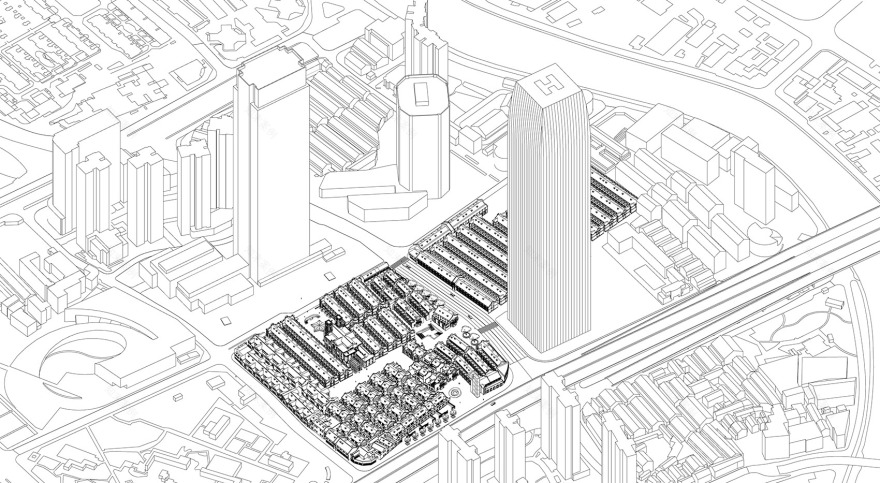
2014 年我们做了上海的一个国际竞赛,我们原来的办公室就处在老城区 1930 年的老洋房弄堂里,所以我对弄堂里面的建筑、生活、人的关系的一些东西的复杂度是有切身体会的。跟那些从国外来的大师们对弄堂的理解是不一样的。我们关注的是与日常生活更密切相关的东西,所以当时我就觉得弄堂里旧的机理应该保留翻新,而不是去盖新的综合楼。
当时跟我一起竞争的大师是普奖得主 David Chipperfield,他们做的方案就是基于欧洲的尺度街区,老房子空地里面插一些小小的高层新楼。但是在我看来这是不对的。因为这些新楼插进去之后,对原来保留的一小块轮廓是杀伤性的。所以,我当时就想把南面最大的街区全部保留,然后在北面腾出的空地,造一个 17 万平方米的超高层。这样南边 1940 年以前的街区才有保留的价值,才能够呈现街区之间错综复杂的历史关系。然后再将一些违章建筑拆除,以保护局部风貌,并保证老建筑不受高层之后基础施工的影响。虽然最后我们的方案没有被选中,但这个思想却实际影响了后来的实施方案。
在中国,我们这种新老混合的颗粒度是不一样的,颗粒粗大才能起到保留作用,因为我们值得看的街区太少了,不像欧洲到处都是非常漂亮的老街区,所以他们并不是在乎这个东西,而我们已经没有完整的街区了,我们希望保留一部分,然后做个超高层,远观的时候,老街区视觉上的轮廓线就会被完整地保留下来。
所以说“让新的更新,让旧的更旧”是基于我们在上海这种特定情况下的一种思想,这种思想也是偏激的,但是偏激的思想就是药,药是治病的,但药不能一直吃。
In 2014, we participated in an international competition in Shanghai. Our office was originally located in a 1930s villa in the old city area, so I had firsthand experience of the complexity of the relationships between buildings, life, and people in the alleys. Our understanding of alleys was different from that of the foreign masters. We focused on things more closely related to daily life, so I felt at that time that the old mechanisms in the alley should be preserved and renovated, rather than building new comprehensive buildings.
The Pritzker Prize laureate David Chipperfield also participated in the competition. Their proposal was based on European-scale neighborhoods, inserting small high-rise new buildings into the open spaces of old houses. But in my opinion, this was not right. Inserting these new buildings was detrimental to the preserved silhouette of the original space. So, I wanted to preserve the largest block in the south entirely, and then create a super high-rise of 170,000 square meters in the empty space in the north. This way, the street blocks from before 1940s in the south would have preservation value, showing the intricate historical relationships between the blocks. Then, some illegal buildings would be demolished to protect the local appearance and ensure that the old buildings were not affected by the construction of high-rises. Although our proposal was not selected in the end, this idea actually influenced subsequent implementation plans.
In China, our granularity of mixing old and new is different. Coarse granularity is needed for preservation because there are too few neighborhoods worth preserving, unlike Europe where there are many beautiful old neighborhoods. So, they don’t care about this, but we no longer have intact neighborhoods. We hope to preserve a part of it and then build a super high-rise so that when viewed from a distance, the visual silhouette of the old neighborhood can be preserved intact.
Therefore, the idea of “Make the new be newer, make the old be older” is based on a specific situation in Shanghai, and this idea is also radical, but radical ideas are like medicine. Medicine treats the disease, but you can’t keep taking it forever.
▼上海东斯文里改造方案,Shanghai East Siwenli renovation plan
10.您评价现代城市的郊区像是一个代码生成的产物,原因有四:1.土地财政;2.资本逐利;3.法律法规(粗暴的法规适用于不同的气候区);4.被洗脑的民众。那作为一名建筑师,您认为可以做哪些力所能及的事情来改善这一现象?
You evaluate modern urban suburbs as products of code generation for four reasons: 1. Land finance 2. Capital-driven profit-seeking 3. Laws and regulations 4. Brainwashed populace. As an architect, what do you think can be done to improve this phenomenon?
其实建筑师的作用是非常微弱的,但我们也确实默默地做了一些努力,比如说通过我们的专业思想尽量地去影响甲方,包括新城的决策者。
比如我们在奉贤做的城市设计,土地出让之前,以及经济效益来看,看定是做两排高层一圈裙房,这个结果是无可改变的。因此,在城市设计里,我们将商业区集中在北侧 40 米的范围内,并将这条规定写进土地出让合同中。地块被压缩之后,南面只能做 6 层,就达到了形成更加丰富的街景的目的。
我又是这个项目的审批专家,所以有的时候会去想一些办法去改变。之后我们又将北侧商业地块切得很碎,这是尽量让郊区不那么郊区化的一种做法,跟人的身体语言是有关联的。中国的现代城市就要下决心把自己切得稀碎,这么做的目的是想让城市生活回归街道空间,这些空间才是我们城市生活的灵魂与精神的所在。
此外,就是尽量的去促成规范层面的一些改动,比如龙南佳苑做完之后,新的租赁住房规范就对日照就放松了。这种松绑的可能,也会起到很多作用,也就不会产生全都住宅都是朝南的结果,进而也产生了很多对整体有好处的设计。规范层面是很重要的,同时也需要宣传上的努力,让人们知道我们这些方案是怎么生成的,它背后的故事是什么,基本上这几个层面都有努力的空间。
Actually, the role of architects is very weak, but we have indeed made some efforts quietly, such as using our professional thinking to influence the decision-makers, including the developers of new cities.
For example, in the urban design we did in Fengxian, before the land was sold and based on economic benefits, it was predetermined to build two rows of high-rise buildings with a ring of podiums. This result was unchangeable. Therefore, in urban design, we concentrated the commercial area within 40 meters on the north side and wrote this requirement into the land transfer contract. After compressing the plot, only 6 floors could be built on the south side, achieving the goal of creating a richer streetscape.
I am also the approval expert for this project, so sometimes I think of ways to make changes. Later, we divided the commercial plots on the north side into smaller pieces, which is a way to make the suburbs less suburbanized, related to people’s body language. China’s modern cities need to be determined to fragment themselves, with the aim of bringing urban life back to street spaces, which are the soul and spirit of our urban life.
Additionally, it’s important to push for changes at the regulatory level. For example, after Longnan Garden Social Housing Estate was completed, the new leasing housing regulations relaxed the requirement for sunlight exposure. This loosening of regulations can have a significant impact and prevent all residential buildings from facing south, leading to many beneficial overall designs. Regulatory changes are crucial, and efforts in publicizing how these solutions are generated and the stories behind them are essential. There is room for effort on these fronts.
▼奉贤南桥新城 10 单元城市设计方案,Fengxian Nanqiao New Town 10 unit urban design

思考与日常
Thinking and Daily life
11.
在您的文章中提到,您认为“建筑设计的内核是运算”,还说“我们过去的建筑教育中,总过于强调构图与形式,而忽略内在规律和算法”。能否给我们解读一下这句话,作为上海交通大学设计学院客座教授,同济大学建筑与城规学院设计导师,您对现在的建筑教育的看法是怎样的?
As a visiting professor at the school of design, SJTU and design instructor at CAUP Tongji University, what is your view on architectural education today?
我们传统的建筑教育,都是把建筑设计艺术化、神圣化,甚至玄学化的。但实际上,在做很多设计的时候,形式的背后是有大量的先决条件的,比如:容积率、气候条件、规模、交通组织,甚至比如基本房型和教室的大小,都会影响到最终的结果。如果统一以灵感、构图来囊括这一切数据的话,建筑设计有点变得太简单化了。此外,建筑设计还是一个跟人以及政治经济发生关系的产物,一旦牵扯到政治和经济,就有算计。这一系列统合的运算,才是多学科交叉的真正内核。
第二点就是,我们现在的建筑学概念是很宽泛的,有人说建筑学已经走向没落,它走向没落的原因有很多,当科学界都在努力地将所有的理论简化统一的时候,我们的建筑学却似乎愿意把自己孤立起来,这是逆科学的。所以说理论家并不是实践者,如果固守着这种通过以前的经验积累带来的他们认为完备的理论体系,那么就会让建筑学越来越落后。
现在孩子们的信息量是很大的,他们可能已经直接进入了人工智能时代,他们很多的设计方法跟我们是不一样的,所以更加证明了传统二维绘图时代产生的很多观点已经是被降维,那么现在我们需要升维思考,不然的话就会被别人降维打击。但我从来没有担心过人工智能取代人类,人工智能只是一个工具,我们能理解的人工智能是一个不同维度的世界和我们三维世界的交叉面。这个交叉面是我们认知的边界。建筑学也是多维度交叉学科,而它的外延和内核一直在不停的变,建筑学是少有的“理论指导不了实践”的一个行业,所以你要去适应这个变化。
Our traditional architectural education tends to artistry, sanctify, and even mystify architectural design. However, in reality, there are numerous prerequisites behind many designs, such as plot ratios, climatic conditions, scale, traffic organization, and even basic room types and classroom sizes, all of which can impact the final outcome. If we try to encompass all this data under inspiration and composition, architectural design may become overly simplified. Additionally, architectural design is a product that relates to people and socio-political economics. Once politics and economics are involved, calculations come into play. This series of integrated computations is the true core of interdisciplinary cross-disciplinary work.
Secondly, our current concepts in architecture are very broad. Some say that architecture has declined, and there are many reasons for this decline. When the scientific community is striving to simplify and unify all theories, our architecture seems to isolate itself, which goes against science. Therefore, theorists are not practitioners. If they stick to a supposedly complete theoretical system based on accumulated experience, architecture will fall further behind.
Children today are facing vast amounts of information, and they may have already entered the era of artificial intelligence. Many of their design methods are different from ours, proving further that many viewpoints generated during the traditional two-dimensional drawing era have been reduced. Now we need to think in higher dimensions; otherwise, we’ll be downgraded by others. However, I have never worried about artificial intelligence replacing humans. AI is just a tool. The AI we understand is a different-dimensional world intersecting with our three-dimensional world. This intersection is the boundary of our cognition. Architecture is also a multidimensional interdisciplinary field, with its extension and core constantly changing. It is one of the rare industries where theory cannot fully guide practice, so you have to adapt to this change.
▼张佳晶老师在上海交大授课期间照片,Zhang Jiajing teaches at Shanghai Jiaotong University


12. 您的网络昵称是 not2busy,现实中事务所实际工作模式是怎样的?平时怎样协调工作?
What does your network nickname not2busy mean? What is the actual working mode of GOM, and how do you usually coordinate work?
从 2010 年开始,我就几乎每天都在工作室。有这样的一些工作环境我觉得我是幸运的,首先要感恩,第二要享受。我跟植物和猫猫狗狗,甚至这里的空气都产生了长达这么多年的交流,所以养植物养狗都成为了我的标签。我晚上几乎没有应酬,因为 7:30 我要准时遛狗,跟呆萌相处的这 14 年,遛狗成了我生活中的一个特别重要的事情。当然我也会给自己留很多时间思考,我喜欢写文章,对哲学数学也非常迷恋,现在又迷上了看书。我一个那么不喜欢看书、看理论的人,最近好像慢慢的有点兴趣的转向,所以说不同的生活会造就你不同的价值观。
▼张佳晶老师与呆萌的合照,Zhang Jiajing and his dog

Since 2010, I’ve practically been in the studio every day. I consider myself fortunate to have such a work environment. First, I am grateful, and second, I enjoy it. I have had interactions with plants, cats, dogs, and even the air here for many years, so caring for plants and pets has become my label. I rarely have social engagements at night because I walk my dog promptly at 7:30. Over the past 14 years, spending time with my adorable dog has become a significant part of my life. Of course, I also allocate a lot of time for contemplation. I enjoy writing articles, am deeply fascinated by philosophy and mathematics, and have recently developed a hobby for reading. I used to dislike reading and theory, but lately, I seem to be developing an interest in them. Different experiences in life shape different values.
▼张佳晶老师与呆萌的合照,Zhang Jiajing and his dog

现状与未来
Present and Future
13.
目前事务所的现状如何,正在进行哪些项目?未来有哪些想要拓展或挑战的领域?
What projects are GOM working on? What areas do you want to expand or challenge in the future?
那么现在进展最大的项目就是万科未来城市的理想之地,时隔多年终于回归房地产。万科用我的目的可能就是觉得我很全面,既有古典主义的训练,又不排斥现代主义,同时又懂房地产,心态又好,还是城市规划方面的专家,那么做这个项目再合适不过了,所以我们现在配合得也挺愉快。在比较全面的语境下,建筑师和房地产就非常容易对话了。
同时进展的还有两个幼儿园,一个初中,以及奉贤马上竣工的上江南商业,还有社会住宅 4.0 的项目,它是龙南佳苑之后的升级版,也就是 apartment 2.6 的升级版,这次升级旨在简化,也总结了原来的错误所在。
现在很多人在想找一些新的赛道,我也在跟很多朋友探讨。前段时间吱音找我们设计了三款家具,其中一款是“跟呆萌的相处的桌子”的升级版,还有一款是嵌套的柜子,这是建筑师很容易转向的赛道,在这个赛道毕竟我们只是做设计,如何变成成品可能还需要去努力。还有很多人希望我去做网络流量博主,因为他们都觉得我特别具备跨界的潜质。我自己也在琢磨,比如说是不是可以做一些网上授课、网上讲座等。这个行业似乎到了一个非常残酷的冬天,但是我们还在坚持。我特别希望有机会再做一个类似于“目外工作室”的项目,去做一些摒弃了规训,无拘无束的、自由的建筑尝试。
▼万科未来城市-理想之地,Vanke Future City – Ideal place
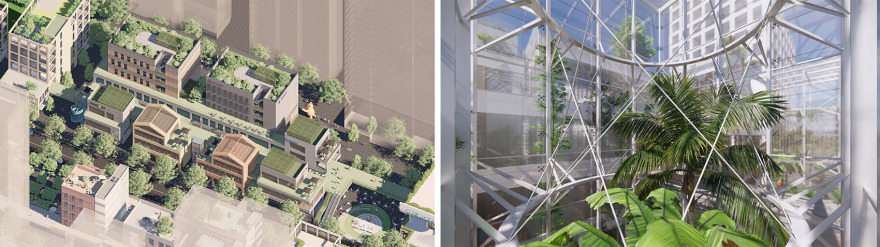
▼其他正在进行中的项目,Ongoing projects
▼家具设计,Furniture design

Our firm’s most significant ongoing project is the Vanke Future City, marking our return to real estate after many years. Vanke probably chose us because they see me as comprehensive—I have training in classicism but am not exclude to modernism. Moreover, I understand real estate, have a good mindset, and am an expert in urban planning. So, collaborating on this project is quite fitting, and we’re enjoying it. In a comprehensive context, architects and real estate can easily engage in dialogue.
We are also progressing with two kindergartens, a junior high school, the imminent completion of Up-Jiangnan Commercial Center in Fengxian, and a project called Social Housing 4.0, an upgraded version after Longnan Garden project, known as Apartment 2.6. This upgrade aims to simplify and rectify past mistakes.
Many people are looking for new avenues, and I’m discussing ideas with many friends. Recently, ziinlife commissioned us to design three furniture pieces, including an upgraded version of the “Living with a Cute Dog Table” and a nested cabinet. Furniture design is a track architects can easily transition into, although turning designs into finished products may require effort. Many also suggest I become an influencer in online content because they see potential for me in cross-disciplinary work. I’m contemplating options like online teaching and lectures. The industry seems to be in a harsh winter, but we persist. I’m especially keen on another project like “MOA Studio,” focusing on free and unrestricted architectural experiments, devoid of conventions and rules.
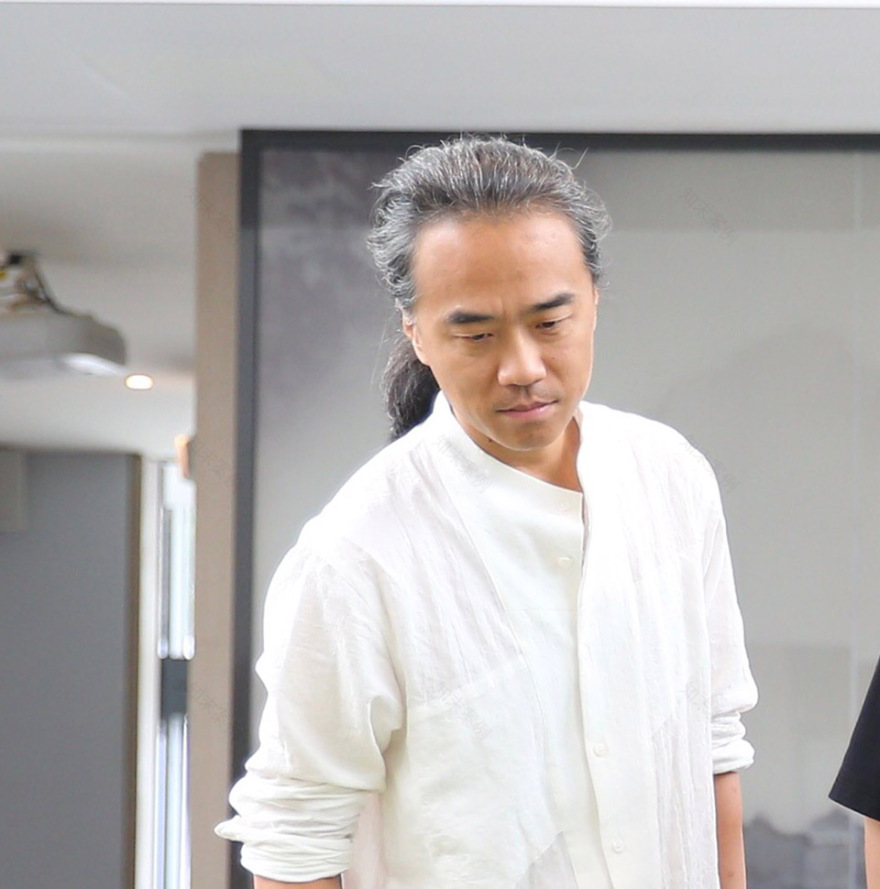
▼张佳晶,Zhang Jiajing


南京喵熊网络科技有限公司 苏ICP备18050492号-4知末 © 2018—2020 . All photos and trademark graphics are copyrighted by their owners.增值电信业务经营许可证(ICP)苏B2-20201444 苏公网安备 32011302321234号
苏公网安备 32011302321234号客服
消息
收藏
下载
最近