

创作上传
VIP
收藏下载
登录 | 注册有礼
查看完整案例

收藏

下载

分享
© CU office
Path yard: Zhiruan Digital Art Gallery is located at Zhaozuizi Hutong No. 86, 88 and 90 in the Tianqiao Historical and Cultural District in Beijing. As one of the pilot projects for the organic renewal of the northern bungalow area of Tianqiao, the project has not only made important attempts in building renewal, but also played the role of a pilot project in serving the organic renewal of the business model of the Tianqiao Performing Arts District. “Path yard: Zhiruan Digital Art Gallery” will become an important node in the micro museum clusters in the hutongs of the northern bungalow area of Tianqiao. Together with projects such as the “Symbiotic Apartment” that are renovated from the tenement courtyards, the micro museum spaces of the renewed whole-yards will form an organic network between the organically renewed architecture and social ecology of the northern bungalow area of Tianqiao.
▼沿街立面,facade facing the alley©金伟琦


▼沿街立面,facade facing the alley©金伟琦

该项目改造前原址包括了位于地块北侧邻赵锥子胡同的平顶砖混结构建筑(赵锥子胡同 90 号),以及位于地块南侧的小四合院(赵锥子胡同 86、88 号),两个部分。它们分别拥有各自的出入口,并且都从赵锥子胡同进入。这在此后的更新设计中得到了保留。
由于该项目地点位于北京中轴线风貌管控区内,因此受到严格的风貌保护方面的管控。更新建筑的尺度不能突破原有建筑的尺度,同时古建的部分也要完全按照古建的方式建造。这就造成了两组性格迥异的空间在同一地块内的状况:在北侧拥有一个相对高大的近似正方形的现代平顶空间和位于南侧的低矮的坡顶的四合院空间。
同时业主并不希望将这两个空间分割为两个不同功能的独立部分,而是整体联通为展馆使用,因此如何将它们连接在一起成为设计概念的重要起点。
Before the renovation of the project, the original site included a flat-roofed brick-concrete structure building (Zhaozuizi Hutong No. 90) on the north side of the plot adjacent to Zhaozuizi Hutong, and a small courtyard (Zhaozuizi Hutong No. 86 and 88) on the south side of the plot. Each had its own entrance entering from Zhaozuizi Hutong. This has been retained in the renewal design. Since the project site is located in the style and appearance control area of Beijing city central axis, it is subject to style and appearance protection control. The scale of the renovated building cannot exceed the scale of the original building, and the ancient building part must be built in the way of traditional Beijing courtyard building. This results in two groups of spaces with very different characters in the same plot: a relatively tall, nearly square modern flat-roofed space on the north side and a low, slope-roofed courtyard space on the south side. At the same time, the owner does not want to divide these two spaces into two independent parts with different functions, but to connect them as a whole for exhibitions, so how to connect them together becomes an important starting point for the design concept.
▼北侧平顶空间室内,flat-roofed space on the north©金伟琦


▼玻璃砖细部,glass brick details©金伟琦

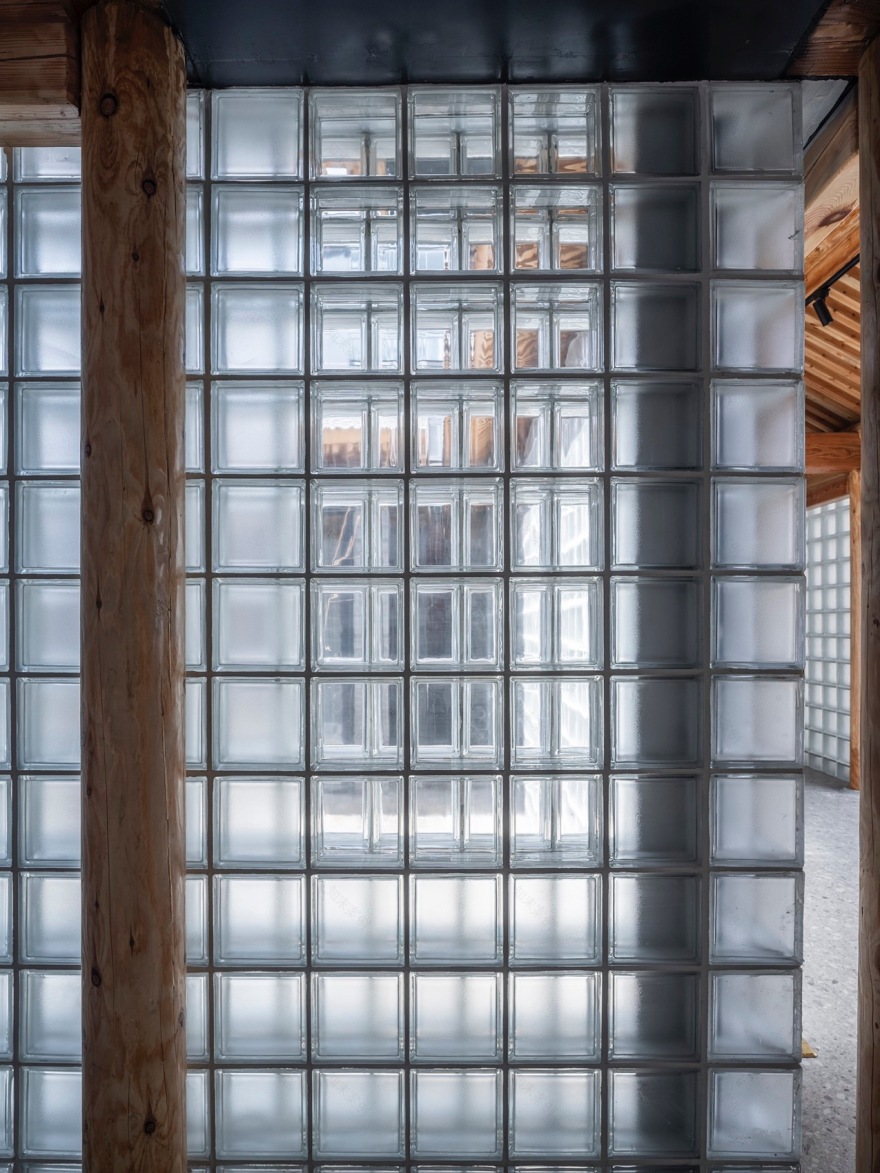
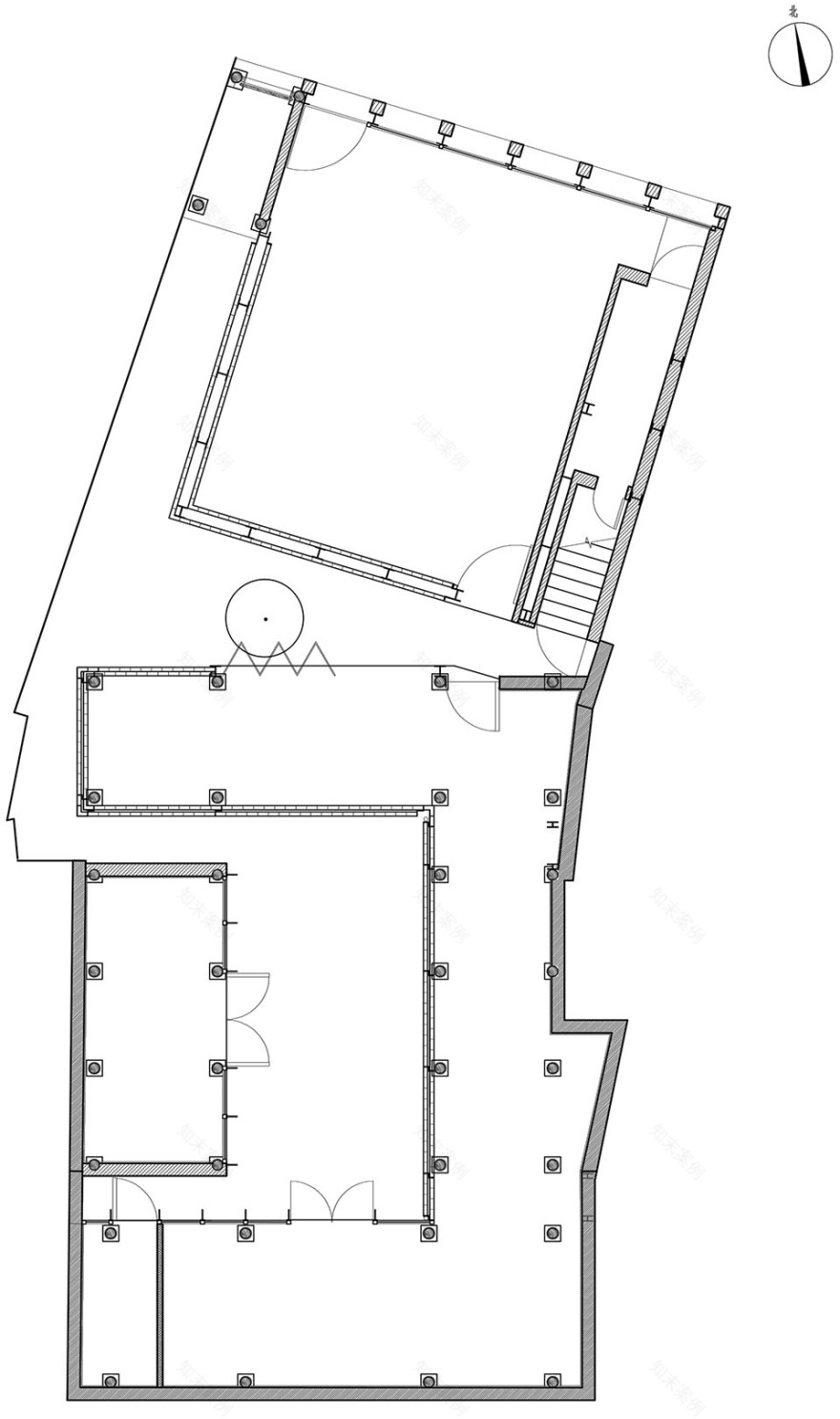
我们将建筑的主入口设计在北侧正方形空间的立面上,这样参观的人流将首先进入正方形空间,然后向南进入四合院的展厅之中,按顺时针方向参观,最后从北侧院落的出口走出并回到赵锥子胡同。为此,在正方形空间与四合院两组建筑中,我们用玻璃砖建造一组连续的墙体,将这两组建筑连接在了一起。不仅在视觉上将位于地块西侧的院落空间与东侧的室内空间融合为一体,更重要的是将四合院的首要朝向从南北向更新为东西向,使得相对独立的西厢房拥有了最佳的庭院视角。而在玻璃砖外侧的室外空间都成为了博物馆空间的外部景观:一组借景——活生生的胡同生活的剧场景观。因此,该项目的更新设计在一开始就将建筑、室内与园林景观作为一个整体来进行设计的。
The main entrance of the building was designed on the facade of the square space on the north side, so that visitors can first enter the square space and then go south to the exhibition spaces of the courtyard, visiting in a clockwise direction, and finally walk out of the exit of the courtyard on the north side and return to Zhaozuizi Hutong. For this reason, glass bricks were proposed to build a continuous wall in the square space and the courtyard to connect the two groups of buildings together. Not only does it visually integrate the courtyard space on the west side of the plot with the indoor space on the east side, but more importantly, it changes the primary orientation of the courtyard from north-south to east-west, so that the relatively independent west wing house gains the best view to the yard. The outdoor space outside the glass bricks has become the external landscape of the gallery space: a set of borrowed scenery – the theater-like landscape of the living Hutong life. Therefore, the renewal design of this project considers the architecture, interior and landscape garden as a whole from the beginning.
▼正方形空间与四合院之间的过道,corridor between square space and the courtyard©金伟琦


▼过道夜景,corridor night view©金伟琦


▼玻璃砖将两组建筑连接在一起,glass bricks connect the two groups of buildings together©金伟琦

▼胡同生活的剧场景观,theater-like landscape of the Hutong life©zhang xuefeng

▼窄巷,narrow lane©金伟琦


建筑更新的过程是在小心翼翼中完成的。整个项目地块是嵌入在周边邻里之中的,除了面向赵锥子胡同的北立面可以独立建造,其他方向的外墙几乎全部是与邻居的共用墙,不仅不能拆除,而且还需要加固。特别是南侧四合院的部分,还有部分屋面与邻居共用,这为建筑的更新带来了更为复杂的问题。位于北侧的正方形空间,由于胡同空间的狭小,使得大型车辆与设备无法抵达现场,因此 8 米长的钢梁被分割为更小的长度以便于人力搬运与施工。
The process of building renewal was completed with great care. The entire project plot is embedded in the surrounding neighborhood. Except for the north facade facing Zhaozuizi Hutong, which can be built independently, the exterior walls in other directions are almost all shared walls with neighbors, which cannot be demolished and need to be reinforced. Especially in the part of the courtyard on the south side, part of the roof is shared with neighbors, which brings more complicated problems to the renewal of the building. In the square space on the north side, due to the narrow hutong space, large vehicles and equipment cannot reach the site, so the 8-meter-long steel beam is divided into smaller lengths for manpower handling and construction.
▼四合院内部庭院,inner courtyard©金伟琦

▼庭院,inner courtyard© zhang xuefeng

▼四合院室内望向庭院,courtyard view from interior©金伟琦

▼南侧四合院室内概览,south building interior overview©金伟琦


▼玻璃砖细部,glass bricks detail©金伟琦
▼轴测,axon© CU office

▼总平面图,site plan©CU office

▼改造后平面图,existed plan©CU office

▼改造前平面图,floor plan©CU office
▼景观平面图,landscape plan©CU office

▼立面图,elecvations©CU office


▼剖面图,sections©CU office

▼细部构造,detail©CU office

项目名称:巷院:知阮数字艺术馆
项目地点:赵锥子胡同 86、88,90 号,天桥地区,北京市
项目功能:胡同博物馆 (建筑、室内、景观)
设计类型:公共建筑
占地面积:255.6 平方米
建筑面积:175.3 平方米
设计时间:2023 年
竣工时间:2024 年
项目业主:北京天桥衡融投资有限公司
项目设计:北京超城建筑设计有限公司
主创建筑师:车飞、章雪峰
设计团队:穆高杰(建筑)、揭以彤(建筑)、陈海凤(室内设计)、黄骁洋(景观)、陈逾(实习生)
机电与给排水:霍金龙、肖文兴、张乔红
结构顾问:李平
建筑摄影:金伟琦
Path Yard:Zhiruan Digital Art Gallery
project name: Path Yard:Zhiruan Digital Art Gallery
Location: Zhaozhuizi Hutong No.86,88,90, Beijing Tianqiao, China
Program: museum
Design Type: Public building (architecture, interior, landscape)
Building area: 175.3 M2
Site area: 255.6 M2
Design time: 2023
Construction: 2024
Client: Beijing Tianqiao hengrong investment Co., Ltd.
Design office: CU office
Chief architects: Che Fei, Zhang Xuefeng
Design team: Mu Gaojie, Jie yitong, Chen Haifeng, Huang Xiaoyang, Chen Yu
Mechanical Engineer: Huo Jinglong, Xiao Wenxing, Zhang Qiaohong
Structure engineering Consultant: Li Ping
Photography by: Jin Weiqi
南京喵熊网络科技有限公司 苏ICP备18050492号-4知末 © 2018—2020 . All photos and trademark graphics are copyrighted by their owners.增值电信业务经营许可证(ICP)苏B2-20201444 苏公网安备 32011302321234号
苏公网安备 32011302321234号客服
消息
收藏
下载
最近