

创作上传
VIP
收藏下载
登录 | 注册有礼
查看完整案例

收藏

下载

分享
沈抚新区是新兴的国家级产业园区,位于沈阳和抚顺的城际交接线附近,其无垠开阔的大地空间状态无异于中国北方类似平原城市的产业园区或经济开发区。沈抚新区智能制造产业园是新区内唯一由政府出资建设的产业园,占地公顷,建筑面积 18 万平方米,以扶植和发展由沈阳智能制造所衍生的产业链为目的。位于初期 3 万平米的样板起步区内的科技中心虽然面积不大只有 3300 平方米,却要担负产业招商、展示、销售、产业孵化、员工食堂等诸多功能需求及未来可变功能的承担。
Shenfu New Zone is a newly developed national industrial park on the border between Shenyang and Fushun. Its openness and vastness are not different from most industrial park zones or economic development zones in cities in the plain of North China. Shenfu New Zone’s intelligent manufacturing park is the only industrial park invested by the government. It covers an area of 18,000 square meters, aiming to support industrial chains developed by intelligent manufacturing industries in Shenyang. While the technology center has only an area of 3,300 square meters within the 30,000-square-meter start-up area, it takes multiple functions such as advertising, exhibitions, sales, business incubators, staff canteen, etc. In the future, it will also include more roles that are ever changing.
▼主入口视角,Main entrance view© C+Z 工作室

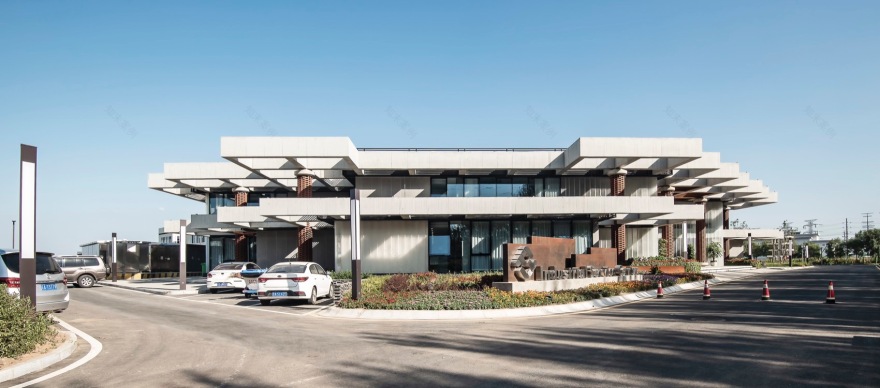
▼主入口绿化,Greening of the main entrance© C+Z 工作室

理念的赋予
Design Idea
沈阳,新中国工业的摇篮,东北地区唯一的中心城市,沈抚新区智能制造产业园科技中心做为样板起步区内彰显政府工作理念和服务意识的建筑,势必被要求赋予更多的文化隐喻、绿色概念引领示范和多功能适应度的需求。建筑师受古代都城九宫格构图及中国结形态构成的启发,以九宫格网格旋转 45 度的菱形构图,隐喻盛京都城和当下智能制造的互联互通,形成中央南北两处高大空间通过东西两侧小庭院围绕两层灵活办公空间的平面构成。北侧的无柱贯通高大空间配有天光采光的展示厅(相当于展示园区规划理念及政策的观摩厅);南侧带天窗调节微气候的高大空间是公共食堂;两侧小庭院及屋顶观光花园既是空间组合的连接节点,又是形成绿色节能、通风、采光理念的物化实景展示。
Shenyang, the industrial cradle of People’s Republic of China, is the only national central city in the Northeast. As a building showcasing service awareness of the government, it must present more cultural metaphors, green design concepts as well as fulfillment of multiple functions. Inspired by nine-grid layout of ancient imperial capitals and shape of Chinese knots, the architect composed a rhombus with a 45-degree rotation of the nine-grid network. It metaphorizes the imperial capital of Shengjing’s connection to the contemporary intelligent industry. The layout gives rise to two tall spaces in the north and south, connected by small courtyards on the east and west sides, flexibly surrounding two levels of office spaces. The column-free tall space on the north side has an exhibition hall with a skylight. The hall showcases concepts and policies of planning. The tall space on the south side with a skylight to moderate the microclimate is a public canteen. The small courtyards on both sides and the roof garden are both a nexus of spatial juxtaposition and a manifestation of green sustainability, ventilation, and lighting.
▼内庭院视角,Inner courtyard view© C+Z 工作室

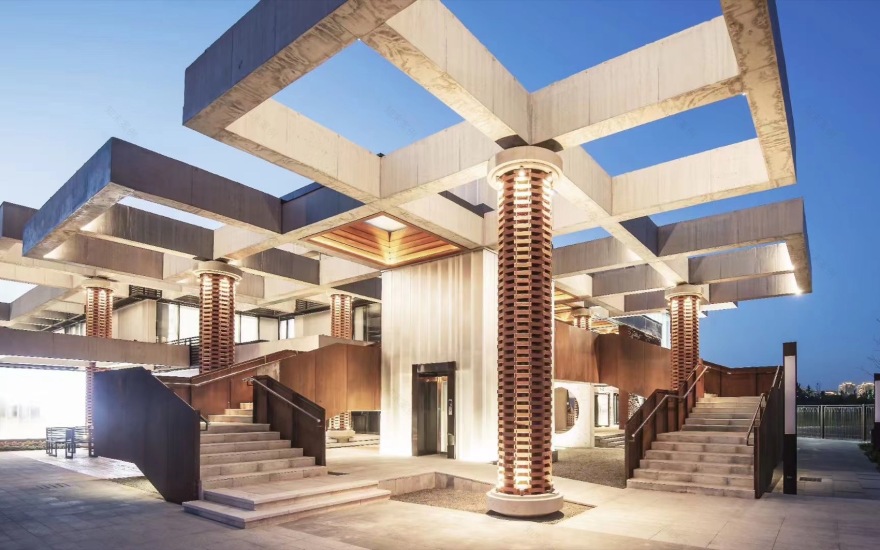
▼餐厅入口夜景,Restaurant entrance night view© C+Z 工作室
场域的控制
Site Control
科技中心的面积指标及造价管控导致如何与环境互动,以及建筑本体的形式能够赋予突出的表现力,有效控制地段周围反复重复的标准化工业厂房样态是此设计的难点。面对如此大规模以生产制造为主导功能的产业园区,通过多重材质的精细组合,结合格构花架的外立面表现方式,严格控制建筑体量尺度同时强化建筑屋面水平延展的表现力,以人性化设计尺度的推敲将屋顶及庭院绿化与建筑造型和环境景观有机结合形成设计的整体表现力,达到对周边相似度极大场域的有效控制和建筑本体自我个性的确立。
It is challenging to determine how the control of area and cost at the technology center negotiates with the environment, how the architectural form possesses an outstanding performance, and how the repetitive typology of the standardized industrial buildings in the surroundings can be manipulated. Faced with such a large-scale industrial park dominated by manufacturing, the design combines multiple materials and composes the facade with a grided trellis, strictly controlling the scale while extending the horizontal volume. Based upon a user-friendly dimension, the greenery of the rooftop and courtyard is organically fused with the constructed environment to achieve the performance and efficacious control of the surroundings and define the distinct identity of the technology center.
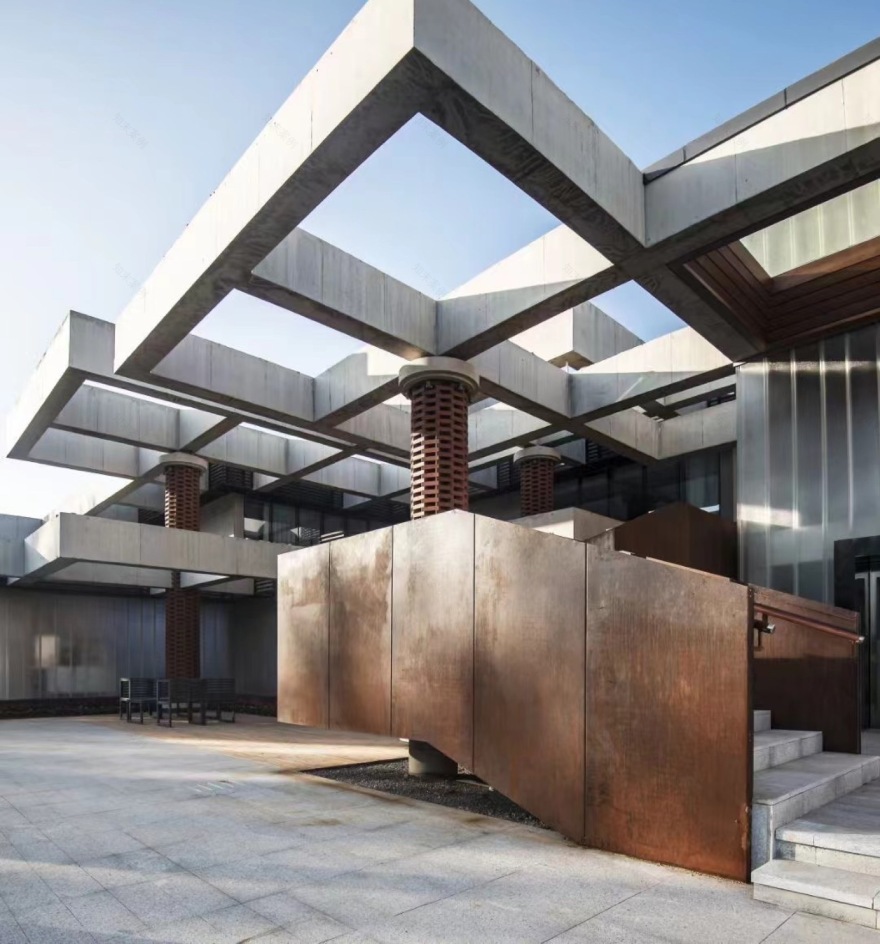
▼清水混凝土与锈蚀耐候钢板,Exposed concrete and corroded weathering steel plate© C+Z 工作室

▼阵列延展的屋架,Array extended roof truss© C+Z 工作室
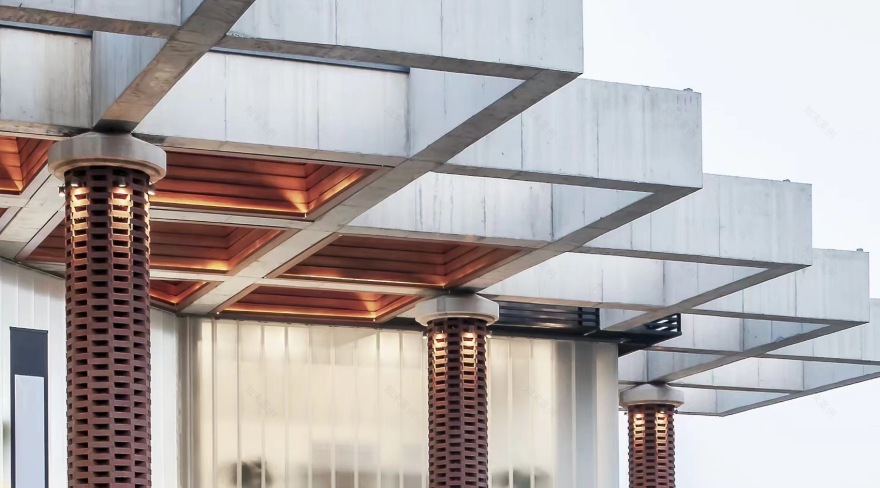
▼屋架细部,Truss detail© C+Z 工作室

设计的节省
Saving Costs for Design
让建筑物美价廉是当下经济运行周期中业主的共识,建筑师从设计的本原来思考节省的问题。在平面设计中,利用无柱开放流动的大空间应对未来不确定性的功能可能性,以增加平面及空间承担未来不确定性的韧性能力。尤其食堂高大空间利用屋顶遮阳可开启天窗及两侧内庭空间形成天然对流通风设计,辅助电风扇补充空气对流(同时满足消防自然排烟需求),免去此处食堂大空间空调及消防机械排烟的设备配备;室内办公空间利用铝拉伸网板做天棚吊顶使其更利于设备的更换和维修,免除设备末端定位及检修口定位的痛点,并巧用防火规范取消消防喷洒系统,让空间和天棚更加高效、简洁美观且节省造价;利用常规材料体现建筑设计特色,格构式屋顶和柱子通过合理利用当地的竹胶板模板的工艺和适宜的混凝土清水施工作法,体现混凝土素材的天然美感,清水砼与机制红砖拉空砌筑方式及锈蚀耐候钢板的混搭,体现服务于现代智能工业产业园的科技孵化中心对人文情怀的投射和关注;运用工业标准化幕墙常规材质:钢化 U 型玻璃、预制增强纤维清水混凝土预制掛板、普通玻璃幕墙、铝单板等多种幕墙的组合,通过技术设计和施工过程中对节点精准度的反复打样测试及把控,以多重普通材质的高精准度组合实现对现代智能化制造工业命题的表达,同时也有效控制造价;建筑师以旋转 45 度模数的柱网、屋顶花园、自由平面、超大延展的屋顶灰空间、连续多重组合的幕墙透射自然环境及屋顶的景观,赋予建筑一定的人文隐喻,以工业化常规材质的朴素表达向实践现代工业的早期现代主义建筑大师致敬。
Clients have reached consensus that architecture should cost them less while performing well during the economic downturn. Architects explore the solution from the nature of design, in which use of column-free and floating open spaces can help deal with uncertain functions and improve resilience of the plan and the space in the future. With roof shading, the open space of the canteen can open the skylight and the interior atrium spaces on both sides to form natural convective winds in support of electric fans and simultaneously fulfil fire safety regulations so that the canteen does not require any air conditioning and fume extractor systems.
The offices adopt aluminum stretch mesh as the sprung roof to make it easier better maintain or renew equipment to avoid hindering situation of endpoint and access panel of equipment. In this way can the designers refer shrewdly to fire regulations to cancel spray systems so that the space and the ceiling will be more efficacious, neat, and beautiful. The architects utilize regular construction materials to show distinct identity: grided roof and columns are made of bamboo plywood molds, materialized by local craftsmanship, and appropriate amount of reinforced concrete to showcase material aesthetics. Reinforced concrete, machine fabricated red bricks, and climate-resistant steel panels reflects projection and care of the technology incubation center toward humanist considerations. The architects also use standardized materials for the curtain wall: tempered U-shaped glass, prefabricated reinforced concrete overhang panels, and aluminum veneer. Following repeated tests and regulations, the precise combination of multiple construction materials manifests intelligent manufacturing industries while constraining costs.
The architects offer the building a humanistic metaphor in reflection of its landscape based upon a column grid in rotation of 45 degrees, a rooftop garden, a free plan, an expansive grey space of the roof, and consecutive curtain walls. The conventional but plain industrialized materials pay a tribute to the masters of early modernism who practiced design for modern industries.
▼入口大堂的光影,Light and shadow in the entrance lobby© C+Z 工作室

结语
End Words
十年地产经济的降速及城市正处于产业的转型期,东北区域的政府投资项目资金控制严格,限价设计与运营策划的前置渐成普遍状态,而体现当下理念的绿色、节能、节地等先进理念需求又必不可少,业主总是希望以最节省的造价让建筑还能担负更多的使命和功能韧性成为市场的常规诉求,因此建筑师强化造价意识同时极大的发挥设计的力量,以建筑学设计本真出发以灵活多变的空间韧性来满足不确定性的未来功能、以真诚适宜的材质、空间及光影塑造力求让小型公共建筑能够承担起业主多方位多角度的诉求。
Following the recession of real estate businesses and the transformation of urban industries, the government in the Northeast has strengthened regulations on investment and funding. It is common that restrictions on costs of design and management take place, whereas the clients now still emphasize greenery, sustainability, and land use efficiency as progressive concepts. They always wish to bring to the buildings more programs and resilience, which have been the regular demand in housing markets. Therefore, architects need to intensify power of design while raising consciousness of saving costs to authentically create flexible spaces to fulfil uncertainty in the future. They should also make small-sized public architecture cater to requests from their clients in terms of authentic and comfortable texture, materiality, space, and lighting.
▼休憩空间夜景,Night view of recreation space© C+Z 工作室
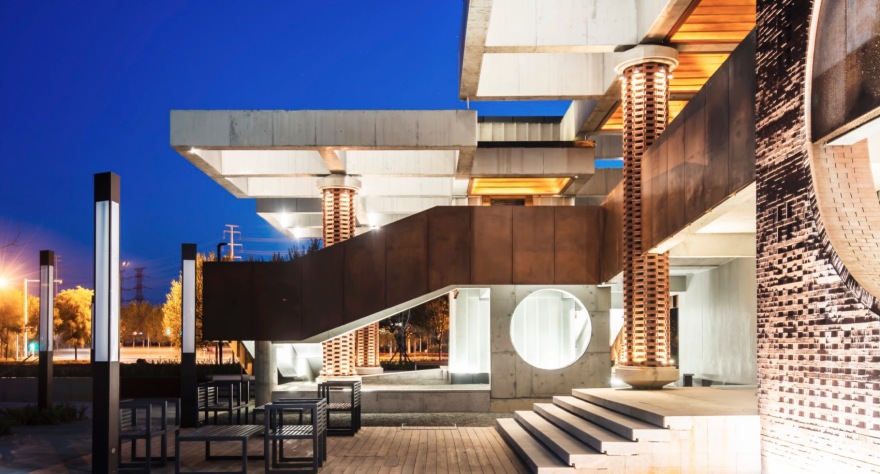
▼屋面绿化夜景,Roof green night view© C+Z 工作室

▼轴测图,Axonometric drawing© C+Z 工作室

▼剖透视图,Cutaway perspective© C+Z 工作室

▼总平面图,General Plan© C+Z 工作室

▼首层平面图,First floor plan© C+Z 工作室

▼二层平面图,Second floor plan© C+Z 工作室

▼7.65 米标高平面图,7.65 meter elevation plan© C+Z 工作室
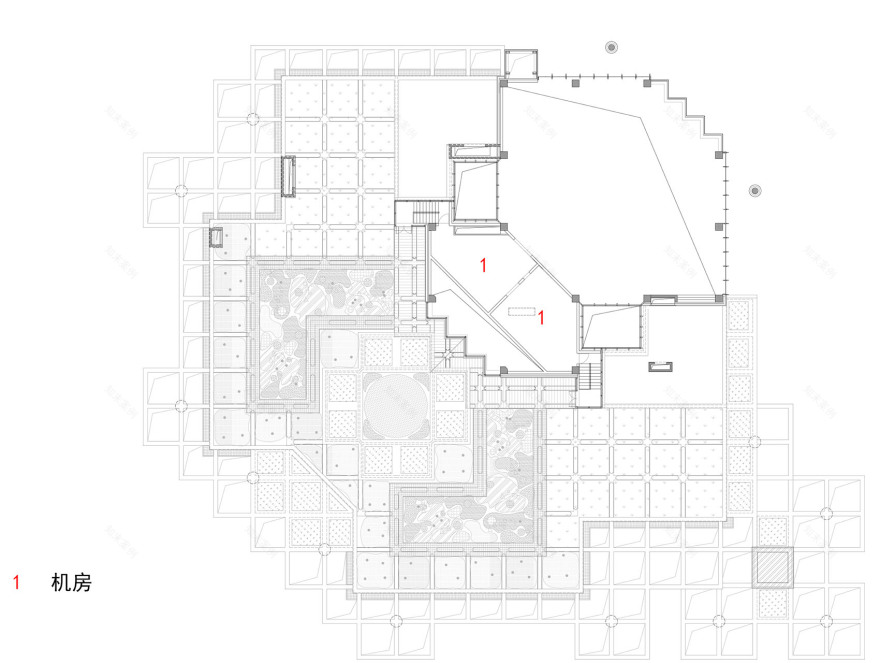
▼屋顶平面图,Floor plan of the roof© C+Z 工作室

▼东立面,East elevation© C+Z 工作室

▼西立面,West elevation© C+Z 工作室

▼南立面,South elevation© C+Z 工作室

▼北立面,North elevation© C+Z 工作室

▼剖面图,sections© C+Z 工作室


▼节点大样图,Large node diagram © C+Z 工作室

项目名称:沈抚新区智能制造产业园科技中心
项目类型:工业/办公
设计方:C+Z 建筑师工作室
项目设计:2022.02
完成年份:2023.07
设计团队:崔岩 刘振洋 隋迪 赵晓林 王瑶瑶
项目地址:辽宁省沈阳市沈抚新区
建筑面积:3245㎡
摄影版权:C+Z 建筑师工作室
客户:辽宁省沈抚示范区开发投资集团有限公司
材料:清水混凝土、锈蚀耐候钢板、U 型玻璃、红砖砌筑、预制混凝土掛板
Project name:Technology Center at Intelligent Manufacturing Industrial Park in Shenfu New Zone
Project type:Industry/Office
Design:C + Z architect studio
Design year:2022.02
Completion Year:2023.07
Leader designer & Team:Yan Cui、Zhenyang Liu、Di Sui、Xiaolin Zhao、Yaoyao Wang
Project location:Shenfu New District, Shenyang City, Liaoning Province
Gross built area:3245㎡
Photo credit:C + Z architect studio
Clients:Liaoning Shenfu Demonstration Zone Development and Investment Group Co LTD
Materials:reinforced concrete、climate-resistant steel panels、tempered U-shaped glass、machine fabricated red bricks、prefabricated reinforced concrete overhang panels
南京喵熊网络科技有限公司 苏ICP备18050492号-4知末 © 2018—2020 . All photos and trademark graphics are copyrighted by their owners.增值电信业务经营许可证(ICP)苏B2-20201444 苏公网安备 32011302321234号
苏公网安备 32011302321234号客服
消息
收藏
下载
最近