

创作上传
VIP
收藏下载
登录 | 注册有礼
查看完整案例

收藏

下载

分享

翻译
Architects:REX ARCHITECTURE
Area:129000ft²
Year:2023
Photographs:Iwan Baan
Acousticians:Threshold Acoustics
Structural Engineers:Magnusson Klemencic Associates
Founding Principal:Joshua Ramus
Personel:Dylan Bachar, Wanjiao Chen, Adam Chizmar (PL), Maur Dessauvage (PL), Nazli Ergani, Alysen Hiller Fiore (PL), Sebastian Hofmeister, James Killeavy, Claire Kuang, Kirby Liu, Weronika Marciniak, Joshua Ramus, Raul Rodriguez, Emma Silverblatt, John Sng, Vaidotas Vaiciulis, Xuancheng Zhu
Competition Team:Giannantonio Bongiorno, Adam Chizmar (PL), Alberto Cumerlato, Mahasti Fakourbayat, Alysen Hiller Fiore (PL), Gabriel Jewell-Vitale, Min Kim, Dominyka Mineikyte, Elizabeth Nichols, Joshua Ramus, Raúl Rodríguez García, Michal Sapko, Emma Silverblatt, Elina Spruza Chizmar, Michele Tonizzo, Vaidotas Vaiciulis, Michael Volk, Cristina Webb
Executive Architect:Davis Brody Bond
Civil Engineering:Philip Habib
Façade Consultants:FRONT
Structural Consulting Engineers:Silman
Interior Architects:Rockwell Group
Signage Designer:Entro
Lighting Design Consultants:Tillotson
Construction Managers:Sciame Construction
Project Managers:DBI
Sustainability Consultants:Atelier Ten
Audiovisual:Boyce Nemec
Commissioning Consultants:Cosentini
Cost Management Consultant:Cost+Plus
Security Design Consultant:Ducibella Venter & Santore
Stone Consultants:FMDC
Vertical Transportation Consultants:Jenkins & Huntington
Concrete Consultant:Reg Hough Associates
Security Consultants:Risk & Protection Consulting Services
Wind Engineer:RWDI
Waterproofing:WJE Engineers
City:New York
Country:United States
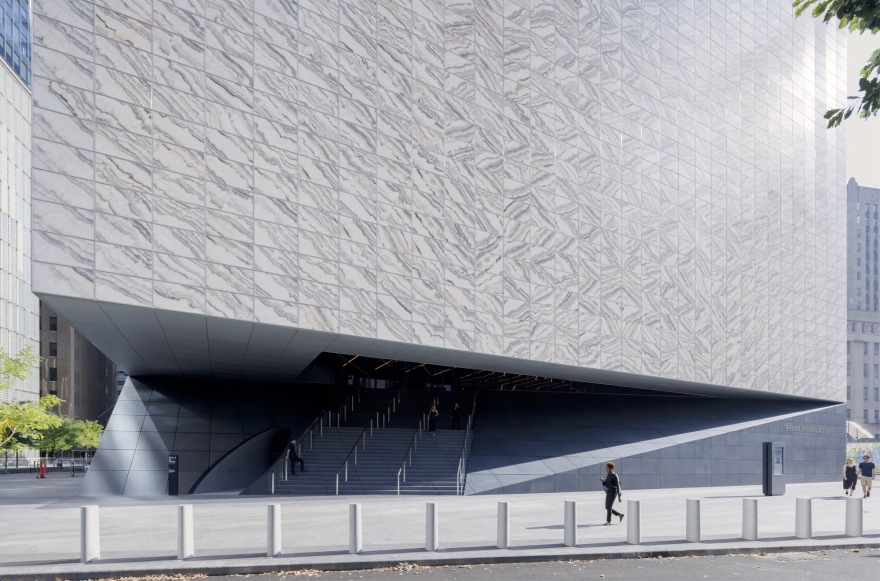
Text description provided by the architects. Adjacent to New York City’s most hallowed site, the Perelman Performing Arts Center (PAC NYC) is the cultural keystone and final public element in the World Trade Center master plan, embracing the restorative power of art as a counterpoint to the site’s commemorative import. A producing house for theater, music, dance, opera, and film, PAC NYC pioneers new forms of theatrical adaptability to amplify the creativity of its artists and empower directors to surprise patrons with new processions and viewing experiences upon each visit.
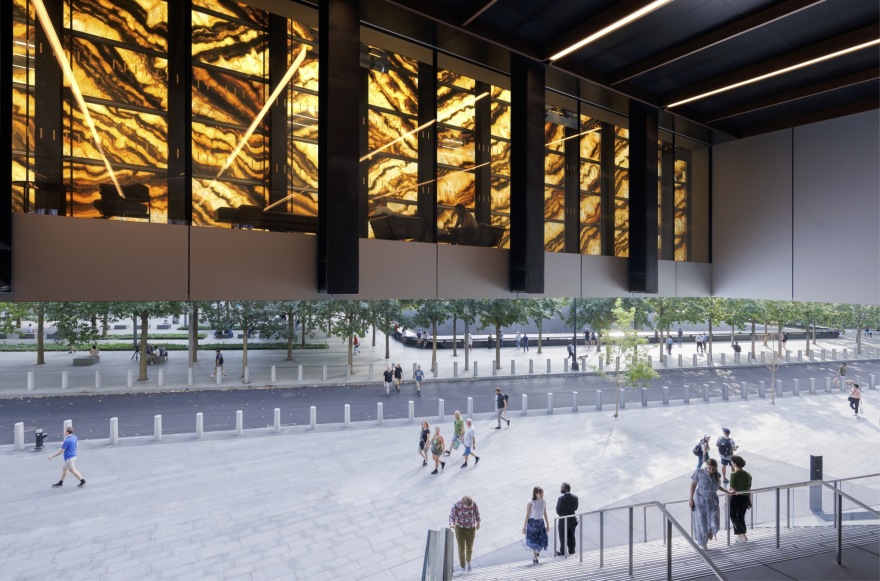
The building’s pure form—rotated and elevated to accommodate complex below- and at-grade constraints—is wrapped in translucent marble. By day, the volume is an elegant, bookmatched stone edifice acknowledging the solemnity of the 9/11 Memorial across the street. By night, this monolith dematerializes, subtly revealing PAC NYC’s creative energy inside.
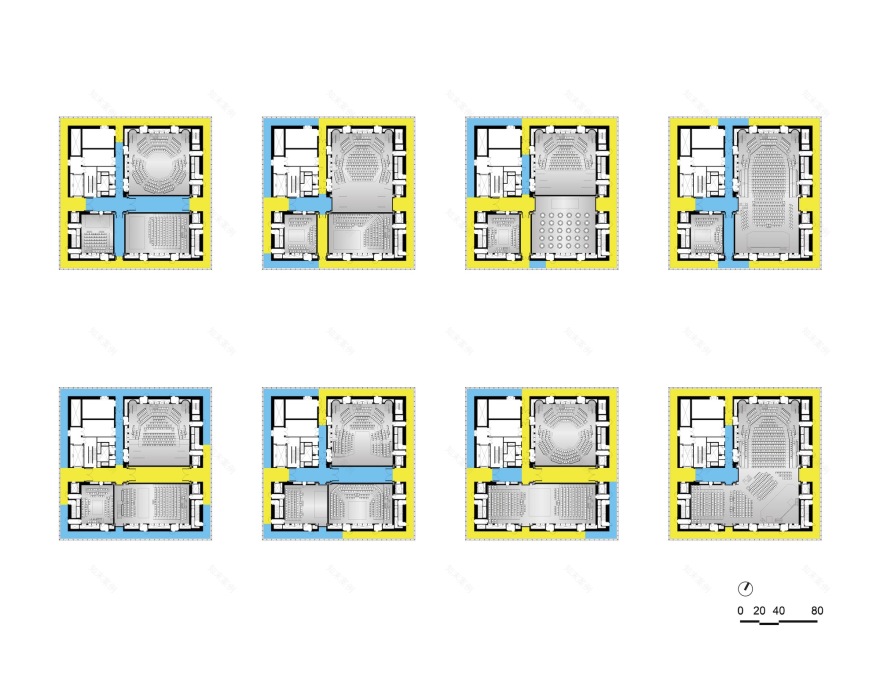

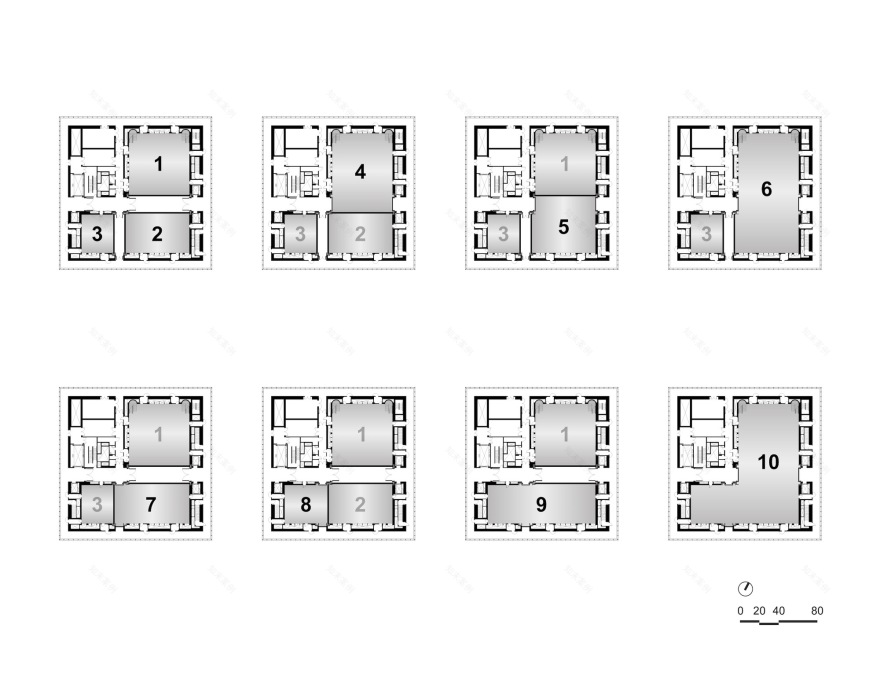
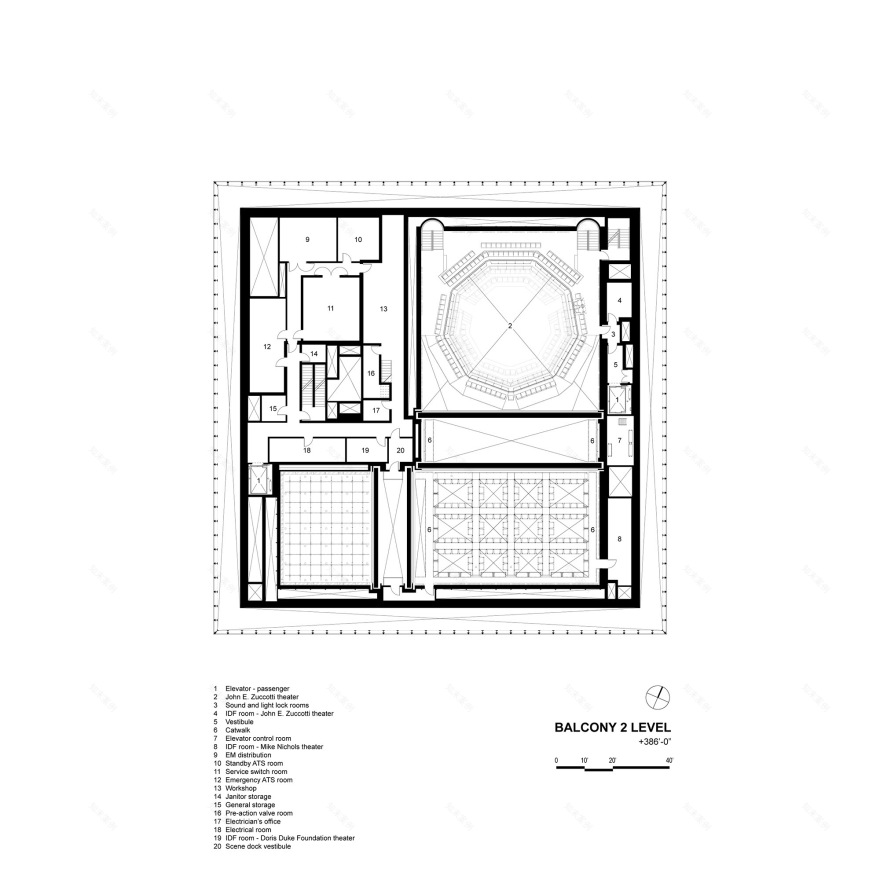
A performance instrument, PAC NYC’s suite of theaters and scene docks can combine into ten (10) proportions and transform into sixty-two (62) stage-audience configurations, from 90 to 950 seats. Creative teams can transmute the spaces to fulfill their desired artistic expressions and audience experiences using a toolkit of automated and manual technical systems. They include four acoustic “guillotine” walls; four movable seating towers (for courtyard, horseshoe, in-the-round, thrust, and other formats); a two-tiered catwalk and walkable grid system; 56 “spiralifts” to mold the theaters’ floor into manifold geometries; and several removable catwalks and audience balconies. F


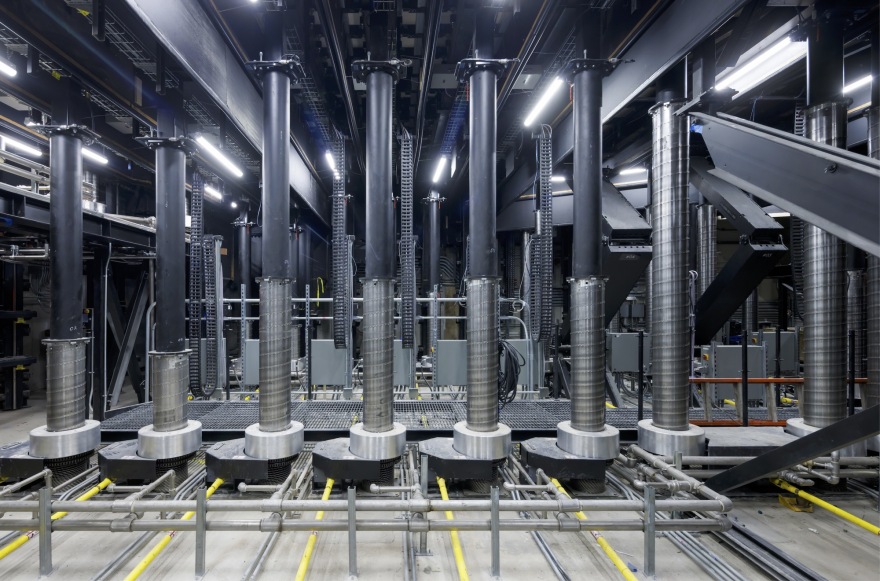
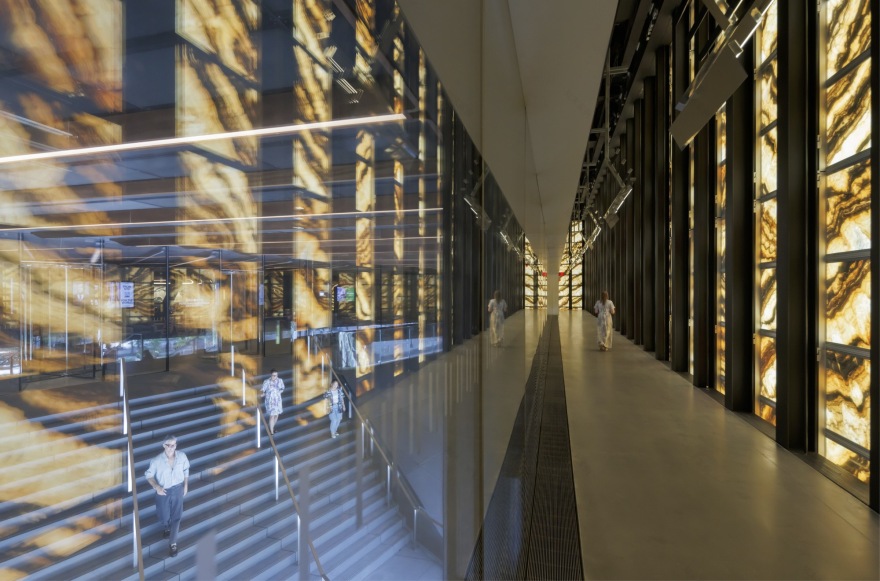
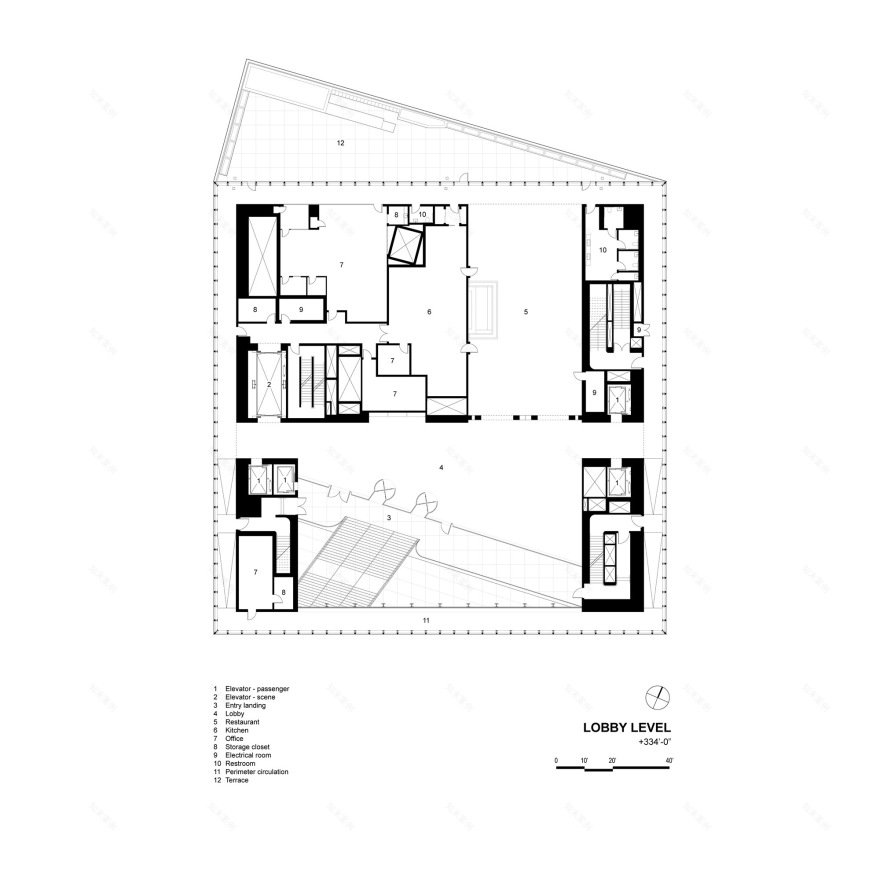
urther, a zone of mutability around the theaters—composed of eight acoustic doors, the cruciform of scene docks/assemblies, and a peripheral circulation loop—allows any of these areas to be allocated as front- or back-of-house and form unexpected lobbies and performance antechambers. Four elevator/stair couplets can also be used individually or in combination, creating diverse circulation sequences from the lobby. As a result of this immense flexibility, PAC NYC is a constant source of surprise for patrons, a “Mystery Box” whose experiences are scripted entirely by each director’s imagination.

To provide exceptional room acoustics within a radically flexible environment (with variable auditorium sizes and proportions; manifold possible stage and audience locations; and voices and instruments, both amplified and unamplified), the theaters are designed to aurally resemble a boundaryless, diffuse “forest clearing.” A perimeter wall of trees—with its random solids and voids—retains acoustic energy without imprinting a defined auditory signature: the ideal environment into which specific soundscapes can be tailored for each performance configuration.

To emulate a forest clearing’s geometry, a system of three planks—with one, two, and three “scoops”—were cost-effectively ripped out of walnut using crown molding knives. Because the scoops at the edge of each plank are of consistent radius, the planks always marry regardless of their arrangement or rotation. This enables 258 permutations of plank combinations. The plank geometries, their arrangements, and the voids between them were iteratively engineered and tested by the acoustician and architect to form an effectively random surface in a cost-effective and standardized manner.

Project gallery







Project location
Address:New York, United States
南京喵熊网络科技有限公司 苏ICP备18050492号-4知末 © 2018—2020 . All photos and trademark graphics are copyrighted by their owners.增值电信业务经营许可证(ICP)苏B2-20201444 苏公网安备 32011302321234号
苏公网安备 32011302321234号客服
消息
收藏
下载
最近