

创作上传
VIP
收藏下载
登录 | 注册有礼
查看完整案例

收藏

下载

分享
开阔、现代的城市入口 ——这是改造后的Chemnitz中央火车站给人的印象,新广场极具吸引力,塑造了游客对Chemnitz的第一印象。上世纪七十年代的前车站大厅被拆除,只剩下支撑结构,并向周围的城市景观敞开大门。这样就形成了一个流动的公共空间,它被遮蔽在一个 “城市天篷 “之下,并延伸到大厅之外,将原本封闭的空间与城市环境联系在一起。
An open, contemporary entree to the city – this is the image projected by the transformed Central Station, with an attractive new plaza that shapes visitors’ first impressions of Chemnitz. The former station concourse from the 1970s was stripped down to its supporting structure and ostentatiously opened up to the surrounding cityscape. The result is a fluid public space sheltered beneath an “urban canopy” and extending beyond the concourse to link what was once a contained space with its urban setting.
▼改造后沿街立面,facade along the street © Jan Bitter


铁路网的重组(2006 年城际铁路停运)推动了车站的重新设计和重组。新的 “Chemnitz 模式 “通过将城市有轨电车与周边地区铁路网连接起来,加强了地区铁路交通。对中央火车站的必要改造为更好地利用其潜力提供了一个激动人心的机会,同时也为城市提供了一个新的焦点。
The impulse leading to the thorough redesign and reorganisation of the station was the restructuring of the railway network (which discontinued Intercity services in 2006). The new “Chemnitz model” strengthens regional rail traffic by linking the city trams with the regional railway network beyond. The required conversion of the Central Station provided a welcome opportunity to make better use of its potential while giving the city a new focal point.
▼改造后沿街立面,facade along the street © Jan Bitter

车站与站台垂直的部分被拆除了,前四条轨道的高度也被降低了,这样公共有轨电车可以直接进入大厅,大厅现在也向城市打开。由于采用了新的换乘系统,有轨电车可以在中央车站直接换乘德铁系统,乘客无需再换乘列车。
The section of the station perpendicular to the platforms was dismantled and the level of the first four tracks lowered, allowing the public trams to continue directly into the concourse, which now opens generously to the city. Thanks to a new switching system, the trams can switch directly at the central station to the DB network, eliminating the need for passengers to change trains.
▼车站内部,inside of the station© Jan Bitter

大厅内部,室内的立面由织物覆盖的金属框架组成,这些框架与外部构件相似,呈交错排列。太阳光从半透明的织物表面穿过,渗透进大厅的深处,显露出支撑结构上的图案,为到达车站的游客们打开通往城市的迎宾视野。
Inside the concourse, the internal façade is made of fabric-covered metal frames which are arranged similarly to the external elements in a staggered pattern. Daylight penetrates deep into the concourse through the transparent textile skin, revealing the pattern of the supporting structure while opening up a welcoming vista into the city for visitors arriving at the station.
▼从内部看金属结构,view from inside© Jan Bitter


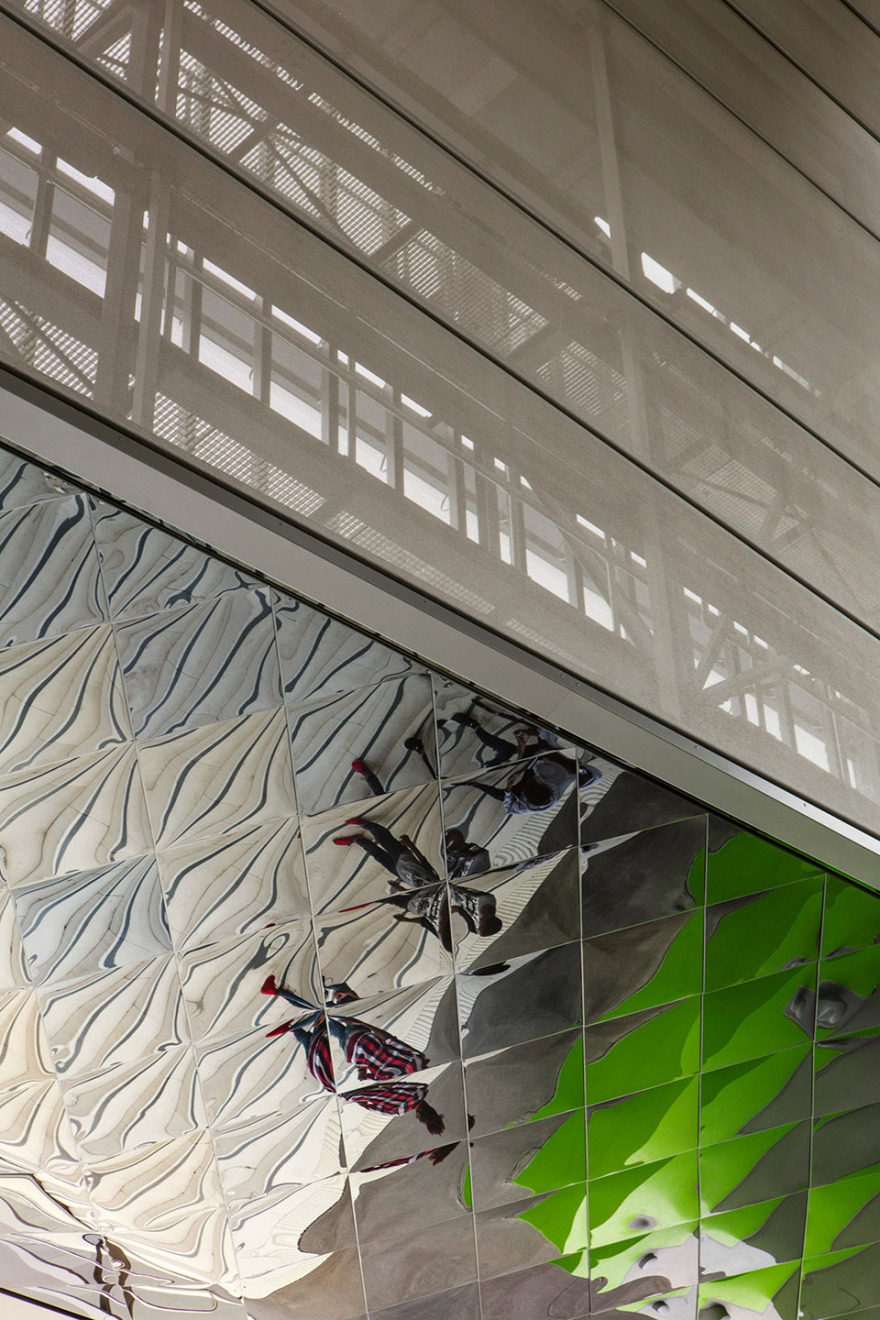
立面结构的内外形成对比,它由黑色抛光不锈钢制成的菱形构件组成,从多面反射出车站内生机勃勃的人流。这一立面沿着纵向的站台微微倾斜,从而将新候车区的树木和绿色座椅基座映射到大厅深处。
A contrast is formed by the underside of the façade, which is made up of diamond-shaped elements in polished black stainless steel that cast multifaceted reflections of the lively circulation through the station. This surface is somewhat tilted along the longitudinal platform, so that it mirrors the new waiting area with its trees and green seating pedestals into the depth of the concourse.
▼结构细部,structure detail© Jan Bitter
新建筑的外立面由磨砂材质的气动ETFE膜构成。从城市界面看,充气的雕塑曲线和反光箔表面营造出封闭空间的外观。在白天,充气膜营造出不透明的外观和纵深的效果,从而使支撑钢结构保持隐蔽。当夜幕降临时,外墙会被移动的灯光图案点亮。媒体立面向城市空间投射适度的光信号,从远处看将车站标记为运动场所,而温暖的灯光则将人们吸引到广场上,使其成为城市天幕下的邂逅之地。
The new building is sheathed in frosted pneumatic ETFE membrane cushions in varying sizes. Seen from the city, the sculptural curves and reflective foil surfaces of the gas-filled cushions create the appearance of a closed volume. During the day, the cushions create an opaque appearance with a depth effect, so that the struts of the supporting steel structure remain concealed. As dusk falls, the façade is artistically illuminated with moving light patterns. The media façade emits moderate light signals into the urban space and marks the station from afar as a place of movement, while a warm light invites people into the square as a place of encounter under the city canopy.
▼夜景,night view© Jan Bitter


▼施工现场,construction site©Grüntuch_Ernst_Architects

▼平面,plan©Grüntuch_Ernst_Architects

▼细部,detail©Grüntuch_Ernst_Architects

Location:Bahnhofstraße 1, 09111 Chemnitz, Germany
Year:1st Prize Competition 2004, Completion 2016
Client:Verkehrsverbund Mittelsachsen
Team:Jost von Fritschen, Florian Fels, Jens Schoppe, Arno Löbbecke, Olaf Menk, Andreas Nemetz, Benjamin Bühs, Erik Behrends, Jacob van Ommen, Matthias Schirrmacher, Robert Tesch and Jon C. Ferrer, Peter Menken
Technical Planners
BuroHappold Engineering, Berlin (structural engineering/building services)
Dr.-Ing. Wolfgang Stucke / Dr.-Ing. Thomas Klähne, Berlin (inspection engineers) Ingenieurgesellschaft Lachmann-Dominok, Oelsnitz (building services)
Topotek 1 Gesellschaft von Landschaftsarchitekten, Berlin (landscape design)
Lichtvision Design, Berlin (lightning design)
Random International, London (art)
Photos: Jan Bitter and Grüntuch Ernst Architects
Film Sven Regener, Leipzig
南京喵熊网络科技有限公司 苏ICP备18050492号-4知末 © 2018—2020 . All photos and trademark graphics are copyrighted by their owners.增值电信业务经营许可证(ICP)苏B2-20201444 苏公网安备 32011302321234号
苏公网安备 32011302321234号客服
消息
收藏
下载
最近