

创作上传
VIP
收藏下载
登录 | 注册有礼
查看完整案例

收藏

下载

分享

翻译
From October 1 to October 24, I took the program "Urbanism and Urban Space Design" at the Sirius Educational Center, the result of which was the project given below. The recording of the broadcast can be viewed at THIS LINK
Video abstraction

We have created a special concept of the museum of material culture on the projected site located in the Imereti lowland.
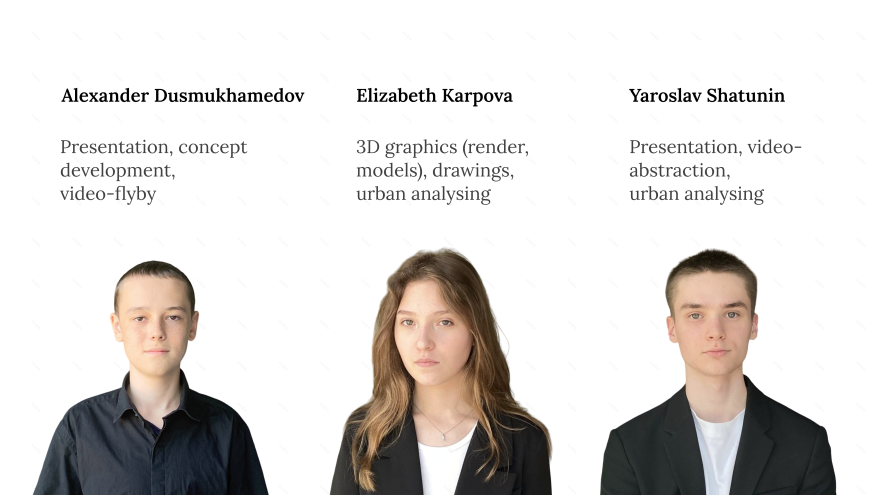
Our team consists of 3 people: Alexander Dusmukhamedov, Elizaveta Karpova, Yaroslav Shatunin


The key feature of the site is the archaeological excavations of the Byzantine temple. Russian architectural tradition and Russian Orthodoxy originate from Byzantium, and our concept was built around them.

We have set ourselves the task of creating a unique concept of landscaping the design area, preserving the historical heritage. We also needed to diversify the local terrain.
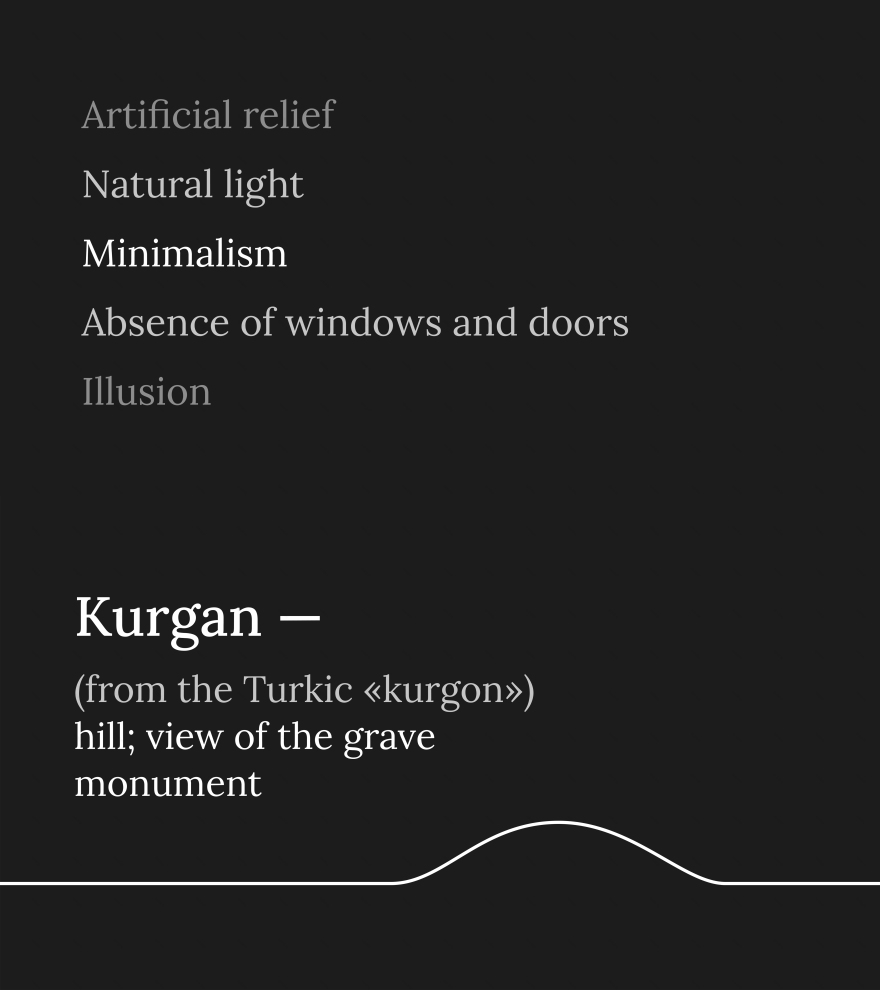
We can outline our concept in five principles. The main one is minimalism, with the help of which we transfer the attention of visitors to the important. The name of our project is a mound, that is, a hill. The word comes from the Turkic language and also means a kind of grave monument.

The architecture of Sochi is frivolous. Large white buildings tend to rise, the infrastructure focuses on recreation and entertainment of tourists. We force people to think and go deep, to put questions of existence in front of them. So we created an image of a temple underground. We have placed the museum in the mound.
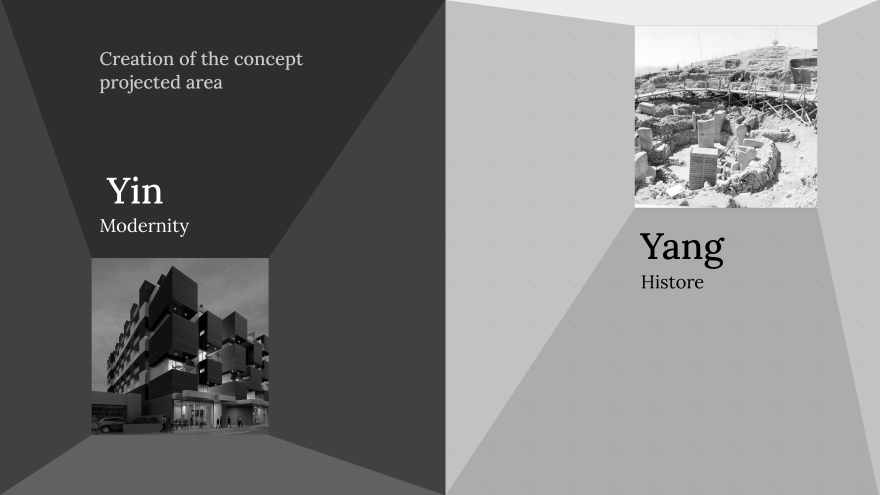
We also divided the entire site in half, and placed opposites on different sides: negative and positive, yin and yang. On the left in the lowland there is a modern pavilion in the form of a cube, on the right there is a Museum—temple of the history of Byzantium, in which the excavations are inscribed.

While sketching, we found exactly the shape of the temple and the location of objects that fully reflect our ideas. The buildings are based on pure geometric lines and shapes. We owe it to Alvar Siza, Tadao Ando and Ludwig Mies van der Rohe. Going down the same path, we take what they did and interpret in our own way.

The confrontation of open and closed. Contrast of light and darkness. Abandonment of decor: building structures, such as concrete slabs, remain uncovered.All this creates a rough unassuming honesty and uncompromising.Thanks to the openings, the walls are permeable, susceptible to the elements — be it sunlight, rain or wind. This allows not only to bring natural lighting into the interior, but also to use artificial sources to illuminate the surrounding area in the evening.


The plot is a rectangle made up of two squares. According to the relief, these squares are opposed to each other, because one is a lowland, and the other is a hill. Between them lies the main track, which is divided by branches in a ratio of 1 to 3. Thus we create an interesting compositional solution. The entrance to the temple-museum is a reference to history, because it is traditionally made from the West. The cube is twisted in the same way as the museum, creating integrity and connectivity of objects.

We have created a plot of the visitors' movement. To do this, we used a protective wall so that people did not take a shortcut, but walked along our path and saw the pavilions from the right viewpoints. After going to the museum, people will discover archaeological excavations in all their glory, and when they reach the cube — an exhibition space. And to admire the views or relax along the entire length of the central road there is a bench that opens at the branches leading to the Cube and the temple.

Continuing the plot, we worked out the landscaping in the same way. Tall grass eliminates the wrong movement of visitors, and lawns, on the contrary, make it possible to have a picnic or take a walk.

Highways run around the site, public transport travels along them, there are also many transport infrastructure facilities nearby, respectively, a large number of people will visit the territory. Therefore, we have thought through the necessary inputs. You can notice one of them on the plan above the temple. This entrance projects directly onto the sidewalk. Indeed, part of the room where the temple is located enters the pedestrian path so that people passing by and passing cars will be interested when they see this corner. Also, this exit may be useful in case of evacuation.


The temple-museum represents the philosophy of the intellectual and spiritual. This is a large-scale concrete structure, in which there are excavations fenced with glass slabs. Everything in the interior is interconnected. The poetry and lyricism of the image are generated by free creativity, the brilliance of strictly mathematically justified proportions, the perfection of the combination of all elements.Such metaphors are designed to take the visitor out of the dim context of the surrounding development and give a certain emotional experience that begins at the entrance to the building and continues inside in a plastic space permeated with rays of light.

The cube has a spherical interior with a chopped arch. Daylight penetrates through a round hole in the dome — the oculus. The oculus has a special mechanism in the form of a shutter like a camera, which helps visitors to better see the projections on the walls, with which the visitor can immerse himself in the history of Byzantium. The area of the Cube is 1600 square meters, its height, respectively, is 40 meters. Just above the 12-storey building. Really impressive!

The main entrance to the museum passes through the dromos — a triangular tunnel. Walking along a narrow long aisle, you begin to think about the meaning of life and pressing problems, but at the end of the way you find yourself in a bright, half-empty space, which is designed to return you to your roots, a point of reference.

As you slowly walk down the path to the Cube, you experience a wide range of emotions. The pavilion is visually transformed, becoming larger and taller, changing its shape depending on the viewing points. It is impossible that after this walk the visitor entered the Cube indifferent, without expectations of some kind of cultural enlightenment.

We strive to leave maximum space for the viewer's dialogue and space, to give an impulse to the viewer's imagination — an impulse to the inner world through the outer world.
A person's attention is switching at lightning speed today. Most people are confused in their feelings, do not know who they are in this world and succumb to the will of fate. To immerse yourself in yourself is the greatest value these days.

南京喵熊网络科技有限公司 苏ICP备18050492号-4知末 © 2018—2020 . All photos and trademark graphics are copyrighted by their owners.增值电信业务经营许可证(ICP)苏B2-20201444 苏公网安备 32011302321234号
苏公网安备 32011302321234号客服
消息
收藏
下载
最近