

创作上传
VIP
收藏下载
登录 | 注册有礼
查看完整案例

收藏

下载

分享

翻译
whose future: building community after steel
Braddock PA
Urban Systems studio Advisor - Nida Rehmanwith studio peers & North Braddock residentsWork published on Public source news article
Work displayed at SoA Exchange 2023 & Braddock Juneteenth
Nida Rehman received a 2022 SOM Foundation Research Prize to support the collaborative project
“Taking Back the Air” with North Braddock Residents For Our Future and General Sisters.

A Note from Edith Abyeta
On a cool spring day neighbors and I met in Braddock near the combined sewer overflow (CSO) at the Monongahela river’s edge. Some people know this as Braddock Beach. You can walk out on the CSO, be in the river, and sometimes see three geese. It has been suggested that these geese which always seem to be present are props but on this day they swam to the edge and got out of the water. The geese are real.The purpose of us coming together was to walk the edge of the mill and share our dreams about where we live. We started at the water’s edge. We were going to walk from that edge along the steel mill’s edge to O’Connell Boulevard which might be considered the edge of town. This is a hazardous walk. There are no sidewalks. The ground is uneven, bumpy, and muddy. The road has two lanes. On the shoulder of the northbound lane semi trucks park especially on Sunday which was the day we were walking.I am lucky I live in close proximity to a lot of dreamers. Even on this walk we talked about how we can time travel, moving through the 19th century to see the remains of the 21st century wrapped in plastic near the side of the road. The vertical farming robots have already lost where we live.Talking about our dreams is one way to survive as fence line residents of a Title V source polluter. Sometimes it seems like dreams are all we have. If they can be spoken out loud and shared, maybe they can come true. Alchemy might just transform our material deficits into gold. Others have joined us to dream. They have written down, drawn, and researched our dreams in chorus with their own. They have come from faraway places and aren’t here for long but they can see what we see. We join together to walk these edges so that our dreams can materialize and turn into gold.Edith Abeyta , April 2023North Braddock Residents For Our Future

Studio objectives and process
The studio aims to develop design and research products towards ongoing community efforts of environmental repair and health. Students learn to bring together existing knowledge and to foreground community voices and histories in urban analysis and design. This includes conducting studies of the built environment and landscape and engaging with conversation and listening to critical voices to develop a contextual understanding of the ongoing history of the area, particularly on issues of ecology, toxicity, urban change, structural abandonment, and environmental justice.
The studio is anchored in an ongoing collaboration, started in 2021, with North Braddock Residents for our Future, a volunteer-run, grassroots organization set up in 2014 to promote community health and clean air in Braddock, North Braddock and surrounding communities. In addition to working closely with members of NBRFOF, Edith Abeyta, Jan McMacnnis and Tony Buba, students connected with local residents, community organizers, and environmental advocates, to pay close attention to concerns about socio-environmental transformations in the region.


Mon Valley Works
The Mon Valley Works comprises three separate locations, the Clairton Coke Works, the Edgar Thomson Steel Works, and the Irving Steel Works, with each site responsible for a particular function in the chain steel production. Large amounts of raw and produced material is transported on an everyday basis between these sites, adding to the emissions and contamination from each of the plants.
The Clairton Coke Works is the supplier for the Edgar Thomson Plant. It uses the coal mined from the Appalachian region that is bought in using the rail networks and road systems. In a year, it produces about 4.3 Million tons of Coke for the Edgar Thomson Plant.
The Edgar Thomson Steel Works is one of the largest steel producers in the US Steel Corporation, producing around 18% of the total steel production of US Steel. It operates using the coke produced in Clairton Coke Works and the iron ore mined in the state of Minnesota. The ore is transported largely by the rail network. The steel, in the form of slabs, blooms, etc. is transported to Irvin Steel Plant for further production. ET produces 14.6 million tons of steel per year.
The Irvin Steel Plant receives the steel manufactured from Edgar Thomson. It produces the steel members and shapes needed in the various industries and by various clients. The members produced here are stored in storage warehouses located near the plant itself and are shipped out as and when needed. It is the final production point in the Mon Valley industrial system for the steel.
Impacts
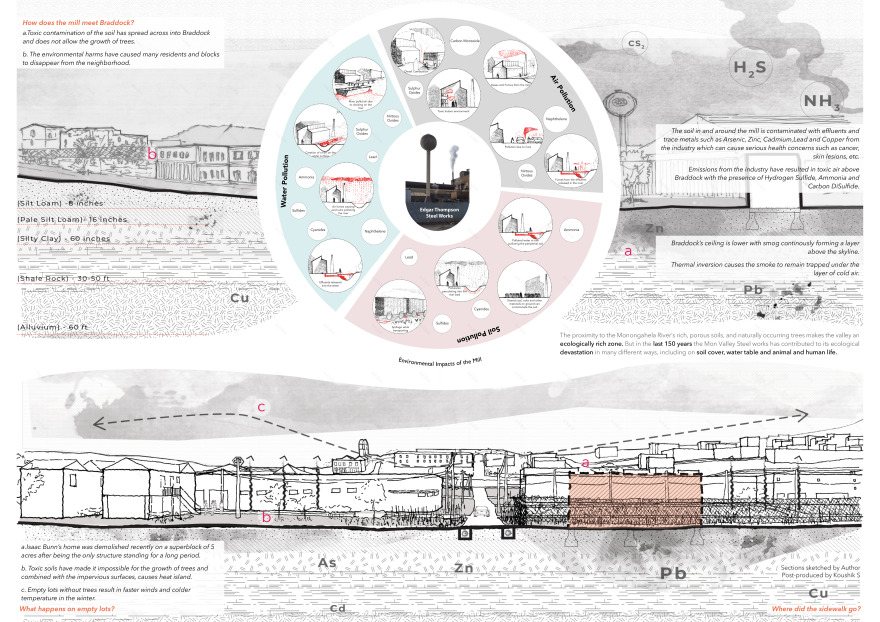
The Mill’s presence in the area through the decades has caused a lot of social and environmental issues. The issues have ranged from shortened lifespan of workers in the Mill to a higher rate of respiratory problems of residents who live in the surrounding neighborhoods, to the significant impact on the natural systems of the area.
Our research focuses on three main factors: Air, Soil and Water.
We looked into the impact the industry has had on them and how it relates to the health issues observed in the people of the area and the natural resources. The proximity to the Monongahela River’s rich, porous soils, and naturally occurring trees makes the valley an ecologically rich zone. But in the last 150 years the Mon Valley Steel works has contributed to its ecological devastation in many different ways, including on soil cover, water table and animal and human life. The following diagrams explore these relationships between the Edgar Thomson Steel Works and the environment by highlighting the cause, process and effect on various elements of the area’s ecology.

Composition of the Mill
From the use of original blast furnaces to the current use of the electric furnace, The Edgar Thomson Steel Works has seen a lot of changes in its lifetime. However, instead of taking away the buildings of the older processes and reusing the land, the Mill has expanded its footprint and added more structures to itself making it the giant it is today.
Blast FurnaceThe oldest part of the Mill is the blast furnace which was the process that was first used when the mill was established. It operates by combining iron ore, coke, and limestone in a controlled process that produces molten iron, which is then further refined into steel.
Open Hearth ProcessDeveloped second in the order of phases, this process was a widely used method for producing steel in the late 19th and early 20th centuries.
Casting and Storage AreaThis area has worked at the industry for one of the longest times. It is used to store the steel produced in the various processes and then formed into blooms and slabs. In the earlier stages of the Mill, the steel forms were produced here and shipped to construction site. However, with the latest expansions in production, the forms are developed at Irvin and the steel is transported in basic forms. These forms are stored in the warehouses till they are transported to the Irvin Steel Works.
Electric FurnaceThe most recent addition to the site is that of the Electric Furnace. This process uses electricity to melt scrap metal and other raw materials.
Steel Recovery BuildingSince the Electric Furnace Process utilizes the scrap steel to produce new steel pieces, there is a small structure dedicated on site to collect the scrap steel from all of Braddock. The success of this plant can not be established nor its effectiveness.

Community Meeting
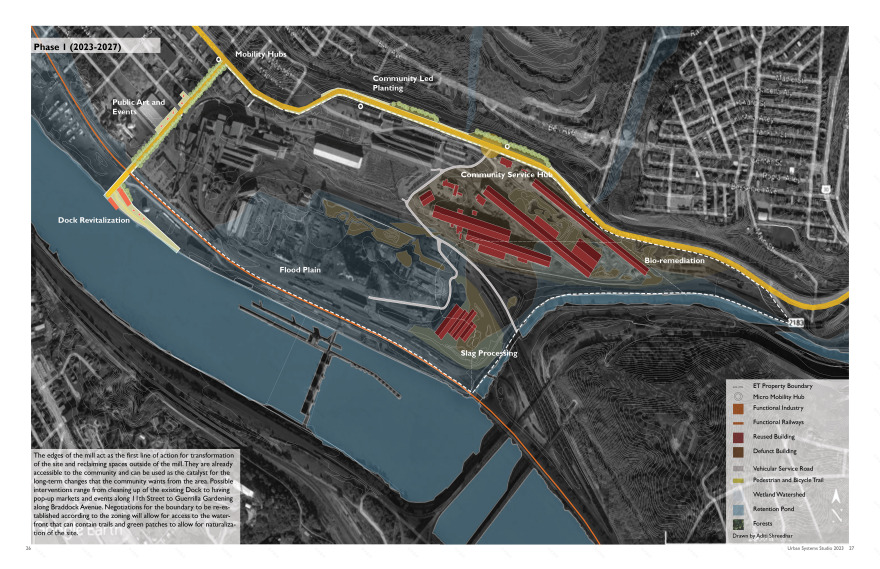
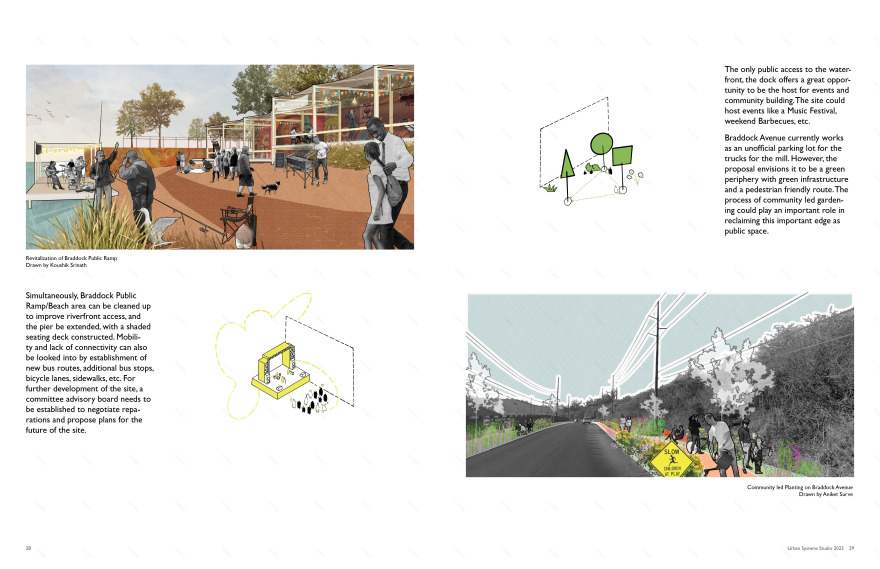
On Friday, March 17th,2023 ,the studio convened a conversation with community members and regional environmental advocates at the North Braddock Municipal Building. This was an initial opportunity to share preliminary work to document the history, functioning, and impacts of the steel mill, and engage in discussion about the future of the site, including how longer term planning can attend to the day-to-day needs of people who live and use the areas near the plant. A diagram summarizing the key discussion points is indicated on the following page.




Partners and Stakeholders
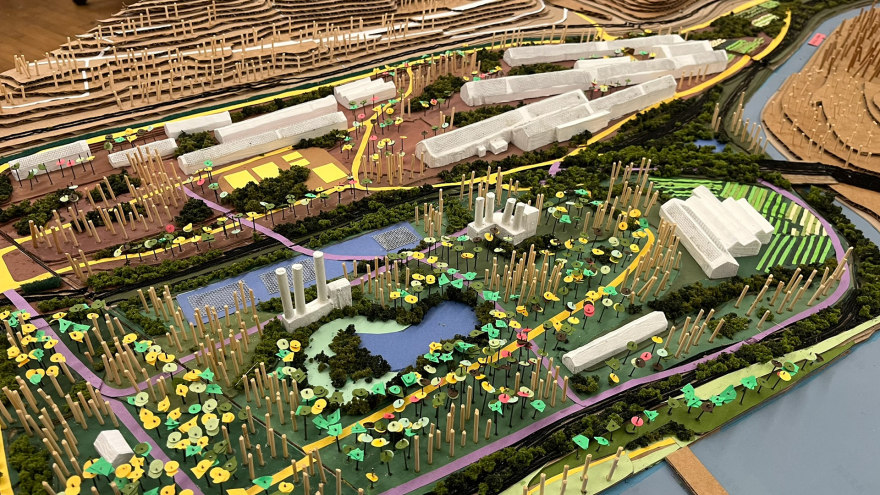
For a project this scale, it is essential to have a few partners that can not only fund the process but also provide their expertise in it. The proposal looks at a few such options. The aim for choosing the possible partners was that they be community members or organizations that aim to help the community at large. Bringing in large corporations was avoided so that the people who were truly affected by the decisions taken were the loudest and the strongest voices on the table.




References
History of the Edgar Thomson Mill Grom, R. M. (2008). Braddock, Allegheny County. Arcadia Publishing.
Tony Buba, & Ray Henderson (1996). Struggles in Steel
Glabicki, Q. (2022, August 8). A hydrogen hub in Western PA would require capture of carbon. PublicSource.
Ecological Impacts and Harms Tunno, B. J., Shields, K. N., Lioy, P., Chu, N., Kadane, J. B., Parmanto, B., ... & Clougherty, J. E. (2012). Understanding intra-neighborhood patterns in PM 2.5 and PM 10 using mobile monitoring in Braddock, PA. Environmental Health, 11, 1-15.
Green New Deal and Just Transitions“Just Transition - Climate Justice Alliance.” Accessed January 16, 2023. https://climatejusticealliance.org/just-transition/.
Zografos, Christos, and Paul Robbins. “Green Sacrifice Zones, or Why a Green New Deal Cannot Ignore the Cost Shifts of Just Transitions.” One Earth 3, no. 5 (November 2020): 543–46. https://doi.org/10.1016/j.oneear.2020.10.012.
Office of Energy Projects. (2017). Braddock Locks and Dam Hydroelectric Project [Review of Braddock Locks and Dam Hydroelectric Project]. FINAL ENVIRONMENTAL ASSESSMENT for ORIGINAL HYDROPOWER LICENSE. Federal Energy Regulatory Commission.
Riparian Buffer Requirements 25 PA. Code 102.14 Riparian Buffer Requirements
南京喵熊网络科技有限公司 苏ICP备18050492号-4知末 © 2018—2020 . All photos and trademark graphics are copyrighted by their owners.增值电信业务经营许可证(ICP)苏B2-20201444 苏公网安备 32011302321234号
苏公网安备 32011302321234号客服
消息
收藏
下载
最近