

创作上传
VIP
收藏下载
登录 | 注册有礼
查看完整案例

收藏

下载

分享
由 MORE 建筑事务所设计的银杏画廊位于中国嘉兴,是一座布满银杏的小岛上的创新型博物馆。受当地村庄的肌理的启发,博物馆的设计邀请参观者在内部的不同部分徜徉探索,就像在小镇中漫游一样。因此设计融合了两种传统的博物馆类型——导览式博物馆与开放平面式博物馆的结合,创造了一个具有“流动的空间”的平面布局。
Ginkgo Gallery by MORE Architecture is an innovative new museum on a ginkgo tree-covered island, in Jiaxing, China. Inspired by the DNA of local villages, the museum invites visitors to wander through and discover the different sections as if they were exploring a small town. It is therefore set up as a blend of two traditional museum typologies – the guided museum meets the free plan museum, creating a floorplan with ‘fluid spaces’.
▼项目外观,exterior of the project© Kris Provoost
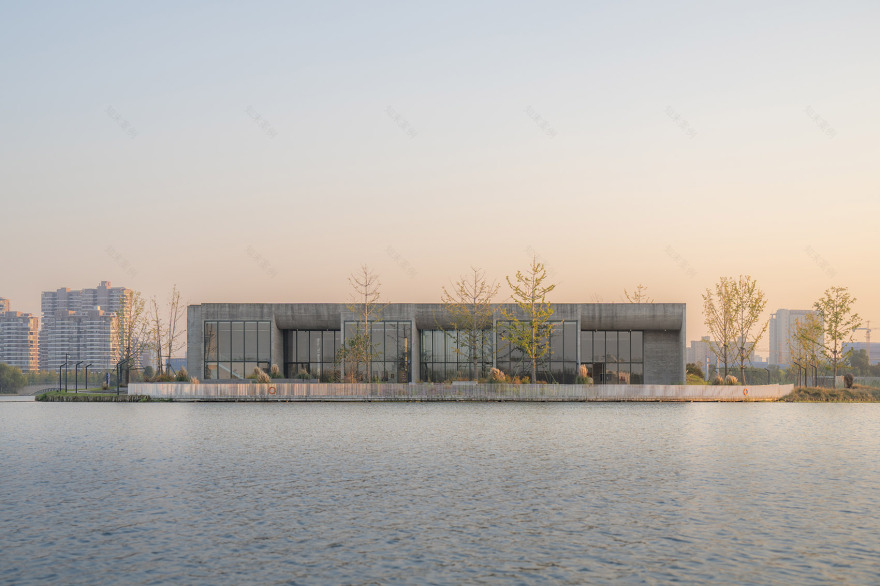

建筑的朝向,与周围的水景和景色之间的联系,都在文化与艺术之间创造了深刻的连结。博物馆的外观低调,强调了它所选用的材料——现浇混凝土。
The orientation towards, and connection with the surrounding water and landscape generate a deep relationship between culture and art. The museum has a modest appearance, emphasized by its materiality: in-situ cast concrete.
▼项目周围环境,surroundings© Kris Provoost

博物馆热潮
Museum Boom
在过去的十几年中,中国经历了“博物馆热潮”,在此期间,不仅建造了大量的标志性的博物馆,传统博物馆的规模也在不断扩大。银杏画廊是对上述现象的解毒剂:一座谦卑的,复杂的博物馆,在这里艺术与自然相互融合,使人身临其境。
Over the past decade, China has been undergoing a ‘museum boom’ in which not only an enormous number of iconic museums were built, but also the scale of the typical museum increased massively. Ginkgo Gallery is the antidote to said phenomenon: a humble, intricate museum where art and nature merge into one immersive experience.
▼建筑外观,exterior of the building© Kris Provoost


客户希望艺术可以成为公共生活的一部分,尤其是帮助孩子们接受现代艺术相关的教育。为了实现这一目的,博物馆内设有一处音乐厅,一处阅读室和工作间。为了实现这一承诺,MORE 建筑事务所对中国当代博物馆进行了广泛的学术研究,并在此基础上制定了需求清单。
▼功能分布,function layout©MORE Architecture
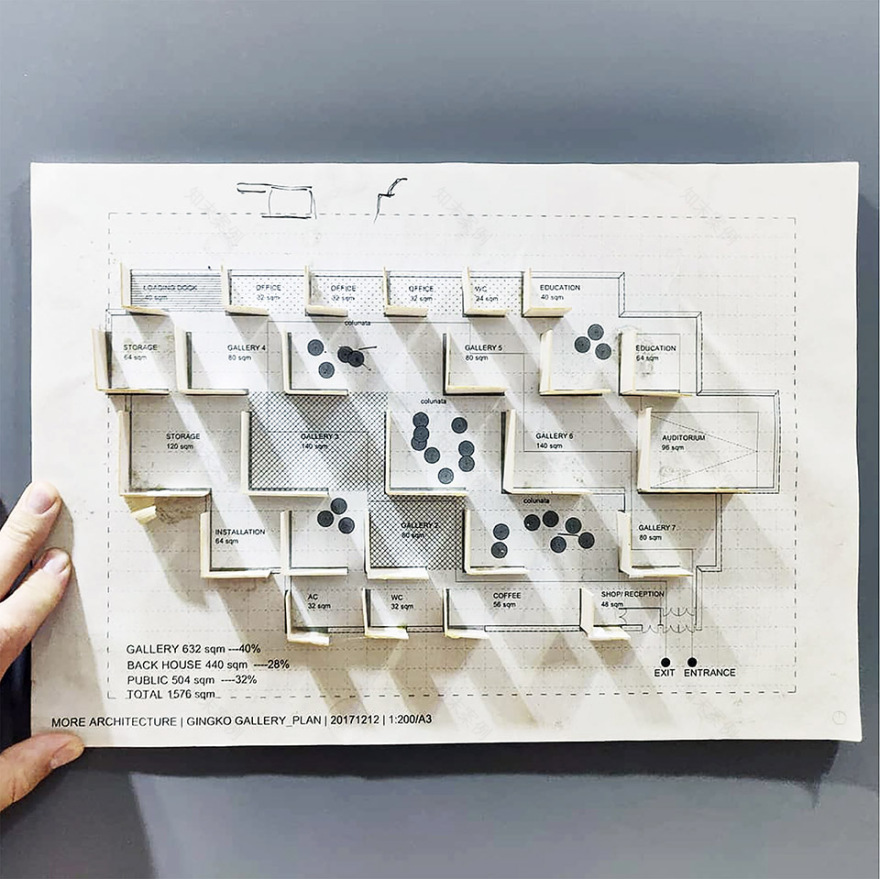
The client aimed to make art a part of public life, and particularly educate children in the field of contemporary art. To this end, the museum also houses an auditorium, a reading room and a workshop space. For this commission, MORE Architecture developed the bill of requirements in-house, based on extensive academic research of contemporary Chinese museums.
▼建筑与景观相结合,building combines with landscape© Kris Provoost

小规模的空间体验 Spatial experience, small scale
从类型学的层面,建筑师希望可以创造一种创新型的博物馆体验。受周围的小镇环境的影响,MORE 建筑事务所将博物馆构想为一个“村落”,让人们可以自由探索。典型的浙江村落的基因——不同尺寸的空间之间构成小规模精细的网络——是这座博物馆的真正灵感来源。
▼概念图,concept©MORE Architecture
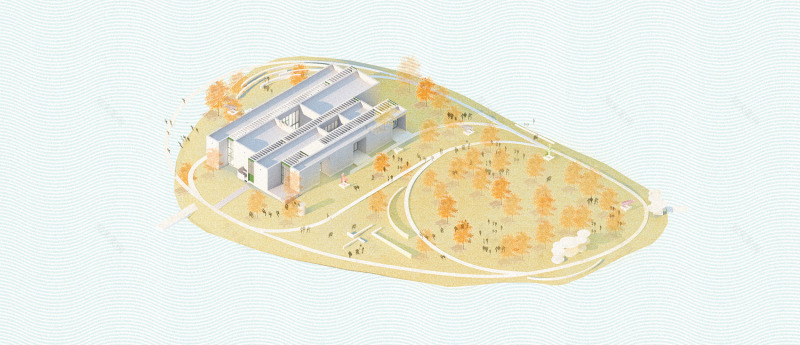
On a typological level, the architects wanted to create an innovative museum experience. Inspired by its rural context, MORE Architecture conceived the museum as a ‘village’ which allows for exploring. The DNA of the typical Zhejiang village – with its small scale and sophisticated network of spaces that differ in size – is the true inspiration for this museum.
▼室内展览大厅,exhibition hall©Kris Provoost
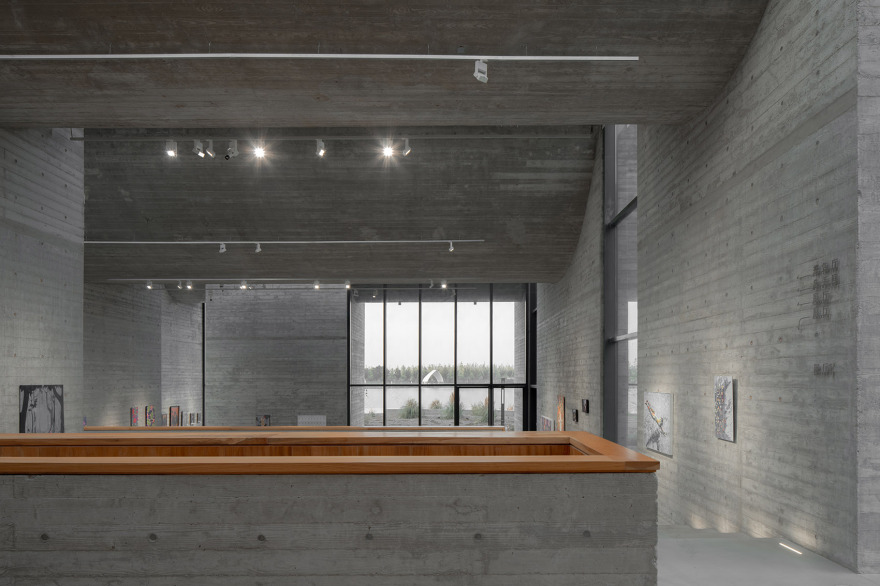
通过融合两种传统博物馆的类型——典型的导览式路线和自由动线的平面——组合在同一空间,建筑师创造了一座拥有“流动空间”的建筑,在这里参观者可以自由探索,选择自己的路线——就像 Schinkels Altes 博物馆和 Mies’Neue 国家美术馆的结合。这种组合使博物馆大厅既互相连接,又有着微妙的不同。通过连接或者分隔不同的展览大厅,它为策展人们创造了不同的叙事方式。但是更重要的是,它可以让参观者们自由探索。
▼模型,model©MORE Architecture

By merging two traditional museum typologies – the conventional ‘guided’ routing and the ‘free flow’ plan – into one museum, the architects created a building with ‘fluid spaces’, where visitors can explore and choose their own route – Schinkels Altes Museum meets Mies’ Neue National Gallery! This merger creates a building with museum halls which are connected yet differentiate themselves in an subtle way. It creates opportunities for the curators to tell stories in various ways – by connecting or disconnecting the exhibition halls. But more importantly, it allows for visitors to explore…
▼自由探索的空间,allows for visitors to explore©Kris Provoost


低调的材料性
Modest materiality
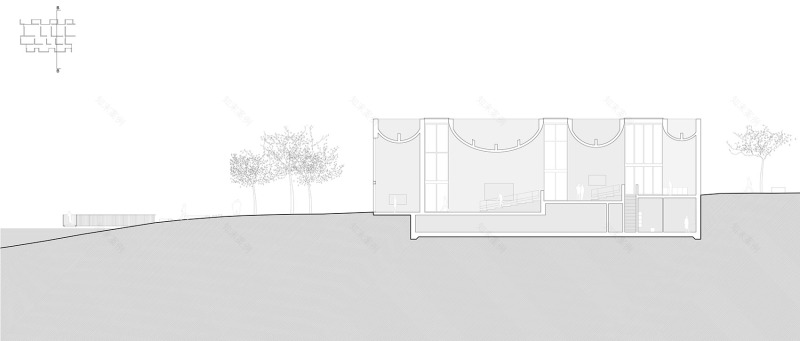
在银杏画廊的早期设计阶段,低调的博物馆设计需要低调的材料选择变得很清晰。因此,建筑师决定要专注于博物馆的空间质量,并限制对材料的选择,从而减少运输、建材垃圾和包装等。MORE 事务所只使用了一种材料:现浇混凝土。博物馆的结构由坚固的混凝土墙构筑而成,支撑着跨度达 17 米的弧形混凝土板。
▼结构轴测,structure axonometric©MORE Architecture

Early in the design process of Ginkgo Gallery, it became clear that a modest museum design also required a modest use of materials. So, the architects decided to focus on the spatial quality of the museum, and limit the number of materials, and therefore transport movements, construction waste, packaging etc. MORE Architecture used one material for the whole building: in-situ cast concrete. The structure of the museum is built up from solid concrete walls, carrying the curved concrete slabs which span up to 17 meters.
▼内部空间由现浇混凝土构成,interior space consists of in-situ cast concrete©Kris Provoost
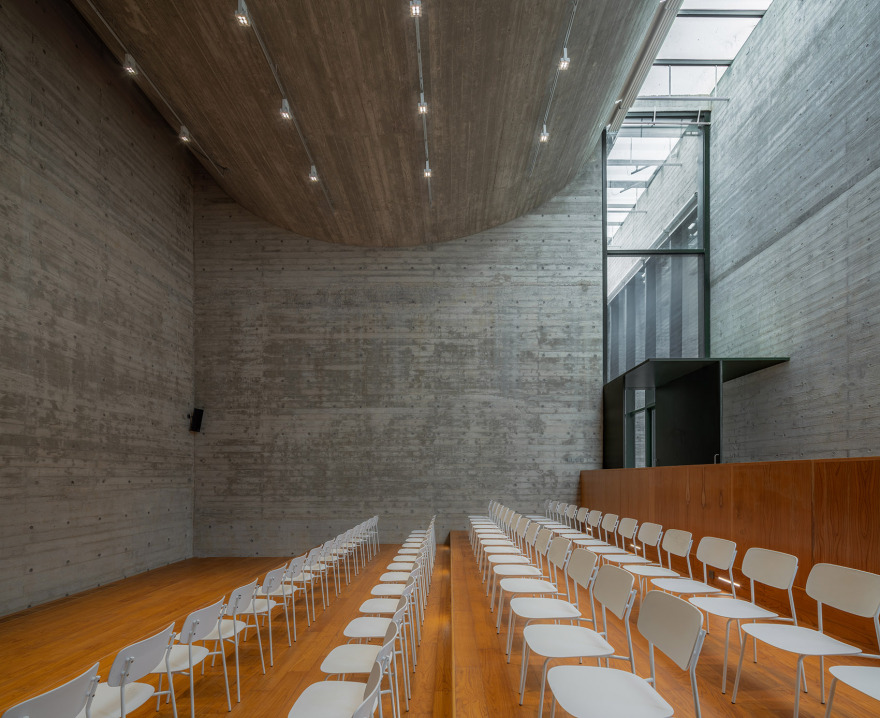
▼现浇混凝土构成的墙壁天花,ceiling and wall consists of in-situ cast concrete©Kris Provoost

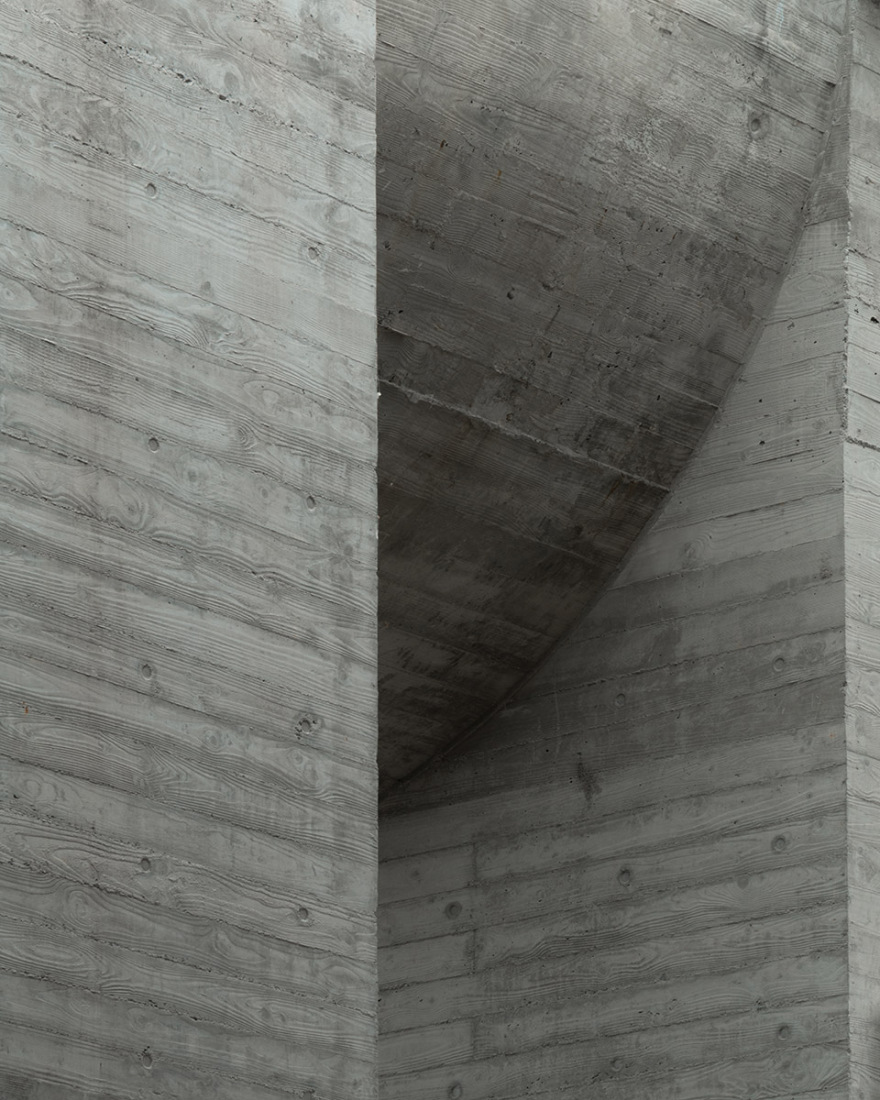
浇筑的铸模使用了脚手架和粗糙木板,木板呈水平放置,图案由施工的工人们决定。虽然弧形混凝土板使用了低技的方法浇筑,但木板的浇铸为建筑外观、墙壁和天花板创造了韵律感和质感。“粗糙”混凝土与光滑的绿色铝制窗框、温暖的榉木细节和室内家具相结合。
The cast was made of scaffolding and rough wooden planks, which were placed horizontally – the pattern being decided by the construction workers. Even the curved slabs were cast with this low-tech method. The cast of the wooden planks creates rhythm and texture in the facades, walls and ceilings of the building. The ‘rough’ concrete is combined with smooth green aluminium mullions, and warm beech details and furniture in the interior.
▼现浇混凝土细部,in-situ cast concrete detail©Kris Provoost

室内室外
Inside and outside
建筑师使南立面相对封闭,而北立面相对开放来创造间接的自然光线。展览大厅从南到北,空间的规模和高度不断扩大。这些建筑由东西走向的“街道”连接,引入自然光。弧形屋顶过滤了射入的日光。
The architects made the building rather closed on its southern façade and opened it up on the northside, to create indirect natural light. The exhibition halls increase in both size and height from the south towards the north. They are connected by ‘streets’ which run east-west that bring in the natural light. Curved roofs filter the incoming daylight.
▼相对开放的北立面,opened up on the northside©Kris Provoost

不仅如此,建筑师希望参观者们可以体验室内和室外之间,建筑和景观之间的丝滑过渡。在设计和博物馆体验中,和景观的互动至关重要:博物馆坐落于岛屿上,走近博物馆本身就是一种体验。
Moreover, the architects want the visitors of the building to experience a soft transition between building and landscape, between inside and outside. The interaction with the landscape is critical in the design and experience of this museum: being situated on an island, approaching the museum is an experience in itself.
▼夜景,night view©Kris Provoost

由于该岛也可用于举办室外展览,因此一经穿过,这种体验就会在雕像花园中开始。一系列弯弯曲曲的小路邀请游客探索这座小岛。一座桥从岛的外围弯向湖面,让游客可以“在水上漫步”。在室内环境中,博物馆向景观和湖泊打开,使参观者们在艺术与自然之间不断取得平衡。
Once across, this experience continues as the exhibition starts in a statue garden, since the island can be used for outdoor exhibitions as well. A series of curvy pathways invite visitors to explore the island. A bridge which curves outside the perimeter of the island onto the lake allows the sightseers to ‘walk on water’. Inside, the museum opens towards the landscape and the lake, letting visitors constantly balance between art and nature.
▼夜景,night view©Kris Provoost

▼场地区位,site map©MORE Architecture

▼场地平面,site plan©MORE Architecture
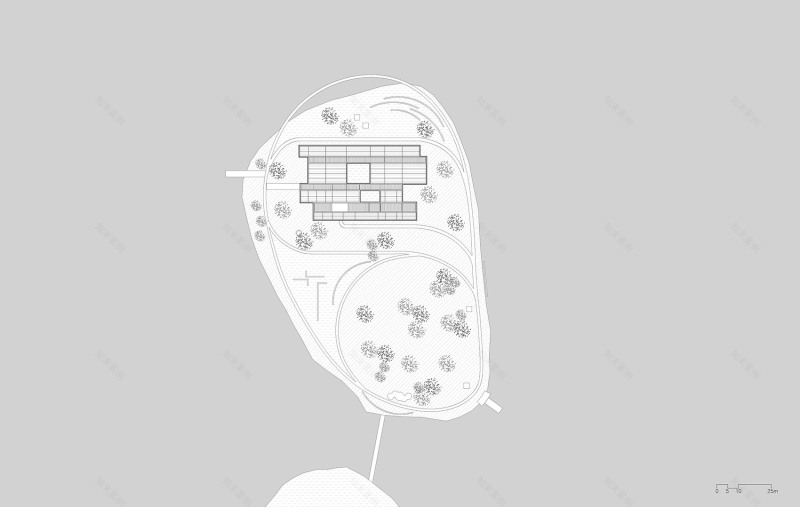
▼平面, plan
©MORE Architecture

▼剖面, section©MORE Architecture

Design: MORE Architecture
Design Lead: Daan Roggeveen
Team: Robert Chen, Lina Peng, Pedro Martins, Emilio Wang, Mengyao Han, Anna Clement, Mae Szeto, Jeffrey Kuo
Client: Di Yuan Art Gallery
Structure / MEP / HVAC: 9LEON, Jiaxing
Contractor: Zhejiang Zhongcheng Construction Engineering Group
Façade: Shanghai Meite curtain wall Co Ltd
Surface area: 2,500 m²
Design: 2018 – 2020
Realization: 2021 – 2023
Photography: Kris Provoost

南京喵熊网络科技有限公司 苏ICP备18050492号-4知末 © 2018—2020 . All photos and trademark graphics are copyrighted by their owners.增值电信业务经营许可证(ICP)苏B2-20201444 苏公网安备 32011302321234号
苏公网安备 32011302321234号客服
消息
收藏
下载
最近