

创作上传
VIP
收藏下载
登录 | 注册有礼
查看完整案例

收藏

下载

分享
JUMP 项目位于巴黎 Aubervilliers 不同城市区域的交汇处。受 Icade 的委托,KAAN 建筑事务所设计了一座连接两个绿色区域的建筑,这两个区域为“Place du Front Populaire”以及“Parc Icade des Portes de Paris”公园中的城市森林区。并且其强而有力的体量感与存在感,JUMP 大楼成为了该地区的中心。该建筑集酒店、办公室、零售空间和停车场于一体。该设计拥抱了当地的折衷主义建筑风格,并增强了地铁 12 号线沿线的城市区域的活力。
JUMP is located at the intersection of diverse urban areas in Aubervilliers, Paris. Commissioned by Icade, KAAN Architecten designed a building that connects two green zones, “Place du Front Populaire” and the urban forest of “Parc Icade des Portes de Paris”. With its colossal landing, JUMP has established itself as the central point of convergence in the area. The building integrates a hotel, offices, retail spaces, and parking. The design embraces the area’s eclectic architecture and enhances the dynamism of this urban area served by Metro Line 12.
▼项目与周围环境鸟瞰,aerial view of the project and surrounding environment© Sebastian van Damme
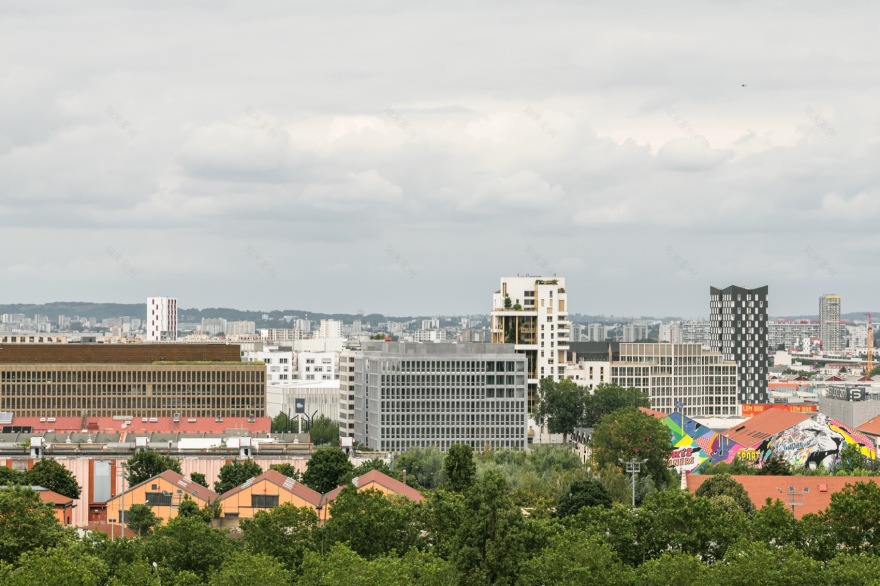
▼外观鸟瞰,aerial view of the building© Schnepp Renou

▼远观,viewing the building from the park© Schnepp Renou


JUMP 将前 covid 时代与今天联系起来。它设计于 2017 年至 2020 年,建造于 2020 年至 2023 年,为应对最近的全球危机而不断发展,具有韧性,并保有应对未来挑战的适应性。业主 Icade 希望建筑能够包含灵活、相互连接、光线充足的办公楼层,为工作人员提供舒适性和易用性。此外,业主还希望建筑中能够容纳一家可提供 180 间客房的酒店,在有限的预算范围内,为“Place Front Populaire”地区带来更多活力。设计旨在使建筑易于运营和维护,同时展示出其优异的能源效率。
▼分析图,analysis diagram©KAAN Architecten

JUMP bridges the pre-COVID era with today. Designed between 2017 and 2020 and built between 2020 and 2023, it has evolved in response to recent global crises, resulting in resilience and ensuring adaptability to future challenges.
Icade wanted to create flexible, interconnected and well-lit office floors that offered comfort and ease of use throughout. Their vision extended to a hotel with 180 rooms catering to small budgets, strategically positioned to bring animation to “Place Front Populaire”. The brief emphasized buildings that are easy to operate and maintain while demonstrating exemplary energy efficiency.
▼东立面,east facade© Schnepp Renou

▼西立面,west facade© Schnepp Renou
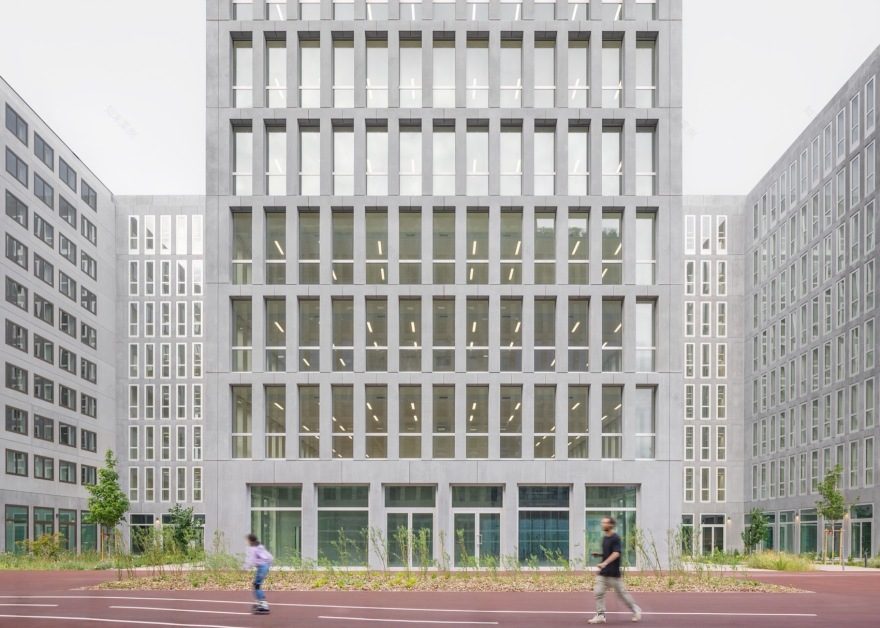
JUMP 大楼高 30 米,占地 45 米×90 米,将两个朝西的空间与花园结合在一起,连接了“Place Front Populaire”和“Parc Icade des Portes de Paris”的绿色区域。花园空间作为办公室与外部世界的过渡以及餐厅的露台,为使用者提供了户外休闲的理想场所。东立面上,四条反射着天空的留白将立面划分为五个部分。极具通透性的底部楼层揭示了花园和邻近的建筑,创造出“Rue de la Garance”和“Rue des Fillettes”之间的视觉联系。酒店体量位于北部,南部从公园中脱颖而出的则是办公体量,与茂密的绿化形成鲜明对比。顶部三层的凉廊打破了立面的单一节奏。零售、大堂、接待、餐厅、咖啡馆和露台将建筑连接到充满活力的地面层和屋顶的公共空间。
▼分析图,analysis diagram©KAAN Architecten


Rising 30 meters high on a 45 x 90-meter footprint, JUMP integrates two west-facing voids with gardens that connect the green areas of “Place Front Populaire” and “Parc Icade des Portes de Paris”. These spaces serve as entry thresholds for offices and terraces for restaurants. Four cut-outs reflecting the sky distinguish the five volumes on the east facade. The transparent public plinth, which reveals gardens and neighbouring buildings, provides the visual connection between “Rue de la Garance” and “Rue des Fillettes”. To the north, the hotel volume, and to the south, the office volume, emerge from the park, contrasting dense urbanity with lush greenery. The loggias on the top three floors break the rigidity of the elevation. Retail, lobbies, receptions, restaurants, cafes and terraces connect the building to the public realm on vibrant ground and roof levels.
▼庭院立面,facades facing the courtyard© Schnepp Renou

▼庭院,courtyard© Schnepp Renou

▼顶层近景,closer view of the top floor© Schnepp Renou


▼顶层露台,rooftop terrace© Schnepp Renou

KAAN Architecten 为 JUMP 秉承的建筑设计基于三个关键原则:灵活的空间、极简的建筑材料,以及坚固的结构。建筑的立面和核心筒的设计旨在承重,不需要额外的支撑,进而形成了开放,无柱的内部空间。建筑的东侧,薄预应力空心芯板可实现 13 米的跨度,横跨整个空间。建筑的西侧则为三个突出的体量,每个体量宽 19 米,中心包含了交通核心,两侧则包含工作空间或酒店房间。
KAAN Architecten’s construction principles for JUMP are based on three key parameters: designing flexible spaces, minimizing building materials, and ensuring robust structures. The façades and cores of the building are designed to be load-bearing without requiring additional support allowing open, column-free interior spaces. To the east, thin prestressed hollow core slabs make it possible to cross the building’s 13-meter width. To the west, three protruding volumes, each 19-meter thick, contain circulation cores in the centre and either workspaces or hotel rooms on the sides.
▼立面近景,closer view of the facade© Schnepp Reno

▼立面节奏,rhythm of the facade© Sebastian van Damme

▼外观,exterior view© Sebastian van Damme

办公空间的立面网格由 1.35 米×43 厘米的坚固结构组成,这种结构为工作空间分区带来了充足的灵活性。预制混凝土“T”形元素形成了建筑结构和立面,没有添加任何装饰。43 厘米的部分水平排列,隐藏了板结构,并在三个突出的体量上形成了统一的立面网格。大型垂直窗户定义了这些不同体量的立面。酒店设有大全景窗户,使房间显得更加宽敞。面向“Place du Front Populaire”的一侧设有 90 间客房,生动的生活场景照亮了酒店一侧的建筑立面。
With a solid mass of 43 cm every 1.35 metres, the façade grid on the office side offers flexibility in the partitioning of workspaces. Precast concrete “T” elements form the building structure and façade, with no cosmetic additions. The 43 cm sections are aligned horizontally, concealing the slab structure and creating a uniform grid over the entire comb-shaped volume. Large vertical windows define the façades of these different volumes. The hotel features large panoramic windows that highlight the spaciousness of the rooms. From the “Place du Front Populaire”, ninety travel scenes illuminate the façade of the hotel.
▼酒店一侧,hotel side© Sebastian van Damme

阳极氧化铝细木工的颜色各不相同:酒店中采用了青铜色,反映了周围的自然环境;银色用于办公室,创造出一种色调一致的铝/混凝土美学。临街一侧,细木工隐藏在内部,进一步突出了混凝土的纯粹美学。在花园空间一侧,细木工与立面齐平,增强了空间的立体效果,由玻璃和铝制窗框组成的大型开窗,反射了天空和环境光。
The anodized aluminium joinery varies in colour: bronze for the hotel, reflecting its immediate environment, and silver for the offices, creating a tone-on-tone aluminium/concrete aesthetic.
On the street side, the joinery is hidden inside. This increases the character of the concrete.
On the garden voids side, the joinery is flush with the façade, enhancing the excavation effect of the voids and reflecting the sky and ambient light in the glass and oversized aluminium frames.
▼办公室一侧立面细部,facade details of the office side© Schnepp Renou


▼酒店一侧立面细部,facade details of the hotel© Schnepp Renou

▼地面层,ground floor level© Schnepp Renou

项目之初,业主就为本项目制定了一项雄心勃勃的环境目标,致力于将 JUMP 大楼打造为具有低碳影响、高能效和创新解决方案的示范项目。KAAN Architecten 选择采用低碳材料并整合可重复使用的组件,与 E+C-label 中制定的碳 1 阈值相比,本项目减少了近 30%的碳足迹。总体温室气体排放量为 1124kgCO2eq/m²,其中 842kgCO2eq/m²归因于建筑材料和能源消耗。
The client set ambitious and clear objectives from the start. They aimed to create an exemplary project with a low carbon impact, high energy efficiency, and innovative solutions. The choice of low-carbon materials and the integration of reused components by KAAN Architecten reduced the carbon footprint by nearly 30% compared to the Carbon 1 threshold of the E+C- label. The overall Greenhouse gas emissions stand at 1124 kgCO2eq/m², with 842 kgCO2eq/m² attributed to construction materials and energy consumption.
▼接待区,reception area© Schnepp Renou
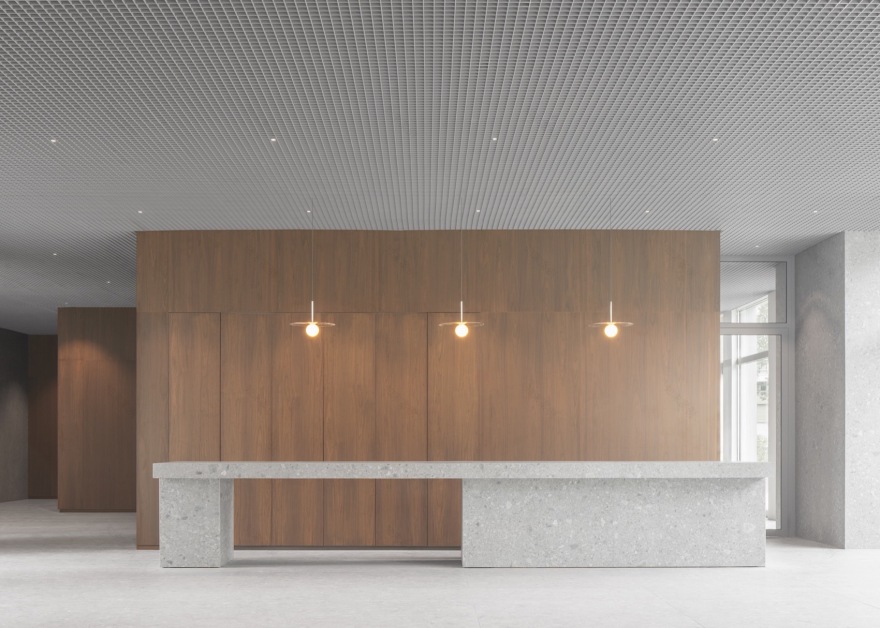
▼接待区细部,details of the reception© Schnepp Renou

设计仔细考虑了建筑的能耗问题,使建筑具有极低的热渗透率为 0.43 m³/(h.m²)。混凝土网格的节奏和厚度,以及细木工的设计和布局,有助于建筑的热和光平衡。与电力或天然气解决方案相比,地热解决方案进一步提高了效率,扩大了建筑的低碳影响。该建筑已经获得了 HQE 建筑耐久性优秀、BREEAM 新建筑优秀、E+C 级 E2C1 和 BBCA 性能等认证,体现了一种可持续的、面向未来的建筑解决方案,丰富了城市的环境。这些荣誉证实了 KAAN Architecten 的设计在应对当今环境挑战方面的成功,以及 JUMP 大楼在所有主要领域的高性能。
Energy consumption has been carefully considered, as evidenced by the extremely low permeability of 0.43 m³/(h.m²). The concrete grid’s rhythm and thickness, along with the joinery’s design and placement, contribute to the building’s thermal and light balance. A geothermal solution further enhances efficiency, providing a low carbon impact compared to electric or gas solutions. The building has been awarded certifications including HQE Bâtiment Durable Excellent, BREEAM New Construction Excellent, E+C- level E2C1 and Label BBCA Performance, embodying a sustainable, future-ready architectural solution that enriches its urban environment. These certifications confirm the success of KAAN Architecten’s project in meeting today’s environmental challenges, and its high performance in all major areas.
▼办公楼层,office level© Schnepp Renou

▼细部,details© Schnepp Renou

▼楼梯,staircase© Schnepp Renou

JUMP 不仅仅是一座建筑,更代表了一种具有前瞻性和可持续性的建筑解决方案,连接和丰富了其所在的城市环境。项目中所展示出的多功能设计和对可持续性的承诺使其成为建筑发展和更新的光辉典范,同时也满足了建筑使用者当前和未来的需求。通过 JUMP 项目,KAAN Architecten 展示了建筑如何在应对环境挑战的同时蓬勃发展,在可持续发展城市的整合和适应方面,本项目堪称为一个杰出的典范。
JUMP isn’t just a building; it’s a forward-thinking, sustainable architectural solution designed to connect and enrich its urban environment. Its versatile design and commitment to sustainability make it a shining example of how buildings can evolve and thrive, meeting both current and future needs. With JUMP, KAAN Architecten demonstrates how buildings can flourish while addressing environmental challenges, establishing it as an outstanding example of sustainable urban integration and adaptation.
▼东立面夜景,night view of the east facade© Schnepp Renou

▼庭院夜景,night view of the courtyard© Schnepp Renou

▼总平面图,master plan©KAAN Architecten

▼标准层平面图,typical plan©KAAN Architecten

▼立面图,elevations©KAAN Architecten


▼剖面图,section©KAAN Architecten

▼细部大样,construction details©KAAN Architecten

Location:Ilot D – ZAC du Front Populaire / Rue des Fillettes / Place du Front Populaire 93300 Aubervilliers, Paris
Architect: KAAN Architecten (Kees Kaan, Vincent Panhuysen, Dikkie Scipio)
Project team:Alessandro Arcangeli, Michael Baas, Beatrice Bagnara, Robin Cals, Maicol Cardelli, Jorge Correia, Daniele Dalbosco, Louise de Chatellus, Javier Cuartero, Marylène Gallon, Renata Gilio, Aleksandra Gojnic, Cristina Gonzalo Cuairán, Sophie Ize, Kees Kaan, Guilherme Miranda, Théodossis Montarnier, Vincent Panhuysen, Nikolina Pavlova, Dikkie Scipio, Joeri Spikers, Jan Teunis Ten Kate, Pauline Trochu, Sophie Twarog, Clémence Vallée, Claudio Zampaglione
Client: Icade, Paris
Programme:Offices, hotel, retail, parking
Design phase:September 2017 – June 2020
Start construction:February 2021
Completion:May 2024
GFA:19.715 sqm (14.859 m² office space, 4.496 m² hotel space, 360 m² retail space, 60 parking spaces, 100 motorised two-wheeler spaces, 208 m² bicycle parking space)
Urban design: Denerier + Martzolf urbanistes, Paris
Design team
Project Management:SCO coordination and MOEX, Paris
Construction advisor:EVP, Paris
Construction W(engineering): ALTO, Paris
Construction E(lectricity): ALTO, Paris
Technical installations advisor: ALTO, Paris
Façade advisor: RFR, Paris
Fire safety advisor: CSD Associés, Paris
Acoustics advisor:Acoustique & Conseil, Paris
Sustainability & Commissioning: SINTEO, Paris
Building costs advisor: VPEAS, Paris
Landscape designer: BASE, Paris
Infrastructure, roads and utilities: ATEVE, Paris
Kitchen advisor: Restauration Conseil, Ivry-sur-Seine
Hotel consultant: HPVA, Paris
Safety coordination:QUALICONSULT, Paris
BIM Manager:R-BIM, Courbevoie
Building control office:SOCOTEC, Villepinte
南京喵熊网络科技有限公司 苏ICP备18050492号-4知末 © 2018—2020 . All photos and trademark graphics are copyrighted by their owners.增值电信业务经营许可证(ICP)苏B2-20201444 苏公网安备 32011302321234号
苏公网安备 32011302321234号客服
消息
收藏
下载
最近