

创作上传
VIP
收藏下载
登录 | 注册有礼
查看完整案例

收藏

下载

分享

翻译
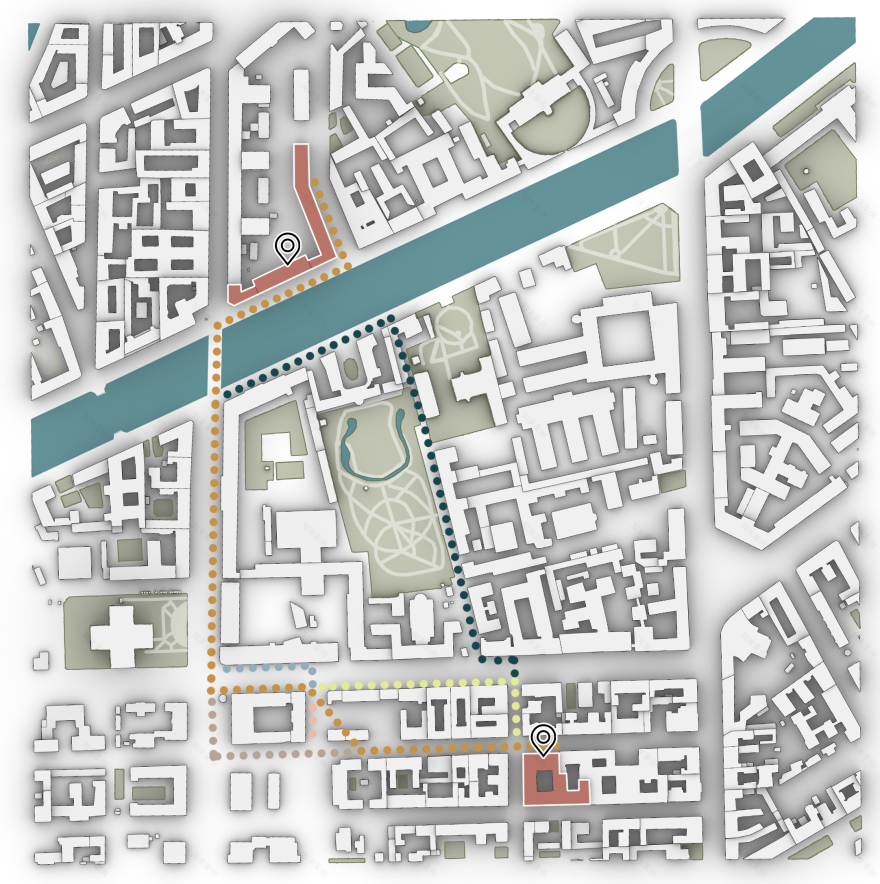

The course project in “Urban Strategies” at the St. Petersburg State University of Architecture and Civil Engineering included an advanced urban analysis of a selected territory close to the university. The subject of this research is the route between the university campus and the dorm which is utilised by students on a daily basis. The analysis found that the route was mainly used by two categories of pedestrians - students and tourists. Various analysis of light, noise, cognitive challenges as well as pedestrian and traffic flows discovered several problems. Therefore, it was decided to consider alternative route options in order to optimise the pedestrian flows between both population groups.


The analysis of the traffic and pedestrian flows showed that the analysed route is strongly preferred by students in comparison to the projected optimal route. Main reasons for the unpopularity of the optimal route are the unnatural appearance of the route due to surrounding front facades as well as the river Fontanka which creates a psychological obstacle. Moreover, the route is filled with physical obstacles such as parked vehicles, large outdoor trash bins and partial absence of pavement which make the route pedestrian unfriendly. The project suggests to transform the optimal route into a pedestrian-friendly path. In addition, an analysis of the distances between the existing bridges of the Fontanka River displays the need of an additional pedestrian bridge connecting both sides of the river.
Thus, the projected optimal route represents the the shortest path between the dorm and the university. The projected bridge also helps to take the pressure off the loaded surrounding bridges. With the separation of the conflicting pedestrian flows, the analysed route becomes more comfortable for tourists and visitors.
南京喵熊网络科技有限公司 苏ICP备18050492号-4知末 © 2018—2020 . All photos and trademark graphics are copyrighted by their owners.增值电信业务经营许可证(ICP)苏B2-20201444 苏公网安备 32011302321234号
苏公网安备 32011302321234号客服
消息
收藏
下载
最近