

创作上传
VIP
收藏下载
登录 | 注册有礼
查看完整案例

收藏

下载

分享
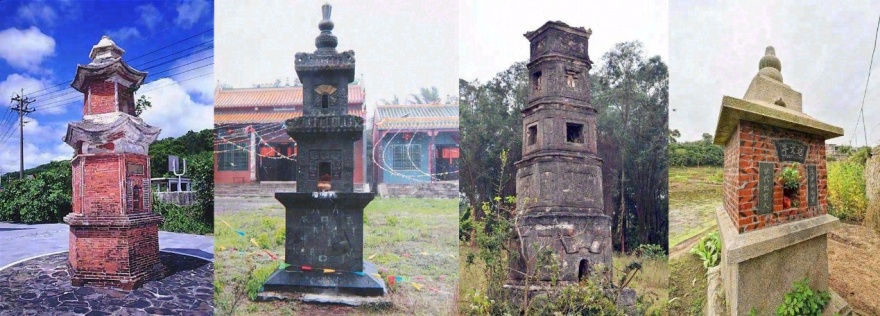
位于大山深处的贵州中关村仍然保留着一项中国的古老习俗——“敬惜字纸”。在我国古代,中国人对于文字有着一种特殊的崇拜,认为字是神圣的,是文化的象征,延伸到对有文字的纸张的敬重与爱惜,他们相信若能“敬惜字纸”,定会获得种种福报。[1]有字的纸是不能随便抛掷的,需要将废弃字纸整理干净妥善收藏于字纸篓,收集以后送到专门修建的“字纸楼”内焚烧成灰,称为“字灰”,每隔一段时间,要开坛祭祀造字的仓颉,然后将字灰送至大江大海,称为“送字灰”或“送字纸”。有些地方还组织有惜字会或文昌会,劝人“敬惜字纸”,这些都是人们“敬惜字纸”的重要内容。[2]如今江南地区许多古村落仍然可以看到古代遗留下来的“敬字炉”、“惜字塔”等设施。
▼敬惜字纸,
“Respecting the Written Characters on Paper” ©️ 图源网络

Deep in the mountains of Zhongguan Village, Guizhou, an ancient Chinese custom called “Jing Xi Zi Zhi” or “Respecting the Written Characters on Paper” is still preserved. In ancient China, people held a special reverence for written characters, seeing them as sacred symbols of culture. This reverence extended to the paper on which characters were written. People believed that respecting the “Character Paper” would bring various blessings. Paper with characters on it was not to be discarded casually; instead, it had to be cleaned and properly stored in specific containers. These papers were then taken to a specially constructed furnace or tower and burned to ashes. Periodically, a ceremony was held to worship Cang Jie, the legendary inventor of Chinese characters, and the ashes were then sent into rivers or seas, a folk custom called “Sending Character Ashes” or “Sending Character Paper.” In some regions, there were also associations dedicated in promoting the respect for “Character Paper”. Even today, in many ancient villages in the Jiangnan region, one can still find constructions for character-burning such as towers and furnaces left behind from ancient times.
▼保留至今的传统敬字炉,Traditional character-burning furnace remains today©️图源网络
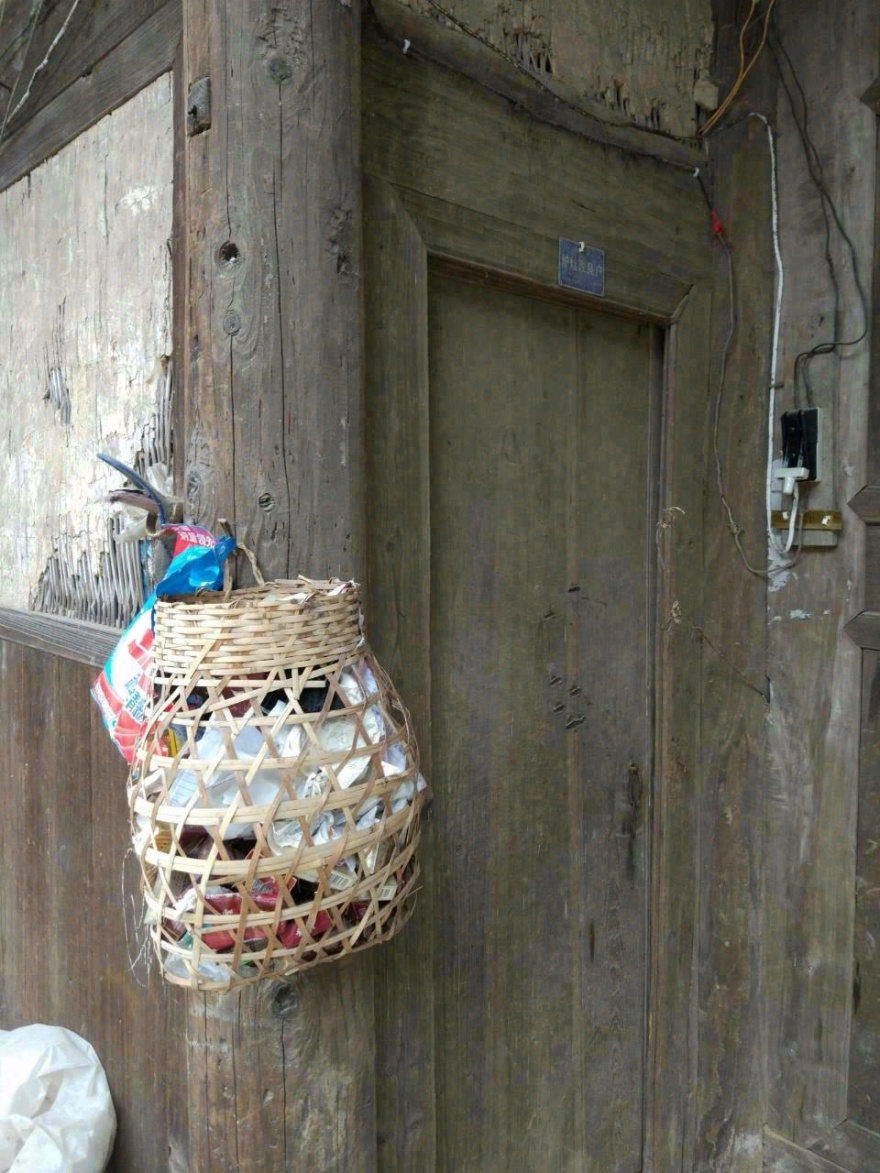
这座黔北的山村至今仍然将“敬惜字纸”这一习俗保存完好,家家户户房前有一个专门的竹篓用于盛放“字纸”,与江南地区相比相对朴素,人们会把盛满字纸的竹篓拿到村庙处的河边焚烧后将字灰倒入河中,并没有专门的设施和场地来进行这项仪式。
中关村由于面临向旅游产业转型,村庙作为一处重要的公共空间被列入设计范围,我们希望依托村庙,将这一颇有特色的民间习俗整合到村庙空间,增加一处设施来承载此项活动,即是延续保留这一传统,同时也会为游客带来一处颇有特色的旅游体验。
This mountain village in northern Guizhou has preserved this custom well. Every household has a bamboo basket in front of their house for collecting the “Character Paper”. Unlike the Jiangnan region, the process is relatively simple: villagers take the filled baskets to the river by the village temple, burn the paper, and then pour the ashes into the river, without any special constructions for this ceremony.
As Zhongguan Village transitions to a tourism-based economy, the village temple, an important public space, has been included in the design scope. We hope to integrate this distinctive folk custom into the temple space, adding a facility for this activity. This not only preserves the tradition but also provides a unique experience for tourists.
▼村中盛放字纸的竹篓,Bamboo basket for “Character Paper” collection in the village ©傅英斌
乡村信仰中心
Village Belief Center
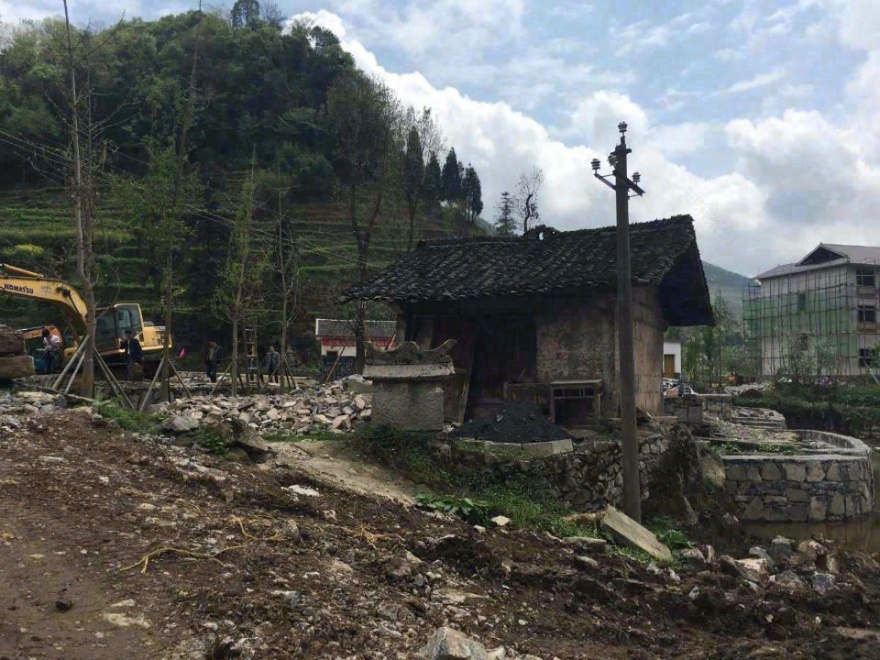
敬字建筑一般选址于临水桥涵处或邻近河流等水系发达处,这样可将纸灰通过塔基部分的出字口直接倾洒于河流水系中。古人深信,水的尽头便是天,纸灰顺水奔流可回至仓颉身边,同时也为自我祈福,以实现子孙聪慧等美好愿景。基于对敬字文化的研究,敬字炉选址位于临河一侧,连接两岸的重要枢纽步行桥处,这里是村庄中最重要、最活跃的公共空间。场地的核心是一组保存下来的古建筑,主建筑是中关村的村庙——一座有接近 200 年的历史的悬山顶石砌建筑,里面供奉观音等民间信仰,与村庙相对的是一处供奉土地神的矮小的石头神龛。
The character-burning facility is generally located near water, such as bridges or rivers, so the ashes can be directly poured into the river through openings at the base of the tower. The ancients believed that the end of the water was the sky and that the “Character Ashes” could flow back to Cangjie, bringing blessings and intelligence to themselves and their descendants.
Based on the culture research above, the furnace is located beside the river, near an important pedestrian bridge. This is the most significant and active public space in the village. The core of the site is a group of preserved ancient buildings, with the main structure being the village temple —a nearly 200-year-old stone building with a suspended roof, dedicated to Guanyin and other folk deities. Opposite the temple is a small stone shrine for the Earth God.
▼村庙与场地改造前现状照片,Village temple and the site before the renovation ©傅英斌
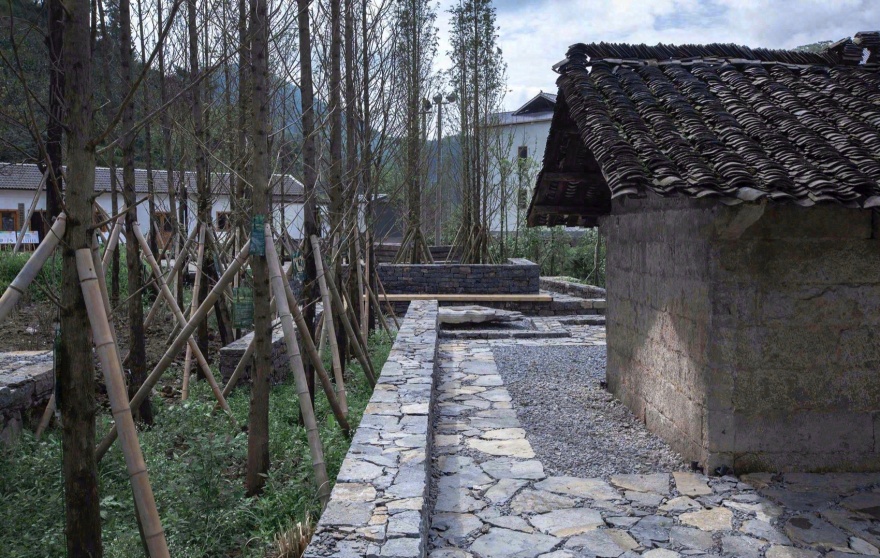
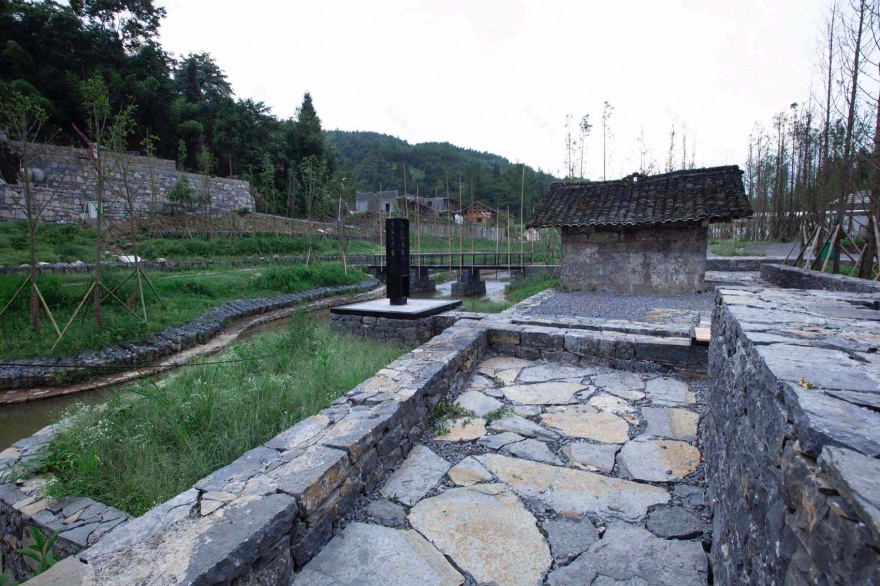
我们将整体空间进行了梳理,分成两组空间:一组为庙前空间,以村庙与神龛为主,保留了建筑的原真风貌,为村庙的相关活动提供了场地,同时给步行桥留出了缓冲集散空间;庙后空间相对安静,便于休憩,空间的高潮部分即为临水进行敬字活动的敬字炉,下方砌筑深入河中的石台,石台与一旁的景观石墙形成对应关系,增强轴线感。为焚纸活动营造出空间序列,引导人到达敬字炉。整体空间通过低矮石墙与粗粝的石板和砺石将空间与形式组织在一起,外围密植水杉林,使这一区域塑造成更加完整的乡村文化和信仰中心。
We have organized the entire space into two main areas: one in front of the temple and one behind it. The space in front centered around the temple and the shrine, provides a place for temple-related activities, leaving a buffer and gathering space for the pedestrian bridge. In order to preserve the authentic view, only light intervention is made in the front space. The space behind the temple is relatively quiet and suitable for resting, with the highlight being the Furnace of Character by the water. Below the furnace is a stone platform extending into the river, corresponding with a nearby stone wall to enhance the sense of axis. This sequence of spaces is arranged on purpose for the character-burning activities, guiding people to the Furnace of Character. The overall space is organized with low stone walls, rough stone slabs, and gravel, and surrounded by densely planted dawn redwoods, creating a more complete village cultural and belief center.
▼改造后的庙前空间,保留了建筑的原真风貌,为村庙的相关活动提供了场地,
The reshaped front space retains the authentic appearance of the village temple and provides places for related activities © 焦冬子

▼改造后的村庙后空间,以临水的敬字炉作为空间高潮,Furnace of Character by the water, the highlight of the rear space after the renovation © 焦冬子

敬字炉的形式与表达 Form of the Furnace of Character
敬字炉在古代通常是砖石塔的形式,立面为塔基、塔身、塔刹组成的三段式结构,布局以方为主,与天圆遥相呼应,又受到奇数阳、偶数阴的传统阴阳思想的制约,所以边数多取偶数,[3]塔内中空用于焚纸。此处作为村庙的一处新建附属设施,形式和体量上都需要与现存的古庙处理好关系。因此我们保留了传统的三段式结构、方形平面与偶数边数,作为对于传统形制的继承。但是在形式与材料上采用了现代的设计语言与建造方式,与传统的村庙形成对比。敬字炉的主体为一个长方体块,用钢板焊接而成,炉壁两侧钢板镂空雕刻了古代敬字塔上的常见对联——“笔墨化为云烟,文章炳于霄汉”。
In ancient times, the character-burning furnace was usually built with brick or stone, with a three-part structure: the base, the body, and the top. The layout was typically square, reflecting the traditional belief in the round sky and square earth, with the number of sides often being even, adhering to the yin-yang philosophy. The tower was hollow inside for the burning process.
As a newly built facility attached to the village temple, the form and volume needed to harmonize with the existing ancient temple. Therefore, on the one hand, we retained the traditional three-part structure, square layout, and even number of sides as an inheritance of traditional form. On the other hand, we used modern design language and construction methods, contrasting with the traditional village temple. The main body of the furnace is a rectangular column made by steel plates perforated with Chinese characters, which is a couplet from ancient furnace: “Ink transforms into clouds and smoke, and literature shines in the sky.”
▼建成后的敬字炉,The Furnace of Character after completion © 焦冬子
▼敬字炉,The Furnace of Character© 焦冬子

“送字灰”活动通常在傍晚进行,夜幕即将降临,焚纸的火光和烟雾通过炉壁上的镂空文字袅袅而出,一种极具神秘色彩的景象便由此而生,强化了这一民间习俗的仪式感。焚纸结束后,人们将炉内纸灰倒入河中随水而去,传统习俗通过这一处空间和设施得到升华和强化。
The “Sending Character Ashes” ceremony usually takes place in the evening. As night falls, a scene of mysterious is reborn in the village: the firelight and smoke emerge through the perforated characters on the steel plate. After the burning, people pour the ashes into the river. The traditional custom is preserved and revived through this space and facility, and the character can float again as in the old times.
▼焚纸中的敬字炉,The Furnace of Character with paper in burning© 焦冬子

后续 Further Development
此次建设是与村民生活密切相关的信仰活动,整个设计和建设过程经多次与村内长者沟通交流,使空间更符合村民习惯,避免有关习俗忌讳。老村长是村里的权威,主张弘扬传统,他对此事极为重视,建成后村里的老村长亲自为敬字炉“开光”,亲自书写了一幅感谢对联赠与我们。
This construction project is closely related to the villagers’ belief activities. The entire design and construction process involved multiple communications with village elders to ensure the space met their habits and avoided any taboos. The village chief, an authority in the village who advocates for preserving traditions, placed great importance on this matter. After completion, the village chief personally “consecrated” the furnace of character and gifted us with a couplet as the appreciation.
▼老村长赠送对联并为敬字炉开光,The couplet gifted by the village chief and the performance of the “consecration” ceremony © 傅英斌


After the renovation, the village temple and the furnace of character at the center of the village became the spiritual guardians of the entire village. The furnace and the custom of “respecting character paper” became popular tourist attractions. The modern version of furnace of character reawakens and passes on this ancient custom. As a new design that carries tradition, it faced many doubts about whether the villagers would accept this modern form. Therefore, we hoped the furnace would stand the test of time. The project has been completed for eight years until now. During this period, we have revisited the site multiple times and inquired by phone about the use of the furnace. It is still in regular use and integrated into the villagers’ daily lives.
▼整体轴测图,Axonometry of the site © 宋嘉

项目地点:贵州省遵义市桐梓县茅石镇
设计时间:2016.4
建成时间:2016.8
面积:140 平米
设计单位:傅英斌工作室
主创设计师:傅英斌
团队:宋嘉、周道兴、闫璐、张浩然
撰文:宋嘉
翻译:赵思媛
摄影:焦冬子、傅英斌
Main Information
Project Location: Maoshi Township, tongzi County, Zunyi City, Guizhou province, China
Design Year: April, 2016
Completion Year: August, 2016
Site Area: 140sqm
Design by Fuyingbin Studio
Chief Designer: Yingbin Fu
Design Team: Jia Song, Daoxing Zhou, Lu Yan, Haoran Zhang
Write articles: Jia Song
Translate:Siyuan Zhao
Photography:Dongzi Jiao, Yingbin Fu

南京喵熊网络科技有限公司 苏ICP备18050492号-4知末 © 2018—2020 . All photos and trademark graphics are copyrighted by their owners.增值电信业务经营许可证(ICP)苏B2-20201444 苏公网安备 32011302321234号
苏公网安备 32011302321234号客服
消息
收藏
下载
最近