

创作上传
VIP
收藏下载
登录 | 注册有礼
查看完整案例

收藏

下载

分享
背景 Background 项目位于南京市秦淮区,紧邻文保建筑“原天山协会旧址”。是大城市中较为典型的老旧城区。
This project is situated in the Qinhuai District of Nanjing, right next to the historically significant “Original Tianshan Association Old Site.” It exemplifies a typical aging urban area within a large city.
▼街景,street view©Mata Okawa


场地南边的科巷,是南京知名的“美食街”,而场地两侧是繁忙的利济巷和长白街。街区中密集的建筑、丰富的沿街餐饮以及川流不息的车辆和人群构成了一幅生动的图景,也代表着南京城丰富的历史底蕴。
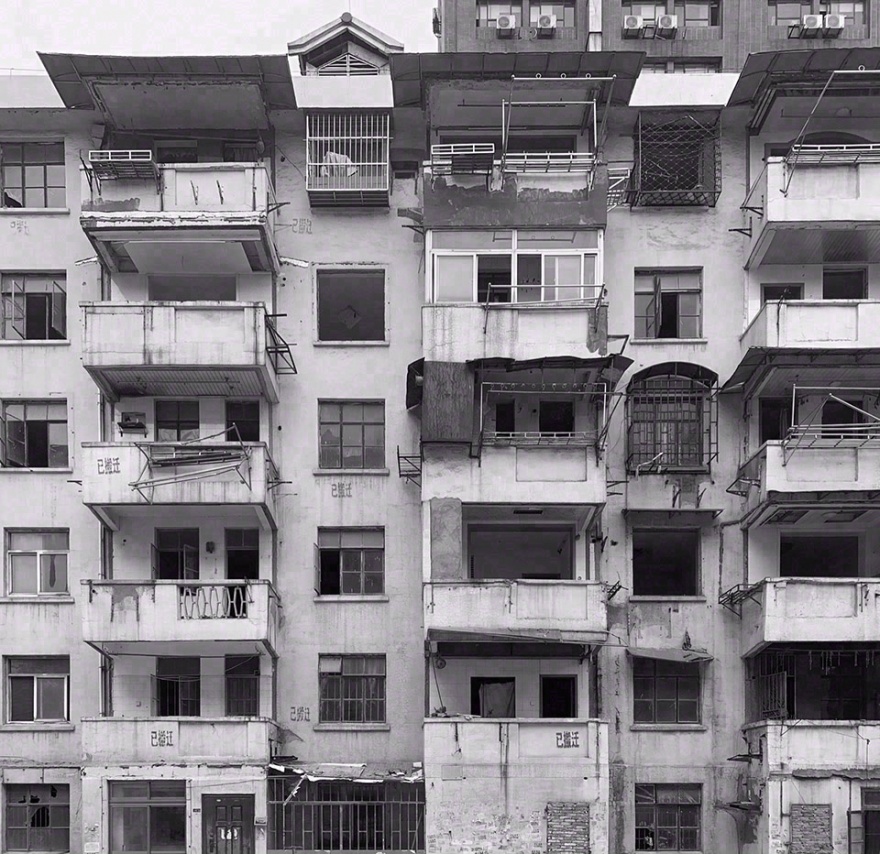
项目的原始建筑为两栋老式的六层居民楼,受业主委托我们将其转化为一个包含餐饮、酒店及公共活动空间的综合性商业街区。在这样的环境中,我们希望通过改造,在维持原有生活氛围的基础上提升整体环境并激发老城片区的活力。
▼原始场地照片,Original site photos


To the south lies Kexiang Alley, renowned as one of popular “food streets” in Nanjing. The project is flanked by the bustling Liji Alley and Changbai Street. The dense architecture, vibrant street-side dining options, and the incessant flow of both vehicles and pedestrians create a lively tableau, encapsulating the rich historical essence of Nanjing.
The original structure comprises two six-story residential buildings. Upon the client’s request, our goal is to transform these buildings into a multifunctional commercial district, integrating dining, hospitality, and communal activity spaces. In this revitalization effort, we aim to enhance the overall environment while stimulating the vibrancy of the old city area, all while preserving the original community atmosphere.
▼街景,street view©Mata Okawa

▼半鸟瞰,half aerial view©Mata Okawa

温和的更新策略
Gentle Renovation Strategy
作为一个城市微更新项目,如何在维持现状建设格局的前提下完成老旧居民楼向商业性质公共建筑的转化,是我们的首要课题。诚然,拆旧建新的模式是过去几十年城市发展进程中的主要手段,然而这种模式在街区乃至城市的尺度是一种粗暴的介入。对于我们而言,建筑师的关注点不应该局限于红线之内,我们更愿意将这个项目视为一个生命体,让它从周边的环境中汲取养料从而更自然的生长、进化。
As a micro-renovation project, our primary challenge is to transform the old residential buildings into commercial public spaces while maintaining the existing urban fabric. While demolishing and rebuilding has been a predominant approach in urban development over the past decades, such methods often involve a blunt intervention at both the district and city levels. For us, the role of the architect extends beyond the confines of property boundaries. We prefer to view this project as a living entity, one that draws nourishment from its surrounding environment to grow and evolve more naturally.
▼建筑的微更新,micro-renovation project©Mata Okawa

▼底层餐饮空间,restaurant/cafe on the ground level©Mata Okawa

创造公共空间
Creating Public Spaces
对外,我们将原本的围墙打开,使其脱离“小区”的性质,成为街道的延伸。特别是在原天山会馆一侧,在围墙拆除后,人流得以引入原本藏在居民区之后的历史保护建筑展馆。
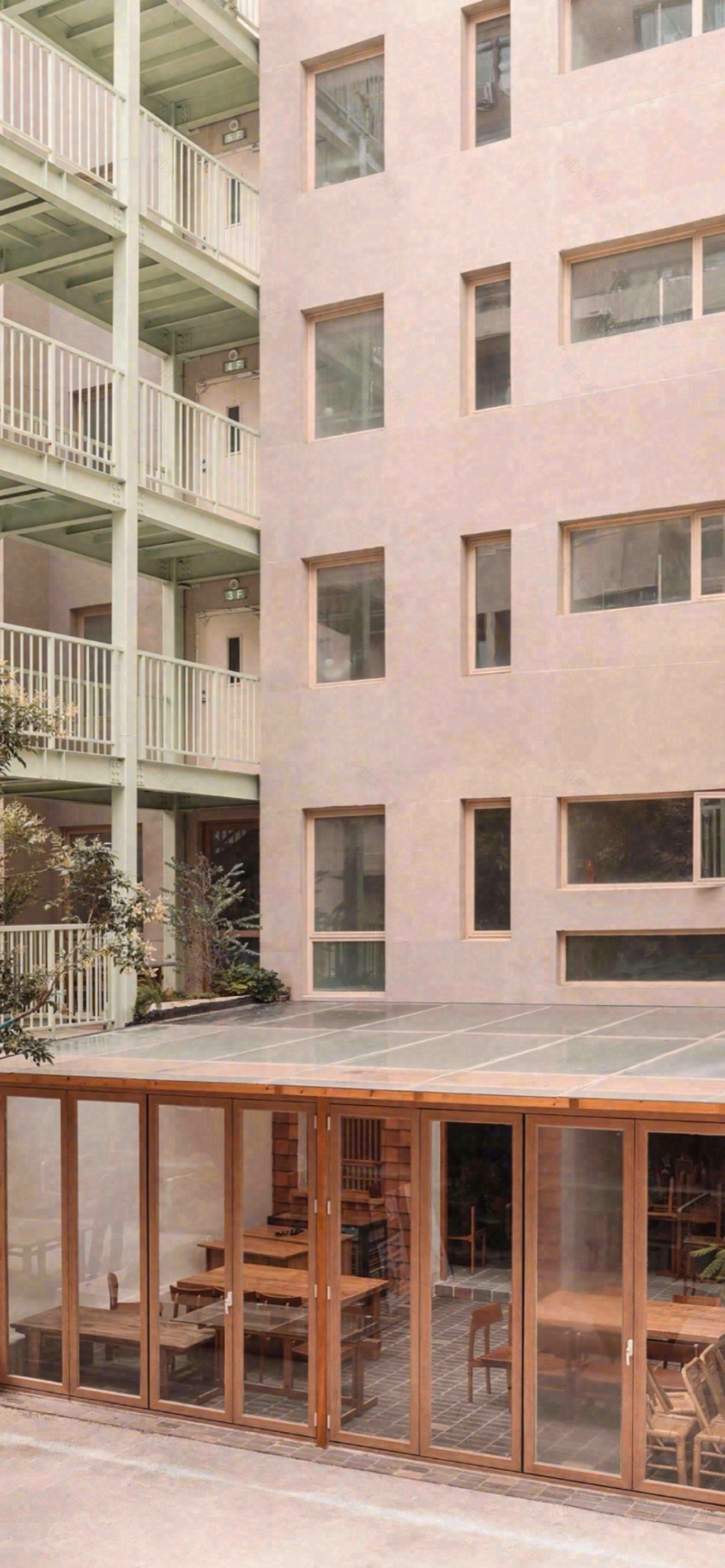
对内,两栋楼的一、二层规划为商业公共区域,我们将两栋建筑的首层空间向广场中心延伸,既为了应对不同业态的需求,并预留足够的灵活性,也使得原本较为疏远的楼栋间距围合成尺度亲人的广场。为了保证足够的采光,外扩空间采用轻盈的钢结构搭建,顶面及立面也选用通透的阳光板和玻璃材质,使沿街路人的视野能贯穿至室内深处,弱化了建筑的边界,使其更具有亲和力。
▼分析图,analysis diagram©上海实在建筑设计工作室
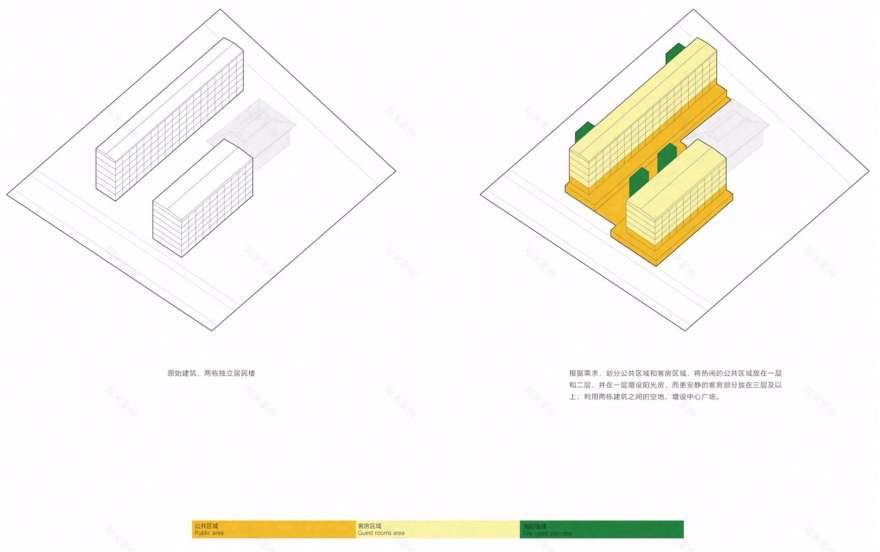
Externally, we are opening up the original perimeter walls to transform the area from a “community” into an extension of the street. The change is particularly notable on the side of the Original Tianshan Association Building, where removing the walls will draw pedestrian traffic into the historical preservation exhibition hall previously hidden behind residential blocks.
Internally, the ground and first floors of the two buildings are designated as commercial public areas. We’ve extended the ground-floor spaces of both buildings towards the central plaza, which not only accommodates various business needs with flexibility but also creates a more intimate plaza by bridging the previously distant building gaps. To ensure ample natural light, the expanded areas feature a lightweight steel structure with translucent sunlight panels and glass materials. The design allows street-level passersby to see deep into the interior, thus softening the building’s boundaries and making the space more inviting.
▼由口袋广场看街道,viewing the street from the yard©Mata Okawa

▼底层公共空间,ground floor public space©Mata Okawa


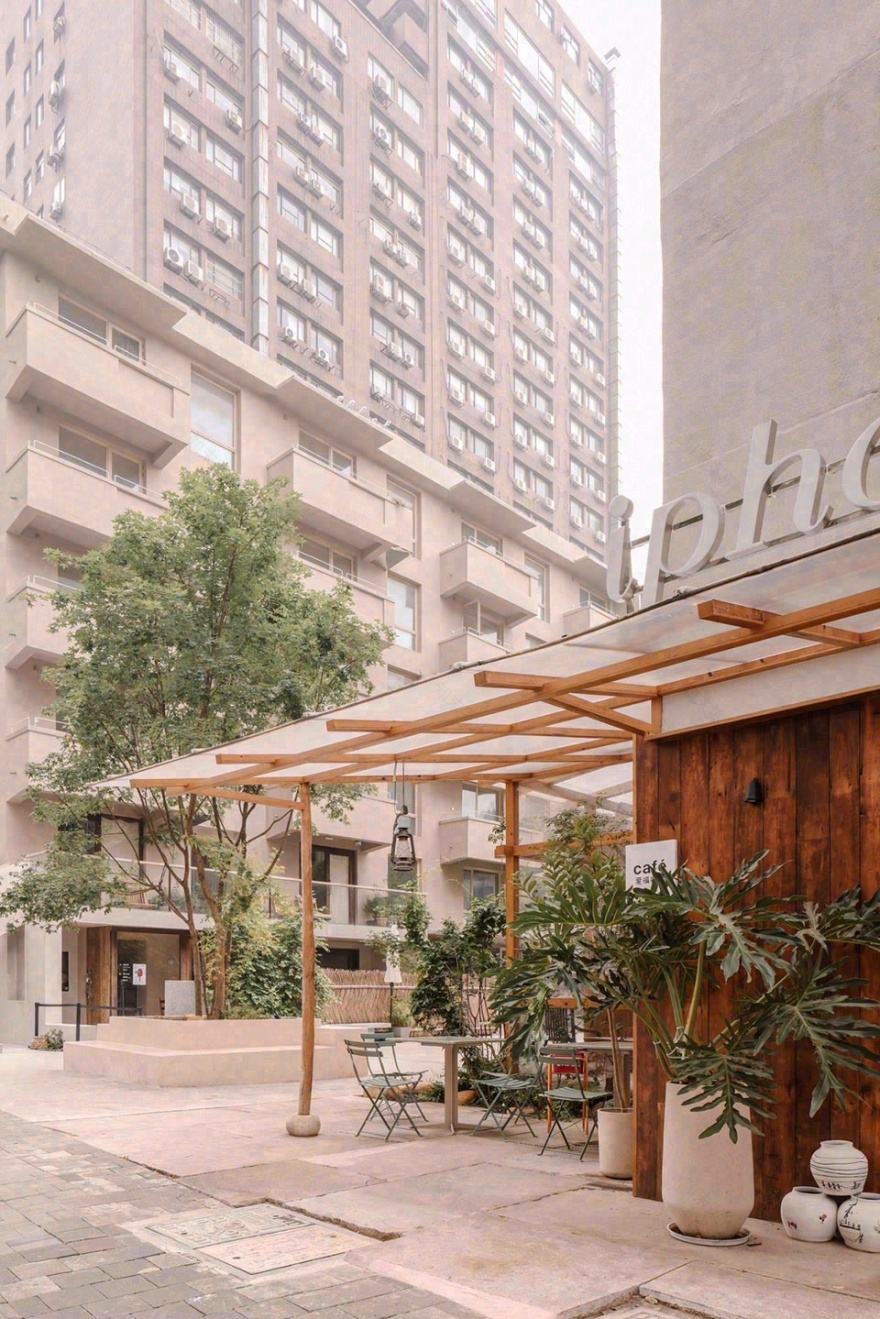
通过加建部分的围合,形成了街区中的口袋广场,配合绿化景观营造出与原始功能截然不同的商业休闲氛围。
By incorporating the newly built sections, we have created a pocket plaza within the block, which, along with the landscaping, fosters a commercial and leisure atmosphere distinct from the original function.
▼与原始功能截然不同的商业休闲氛围
commercial and leisure atmosphere distinct from the original function©Mata Okawa


▼绿化与露台,planting and terrace©Mata Okawa


东面沿科巷在一层打开沿街面,设置了灰空间,让周边的居民及用餐的客人都能在这片居民区中有一片小憩之地。
On the eastern side along Kexiang Alley, we have opened up the ground-floor facade to create a gray space, which provides a resting area for local residents and dining patrons.
▼沿街灰空间,gray space along the alley©Mata Okawa


外立面改造 Facade Renovation
原始建筑为砖混结构,不宜大刀阔斧地改变外立面造型。但原住户自发地加建和改造已经破损较为严重,有一定的安全隐患,也使立面失去了统一性。我们将现状的阳台门窗及玻璃房拆除,清理出了建筑最初始的样貌。然后将原本的小形方窗向下延伸,在不破坏原有结构的情况下形成落地窗,增加了室内的采光。同时选择部分阳台横向拓展为花池,使立面语言更加丰富有机。
▼改造前后立面图,elevation before and after renovation©上海实在建筑设计工作室

The original buildings are brick-concrete structures, which makes significant changes to the facade impractical. However, the extensive alterations and additions made by previous occupants have caused considerable damage and safety concerns, resulting in a lack of uniformity in the facade. We began by removing the existing balcony doors, windows, and glass rooms, revealing the building’s original appearance. We then extended the small, square windows downward, converting them into floor-to-ceiling windows to enhance natural light without altering the original structure. Additionally, some balconies were expanded horizontally into flower beds, thus enriching the facade’s visual language and adding a more organic feel.
▼建筑立面,facade©Mata Okawa

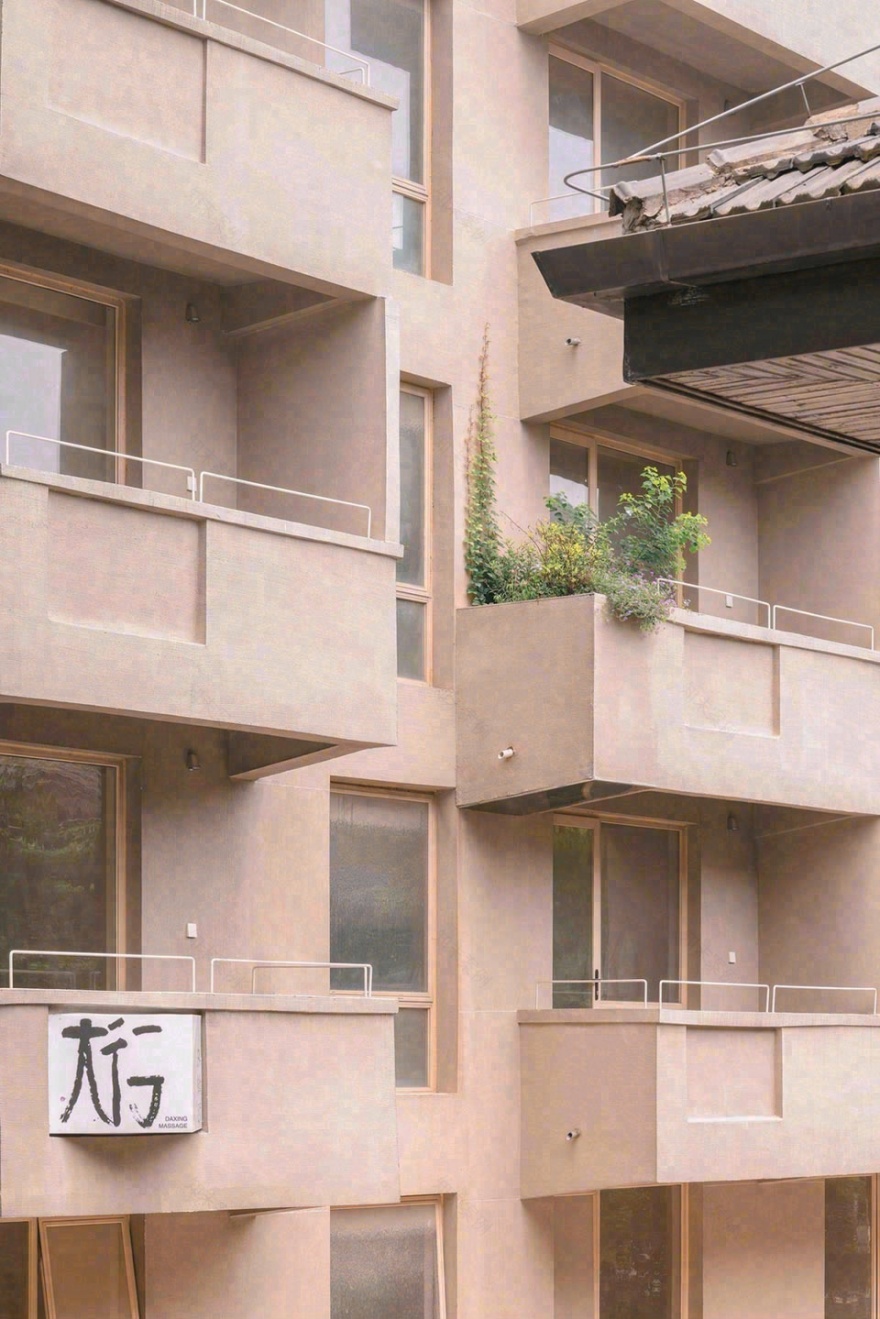

我们选择了较为沉稳且与周边环境协调的米色作为建筑的主体颜色,同时采用横竖向的手工拉槽工艺,进一步丰富了外墙肌理。
For the main color, we chose a muted beige that harmonizes with the surrounding environment. We also employed horizontal and vertical hand-troweled textures to further enrich the facade’s surface.
▼外挂钢结构疏散楼梯,thenew external steel evacuation stairs©Mata Okawa
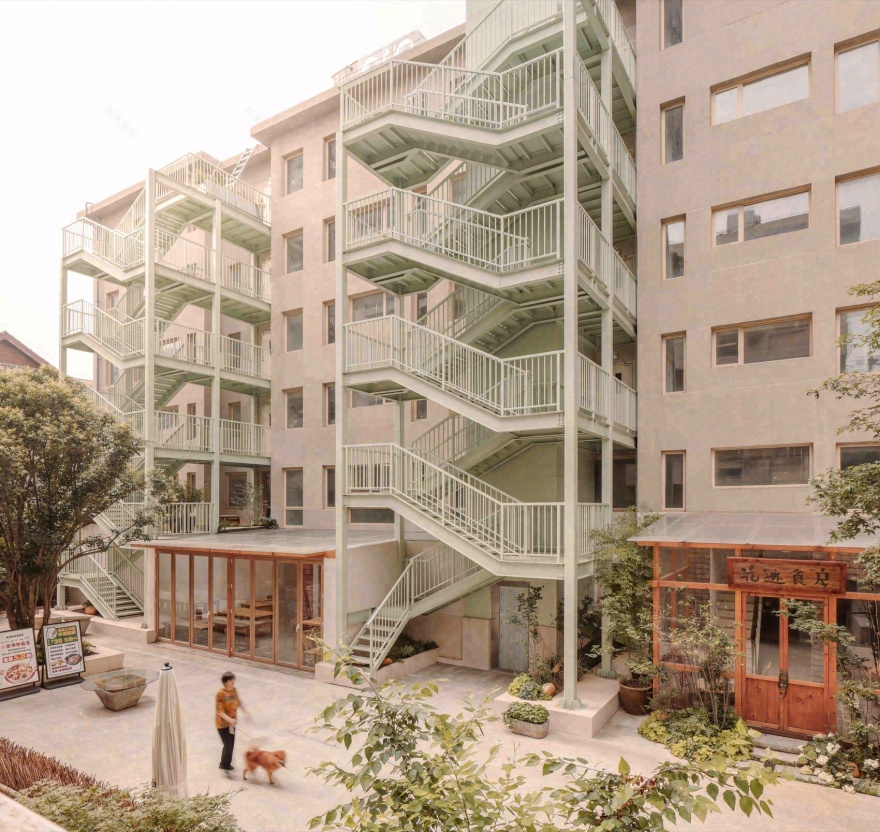
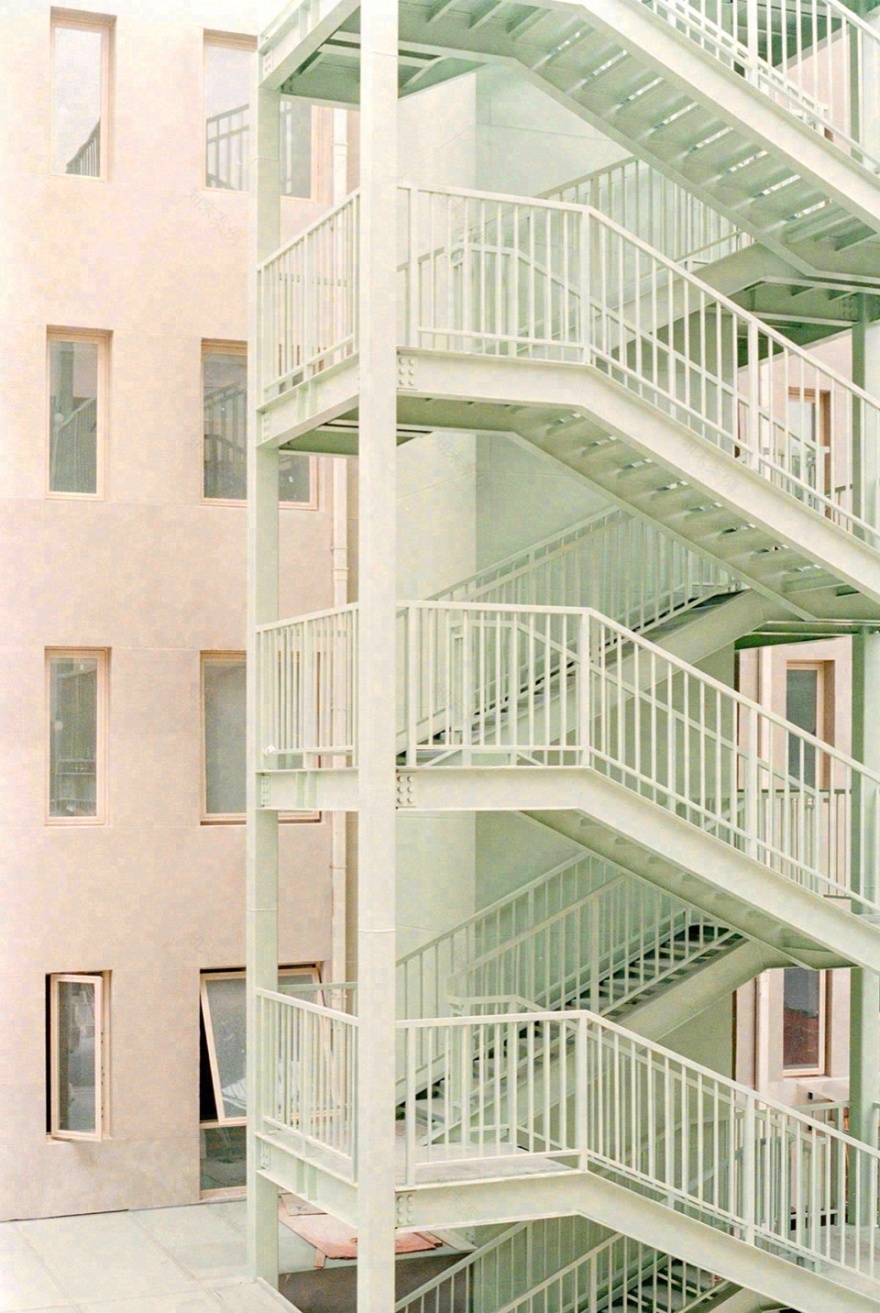
建筑北侧新增的外挂钢结构疏散楼梯和电梯是满足建筑功能转化的必要措施,加建部分我们选用绿色的涂料,强调轻盈感的同时也为立面增添了趣味性。
The new external steel evacuation stairs and elevator added to the north side of the building are crucial for supporting the functional conversion of the structure. To highlight their lightweight nature and introduce an element of visual interest, we selected a green paint for these additions.
▼楼梯平台,landing©Mata Okawa

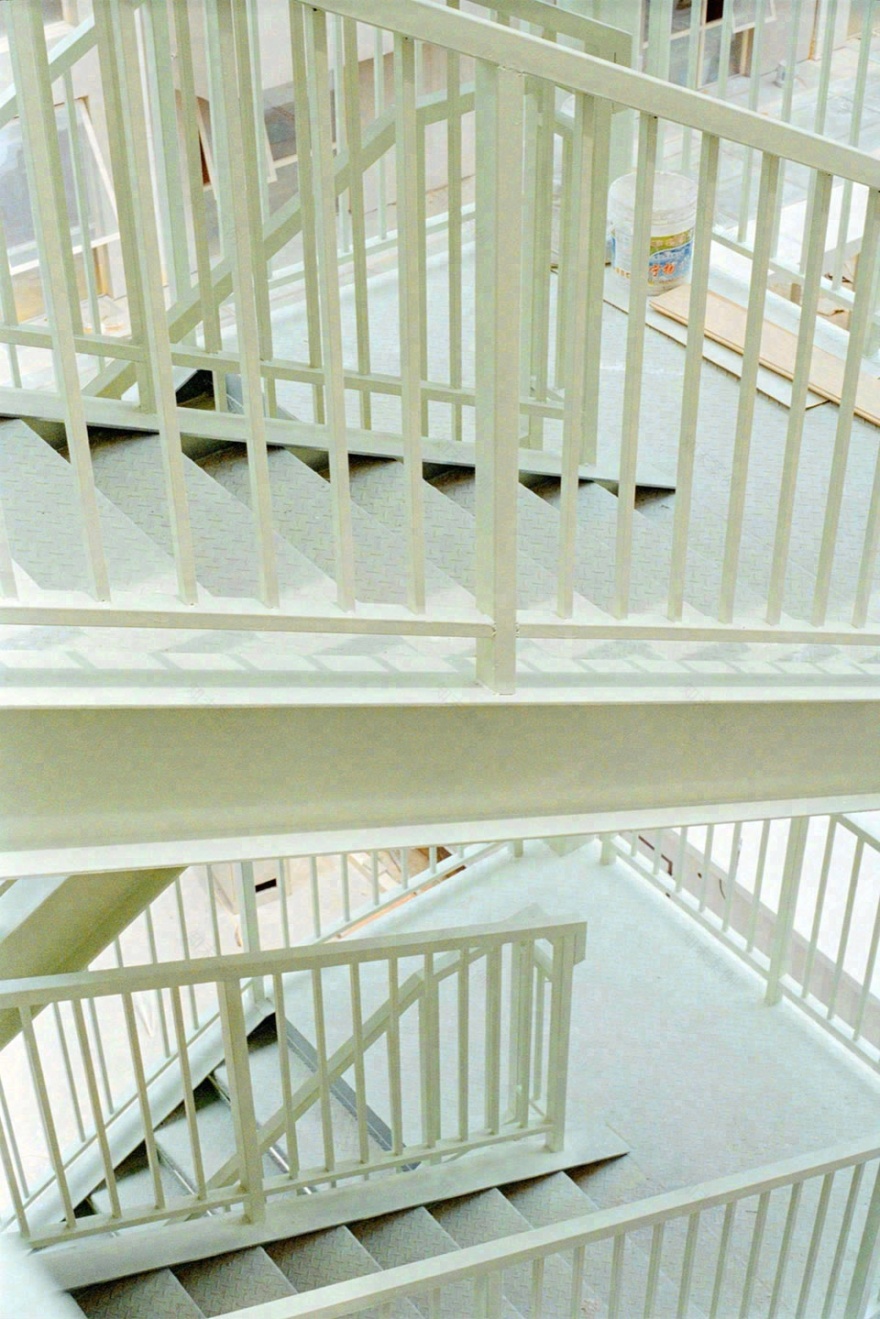
▼楼梯细部,details of the staircase©Mata Okawa
室内改造 Interior Renovation 基于原始结构,经过与结构加固单位的多轮探讨,我们选择了改动最小也最经济的微创手术方式:在横向空间,通过在南北向墙体上统一打开高 2.2 米、宽 0.9 米的洞口,串联起原本独立的格子间,使空间具有一定的连贯性。纵向空间上,由于原始建筑的层高有限,我们在每两层的公共区域拆除部分楼板形成挑高空间,使得原本单一的横向空间有了更多的变化。▼分析图,analysis diagram©上海实在建筑设计工作室

Based on the original structure and after multiple rounds of discussions with structural reinforcement experts, we Opted for a minimally invasive and cost-effective approach. Horizontally, we created uniform openings measuring 2.2m in height and 0.9m in width on the north-south walls, which connects previously isolated rooms, thus enhancing the spatial coherence. Vertically, due to the limited floor height of the original building, we removed parts of the floor slabs in the public areas every two floors to create double-height spaces, thus introducing a dynamic vertical dimension to what was previously a more uniform horizontal layout.
▼视觉联系,visual connection©Mata Okawa

▼餐厅室内,interior of the restaurant©Mata Okawa


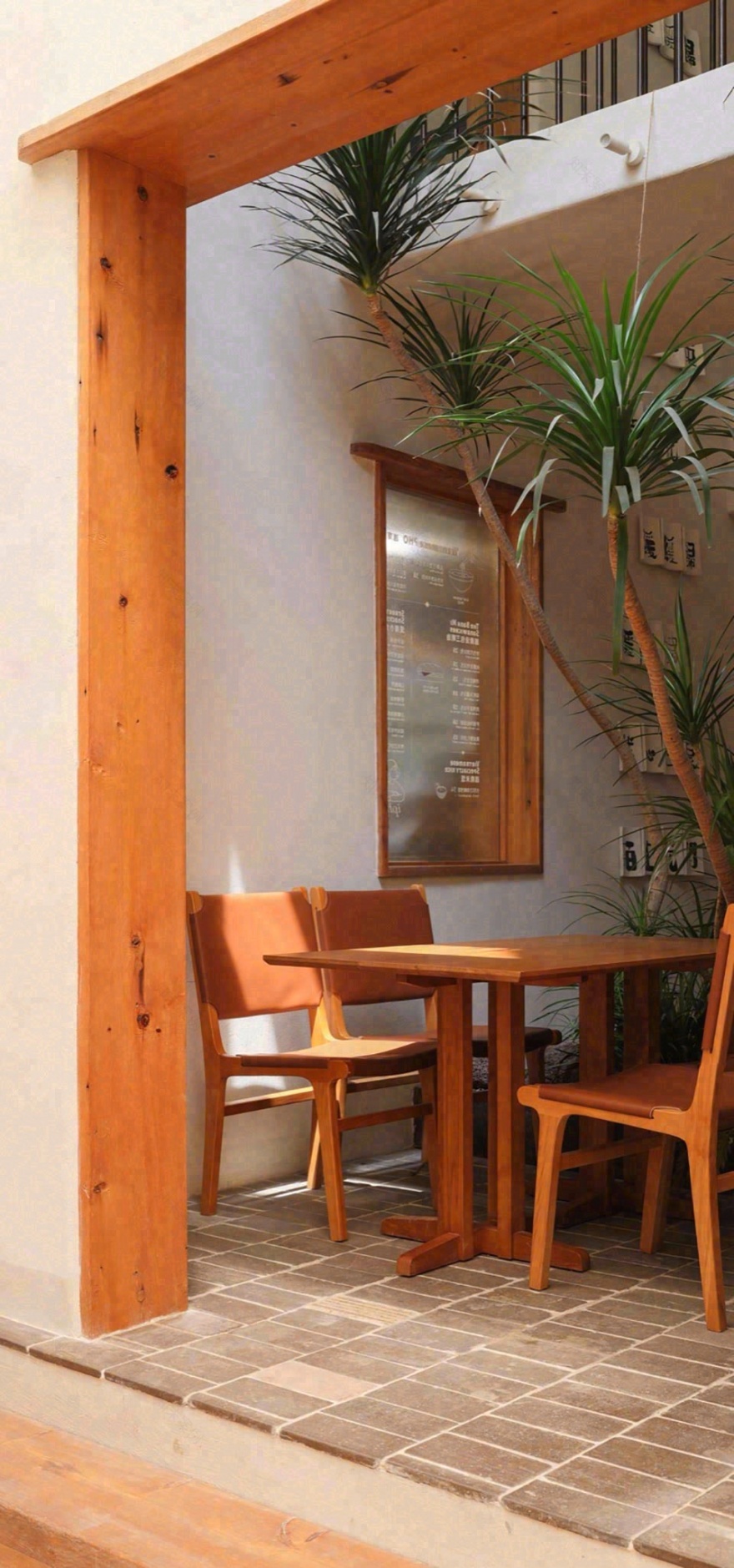
连续门洞串联起的视觉效果形成了层层递进的空间序列。将北楼一层南侧的天井设置为餐厅的阳光房,通过植物点缀整体空间,在拆除楼板形成挑空后新增了桥的路径体验,使餐厅的一、二层产生互动。
The series of continuous door openings creates a visually layered sequence. The south side of the north building’s ground floor has been transformed into a sunroom for the restaurant. By adding plants to the space and removing the floor to create a double-height area, we introduced a bridge pathway, which facilitates interaction between the restaurant’s first and second floors.
▼餐厅阳光房,sunroom for the restaurant©Mata Okay


▼细部,details©Mata Okawa

而在三至六层的酒店区域,由于原始建筑的楼梯无法满足现有消防规范,我们将楼梯拆除后重新梳理了动线,将过道及后勤区域设置在北侧,同样通过统一打开门洞作为过道。而客房统一设置于南侧,并根据运营需求打造了不同的房型。通过打开部分楼板形成纵向的贯通,打破了原本狭长幽深的空间感受,作为酒店休息公区串联起每一层的客房。
In the hotel area on the third to sixth floors, the original staircase did not meet current fire safety regulations. We removed the old staircase and reconfigured the circulation routes. Hallways and service areas have been relocated to the north side, connected by uniformly aligned door openings. Guest rooms are now positioned on the south side, with various room types designed according to operational needs. By opening parts of the floor slabs, we created vertical connections that break up the previously narrow and cavernous spatial experience, linking each floor’s guest rooms with the hotel’s public areas.
▼客房卧室,bedroom©Mata Okawa

▼客房细部,details of the guestroomk©Mata Okawa


结语
Conclusion
大行宫项目是我们在南京完成的第二个老城区微更新设计,过程中经历了疫情、预算缩减等重重挑战,使我们不得不面对最终的些许遗憾。如今该片区已投入使用,不同的商家和顾客在这里共同演绎着新的生活,它们作为养分继续注入这片土壤,而这两栋建筑将承载着街区的记忆与温度继续生长。
This project marks our second micro-renovation endeavor in the old city of Nanjing.Throughout the process,we encountered several challenges,including the pandemic and budget cuts,which led to some unavoidable compromises.Now that the area is operational,a diverse array of businesses and customers are contributing to a vibrant new chapter.Their presence infuses the space with fresh energy,allowing the two buildings to embody and preserve the district’s history and warmth as they continue to evolve.
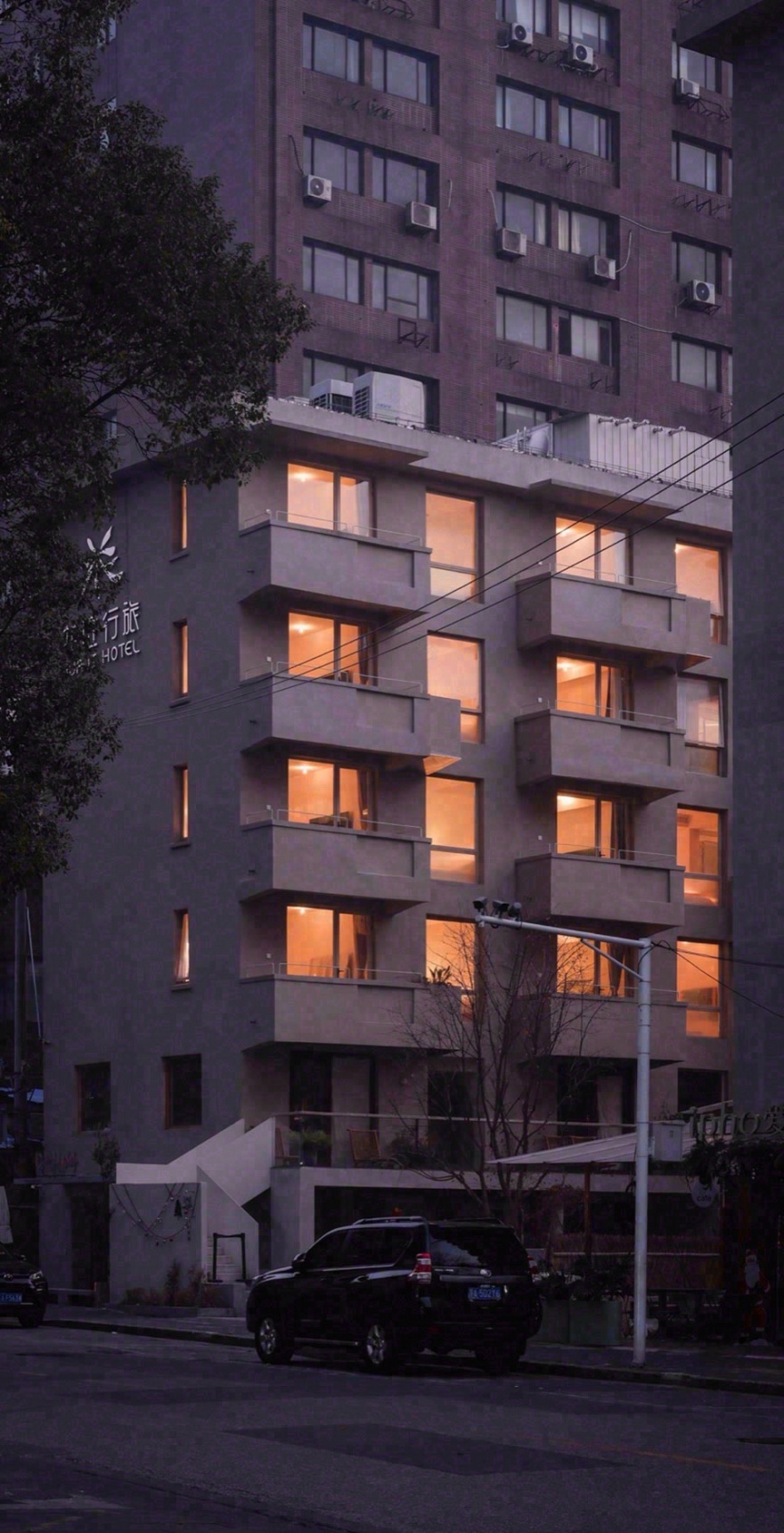
▼温暖灯光效果,lighting effect©Mata Okawa

▼夜景,night view©Mata Okawa
▼区位图,location©上海实在建筑设计工作室

▼一层平面图,first floor plan©上海实在建筑设计工作室

▼二层平面图,second floor plan©上海实在建筑设计工作室

▼三层平面图,third floor plan©上海实在建筑设计工作室

▼四层平面图,4th floor plan©上海实在建筑设计工作室
▼五层平面图,5th floor plan©上海实在建筑设计工作室
▼六层平面图,6th floor plan©上海实在建筑设计工作室
▼剖透视图,perspective section©上海实在建筑设计工作室

项目名称:南京大行宫老城区微更新改造
项目类型:建筑/室内/景观
设计方:上海实在建筑设计工作室
项目设计:2021 年-2022 年
完成年份:2023 年
设计团队:(主持建筑师)张志坤、刘悦;(项目成员)徐桦、梁鑫、孔德勇
项目地址:中国江苏省南京市玄武区
建筑面积:11,000㎡
摄影版权:大川又 Mata Okawa
合作方:南京长江都市建筑设计股份有限公司
客户:南京花迹文旅
材料:(门窗)南京半杯水建筑装饰工程有限公司、(布料)parallel™ textiles 朴昕™布料
Project name: Micro Renovation of the Old City, Nanjing Daxinggong
Project type: Architect/Interior/Landscape
Design: SZ-Architects
Design year: 2021-2022
Completion Year: 2023
Leader designer & Team: (Lead Designer)Zhikun Zhang, Yue Liu. (Team)Hua Xu, Xin Liang, Deyong Kong
Project location: Nanjing, Jiangsu, China
Gross built area: 11,000㎡
Photo credit: Mata Okawa
Partner: Nanjing Yangtze River Urban Architectural Design Co., Ltd
Clients: Nanjing Huaji Cultural Tourism Co., Ltd.
Materials: (Architectural doors and windows)Nanjing Banbeishui Construction & Decoration Engineering Co., (Textile)parallel™ textiles

南京喵熊网络科技有限公司 苏ICP备18050492号-4知末 © 2018—2020 . All photos and trademark graphics are copyrighted by their owners.增值电信业务经营许可证(ICP)苏B2-20201444 苏公网安备 32011302321234号
苏公网安备 32011302321234号客服
消息
收藏
下载
最近