

创作上传
VIP
收藏下载
登录 | 注册有礼
查看完整案例

收藏

下载

分享
台糖绿能循环聚落(TCV)是是台湾第一个完全融入循环经济的住宅项目。TCV包括三栋住宅体量,一栋循环示范屋(C-House),一栋生态屋(E-House)。一共可容纳351个可出租住宅单元,庭院中央有一座都市农场和一个生态池塘。
Taisugar Circular Village (TCV) is the first residential project in Taiwan to be fully integrated to the circular economy ideology. TCV comprises three housing blocks, a Circular Demo House (C-House), and an Eco-House (E-House); it accommodates 351 rental units, an urban farm, and an eco-pond, centrally located in the courtyard.
▼项目鸟瞰,Ariel view of the project ©Studio Millspace


TCV的设计呼应了现代生活的集体需求,同时也强化了社区的亲密程度。对于住户而言,住宅单元是他们的房间,E-House是他们的厨房,而C-House则扮演花园的角色。
▼功能轴测图,Circularity Diagram ©Bio-architecture Formosana

TCV is designed in response to the call for collective requirements for contemporary living, while re-enforcing an intimate sense of community. For the residents, the residential units serve as their rooms, the E-House functions as the kitchen, and the C-House plays the role of a garden.
▼项目外观,exterior of the project ©Studio Millspace


设计一栋循环建筑很大程度上非常依赖灵活性和可适应性。TCV的循环设计关注在模块化和以服务为导向的家电设备支持,都集成在建筑护照(建筑护照:获取和管理建筑与房地产全生命周期数据和信息的工具)中,以实现最大化的利用。
Designing a building for circularity relies heavily on flexibility and adaptability. TCV’s circular design focuses on modularization and service-orientated appliance supply, all integrated within a building passport for better optimization.
▼项目外观,exterior of the project ©Studio Millspace


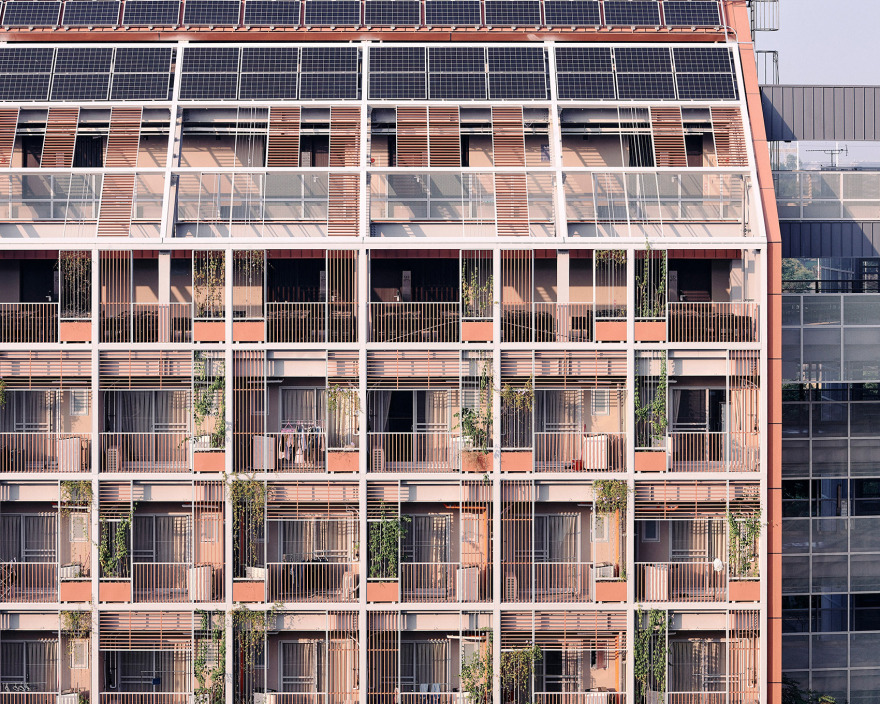
模块化从三栋住宅重复性的阳台立面系统中得以体现。所有的模块都是在施工过程中预制的,以此降低现场的材料浪费:整个外立面都由预制化模块构成,部件之间用螺母和螺栓连接,便于日后拆卸。预制化阳台立面系统的安装类似于幕墙系统。楼板系统采用模块化预制中空板,横跨在主梁上。相较于楼承板系统,大大降低了对较小横梁的使用。模块化的使用有利于未来的重复利用和再利用,延长了材料的使用寿命,提高其在价值链中的位置。
Modularization is evident in the design of three housing blocks with a repetitive balcony façade system. All modules were prefabricated during construction to minimize on-site material waste: the entire external façade was made using pre-casted modularized panels, with components connected with nuts and bolts for future ease of disassembly. The prefabricated balcony façade system was installed similar to a curtain wall system. Modular prefabricated hollowed core slabs were used as the floor system, spanning across the main beams. This significantly reduces the use of smaller beams compared to decking systems. Modularization allows for future reuse and repurpose, extending materials’ life cycles and position within the value chain.
▼模块化阳台立面系统,Modularization balcony façade system ©Studio Millspace


所有在TCV中使用的材料都在材料护照中拥有一个独特的id,以储存数据信息。这样做可以确保建筑构件的生命周期在拆除以后得以延续。TCV的设计有六个层面:基础,结构,立面,系统,隔断和设备。这样就可以在不影响其他部分的时候进行独立的修整。由于采用了可持续的能耗系统,TCV在2022年的能耗比预期的低50%,细节都在持续性这一章节为读者提供。
▼模块化分析图,Modularization Diagram ©Bio-architecture Formosana

Every material used in TCV is assigned a unique id in the material passport to keep its data in check; doing so helps ensure that the life cycles of building components continue post-demolition. TCV is designed in 6 layers: foundation, structure, façade, system, partition, and appliances. This allows for isolated repairs without compromising other components. TCV’s energy use in 2022 was approximately 50% less than predicted due to its renewable energy systems, details of which will be provided in the sustainability section.
▼阳台立面系统,balcony façade system ©Studio Millspace


▼预制阳台立面系统,precast balcony facade system ©Studio Millspace

TCV 通过提供基于服务的方法,改写了为每栋楼制造特定设备的传统。制造商仍拥有对产品的所有权,在产品在拆解后可以持续其使用周期。要在以消费者为导向的社会中率先实现这一变革,就需要与家具、电梯、厨房以及电子锁供应商逐一沟通,量身定制以服务为基础的可持续供应合同。由于采购模式的试验性质,银行合同和用户协议都是从零开始定制的,以确保符合法律要求,同时保持循环设计原则。
TCV brings changes to the conventional practice of manufacturing specific appliances for each building by offering a service-based approach. Manufacturers retain ownership of products, enabling a continuous product life cycle after dissembling. To pioneer this change in the consumer-oriented society involves working door to door with furniture, elevators, kitchen, and all the way to the electronic locks suppliers to tailor a sustainable service-based supply contract. Owing to the experimental nature of the procurement model, bank contracts and user agreements are tailored from scratch to ensure the legal requirement, while maintaining the course of circular design principles.
▼中央庭院,central courtyard ©Studio Millspace

▼生态循环示范屋,Circular Demo House ©Studio Millspace

▼生态循环示范屋,Circular Demo House ©Studio Millspace


▼远眺项目,distant view ©Studio Millspace

围绕持续性经济,TCV建立起培养社区意识的可持续性框架。将住户们视为当地共享生态系统的一部分,促进人,自然,产品消耗之间的重新连接。这种综合性方法使TCV成为可持续建筑的典范。
Embracing a circular economy, TCV establishes a sustainable framework that cultivates a sense of community. It transforms residents into integral parts of a shared local ecosystem, fostering a reconnection between people and nature and consumption with production. This holistic approach positions TCV as an exemplary model in sustainable architecture.
▼培养社区意识,cultivates a sense of community ©Studio Millspace


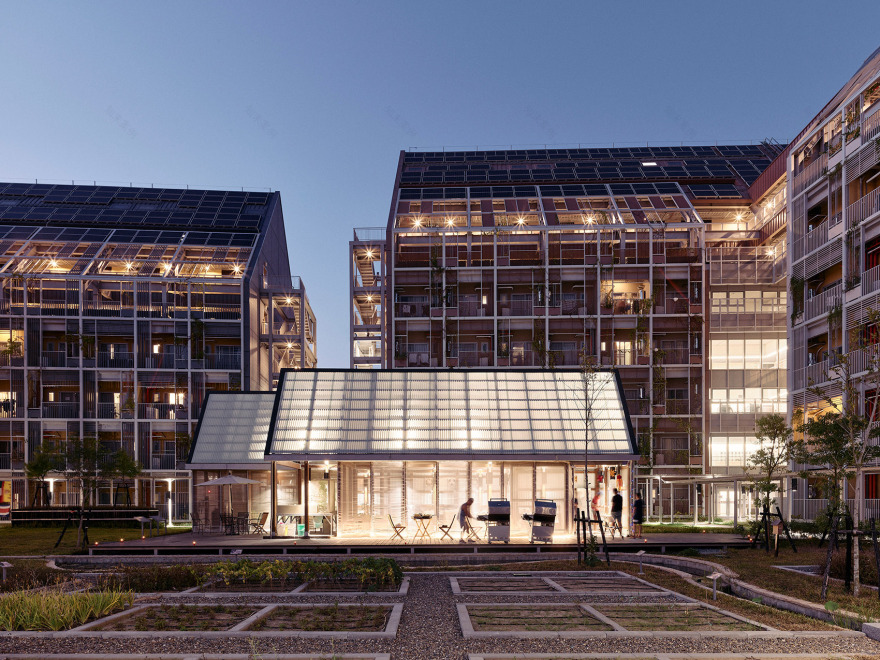
▼夜景,night view ©Studio Millspace
▼场地平面,site plan ©Bio-architecture Formosana

▼平面图,plan ©Bio-architecture Formosana

▼剖面图,section ©Bio-architecture Formosana

南京喵熊网络科技有限公司 苏ICP备18050492号-4知末 © 2018—2020 . All photos and trademark graphics are copyrighted by their owners.增值电信业务经营许可证(ICP)苏B2-20201444 苏公网安备 32011302321234号
苏公网安备 32011302321234号客服
消息
收藏
下载
最近