

创作上传
VIP
收藏下载
登录 | 注册有礼
查看完整案例

收藏

下载

分享
悠悠长江畔,融融东西学。在中国武汉市洪山区,一座充满历史感与现代美的建筑北临长江而立。红砖承载着东西方历史长河中的浓郁人文色彩,与被雕刻出简约几何形态的建筑形体结合,呈现出东西融合贯通的空间美感。
On the bank of the Yangtze River, blending East and West in learning. In Hongshan District, Wuhan City, China, a historic and modern building faces the Yangtze River to the north. The red brick carries the rich cultural color of the east and West in the long history, and combines with the architectural form that is carved out of simple geometric form, showing the spatial beauty of the integration of east and west.
▼校园鸟瞰,campus Ariel view©吴清山

在高处远观学校用地被一条代建道路分隔,划分为大小两个部分。小地块上设置了相对独立的幼儿园与教工宿舍,大地块则是学校主体及其配套学生宿舍。
▼总平面图,master plan©筑博设计-联合公设
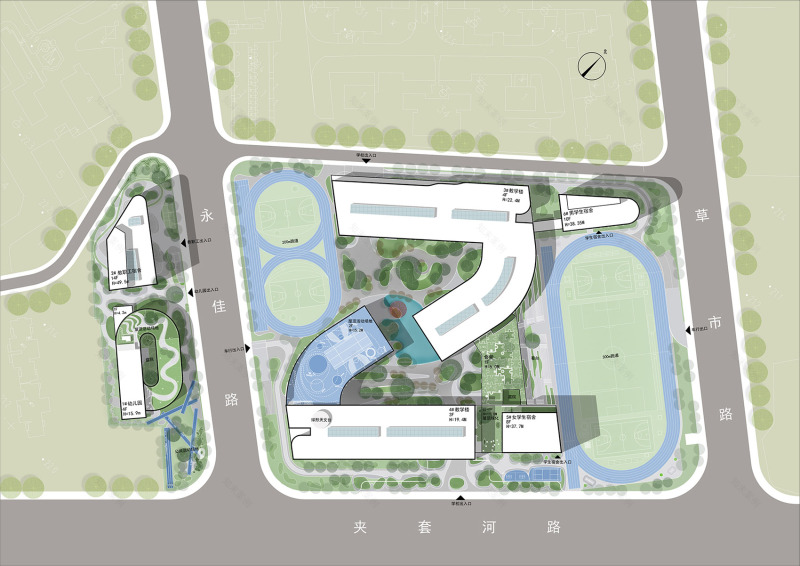
From a high vantage point, the school site is divided into two sections by an agent built road. The small plot is equipped with relatively independent kindergarten and staff dormitory, while the large plot is the main body of the school and its supporting student dormitory.
▼学校南侧沿路入口,School entrance©吴清山

学校由国际学校与双语学校两部分构成,两栋现代的西式教学楼犹如东方太极般盘旋在场地之上。学校总建筑面积超过 7.8 万平方米,致力于创造让学生全方位、多维度发展的“现代全天候校园”,为华中地区补充了高质量国际教育资源。
▼教学楼形体生成,Form generation©筑博设计-联合公设

The school consists of two parts: an international school and a bilingual school. Two modern Western-style teaching buildings hover over the site like Oriental Tai Chi. With a total construction area of more than 78,000 square meters, the school is committed to creating a “modern all-weather campus” for students to develop in an all-round and multi-dimensional way, supplementing high-quality international education resources for Central China.
▼学校西南侧人视,View of southwest side©萧稳航

▼田径场,Playground©吴清山

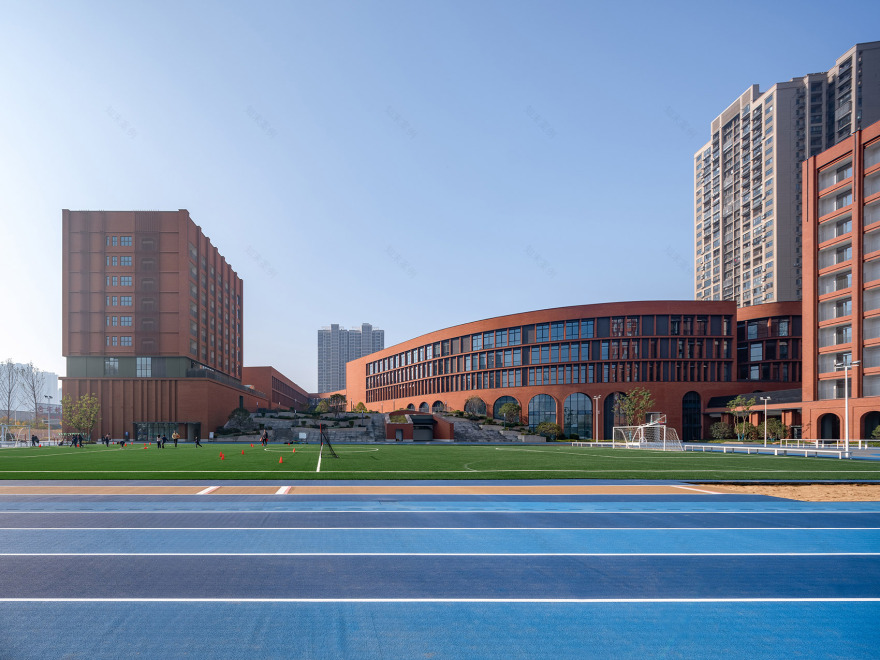
▼东南半鸟瞰,Southeast half bird ‘s-eye view©吴清山

▼中心庭院,Central courtyard©吴清山

校园主材采用了一种贯穿中西方建筑历史长河的材料–砖,建筑师对传统材料采用了现代的施工工艺与几何化的简练造型,塑造出一所既现代简练又充满历史庄重感的校园。游历其中,能深深体会到许许多多既有东方韵味又有西式风格、两者融汇贯通的空间。
▼功能分析,Functional analysis©筑博设计-联合公设

The main material of the campus is brick, a kind of material that runs through the long history of architecture in China and the west. The architect adopts modern construction technology and geometric concise shape of the traditional material, creating a campus that is both modern and concise and full of historical significance. Traveling among them, you can deeply appreciate the many Spaces that have both Oriental charm and Western style, and the integration of the two.
▼教学楼立面,Facade of teaching building©萧稳航

▼看台,Playground stand©吴清山

▼宿舍楼立面,Facade of dormitory building©萧稳航

双教学楼,两个交互的微型城市
Double teaching buildings, Two interactive micro cities
学院大道的两个端头分别为国际学校与双语学校的入口门厅,经由门厅可分别进入双语学校教学组团与国际学校教学组团。两个教学组团围绕各自的中庭展开,各教学组团构成各自的微型城市,形成“多元学习综合体”。
▼功能爆炸图,Functional analysis©筑博设计-联合公设

The two ends of College Avenue are the entrance foyers of the International School and the Bilingual School, through which you can enter the bilingual school teaching group and the International School teaching group respectively. The two teaching clusters are spread out around their respective atriums, and each teaching cluster forms its own micro-city, forming a “multi-learning complex”.
▼学校南入口,School South Entrance©吴清山

▼学校南入口,School South Entrance©萧稳航

▼学校北入口,School North Entrance©吴清山
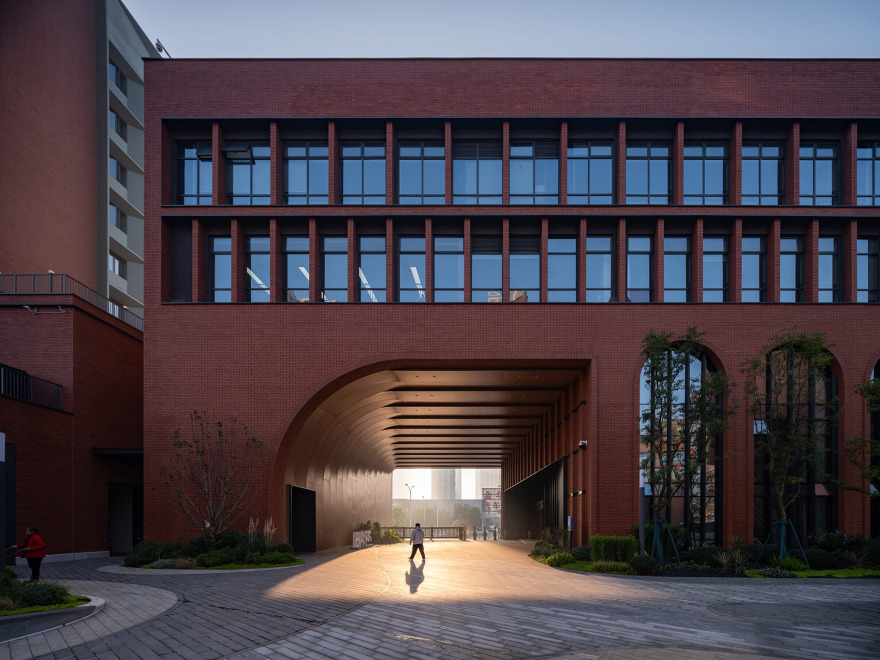
基于 BASIS 走班制的授课模式,两栋独立设置的教学组团在其首层由功能带入场景融合,通过各类公共教学设施与公共场所相联系。包括容纳 500 人的报告厅、室内罗马剧场、黑匣子剧场、音乐教室、舞蹈教室和 2 个独立的室内体育馆等,它们共同构成了首层的学院大道,贯穿整个校园,能够为师生提供全天候无风雨的交流联系。
▼流线爆炸图,Circulationanalysis ©筑博设计-联合公设

Based on the teaching mode of BASIS class system, the two independently teaching groups are integrated from function to scene on the first floor, and are connected with public teaching facilities and public places. The 500-seat lecture hall, the indoor Roman Theatre, the Black Box Theatre, the music room, the dance room, and two separate indoor gymnasiums form the first floor of the College Avenue, which runs through the entire campus, providing teachers and students with all-weather communication.
▼室内泳池,Swimming Pool©萧稳航
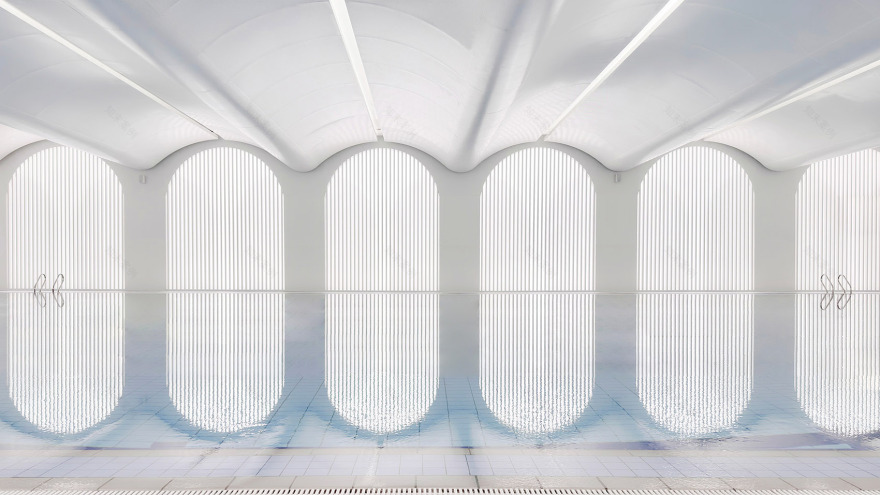
▼接待大厅,Reception hall ©萧稳航

在校园中央共享的室外区域,两个教学组团的入口交错敞开,呈现出柔和相融的路径,这也是教师学生课后交流往来与沉思的场所之一。建筑悬挑落地时被切割出的几何弧线与水面映衬,放大了建筑空间的柔和感,拉近了建筑与人的距离,同时也与内部的拱形空间相呼应。
In the shared outdoor area in the center of the campus, the entrance of the two teaching groups is staggered and open, presenting a soft and harmonious path, which is also one of the places for teachers and students to exchange and meditate after class. The geometric arcs cut out when the building is suspended from the ground are set off against the water, which magnifies the soft sense of the building space, Narrows the distance between the building and people, and echoes the arch space inside.
▼中心庭院,Central courtyard ©吴清山


▼中心庭院,Central courtyard
©萧稳航
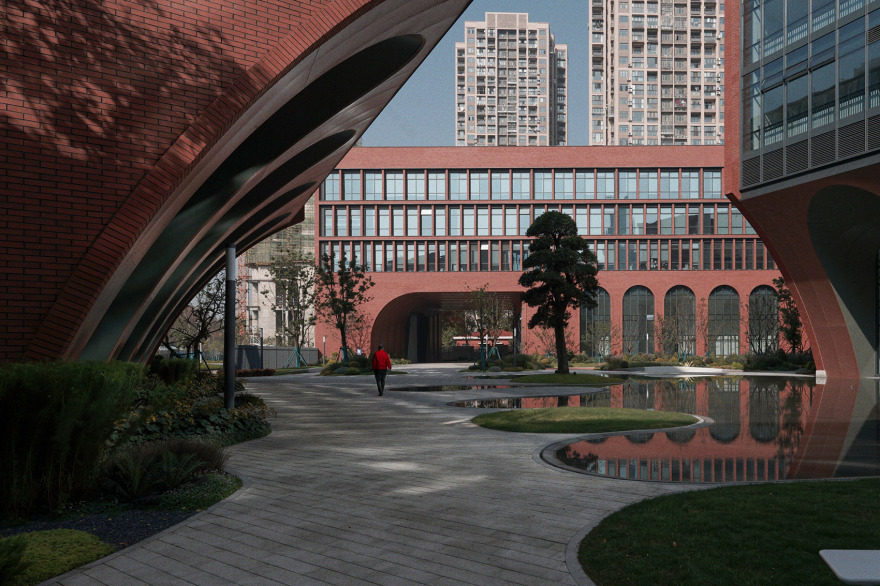

▼中心庭院细部,Central courtyard detail©萧稳航

“街道”与“广场”,留白即可能
“Street” and “square”, Blank is possible
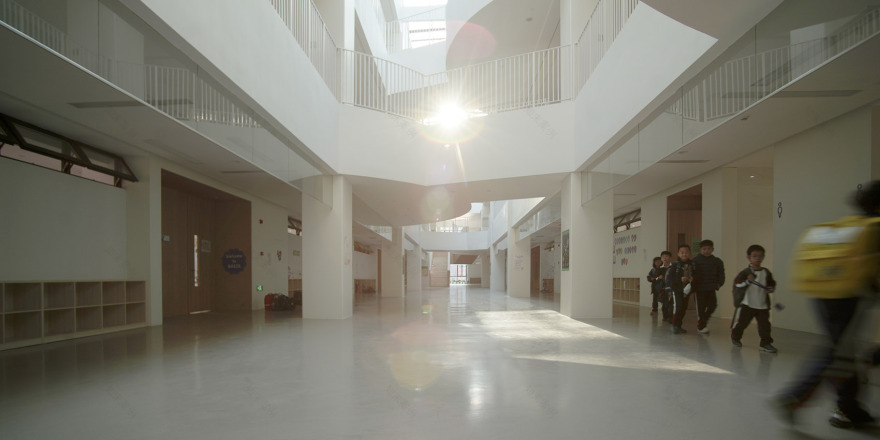
学校中庭创造了类似城市外部空间特征的“街道”与“广场”。其“街道”不仅可作为学生平时课下走班换班的交通空间,还是人流+信息流的多重叠加。而“广场”则是“街道”延伸出未被定义的口袋空间,可以作为“教学课堂延伸”的场所,可以成为开放的教学模式的多种载体,也是课后同学间小范围交流的理想空间。
▼“广场”与“街道”分析图,“Squares” and “streets” analysis ©筑博设计-联合公设

The school atrium creates “streets” and “squares” that resemble the characteristics of the outer space of the city. Its “street” can not only be used as a traffic space for students to change classes after class, but also a multiple superposition of people flow + information flow. The “square” is the undefined pocket space extended from the “street”, which can be used as a place for “teaching and classroom extension”, can become a variety of carriers of open teaching mode, and is also an ideal space for small-range communication between students after class.
▼“广场”与“街道”,“Squares” and “streets”
©吴清山

空间的营造思路是提倡空间的“留白”,既强调交流也强调独处。中庭顶部采用天窗做法,使得中庭空间完全通透,穿行在中庭犹如在城市中的街道、广场漫游穿行。“微型城市”的做法创造了复杂的类城市的建筑内部空间,如同一个具有丰富内容的文化容器。
The idea of space construction is to advocate the “blank space”, emphasizing both communication and solitude. The skylight on the top of the atrium makes the atrium space completely transparent, and walking through the atrium is like roaming through the streets and squares in the city. The practice of “micro-city” creates a complex city-like architectural interior space that acts as a cultural container with rich content.
▼“广场”与“街道”,“Squares” and “streets”©萧稳航

被光柔和覆盖的阅览体验
A reading experience gently covered by light
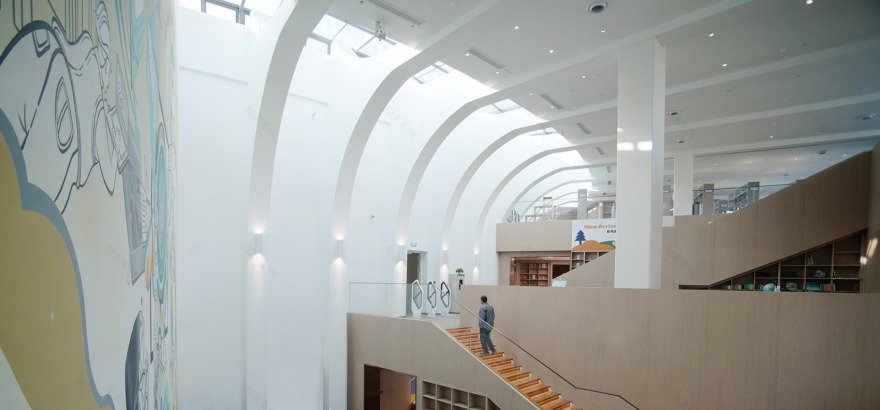
同样置于校园中心的,还有一个具备 3 层体量的图书馆,图书馆集中设置一方面降低校方的管理维护压力,一方面可获得较大的体量,为营造独特的阅览空间创造条件。图书馆三层通高,三层阅览空间呈阶梯状设置,共享区域设置了天窗,充足的天光可被拱券结构分割,反射在如鲸鱼肋骨般洁白的拱形房梁后,再反射至阅览区,师生坐在这里感受光影下跳动的文字,沉浸在阅读的海洋。
Also located in the center of the campus, there is a library with a 3-story volume. On the one hand, the centralized setting of the library can reduce the pressure of management and maintenance of the school, and on the other hand, it can obtain a larger volume, creating conditions for creating a unique reading space. The library has three double-height floors, and the reading space of the three floors is set in the shape of a ladder. The shared area is set with skylights. Sufficient sky light can be divided by the arch structure, reflected behind the white arched beams like whale ribs, and then reflected to the reading area, where teachers and students sit to feel the words dancing under the light and shadow, immersed in the ocean of reading.
▼图书馆阅览区的自然采光,natural lighting for library©萧稳航
相望呼应,自成一体 Looking at each other and responding to each other, they form a unified whole
幼儿园与教工宿舍位于场地的西南角,与学校其余部分隔路相望,两个区域分设门禁,相互独立。幼儿园同样采用砖这一个材料元素,独特的材料特性有别于市面上常见的花花绿绿的幼儿园形式,更添书香沉卷的稳重气息。
▼幼儿园形体生成,Form generation©筑博设计–联合公设

The kindergarten and the staff dormitory are located in the southwest corner of the site, across the road from the rest of the school, and the two areas are separately guarded and independent from each other. The kindergarten also uses brick as a material element, the unique material characteristics are different from the common colorful kindergarten form on the market, and add a stable atmosphere of bookish heavy roll.
▼幼儿园与职工宿舍楼,Kindergarten and dormitory building©吴清山

▼幼儿园,Kindergarten©吴清山

▼幼儿园庭院,garden of kindergarten©吴清山

立面的塑造则是采用了更富童趣的帆拱,形体则围绕条形的中心庭院螺旋上升,塑造出一个连接 2 层与 4 层的缓坡花园,为紧张的活动场地拓展出了更多的可能。
The facade is shaped by a more childlike sail arch, and the form spirals around the central courtyard of the strip, creating a gentle slope garden connecting the 2nd and 4th floors, which opens up more possibilities for the tense activity space.
▼学校南入口夜景,School South Entrance©吴清山

▼学校北入口夜景,School North Entrance©萧稳航
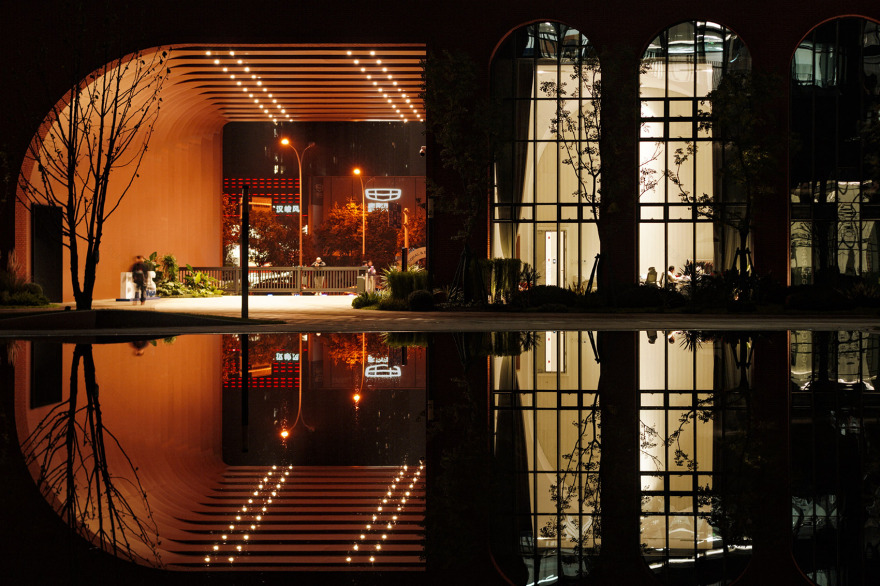
▼中心庭院夜景,Central courtyard at night©吴清山

▼教学楼标准层平面,typical floor plan©筑博设计–联合公设

▼教学楼南立面,south elevation©筑博设计–联合公设

▼剖面图,section©筑博设计–联合公设

项目名称:武汉贝赛思国际学校
项目地点:中国 武汉
建筑面积:78,000 平方米
项目周期:2020 年 12 月至 2023 年 8 月
建筑设计:筑博设计-联合公设
总建筑师:钟乔
主创建筑师:萧稳航、吴玉华
设计团队:马衡驷、彭璟阳、郑晓婷、黎炜琦
施工图设计:武汉理工大设计研究院有限公司
室内设计:深圳万间室内设计
景观设计:太璞建筑环境设计咨询(上海)有限公司
幕墙设计:珠海兴业绿色建筑科技有限公司
建设单位:爱圣国际教育集团
建筑摄影:吴清山、萧稳航
Project Name: BASIS International School Wuhan
Project Location: Wuhan, China
Construction Area: 78000㎡
Project Cycle: Designed from December 2020, Completed by August 2023
Architecture Design: ZHUBO Design-AAO
Project Director: Zhong Qiao
Lead Architects: John Siu、Wu Yuhua
Design Team: Ma Hengsi、Peng Jingyang、Zheng Xiaoting、Li Weiqi
Construction Drawing Design: WHUT DESIGN&RESEARCH INSTITUTE CO., LTD
Interior Design: Wanjian Design
Construction Unit: ZHUngnuo Construction


南京喵熊网络科技有限公司 苏ICP备18050492号-4知末 © 2018—2020 . All photos and trademark graphics are copyrighted by their owners.增值电信业务经营许可证(ICP)苏B2-20201444 苏公网安备 32011302321234号
苏公网安备 32011302321234号客服
消息
收藏
下载
最近