

创作上传
VIP
收藏下载
登录 | 注册有礼
查看完整案例

收藏

下载

分享
能源转型 Energy Transformation 这座小型建筑是由 DH Ecoenergías 公司推动的区域供暖网络下的可见部分,也是帕伦西亚市新型能源基础设施的核心,堪称西班牙城市能源转型的先锋典范。帕伦西亚的区域供暖网络实属西班牙同类设施的首例,旨在为国家城市区域的大部分实现脱碳,逐步淘汰依赖国际进口的昂贵化石燃料供暖设备(柴油和天然气),并以清洁能源网络取而代之。该网络主要依赖对西班牙森林进行更优管理后获得的可再生资源提供燃料。
This small building is the visible part of a whole that remains hidden from view. It is the head of a new energy infrastructure for the city of Palencia. A District Heating network promoted by the company DH Ecoenergías, a brave pioneer in the energy transformation of Spanish cities. Palencia’s network is the first of a long series of similar projects that seeks to decarbonize a good part of the national urban geography, turning off fossil fuel heaters – diesel and gas, costly internationally sourced – to replace them with a clean network, fueled by renewable resources that will largely come from an improved management of Spanish forests.
▼项目概览,overall of the project© Polimertecnic

教育功能
Pedagogical Vocation
区域供暖网络遍布帕伦西亚市的街道,为城市中大部分建筑输送由可再生能源(主要是森林生物质)生产的热水。而中央设施不仅承担技术功能(热水生产过程),还肩负客户所期待的显著教育功能:具象化能源转型过程,并支持与推广这一理念。这一双重功能要求以更广泛的建筑视角来设计,而不仅仅局限于建筑的经济效益。正如 DH Ecoenergías 的创始人 Teo López 所说:“这个项目必须成为能源与环境转型的标志和参考,其建筑必须象征可再生能源的来源、类型的转变,并最终改善城市的公共健康。”
The District Heating network runs under the streets of the capital of Palencia, carrying hot water produced with renewable energies – mainly forest biomass – to buildings in a good part of the city. The Central, on the other hand, fulfils a technical function – hosting the hot water production processes – but at the same time, it has a markedly pedagogical vocation desired by the client: to make the transformation visible and support and allow its dissemination. This double condition requires the approach to the problem of industrial construction not only as a strictly functional matter, where only the economic performance of the building matters, but in a more broadly architectural way. In the words of Teo López, founder of DH Ecoenergías: “This project must be an icon and reference for energy and environmental transformation, and its architecture must symbolize the sources of renewable energies, the change of paradigm, and ultimately, the improvement of public health in cities.”
▼立面,facade© Polimertecnic

▼建筑近景,closer view of the project© Polimertecnic

▼外观细部,details of exterior© Polimertecnic

基座与灯塔
Base and Lantern
因此,中央设施的建筑形式既在几何上象征能源与经济的循环性,也在材质上强调直观与教育性,以标志性建筑的形式呈现出来。建筑由两个主要部分构成:由坚固混凝土构成的“基座”,以及由轻钢和可回收塑料构成的“灯塔”。基座支撑所有机械设备,与外界通过两扇大型镀锌钢门相连,同时地下连接着生物质料仓。基座内部设有夹层,形成环绕机械设备的环形步道。椭圆形的平面设计优化了参观者在整个能源生产流程中的参观体验。
Thus, the architecture of the Central is symbolic, both in its geometry – based on energy and economic circularity – and in its materiality – which opts for literal and pedagogical transparency – presenting the whole as an identity. Two main elements make up the building: a bathtub of heavy concrete and a light steel and plastic lantern – recyclable. The base serves as support for all machinery and establishes terrestrial connections with the outside – through two large, galvanized steel gates – and with the biomass silo located underground. Inside, the concrete base has a cover that becomes a perimeter walkway that surrounds all the machinery. The pill-shaped floor allows optimal circulation of visitors around the complete energy process.
▼基座与灯塔,Base and Lantern© Polimertecnic

▼底部为混凝土与钢材,上部为半透明的聚碳酸酯结构
the bottom is concrete and steel, and the top is translucent polycarbonate structure© Polimertecnic


▼入口,entrance© Polimertecnic

由轻钢和可回收塑料构成的“灯塔”部分则通过重新诠释工业建筑中的经济解决方案,与其所服务的社区建立显著联系,堪称一座“能源教堂”。外立面采用三种尺度的波纹聚碳酸酯板构成,犹如柔和的白色面纱,由精细的镀锌钢丝和涂漆钢结构支撑。最终,半透明的塔楼排出经过净化的白色烟雾,白色烟雾迷漫到大部分空间中,为整个建筑画上点睛之笔。
The steel and plastic lantern reinterpret economical solutions typical of industrial buildings to establish a significant connection with the community it serves: a small cathedral of energy. The facade of polycarbonate sheets – ribbed on three scales – is configured as a soft whitish veil supported on a delicate galvanized and painted steel wire structure. As a final touch, a translucent tower expels the white smoke resulting from a filtering process that occupies most of the industrial space.
▼室内视角,interior view© Polimertecnic

▼夹层形成步道,the cover that becomes a perimeter walkway© Polimertecnic


▼二层空间,upper floor space© Polimertecnic


▼室内细部,details of interior© Polimertecnic


▼区位,location
© FRPO Rodríguez & Oriol

▼平面图,plan© FRPO Rodríguez & Oriol

▼立面图,elevation© FRPO Rodríguez & Oriol
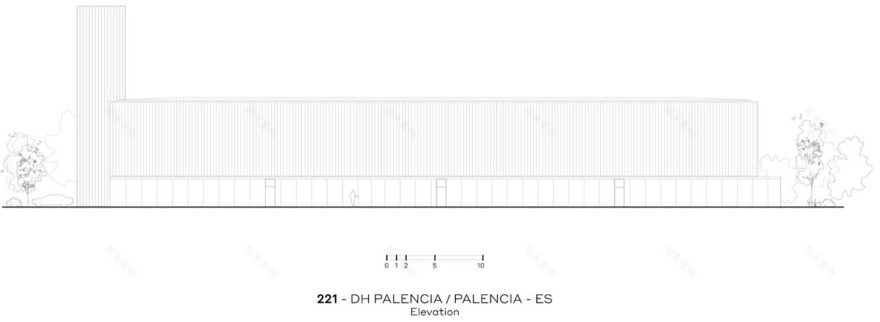
▼剖面图,section© FRPO Rodríguez & Oriol

Studio: FRPO Rodríguez & Oriol
Author: Pablo Oriol, Fernando Rodríguez
press@frpo.es
Social media:
Studio address: Loeches, 3, Bajo Izda., 28008 Madrid, Spain
Design team: Adrián Sánchez Castellano
Project location: Palencia
Project country: Spain
Project year: 2019
Completion year: 2023
Gross floor area: 1960m²
Usable floor area: 1833m²
Plot size: 4000m²
Cost: 1 653 000 €
Client: DH Ecoenergías
teo@dhecoenergias.es
Photographer: Luis Asín,
Collaborator: MEP services: DH Ecoenergías,
Structure: Mecanismo Ingeniería,
Quantity surveyor: Jesús Eguren
Landscape: Juan Tur
Facade: Nummit,
Measurements: Marc Buxó
Materials:
in-situ concrete base with formwork based on drainage sheet Danodren
reinforced concrete slab floors
structural steel with standardized open profiles, applied intumescent, anticorrosive, and lacquered protection
exterior doors in galvanized stesheet on substructure of tubular metal frames
interior doors in galvanized steel sheet
stairs in galvanized steel sheet on galvanized metal profiles
balustrades in galvanized steel tube
roof formed by corrugated sheet, insulation, and TPO membrane on the exterior
facade made of fluted polycarbonate on a substructure of galvanized profiles, curved to measure for the generation of facade waves
Products and Brands:

南京喵熊网络科技有限公司 苏ICP备18050492号-4知末 © 2018—2020 . All photos and trademark graphics are copyrighted by their owners.增值电信业务经营许可证(ICP)苏B2-20201444 苏公网安备 32011302321234号
苏公网安备 32011302321234号客服
消息
收藏
下载
最近