

创作上传
VIP
收藏下载
登录 | 注册有礼
查看完整案例

收藏

下载

分享
项目背景
Project background
近些年安吉发力推动传统产业转型升级,以数字经济为基础的新经济、总部经济逐渐培育壮大,凭借着得天独厚的自然资源和前瞻性的绿色发展战略,安吉正以其独特的方式,向世界展示着如何将生态特色与经济发展完美融合。
In recent years, Anji, which strives to promote the transformation and upgrading of traditional industries, has witnessed the gradual growth of the new economy and headquarters economy based on the digital economy. With its unique natural resources and forward-looking green development strategy, Anji is showing the world how to achieve the perfect integration of ecological characteristics and economic development in its unique way.
▼“安吉”县名出自诗经《无衣》“不如子之衣,安且吉兮。”—— 寓意舒适且美好,”Anji” county name from ShiJing — meaning comfortable and beautiful© 黎伟

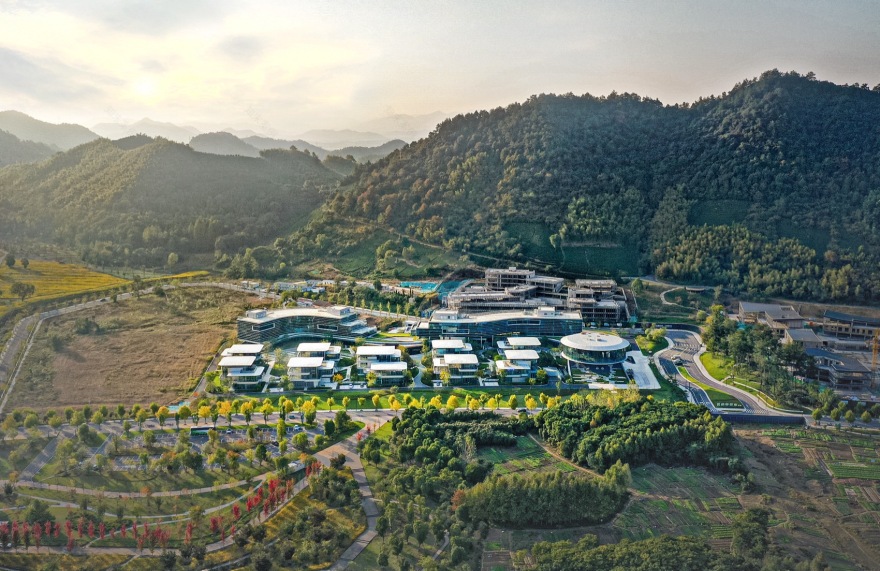
本项目的核心正是充分利用好自然要素,营造具有安吉特色体验与意境的办公场所。
The core of this project is to make full use of natural elements to create an office space with unique local experience and artistic conception.
▼上位规划图,Upper planning diagram © 中国美术学院风景建筑设计研究总院有限公司

▼上位规划图与基地现状图,Upper planning diagram and base status diagram © 中国美术学院风景建筑设计研究总院有限公司


在经济大环境、招商、运营等诸多不确定因素的情况下,我们提出了“1+N”的设计策略:“使项目具有更多适应性、可变性、开放性以应对未来的不确定”。通过自身的调节让其成为“内功”深厚的生态数字经济产业园区。
Taking into account the economic environment, investment, operation and many other uncertain factors, the designers put forward the “1+N” design strategy, specifically, “to make the project have better adaptability, variability, openness in order to cope with future uncertainties”, aiming to make it become an ecological digital economy industrial park with a strong driving force through its own adjustment.
▼主入口广场远山淡影,View the distant mountains from the main entrance square© 黎伟

“1+N”的总体布局
Overall layout of “1+N”
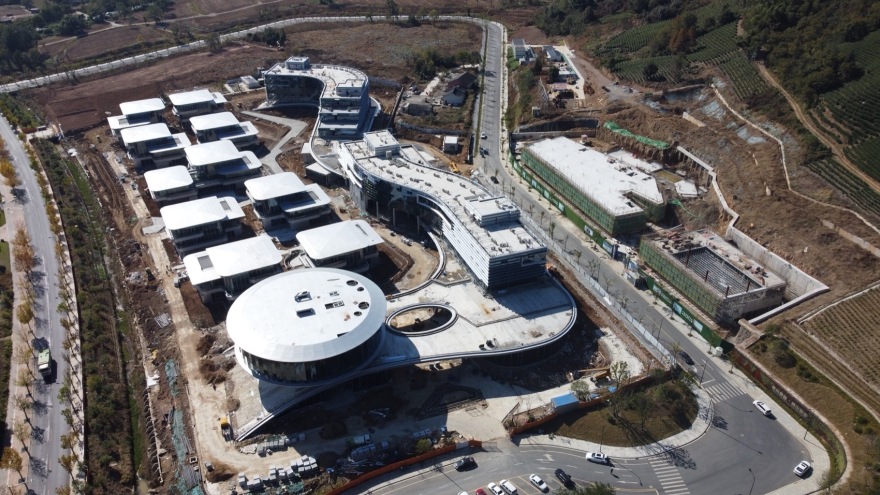
项目位于灵峰山脚下,顺应等高线形态,将场地 6 米高差划分成三个层级。两幢体量最大的总部办公顺应山势,由南往北设置在地势最高处,构成了“1”的部分,九幢独栋办公以组团形态布置在较低处,路演中心结合斜坡覆土屋面在场地最低处。两者共同构成了“N”的部分。建筑体量由小到大,高度随地势由低到高,形成从城市到自然的过渡。
Located at the foot of Lingfeng Mountain, the project follows the contour line shape and divides the 6-meter height difference of the site into three levels. The two largest headquarters buildings are positioned at the highest point of the mountain from south to north, thus forming part of “1”. Nine single-building offices are arranged in a group at the lower part of the site, and the roadshow center is at the lowest part of the site in combination with the sloping earth covering roof. The two together form the “n” part. The building volume from small to large and the terrain from low to high form a transition from city to nature.
▼场地现状高差(左),场地设计后高差(右),Current site height difference (left), site height difference after design (right) © 中国美术学院风景建筑设计研究总院有限公司


▼总体布局,Overall layout © 中国美术学院风景建筑设计研究总院有限公司
▼场地整体剖面图,Overall section of the site © 中国美术学院风景建筑设计研究总院有限公司

▼总体布局与周边环境关系 Relationship between overall layout and surrounding environment© 黎伟

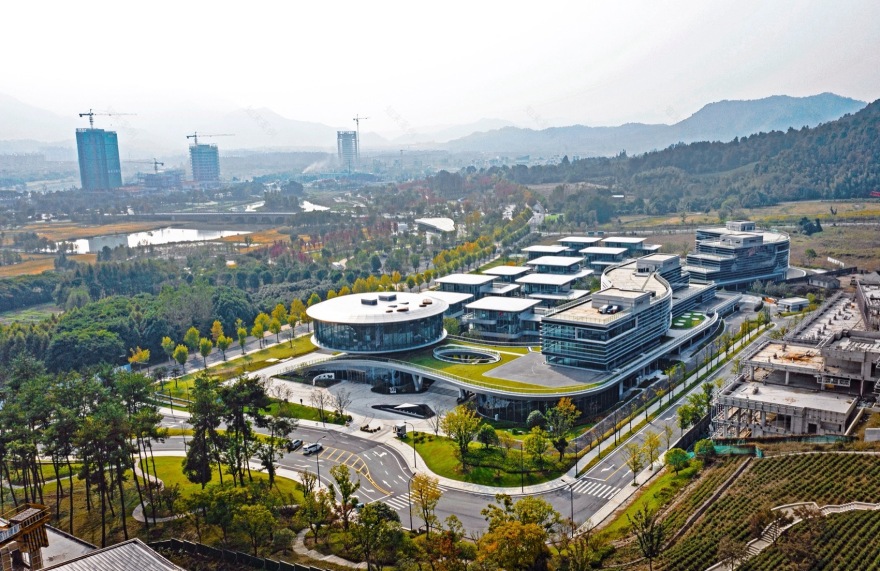

▼建筑形态与周边环境关系,Relationship between architectural form and surrounding environment © 黎伟

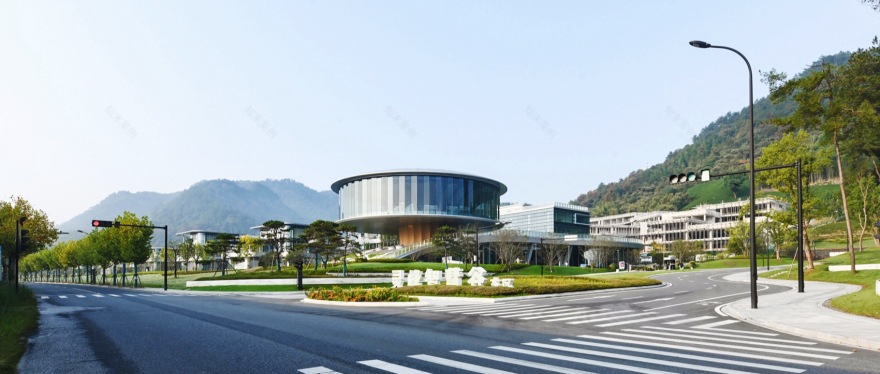
▼城市路口标志性建筑,A landmark building at a city crossroads© 黎伟
“1+N”的空间景观结构
Space landscape structure of “1+N”
“1+N”即一轴多岛的景观空间结构,项目定位为开放式办公园区,通过梳理周边自然资源,形成了一条连接北侧保留松林和南侧运动公园的景观绿轴,使项目与城市景观系统融为一体。
“1+N” refers to a landscape spatial structure with one axis and multiple islands. The project is positioned as an open office park, and the surrounding natural resources are utilized to form a green axis connecting the pine forest to the north and the sports park to the south, thus integrating the project into the urban landscape system.
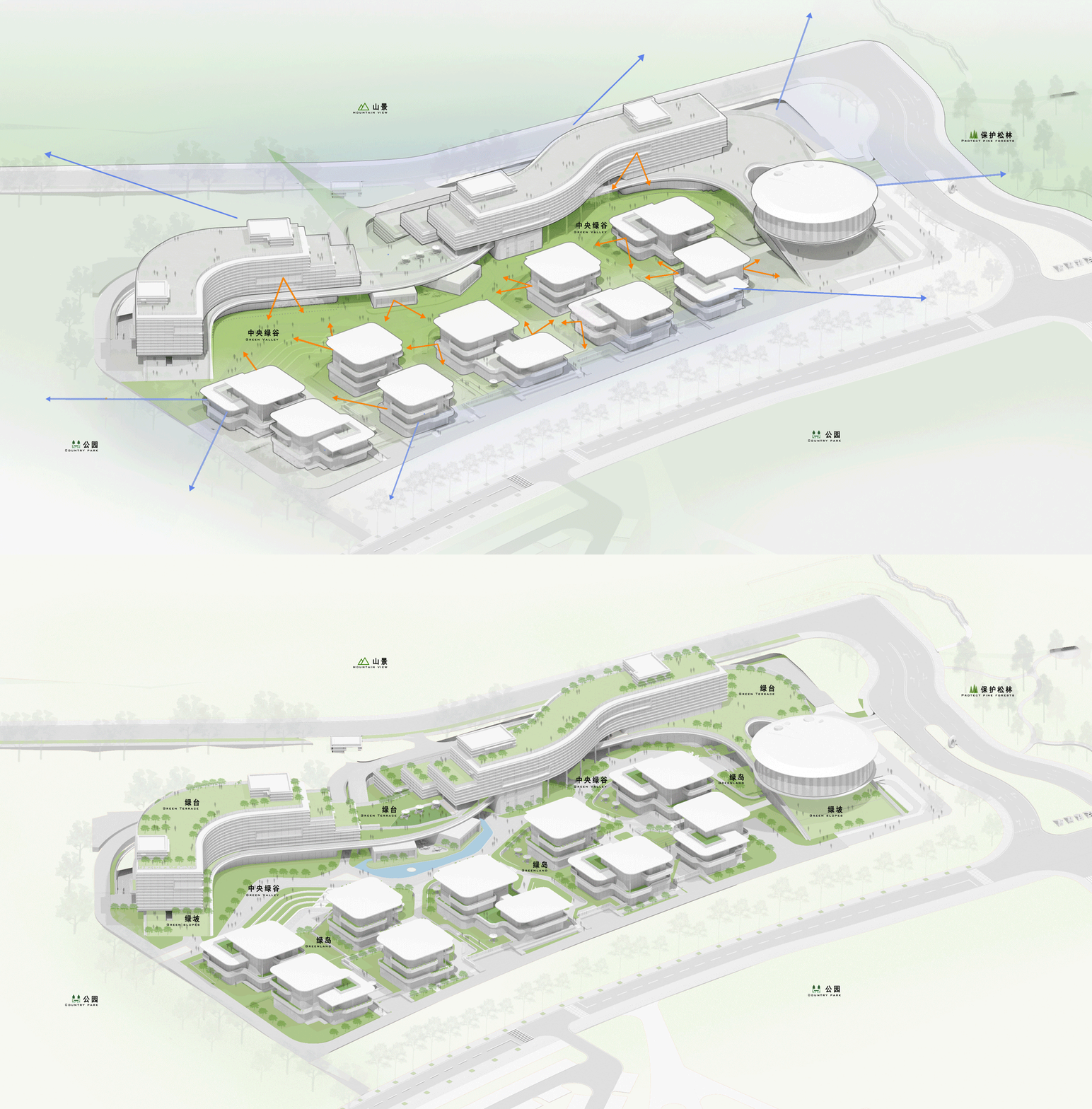
▼景观分析图,Landscape analysis © 中国美术学院风景建筑设计研究总院有限公司

▼视线分析图,Sight analysis © 中国美术学院风景建筑设计研究总院有限公司
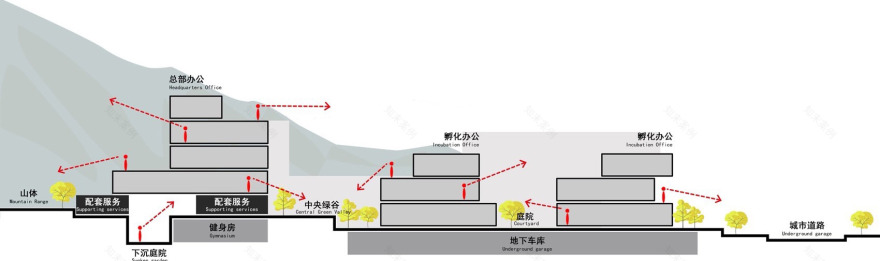
▼视线剖面分析图,Section of sight analysis © 中国美术学院风景建筑设计研究总院有限公司
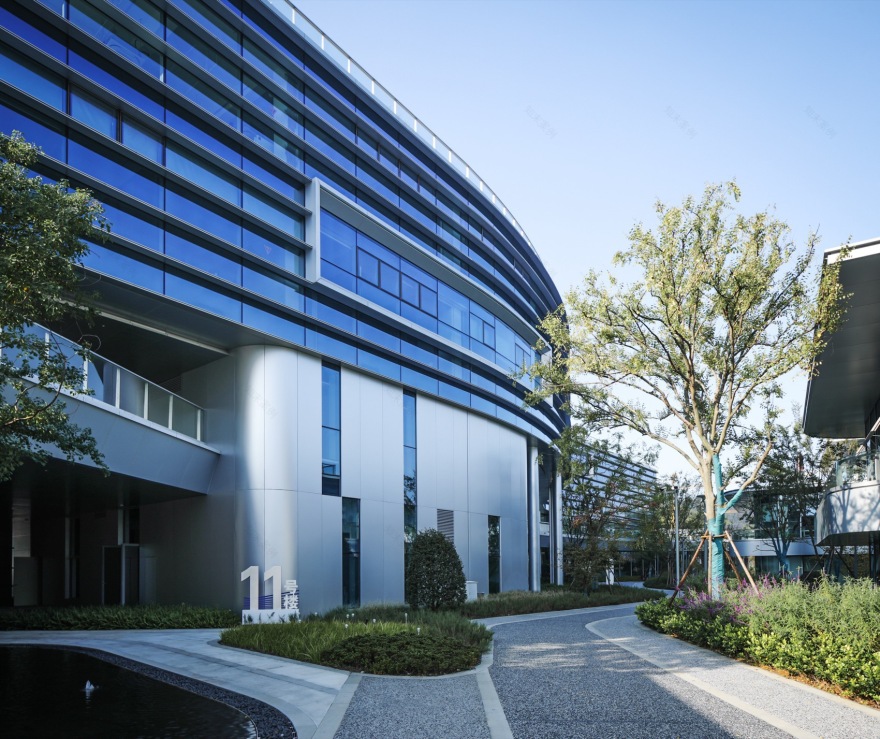
▼景观绿轴,Landscape green axis© 黎伟

▼利用高差形成的景观广场,Landscape square formed by height difference© 黎伟

▼景观广场与建筑的呼应关系,The echo relationship between landscape square and building© 黎伟

▼主入口景观节点空间,Main entrance landscape space© 黎伟

总部办公设置 1-2 层的底层架空,将绿轴景观延伸至架空层与西侧山体形成呼应。增加了景观层次和视野,减少了建筑体量带来的压抑感。
The headquarters office employs the elevated one floor or two floors, and the green axis is extended to the elevated floor to echo the mountain on the west side. The landscape level and vision are increased, and the oppression brought by the building volume is reduced.
▼景观绿轴高差关系,Landscape green axis height difference relationship© 黎伟

▼景观延伸进架空层,The landscape extends into the elevated level© 黎伟

▼架空层空间,The elevated level© 黎伟

绿轴两侧结合地形和功能形成若干绿岛,设计分别赋予了阅读绿岛、社交绿岛、艺术绿岛、创意花园绿岛等主题,提升了办公空间的丰富性。
On both sides of the green axis, a number of green islands are formed by combining topography and function. The design gives the themes of “reading green island”, “social green island”, “art green island” and “creative green island”, which enhance the richness of the office space.
▼工作生活场景分析图,Work and life scene analysis diagram © 中国美术学院风景建筑设计研究总院有限公司

▼工作生活场景分析图,Work and life scene analysis diagram © 中国美术学院风景建筑设计研究总院有限公司

▼独栋组团庭院,Architectural group courtyard© 黎伟


▼夜景氛围,Night atmosphere© 黎伟

“1+N”的街、巷步行系统
“1+N” street and lane walking system
项目借鉴安吉传统村落主街+小巷路网模式设计,提出了“1+N”的步行系统。项目景观绿轴设计为复合立体步行“主街”,由北往南依次串联了多个主要户外功能空间。
The “1+N” walking system is proposed based on the design of the road network pattern of the traditional village of Anji. The green axis of the project is designed as a composite three-dimensional pedestrian “main street”, connecting a number of main outdoor functional spaces from north to south.
▼“街巷”流线分析图,”Street” flow line analysis diagram © 中国美术学院风景建筑设计研究总院有限公司

设计结合景观组团分布,由主街发散出若干不同尺度和形态的“小巷”到达每幢建筑的出入口。通过街巷步行系统,由公共空间过渡到私密空间,提升了使用者的归属感。
The design combined with the landscape group distribution from the main street emanates a number of different scales and forms of “alleys” to reach the entrance and exit of each building. The transition from public space to private space through the pedestrian system of streets and alleys enhances the user’s sense of belonging.
▼主街空间,Main street space© 黎伟

▼小巷空间与主街空间衔接,The alley space connects with the main street space© 黎伟

“1+N”的经营业态分布
Distribution of “1+N” business formats
“1+N”代表了整体与分散的经营方式。沿山两幢总部办公,既能整幢使用、也能分层或按照不同面积需求分割使用。9 幢独栋建筑可提供给具有潜力的中小创业企业。接待、餐厅、超市、咖啡厅、健身房等配套功能结合使用流线便利性散落布置在不同景观节点处,增添了生活氛围。由于项目的开放性其配套可对社会共享,增加商业流量。
“1+N” represents a holistic and decentralized approach to business. The two headquarters office buildings along the mountain can be used as a whole, or can be divided into floors or divided according to different area needs. The nine individual buildings are available for use by small and medium-sized entrepreneurial enterprises with potential. With the convenient use flow line, reception, restaurant, supermarket, cafe, gym and other supporting functions are arranged in different landscape nodes to add a living atmosphere. The openness of the project allows its supporting facilities to be shared with the public, thereby increasing business traffic.
▼功能分析图,Functional analysis chart © 中国美术学院风景建筑设计研究总院有限公司

▼整体办公氛围,Overall office atmosphere© 黎伟

▼架空层休息空间,Elevated level rest space© 黎伟

“看与被看”建筑造型与幕墙构造
“See and be seen” architectural modeling and curtain wall construction
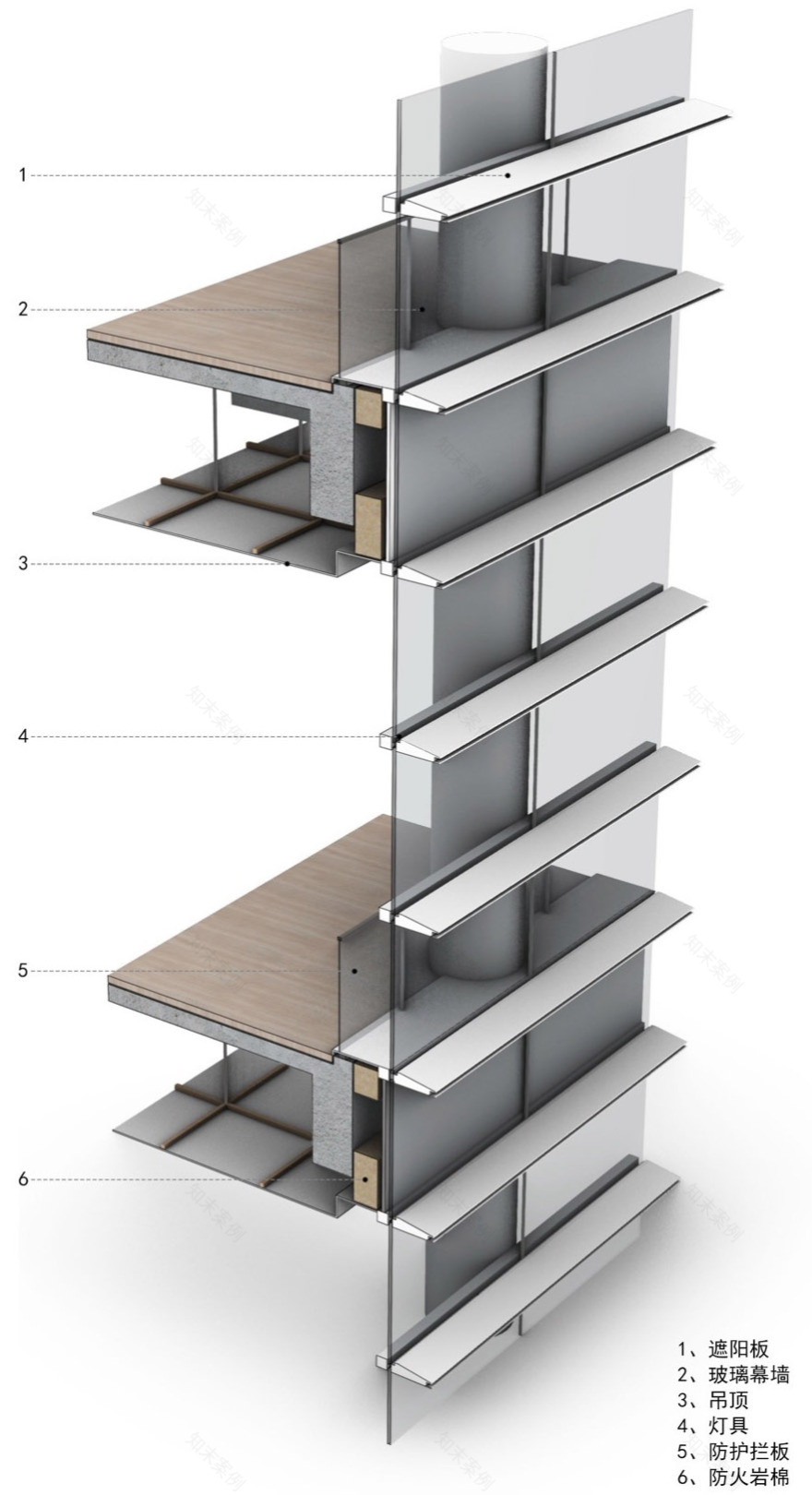
山水是主角,建筑是融入自然之中的风景,结合传统园林“看与被看”理念,建筑造型设计既需要形体的表达也需要由内向外的视觉感受。9 幢独栋建筑从赖特的“草原样式”吸收灵感,提取转化安吉传统民居坡屋顶和屋檐的样式,用过铝板和玻璃的搭配生成独特的建筑造型。与景观呼应的半室外露台空间,增加了办公与自然的亲密度,同时大尺度屋檐使其内部视线更加聚焦自然景观。沿山建筑通过设置尺度合适的铝合金遮阳板、双层架空空间、层层跌落的退台,呼应了山体的起伏,弱化了建筑体量感,使建筑融合在环境之中。
Landscape is the leading role, and architecture is the view integrated into nature. Combined with the concept of “seeing and being seen” in traditional gardens, architectural design requires both the expression of shape and the visual feeling from inside to outside. The nine individual buildings draw inspiration from Wright’s “grassland style”, the styles of pitched roofs and eaves of traditional houses in Anji are extracted and transformed, and the combination of aluminum plate and glass is used to generate unique architectural shapes. The semi-outdoor terrace space echoes the landscape to bring the office space closer to nature, while the large eaves make the internal view more focused on the natural landscape.
▼独栋办公形态,Single office building form © 黎伟

▼独栋办公立面细节,Office facade details© 黎伟 /中国美术学院风景建筑设计研究总院有限公司

▼铝板百叶与环境关系,Aluminum shutter and environmental relationship© 黎伟

▼铝板百叶、玻璃栏杆细节,Aluminum shutter, glass railing details© 黎伟

技术难点与创新 Technical difficulties and innovation
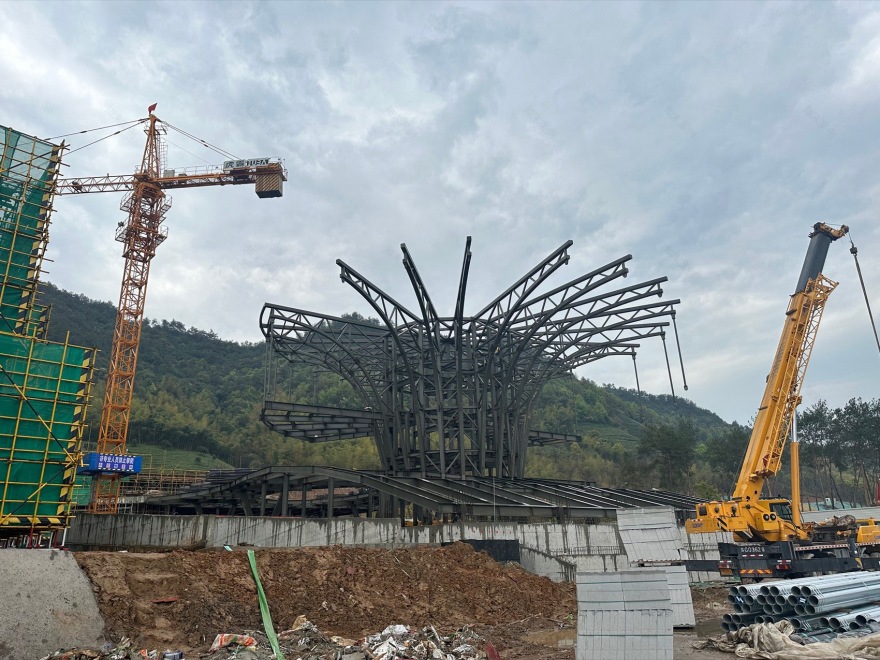
路演中心其独特的圆盘悬浮造型和内部竹节伞状结构系统为本项目最具代表性的特色。设计利用参数化归纳了十二品钢桁架和表皮,并将设备管线巧妙地环绕在网架内部,形成一个开阔的伞状会议空间。在钢桁架顶部悬吊的三层结构,使得上层空间悬浮于下方的无柱区域之上,独特的建筑造型与入口形象广场共同构成了区域的地标。下部空间与市政绿化相接,提供了一个开放的城市公共观景休憩空间。
The most representative features of this project are the unique circular disk floating shape of the roadshow center and the internal bamboo joint umbrella structure system. The design takes advantage of parameterization to generalize twelve steel trusses and skins and cleverly wraps the equipment pipelines around the interior of the grid to form an open umbrella-shaped meeting space. The suspended three-story structure on top of the steel truss allows the upper space to be suspended above the column-free area below, and the unique architectural form and the entrance image plaza constitute the landmark of the area. The lower space connects with the municipal greening to provide an open urban public viewing space.
▼路演中心透视角度,The roadshow center © 黎伟


▼路演中心室内外,The roadshow center exterior and interior© 黎伟


▼路演中心底层,The roadshow center © 黎伟

▼路演中心钢结构模型,Steel structure model of roadshow center © 中国美术学院风景建筑设计研究总院有限公司

▼路演中心内部造型表皮,Roadshow center interior view © 中国美术学院风景建筑设计研究总院有限公司

▼路演中心内部桁架分析图,Analysis diagram of the trusses inside the roadshow center © 中国美术学院风景建筑设计研究总院有限公司

结语
Conclusion
互联网时代,创新产业更向往“离自然很近,距城市不远”的地方。项目场地一边连接着静谧山谷,一边渗透进尘世烟火。城市、乡村、自然相互赋能,传承了安吉“远山淡影”的地域美学,为安吉构建生态绿色数字经济产业园区迈出具有开拓性的一步。
In the Internet era, the innovation industry is more eager to be “close to nature, not far from the city”. The site is connected to a quiet valley and infiltrated with the city. The mutual empowerment of city, countryside and nature has inherited the regional aesthetics of ” A Pale View of Hills ” in Anji, and taken a pioneering step for the construction of ecological green digital economy industrial park in Anji.
▼施工过程,Construction process © 中国美术学院风景建筑设计研究总院有限公司


▼模型,Model© 中国美术学院风景建筑设计研究总院有限公司


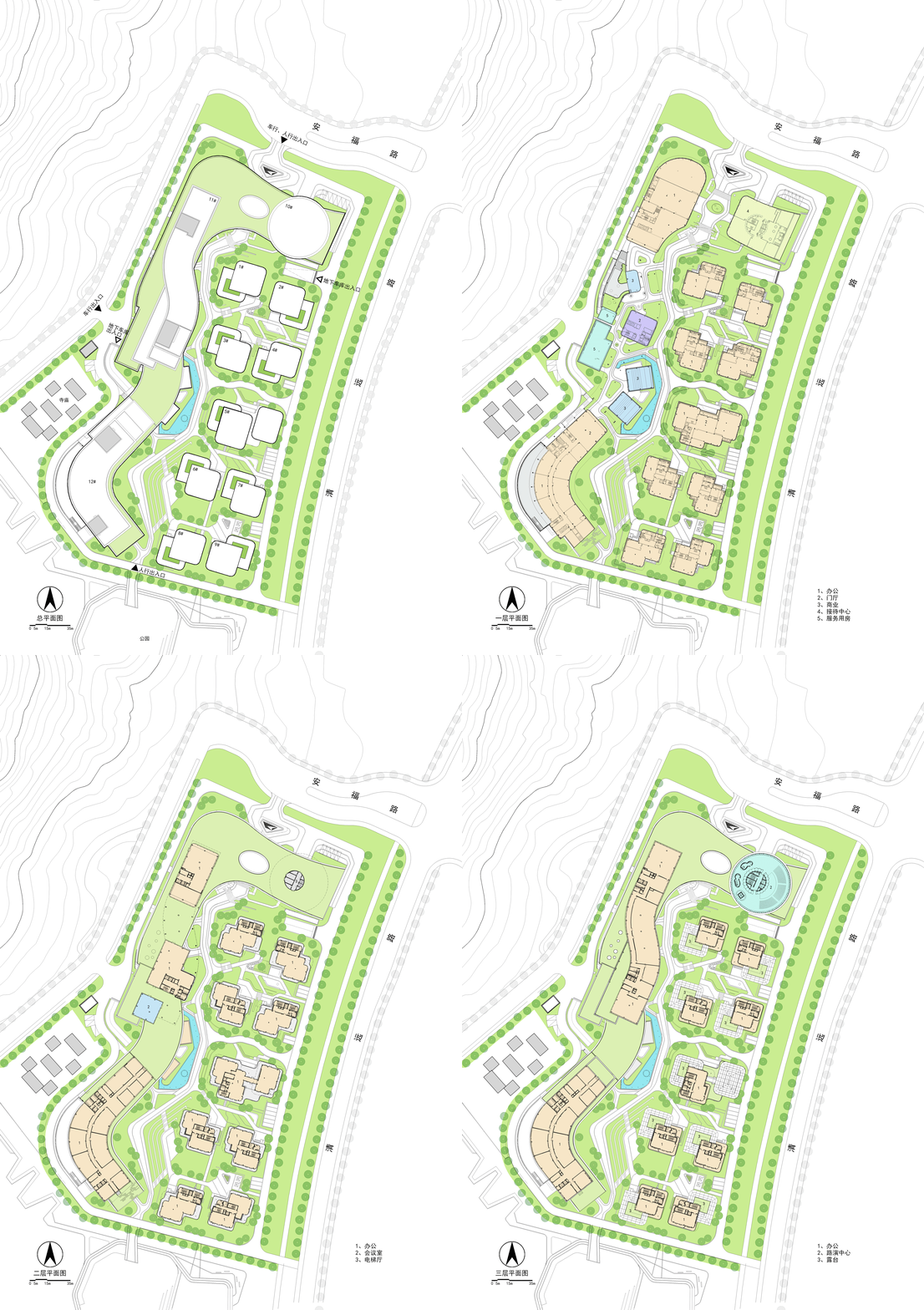
▼各层平面图,Floor plans© 中国美术学院风景建筑设计研究总院有限公司
▼细部详图,Detailed drawings© 中国美术学院风景建筑设计研究总院有限公司

项目名称:灵峰“智慧谷”平台示范区建设工程(一期)
项目类型:建筑
设计方:中国美术学院风景建筑设计研究总院有限公司
项目设计:2021.09
完成年份:2024.08
建筑设计:张欣然、王剑鉴、黄海科
结构设计:李磊、江之源、宣圣华、潘艺倩、谷圣杰
设备设计:朱卫平、潘信峰、祝悦、朱超成、李闪闪、刘洋
景观设计:严江平、杨松、张慕霜、王莉姗
幕墙设计:刘德权、祝建伟
灯光设计:方晓灵
项目地址:浙江省湖州市安吉县灵峰街道
建筑面积:51873.67㎡
摄影版权:黎伟
客户:安吉七彩灵峰乡村旅游投资有限公司
Project name: Lingfeng “Smart Valley” Platform Demonstration Zone Construction Project
Project type: Architectural
Design: The Design Institute of Landscape & Architecture China Academy of Art Co.,Ltd.
Design year:2021.09
Completion Year:2024.11
Architectural design:Zhang Xinran,Wang Jianjian,Huang Haike
Structural Design:Li Lei,Jiang Zhiyuan,Xuan Shenghua,Pan Yiqian,Gu shengjie
Equipment Design:Zhu Weiping,Pan Xinfeng,Zhu Yue,Zhu Chaocheng,Li Shanshan,Liu Yang
Landscape design:Yan Jiangping,Yang Song,Zhang Mushuang,Wang lishan
Curtain Wall Design:Liu Dequan,Zhu Jianwei
Lighting Design:Fang Xiaoling
Project location:Anji,Huzhou,Zhejiang,China
Gross built area: 51873.67㎡
Photo credit: Li Wei
Clients:Anji Colorful Lingfeng Rural Tourism Resort Co., Ltd









南京喵熊网络科技有限公司 苏ICP备18050492号-4知末 © 2018—2020 . All photos and trademark graphics are copyrighted by their owners.增值电信业务经营许可证(ICP)苏B2-20201444 苏公网安备 32011302321234号
苏公网安备 32011302321234号客服
消息
收藏
下载
最近