

创作上传
VIP
收藏下载
登录 | 注册有礼
查看完整案例

收藏

下载

分享
项目背景 Project Background 中国传统建筑最大的魅力就在于层台累榭,解决好院子和院子、院子和房子、院子和绿化这三者之间的关系,一个空间的层次便分明了。在我们的设计里,“院子”是整个建筑设计的核心,上下参差、内外有别的院落穿插在不同空间组合里,或居中成院、讲究围合;或切角为庭、以建筑环绕;或建筑与庭院各占一边、遥相呼应。在各式的园子类型中,体现着不同类型院子的丰富性、差异性及趣味性,丰富组合的本身也自然而然的为营造花园和乐园提供了更多的可能性。除此,加上温暖的色彩设计及柔和的材料选择,完全打破了医院带给人们冰凉理性的固有印象。
The most attractive part of traditional Chinese architecture lies in the intricate design and delicate balance between the courtyards, buildings, and gardens. By resolving these three relationships, the spatial structure becomes clear. The “courtyard” is the core of our architectural design. Gardens of varying elevations are placed in different combinations; either as the central focus of a space surrounded by architecture, or placed in corners used to accent the buildings, or balanced with the architecture on opposite sides of a courtyard in a harmonious relationship. This showcases the richness, diversity, and allure of different types of courtyards, and also provides numerous possibilities for creating gardens and paradise. Furthermore, the warm color palette and the use of soft materials completely dispel the cold and depressing impression often associated with hospitals.
▼鸟瞰实景照片,aerial view©一界摄影

项目位于广东佛山三龙湾高端创新集聚区,总建筑面积 19 万㎡,是佛山新城第一家也是唯一一家三级公立医疗保健机构,同时也是全国妇幼保健系统中单体建筑最大的院区之一。
This project is situated in the Guangdong Foshan Sanlongwan High-end Innovation Cluster, covering a total construction area of 190,000 square meters. It is the first and only tertiary public medical and healthcare institution in Foshan New Town, a key planning area within Foshan City. Additionally, it stands as one of the largest single-building campuses in China’s national maternal and child healthcare system.
▼沿街立面,street view©一界摄影

对于拥有 1000 张床位,体量超规模,功能流线复杂,不仅服务于普通病患、也服务于大量产妇等健康人群的大型妇幼综合医院,如何让它摆脱疏离冷漠的“医院神态”,如何让就医群体在医院感受到芝兰之室的氛围,是我们设计的难点与重点。
For a large-scale maternal and child healthcare hospital with 1,000 beds, an expansive volume, and complex functional circulation, which not only serves general patients but also caters to a large number of expectant mothers and other healthy individuals, the challenge and focus of our design lie in how to move away from the cold, impersonal “hospital appearance” and create an atmosphere that allows patients to feel the warmth and comfort of a refined and welcoming space.
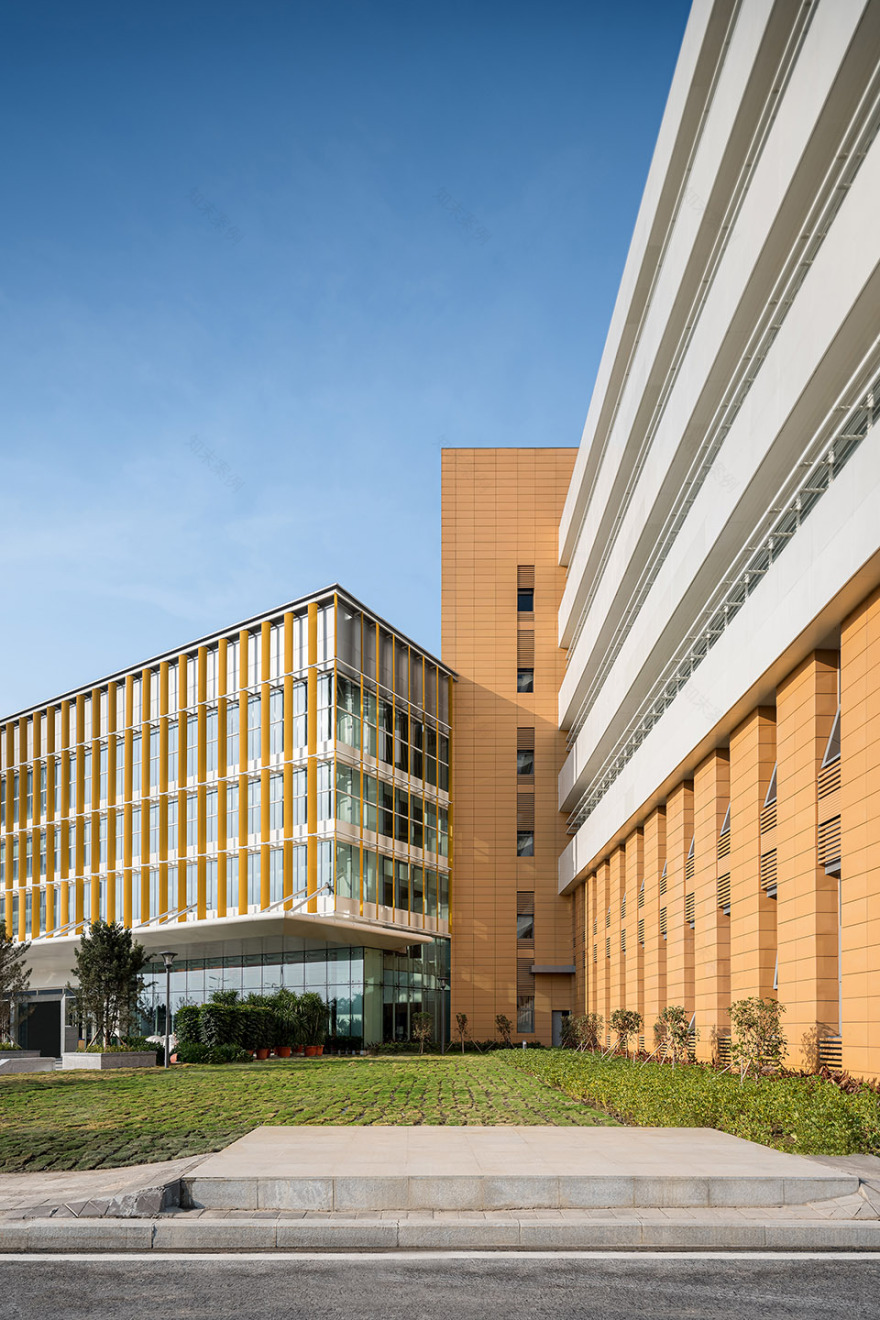
▼沿街立面,street view©一界摄影

设计理念
Design Concept
围棋理论,点院成园
Go’s points as courtyards, courtyards as a garden
面对紧张且不规则的用地,风向和远期规划成为解决问题的关键与突破口。多边形曲折基地进行分解,解决了多个城市界面车行出入口的限制,有效的缓解城市和院区的交通压力。中心医疗区采用围棋理论顺应切割后的场地,突出“医疗分中心”既相互联系又相对独立的概念。考虑预留扩建场地的可能性,进一步减小建筑尺度,削弱建筑对场地的压迫感,最终形成统一而又富有韵味的形体和空间变化。
▼围棋理论、点院成园,Go’s points as courtyards, courtyards as a garden©中国中元国际工程有限公司
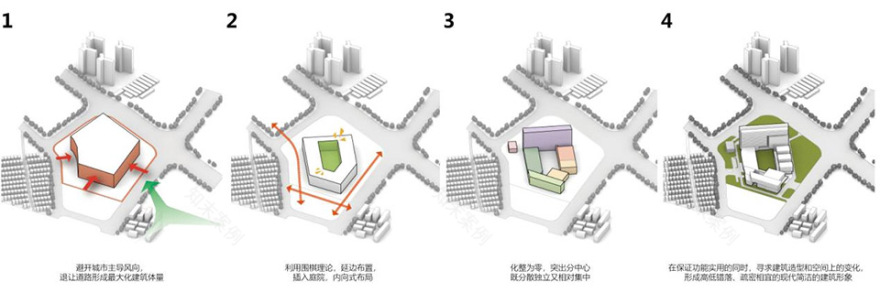
Facing challenges related to limited land-use and an irregularly shaped site, wind direction and long-term planning became key factors in addressing the challenges. We deconstructed the polygonal site to resolve the constraints of multiple vehicular access points at urban interfaces, effectively alleviating traffic pressure between the city and the hospital campus. For the central medical site, we used the theory of Chinese Go to emphasize the concept of “Medical Sub-center” that are interconnected yet relatively independent. Considering the potential for future expansion, we further reduced the building scale to soften its impact on the site, ultimately creating a unified yet dynamic form with spatial variations.
▼空中花园,rooftop garden©一界摄影
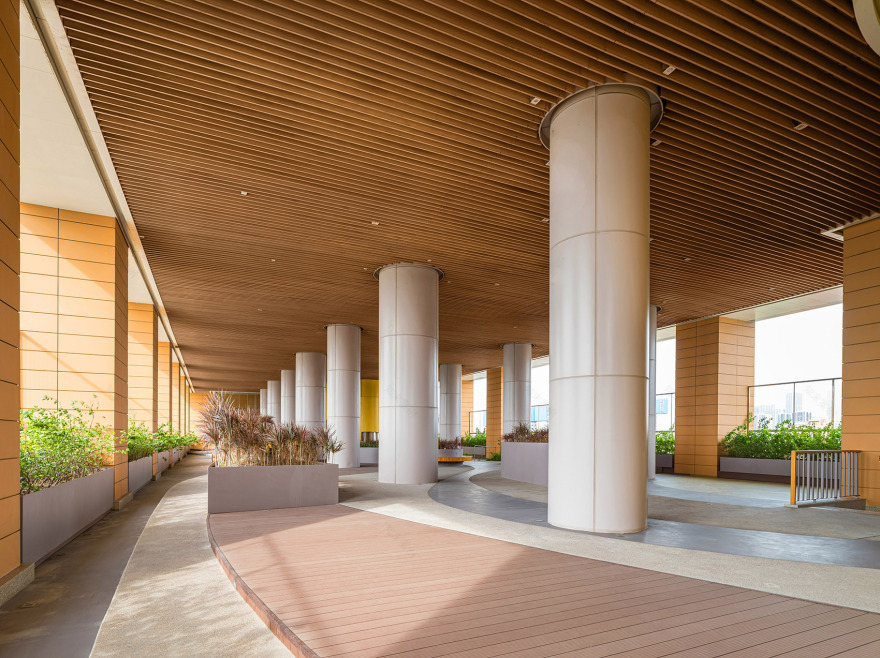
▼形成统一而又富有韵味的形体和空间变化,creating a unified yet dynamic form with spatial variations©一界摄影
强专科、小综合布局 Specialized Layout, Small-Scale Comprehensive Design
任何建筑都不是一个简单的院落概念,尤其医院,相对其它建筑更为理性。其复杂的功能需求与流线组织方式最终形成可以支配整体布局的结果。诊疗和医技空间的模块化决定了形体的规模和形制,各个功能区之间的关系和流线又决定了其层次的先后。
In architectural design, no building can be reduced to a simple courtyard concept. This is especially true for hospitals, which, compared to other building types, are more rational in design. Their complex functional requirements and circulation system ultimately shape the overall layout. The modularity of the diagnostic and medical technology spaces determines the scale and form of the building, while the relationships and circulation between different functional zones define their hierarchical order.
▼护士站,nursing station©一界摄影
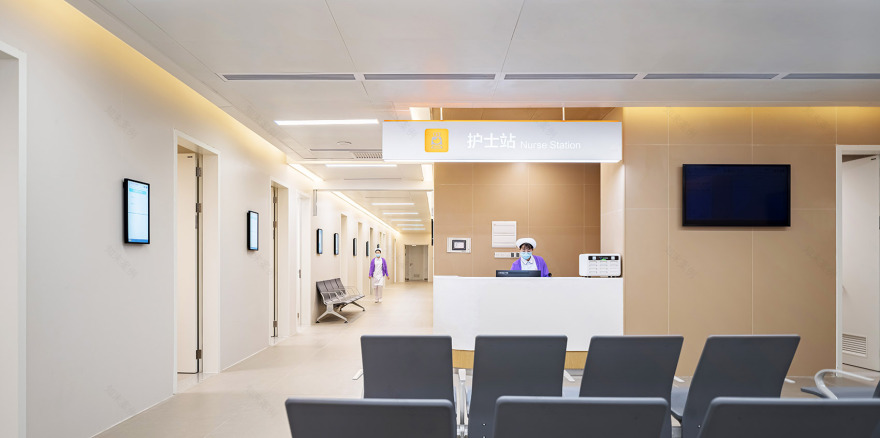
我们尝试突破常规的设计思路整合医疗功能。妇幼医院的特殊性和分中心的概念,是这个想法的催化剂。突出“分中心”既相互联系又相对独立的概念,将四部四中心进一步化整为零。医技与门诊之间插入一个大尺度下沉庭院,庭院上空以连廊、平台相互错落相连,影像中心解决采光问题的同时与急诊、门诊联系紧密。门诊大厅是联通地下落客乃至整个医院各个分中心的枢纽,南侧与妇儿保健中心、后勤保障中心相连,北侧串联起门诊主街、急诊急救中心、影像中心。病房则位于体量的最北侧,满足良好的日照和朝向,同时有效与门急诊人流区分,保持了病房部分的相对安静。
We aim to break through conventional design approaches by integrating medical functions. The unique nature of maternal and child healthcare and the concept of the sub-center have catalyzed this idea. The concept of the “sub-center”, which is both interconnected and relatively independent, has led to the further subdivision of the four main parts into smaller functional units. A large-scale sunken courtyard is inserted between the medical technology and outpatient areas, with corridors and platforms interspersed above, creating a dynamic connection. The imaging center not only addresses the lighting requirements but also maintains close links with the emergency and outpatient department. The outpatient lobby serves as a hub connecting the underground drop-off area and various sub-centers of the hospital. To the south, it connects to the maternal and child health center and the logistics support center, while to the north, it links the outpatient main street, emergency center, and imaging center. The inpatient wards are located at the northernmost end of the building, ensuring ample sunlight and optimal orientation. At the same time, the effective separation of pedestrian flows between the outpatient and emergency areas helps maintain a quiet environment in the ward section.
▼护理单元实景图,Inpatient area©一界摄影

人车分流,衔接城市 Balancing Pedestrian and Vehicle Flows, Seamlessly Connecting the City
利用不同的垂直空间,实现“人车分流、洁污分流”,分别安排公交车、出租车、私家车、员工车辆通道和洁污运输通道,避免人流、车流和物流的交叉,形成通畅的交通流线。机动车组织采用了地上地下相结合的方式,机动车从西侧道路进入院区后,即可以从地面到达门诊、急诊及住院楼,也可通过地下落客到达上述各功能区,从而有效缓解院区地面的交通压力。
▼总平面图,site plan©中国中元国际工程有限公司

By utilizing different vertical spaces, the design achieves “pedestrian-vehicle separation” and “clean-pollution separation”, with dedicated routes of buses, taxis, private cars, staff vehicles, and clean/waste transportation, preventing the intersection of pedestrian, vehicular, and logistical flows, and ensuring smooth traffic circulation. The vehicle circulation system combines both surface and underground routes. Vehicles enter the campus from the west road and can either access the outpatient, emergency, and inpatient buildings directly from the ground level or use the underground drop-off areas to reach these functional zones, effectively alleviating traffic congestion on the campus ground.
▼清晰流畅的交通流线布局,smooth and clear traffic circulation©一界摄影
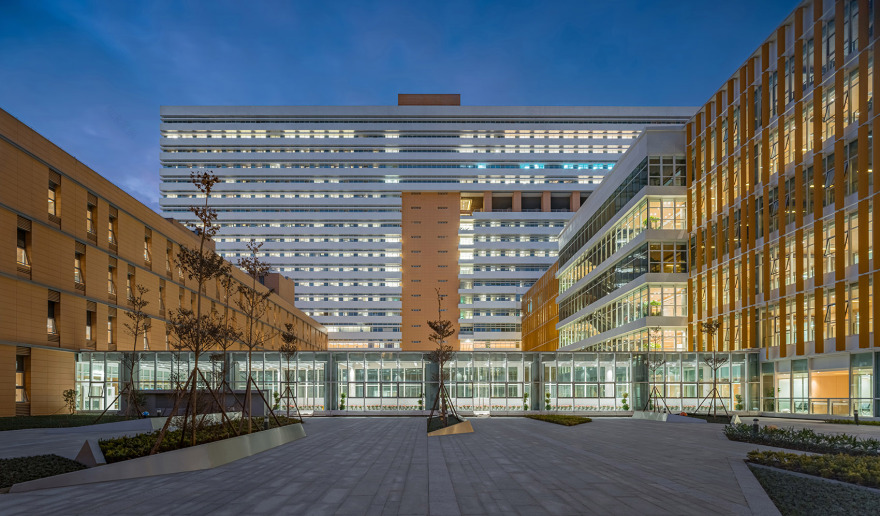
疗愈彩虹、绿色低碳
“Rainbow” Compassion, Green Sustainability
在保证功能实用的同时,建筑造型寻求色彩和空间上的变化,以多元化的建筑语汇,表达着对城市区域和建筑功能特性的理解。陶板与白色铝板,搭配竖向橙色百叶,单体形象简洁明快、尺度宜人,形成高低错落、疏密相宜、现代简洁的建筑形象。
While ensuring functional practicality, the building’s form seeks variation in color and space, using a diverse architectural vocabulary to express an understanding of the urban context and the functional characteristics of the building. The combination of ceramic panels, white aluminum cladding, and vertical orange louvers creates a simple, bright, and proportionate massing, resulting in a building form with a harmonious balance of scale, spatial variation, and a modern, minimalist aesthetic.
▼立面竖向遮阳,Vertical Sunshading on the Facade©一界摄影

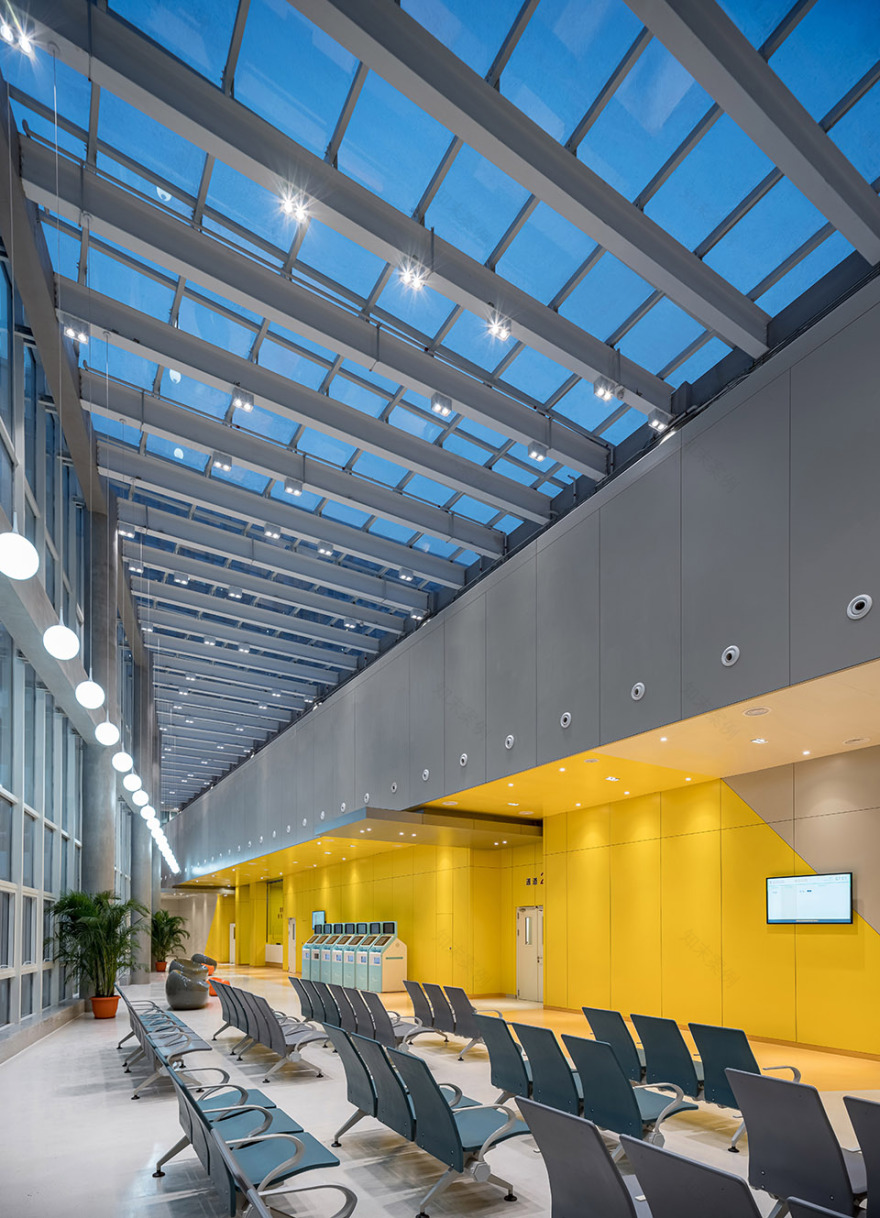
室内空间致力于探索犹如游乐场的新型医疗空间概念和患者体验感的打造,利用丰富有序的色彩组合和尽量避免死角的弧形空间语汇,表达对妇女儿童无微不至的人文关怀。从广场花园的落客到开敞明快的大厅,再到舒适的候诊空间和步移景异的立体花园,使人们能在医院空间中感受到宁静与愉悦的氛围。充分考虑妇幼医院的特殊性,满足不同人群对于私密空间的使用要求。
The interior space is dedicated to exploring a new medical environment concept, akin to a playground, and enhancing the patient experience. It utilizes a rich and organized color palette and curved spatial design to minimize dead corners, expressing meticulous humanistic care for women and children. From the drop-off area at the plaza garden to the open and bright lobby, followed by the comfortable waiting areas and the dynamic, ever-changing three-dimensional gardens, the design creates a tranquil and pleasant atmosphere within the hospital space. The design fully considers the unique needs of a maternal and child healthcare, catering to the diverse requirements for private spaces by different user groups.
▼门诊大厅,Outpatient Hall©一界摄影

▼门诊医疗主街,Main Street of Outpatient Department©一界摄影
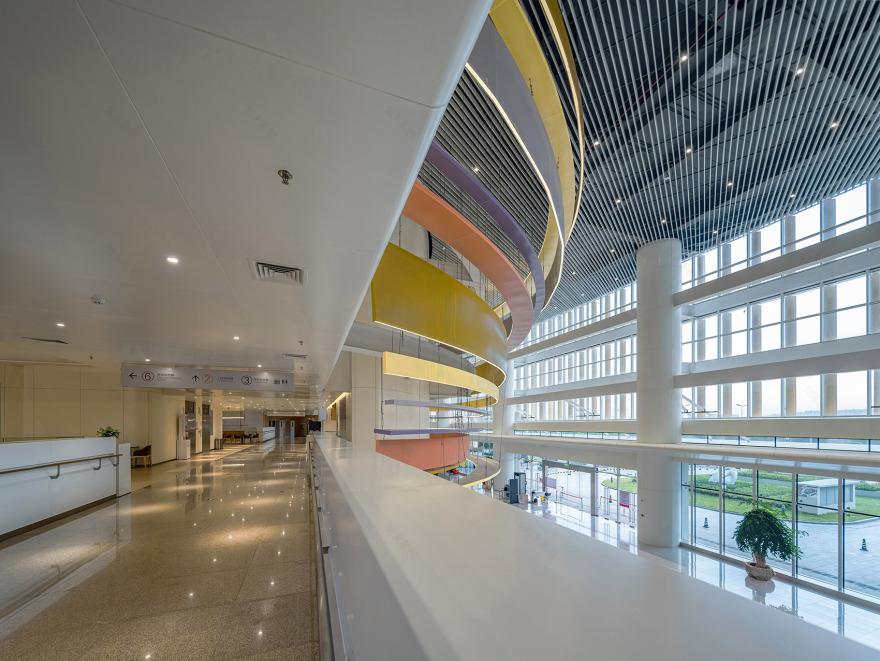
▼急诊大厅,Emergency hall©一界摄影

建筑从方案设计伊始,就把绿色低碳的理念贯穿整个构思之中,并将其融入设计的全过程,实现建筑被动式节能,并取得绿色建筑评二星 A 级证书。设计充分考虑中国南方气候特点,将竖向遮阳与水平遮阳相结合,大尺度下沉庭院、挑空廊桥、绿色屋顶、空中花园相结合,与自然环境和谐相融并延伸至内庭院,形成步移景异的立体景观空间。
From the outset of the design, the concepts of green building and low-carbon impact have been integrates into the entire design process. This project incorporates passive energy-saving technologies and has earned a two star, A-level certification in national green building evaluation. The design fully considers the climatic characteristics of southern China, combining vertical and horizontal shading techniques. It integrates large-scale sunken courtyards, open corridor bridges, green roofs, and rooftop gardens. These elements harmonize with the natural environment and extend into the inner courtyards, creating a dynamic, three-dimensional landscape that offers ever-changing views.
▼放射科等候区,Radiology Waiting Area©一界摄影
结语
Conclusion
设计是一个复杂和持久的工作。创意设计在于不断的推敲和权衡利弊,同时还需要延伸到后续的设计当中。取舍是一个痛苦的过程,在解决地下一层停车落客与首层医疗街的关系时,我们反复推敲着最优的解决方案;医疗流线最短、功能第一的原则也让我们牺牲了概念方案中较多架空和退台;外墙低矮花槽、遮阳板高度与视线遮挡的墙身推敲;门诊与医技之间的连廊最终恰到好处的整合在影像中心局部挑空的部分。每一次的修改都是设计,“再设计”的本身也充满挑战和趣味性。医疗建筑师除了要平衡复杂的医疗功能,也是为医生和患者等未来一系列使用者搭建平台的媒介者。故此,不断学习、了解使用者,不断去体验才是我们集腋成裘的唯一方式。
Architectural design is a complex and ongoing work. Creative design lies in constant refinement and weighing the pros and cons, and it also needs to extend into the subsequent stages of the design. Making choices is often a painful process. In solving the relationship between the underground parking drop-off area and the first-floor medical street, we repeatedly deliberated to find the optimal solution. The principle of minimizing medical circulation and prioritizing functionality led us to sacrifice many of the open spaces and setbacks from the conceptual design. We carefully considered the height of the low exterior flowerbeds, shading panels, and the walls that obstruct views. The corridor between the outpatient and medical technology areas was ultimately integrated seamlessly into the partially open space in the medical imaging center. Each revision is part of the design process, and the act of “re-designing” itself is both challenging and rewarding. As healthcare architects, we not only balance complex healthcare functions but also serve as intermediaries, creating platforms for doctors, patients, and all future users. Therefore, continuous learning, understanding the users, and gaining firsthand experience is the only way for us to refine and perfect our work.
▼夜景,night view©一界摄影

▼地下一层平面,basement plan
©中国中元国际工程有限公司

▼二层平面,second floor plan©中国中元国际工程有限公司

▼三层平面,third floor plan©中国中元国际工程有限公司

▼四层平面,fourth floor plan©中国中元国际工程有限公司
▼立面图,elevations©中国中元国际工程有限公司

▼剖面图,section©中国中元国际工程有限公司

项目名称:佛山市妇女儿童医院建设项目
项目类型:医疗建筑
建设地点:广东省佛山市
用地面积:6 万㎡
建筑面积:19.9 万㎡
床位数: 1000 床
设计时间: 2013
竣工时间:2021
业主单位:佛山市妇幼保健院
设计单位:中国中元国际工程有限公司
主创建筑师:许海涛、谷建、张丽欣
设计团队:陈兴忠、梁辉、张恒仓、孙苗、刘建、潘洁、何源、牟惟勇、田军、石鹿言、邓峥云、张颖、袁白妹、邢云峰、魏威、崔岩博
摄影版权:一界摄影

南京喵熊网络科技有限公司 苏ICP备18050492号-4知末 © 2018—2020 . All photos and trademark graphics are copyrighted by their owners.增值电信业务经营许可证(ICP)苏B2-20201444 苏公网安备 32011302321234号
苏公网安备 32011302321234号客服
消息
收藏
下载
最近