

创作上传
VIP
收藏下载
登录 | 注册有礼
查看完整案例

收藏

下载

分享
位于东京的池尻大桥区域可能成为未来发展的目标区域,该区域的建筑,包括本项目的地点——大桥会馆,可能会被拆除。另一方面,重建项目可能需要几年时间才能开始。在这一过渡期内,建筑业主启动了这个项目,旨在利用现有建筑活化该区域,增加商铺数量,并促进社区建设,以便在重建后创造更好的环境。DDAA建筑事务所负责了餐厅和咖啡厅Massif的设计,以及画廊 CEKAI O!K STORE&SPACE 的室内设计,这两个空间位于建筑的一楼,相邻而设。
The Ikejiri Ohashi area may be a target for future development, and the buildings in the area, including Ohashi Kaikan, the site of this project, may be demolished. On the other hand, there is a period of several years before a reconstruction project is potentially slated to begin. Taking advantage of this interim period, the building owner initiated this project with the idea of using existing buildings to revitalize the area, increase the number of shops, and foster a community so that a better environment can be created after reconstruction. DDAA oversaw the interior design of the restaurant and café, Massif, and the gallery CEKAI O!K STORE&SPACE, which are adjacent to each other on the first floor of the building.
▼室内概览,overview of the indoor space ©Kenta Hasegawa
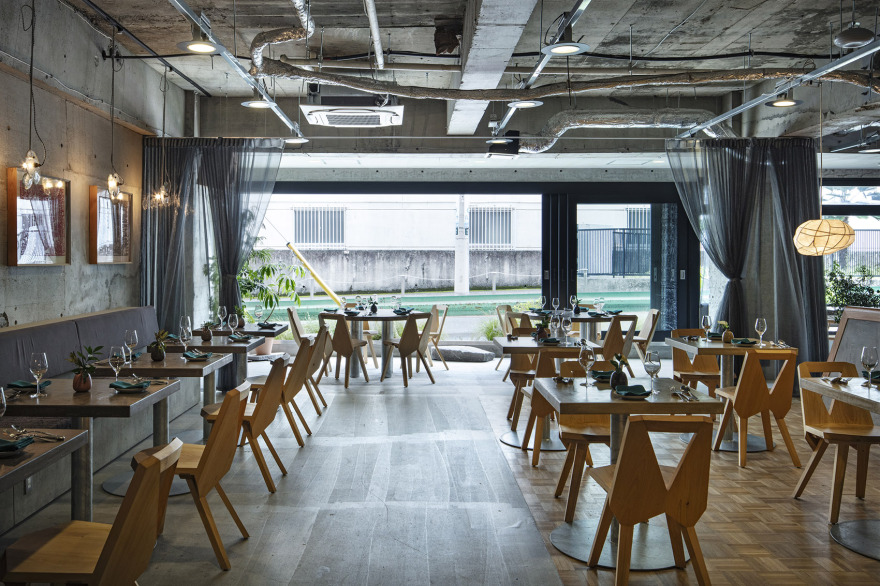

在日本,室内设计的生命周期较短,尤其是商业设施。这是设计师在做了许多室内设计项目后深感的困境。在这种“城市新陈代谢”中,一些区域发生变化,而另一些则保持不变。从积极的角度看,商业空间的室内设计作为变化的短暂领域发挥作用。然而,设计师并不能完全认同“拆除重建”的方式,尤其是当项目从一开始就注定是短期存在的情况下。
The lifespan of interiors is short in Japan, especially for commercial facilities. This is the dilemma I have felt while working on many interior design projects. In this “urban metabolism”, some areas change, and some do not. In a positive light, interior design for commercial spaces, acts as the ephemeral realm of change. That said, I can’t whole heartedly agree with the scrap-and-build approach, especially when the project is predestined to be short-lived from the outset.
▼入口,entrance ©Kenta Hasegawa


在Massif餐厅项目中,涉及建筑、电气、室内和家具设计,设计师有意识地尽量减少对原有餐厅空间的室内设计干预和施工。设计保留了原有的基本布局,尽可能地重新使用现有设施和厨房,并且在拆除墙壁和天花板后只进行了最小的修复。还修复了原餐厅的木质瓷砖地板,重新抛光并重新塑形,略微调整了轮廓。尽量减少室内施工,只在必要的地方进行拆除。另一方面,设计师精心设计了家具和其他人们直接接触的区域的质感和手感。这种方法能够平衡分配成本的区域和不进行干预的区域。即使这座设施在几年后被拆除,为这个项目制作的家具也可以在其他地方重新利用。
▼保留了原有的基本布局,kept the original basic layout ©Kenta Hasegawa

现有建筑由固定间隔的A形混凝土柱支撑。布局设计使得空间的功能随着人们穿越由A形柱体创造的开口而发生变化。餐厅以中央A形柱作为界限,将前面的咖啡厅和酒吧与后面的餐厅隔开。在另一组柱子之后,有一个通向CEKAI运营的画廊的入口。画廊和餐厅之间的通道有一个可开关的隔板,根据展览的性质或餐厅的状态,可以调整空间的氛围。
The existing building is supported by concrete pillars in the shape of the letter A at regular intervals. The layout was designed so that the function of the space changes as one passes through each of the openings created by the A-shaped columns. The central A-shaped pillars in Massif serve as a boundary, separating the café and bar in the front from the restaurant in the back. Beyond another set of pillars, there is an entrance to the gallery operated by CEKAI. The passageway between the gallery and the restaurant has a partition which is opened or closed depending on the nature of the exhibition or the status of the restaurant, so that the atmosphere can be adjusted accordingly.
▼A形混凝土柱,concrete pillars in the shape of the letter A ©Kenta Hasegawa

▼餐厅空间,restaurant space ©Kenta Hasegawa

现在回到家具部分。餐桌面由来自真鶴采石场的石材下脚料制成,石材表面自然裂开,未经加工的废料石材直接使用。由于它们不平整或方正,因此并未用于餐厅,而是仅在酒吧使用,放置在带有镀锌金属底座的咖啡桌上,以及由镀锌钢架做的高桌上。此外,原餐厅的自动门被重新利用,作为咖啡厅和酒吧入口的滑动门,采石场的石材也被用在门把手上。
Now let’s go back to furniture. The tabletops are made stone offcuts from a quarry in Manazuru. The tabletops are used as is, with a natural cracked surface from the unprocessed scrap stone. Since they are not flat or square, they are not used in the restaurant, but only in the bar, on cafe tables with galvanized metal bases as well as on high tables made of galvanized steel scaffolding. In addition, the preexisting automatic door of the previous restaurant was reused as a sliding door for the entrance to the cafe and bar, and stones from the quarry were attached to use as handles.
▼餐桌面上的石材细部,stone detail of the tabletops ©Kenta Hasegawa


吧台和餐桌面由两种不同质感的沙土混合石膏制成,一种具有类似湿润的土面质感,另一种看起来似乎干燥的土质感。它们呈现粗糙的土壤外观,但手感光滑。沙发采用由传统日本和服采用“裂织”技法修复的靛蓝染布料制成。墙边的玻璃吊灯是用回收瓶手工制作的。
The bar counter and restaurant table tops are made of two types of plaster mixed with sand, each with a different texture: one with a damp-like texture of the earthen floor of tataki (traditional Japanese earthen floor) and the other with a seemingly dry earthen texture. They have a rough soil-like appearance but feel smooth to the touch. The sofas are made from fabric that has been upcycled from indigo-dyed kimono using a technique called sakiori, which is used in kimono restoration. The glass pendant lights by the wall were handmade using recycled bottles.
▼吧台,the bar counter ©Kenta Hasegawa

▼采用由传统日本技法修复的靛蓝染布料制成的沙发,The sofas are made from fabric using a technique called sakiori ©Kenta Hasegawa

▼沙发布料细部,The sofas fabric using detail ©Kenta Hasegawa
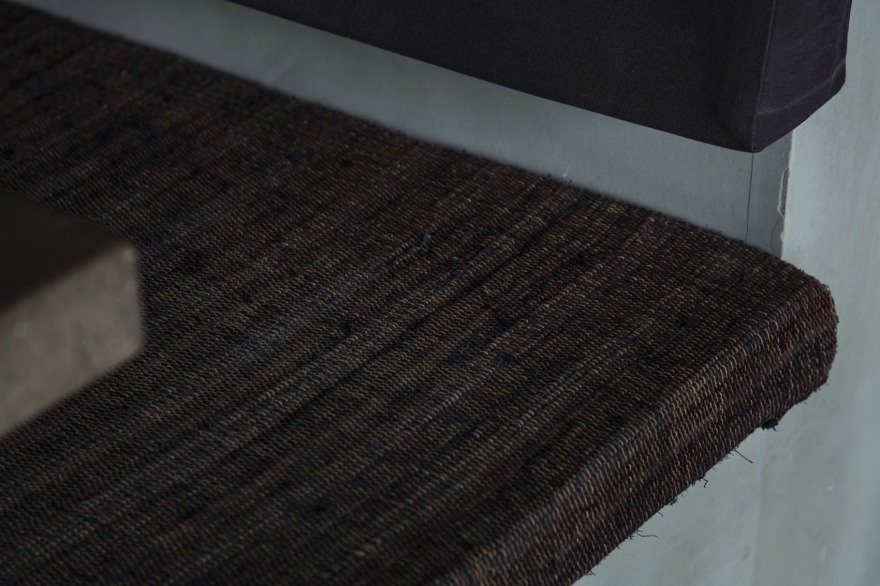
▼卡座一角,booth corner ©Kenta Hasegawa

和石膏桌配套的椅子由Martino Gamper设计,并在日本本地使用桧木制作,这些椅子在日本并不常见。他提供了设计图纸,设计师在日本制作了这些椅子。客户尤其希望使用这些椅子。考虑到运输成本和二氧化碳排放,建立一个设计师提供设计图纸、本地生产家具并将部分利润分配给设计师的系统,似乎比使用传统的家具分销系统(将欧洲制造的家具进口到日本)更为合适。
The chairs accompanying the plaster tables were designed by Martino Gamper, and are not commercially available in Japan. He shared his drawings, and we had them made in Japan using local hinoki wood. The client was particularly keen to use these chairs. Considering shipping costs and CO2 emissions, it would be better to create a system where a designer provides design drawings, furniture is produced locally, and some of the profits are distributed to the designer, rather than using the traditional furniture distribution system model where furniture is made in Europe and imported to Japan.
▼本地桧木制作的椅子,chairs using the local hinoki wood ©Kenta Hasegawa


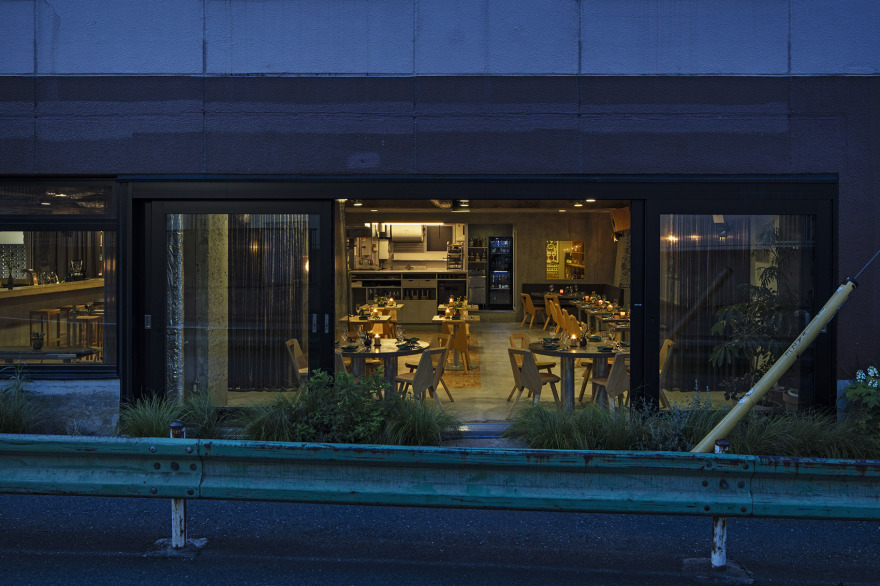
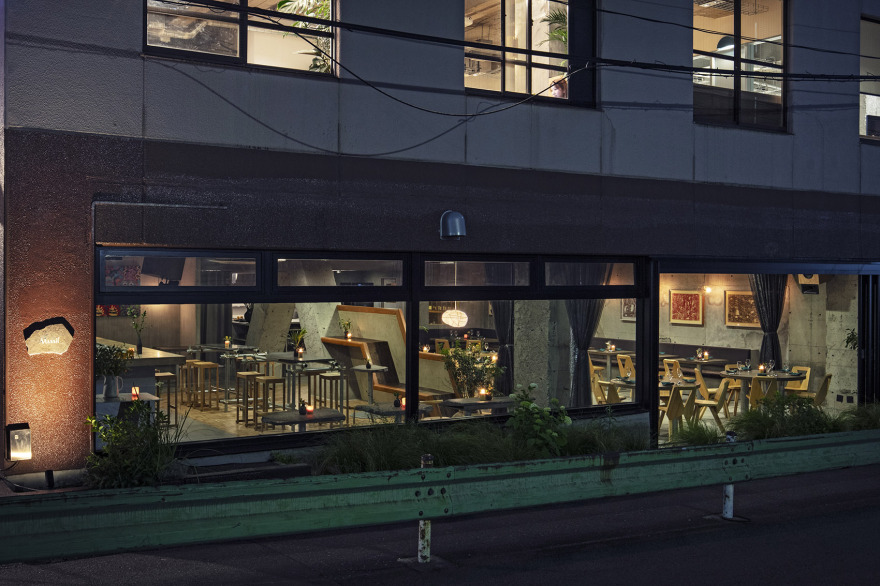
室内露台是项目中唯一涉及建筑设计的部分。客户希望能创造一个能让人感受到室外氛围的空间。设计师也常常觉得东京缺乏好的露台座位。考虑到这一点,设计扩大了朝街的外墙开口,安装了大面积可开启的推拉门。并安装了两个六人圆桌,并挂上了深灰色的欧根纱窗帘,以划分空间。通过开关窗帘,这个空间可以作为通透的室内露台,也可以作为半私密的餐厅使用。
The indoor terrace was the only part of the project that incorporated architectural moves. The client wanted us to create a space where one could feel the outside atmosphere inside. We also often feel the lack of good terrace seating in Tokyo. With this in mind, we enlarged the opening in the exterior wall facing the street and installed large openable sliding doors. We installed two round tables for six people and hung dark gray organza curtains to delineate the space. By opening and closing the curtains, the space can be used as an airy indoor terrace or as a semi-private dining room.
▼室内露台,the indoor terrace ©Kenta Hasegawa


▼用深灰色的欧根纱窗帘分隔开的空间,space divided by dark gray organza curtains ©Kenta Hasegawa

▼入口夜景,entrance at night ©Kenta Hasegawa

Client: Terrain / Massif
Location: Meguro-ku, Tokyo
Usage: Restaurant
Structure: Reinforced Concrete
Total site area: 222.87m²
Date of completion: September / 2023
Architects: DDAA
Project Team: Daisuke Motogi / Chihiro Bando / Yurika Mantoku / Riku Murai
Design Corperation: Keisuke Hatakenaka Architects Studio
Construction: Ishizue Column
VI・Sign Planning: Takahiro Yasuda (CEKAI)
Artwork: Kentaro Okawara / Kori Girard / Elijah Anderson / Bennet Schlesinger / Fumiko Atsukawa
Custom-made Lighting Production: STUDIO PREPA
Planting Design: Yard Works
Photo: Kenta Hasegawa
Editor/Writing Supervisor: Soyoka Tsuji
Translator: Kazuko Sakamoto


南京喵熊网络科技有限公司 苏ICP备18050492号-4知末 © 2018—2020 . All photos and trademark graphics are copyrighted by their owners.增值电信业务经营许可证(ICP)苏B2-20201444 苏公网安备 32011302321234号
苏公网安备 32011302321234号客服
消息
收藏
下载
最近