

创作上传
VIP
收藏下载
登录 | 注册有礼
查看完整案例

收藏

下载

分享
背景 Background
2019 年,Dimnikcobau 公司在卢布尔雅那的 Moste 工业区组织了一场国际竞赛,以设计 DCB 商务中心。最终获选的方案由巴塞罗那的 BAX 事务所提出,其设计超越了办公空间的功能性,将建筑转变为城市催化剂,为这一以商业和物流用地为主的郊区区域增添了价值。
In 2019, the Dimnikcobau company organized an international competition to design the DCB business centre in the Moste industrial zone of Ljubljana. The chosen project was conceived by the Barcelona studio BAX, and it transcends the building’s functional character as an office space turning it into an urban catalyst, adding value to this suburban area which is historically linked to generic spaces for business and logistics.
▼街景,street view© AnaSkobe

▼外观,exterior view© AnaSkobe

城市规划 Urbanism
该综合体由三座建筑组成,其中一座是现有建筑,另外两座为新建,彼此相对而立,坐落于 Leskoškova 街。建筑群通过对角斜切的造型形成正式的对话,并通过公共空间将其整合为整体。其中最高的建筑 —— DCB Montana,在第一阶段建设完成,同时在地面层设置了露台和花园,形成多个由绿色景观和蜿蜒长凳定义的微环境。
▼分析图,analysis diagram© BAX studio

The complex consists of three buildings, one of which already exists and two others which are newly built, situated facing each other on Leskoškova Street. The buildings integrate together through the use of diagonal chamfering which establishes a formal dialogue, and through the public space that integrates them as a whole. The tallest of the three, the DCB Montana, was built in a first phase along with an external area of after terraces and gardens on the ground floor that create various micro-environments defined by garden zones and serpentine benches.
▼地面层空间,ground floor space© AnaSkobe


建筑设计
Building
新建筑的空间布局紧凑,地面层呈菱形,并向上延伸 10 层,高度超过周围建筑,成为该区域的地标性建筑。地面层的对角错位布局,使人们可以进入中央门厅,该门厅由一个流线型的大中庭组成,并垂直向上延伸,最终在顶部以天窗收尾。中庭通过两个高达三层的大型玻璃窗与外界相连,这一雕塑般的设计赋予空间独特的视觉特征,使其能够从两个方向获得充足的自然光,并提供俯瞰城市轮廓与阿尔卑斯山区景色的露台视野。
▼分析图,analysis diagram© BAX studio

The compact space of the new building, with the ground floor shaped like a rhomboid and 10 floors above ground level, is taller than neighbouring buildings and dominates the landscape of the area. The diagonal displacement of the ground floor allows access to the central foyer consisting of a large atrium with a fluid shape and which goes up vertically to end in a skylight overhead. The atrium opens up to the exterior through two large windows that are the height of three levels and which add a sculptural character to the space, allowing it to be bathed in natural light from two sides, as well as allowing views of the city’s outline and the mountainous Alpine scenery from its terraces.
▼底层大堂,ground floor lobby© AnaSkobe

▼仰视楼梯,looking up to the staircase© AnaSkobe

功能布局
Programme
该建筑地上建筑面积为 12556 平方米,地下部分占地 8114 平方米,设有三层停车场。公共区域位于地面层,包括餐厅、咖啡馆、多个会议室以及一个多功能展厅,可用于举办各类活动。其余九层主要为办公空间和共享区域。中央中庭协调了人流动线,并最大化促进不同功能区之间的互动。每层设有四个可根据租户需求自由配置、组合或扩展的办公模块。
The building has an aboveground level surface area of 12,556 m and 8,114 m below ground occupied by three parking levels.
The public area is located on the ground floor: a restaurant, a café, various meeting rooms, and a multifunctional gallery that can be used to host different events.
On the remaining nine levels above, there are offices and common spaces.
The central atrium coordinates the flow of people and maximizes the interaction between the different programmes.
Each level has four office modules that can be configured, combined or extended according to the requirements of the tenants.
▼通高中庭,the atrium© AnaSkobe

▼俯瞰螺旋楼梯,overlooking the spiral-staircase© AnaSkobe

内外立面
Internalandexternalfacade
建筑的内外立面设计旨在弱化建筑体量,使其展现出轻盈与优雅的特质。外立面采用深色玻璃幕墙,并覆盖以不同角度倾斜、以不同节奏排列的白色遮阳板。室内部分则围绕中庭打造垂直门厅,并采用“L”型和“Y”型的镀金阳极氧化铝型材进行装饰,其色调会随着太阳的移动而变化。精细的空间处理、表面质感,以及对细节的敏感把控,使建筑在不同尺度上都呈现出高度的空间丰富性。
Both the covering of the interior and exterior facade seeks to dematerialize the volume mass by giving it a certain fragility and elegance. The exterior dark glass facade is covered with white brisesoleils sloping at different angles and placed at different progressions. While within the interior, the vertical foyer shaped around the atrium is covered with “L” and “Y” gilded anodized aluminium profiles whose tones change depending on the sun’s movements. The delicate treatment of the space and the surfaces, as well as the sensitive way that the detailing has been handled, have resulted in a building possessing high spatial richness at different scales.
▼室外立面,external facade© AnaSkobe
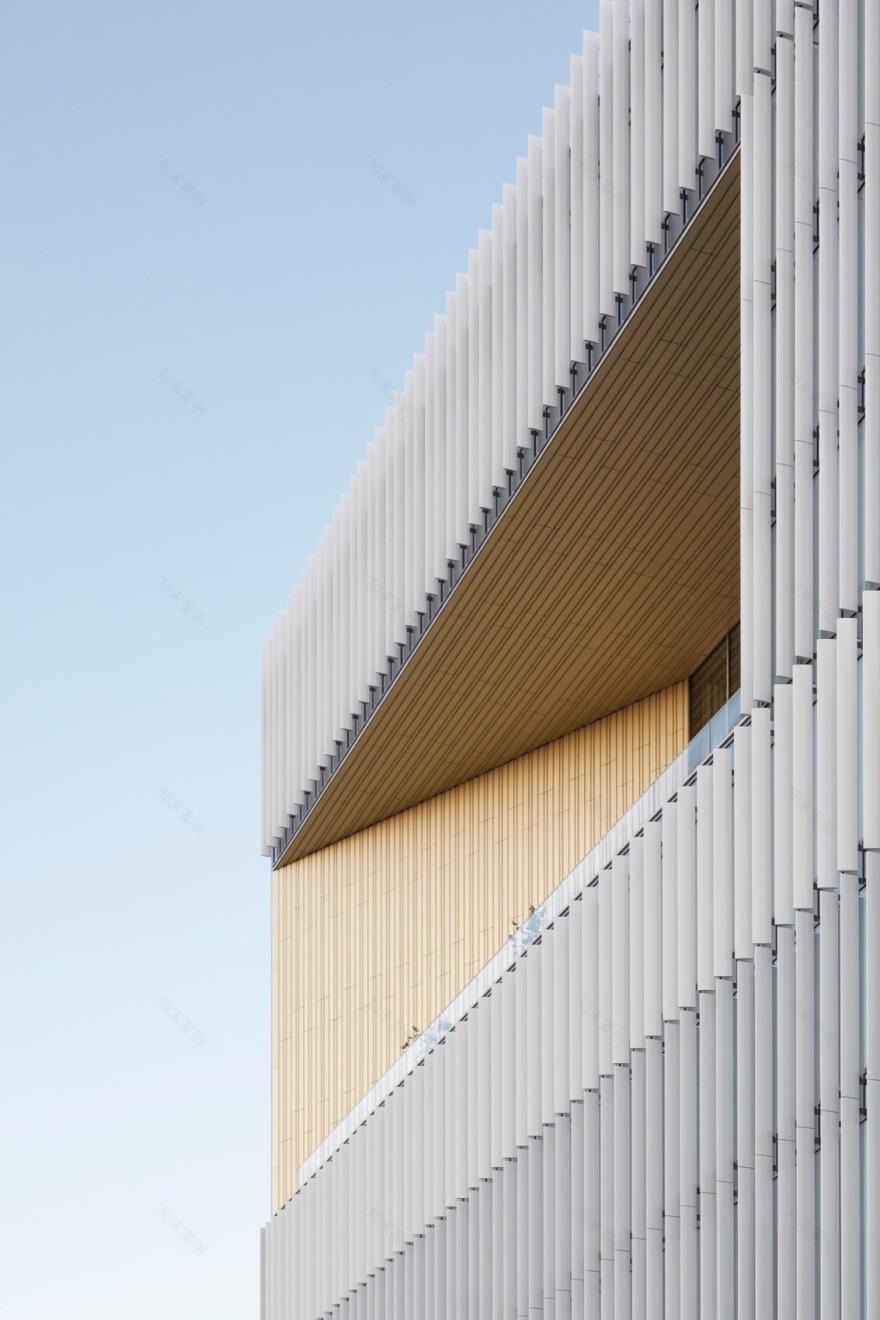
▼室内立面,internal facade© AnaSkobe

▼天窗,skylight© AnaSkobe

生物气候策略 Bioclimaticstrategy 贯穿建筑的中央中庭不仅是空间轴线,还承担着通风系统的核心功能。该空间作为办公区的回风管道,排出使用后的空气,并通过“烟囱效应”向上输送。中庭顶部配备先进的气候控制系统,可在空气循环前回收能量和湿度,并重新分配到各个办公区。办公区的空调系统结合了地暖与低位风机盘管系统,使温度控制更精准,并确保用户的最大舒适度。
The central atrium, which crosses the building vertically, not only functions as a spatial axis, but also as a key element of its ventilation system. This space acts as a return duct for ventilation of the offices, extracting used air and pushing it upwards like a chimney. At the top of the atrium, an advanced climatic control system recovers the energy and humidity in the air before redistributing fresh air throughout the offices. The air conditioning system for the offices combines underfloor heating and cooling with low-level individual fan coil units, which allows for accurate temperature control and guarantees maximum comfort for all users.
▼大面积的玻璃为中庭引入充足光线,large areas of glass bring in plenty of light to the atrium© AnaSkobe

环境认证 Environmentalcertification DCB Montana 自规划之初,就被设想为斯洛文尼亚首批可持续办公建筑之一。其紧凑型设计优化了能源效率,而外立面的遮阳结构、卓越的热绝缘性、充足的自然光照以及低水耗等被动与主动策略,确保了最低资源消耗。正因如此,该建筑荣获 DGNB 金级认证,并达到了 A1 能效评级,成为中欧可持续建筑的先锋之一。
From its inception, DCB Montana was planned as one of the first sustainable office buildings in Slovenia. Its compact design optimizes energy efficiency, while the different passive and active solutions – such as the shading elements on the external facade, excellent thermal insulation, abundance of natural light throughout all areas and low water consumption – guarantee minimum consumption of resources. These measures have earned it the DGNB Gold certification and an A1 energy rating, making it a leader of sustainable architecture in Central Europe.
▼办公空间,office area
© AnaSkobe
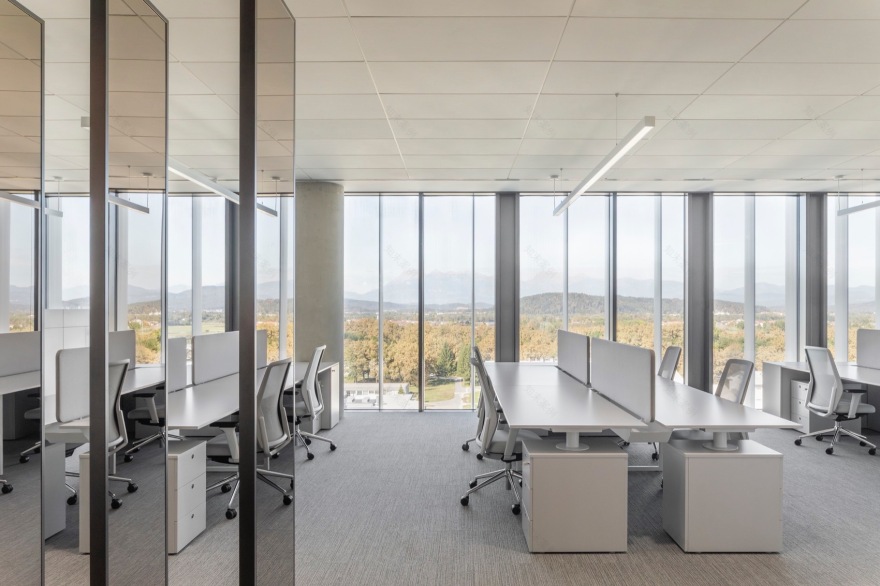
▼会议室,meeting room
© AnaSkobe

结构设计
Structure
该建筑结合了高质量的钢筋混凝土和钢结构。钢筋混凝土的使用使得建筑能够形成比常规建筑更大的体量,并通过减少内部柱子的需求来最大化室内空间的灵活性。在由两扇大窗户形成的露台部分,钢结构被策略性地用于跨越大跨度空间,从而营造出更加轻盈且优雅的建筑形式。
The building combines high-quality reinforced concrete and a steel structure. The use of reinforced concrete enables the creation of larger volumes than usual, maximizing the flexibility of internal spaces by eliminating the need for intermediate pillars. In the terraces formed by the two large windows within the volume, the steel structure has been strategically used to go above the large open spaces, thereby achieving a lighter and more elegant space.
▼露台,terrace© AnaSkobe


▼总平面图,plans© BAX studio

▼平面图,plans© BAX studio

▼剖面图,sections© BAX studio

Projectdata
Name: DCB Montana
Location: Leskovškovastreet, Ljubljana, Slovenia
Budget: Private
Build gross surface: 20.670sqm
International competition: 2019
Construction completion: September 2024
Architecture
Authors: BAX studio architectures.l.p.–Mónica Juvera, Boris Bežan
Collaborators: Ana Irisarri, Carlos Parra, Pere Molas, Bianca Maria Teti, Carmen Castañs, Jaka Bežan, Rafael Berengena, Raúl Escuin, David Rodríguez Meizoso, Ignacio Campos, Juan Mier, Álvaro Vilanova, Albert Rabinad.
Main external collaborators
Structure: Other structure, s.l.p., Protim Ržišnik Perc d.o.o
Electrical Installation: Protim Ržišnik Perc d.o.o.
Landscape architecture: Adkrajine, krajinskoarhitekturno projektiranje d.o.o.
Building permission plans: Šabec Kalan Šabec arhitekti
Fire consultant: Fojkar fire, d.o.o.
Kitchen consultant: PRO prima d.o.o.
Client
Project manager
Construction main contractor: CBE d.o.o.
Main subcontractors
Façade: Alukam d.o.o.
Interior façade: Alufinal d.o.o.
Steel structure: Bemija d.o.o.
Electrical: Zumtobel, Elcom d.o.o
Mechanical installations: Proins d.o.o.
Ceramic: Product–Atlas concorde, Dacomm storitve in trgovina d.o.o.
Ceilings and drywall and glass division walls: Alfa-M d.o.o.
Interior wooden and glass division walls: Markelj d.o.o.
Concrete prefabricated elements: Žurbiteam d.o.o.
Moving walls: Optimal, MFH d.o.o.
Curtains: Gregor Fujs
Equipment and glass division walls: Decor&Design d.o.o.

南京喵熊网络科技有限公司 苏ICP备18050492号-4知末 © 2018—2020 . All photos and trademark graphics are copyrighted by their owners.增值电信业务经营许可证(ICP)苏B2-20201444 苏公网安备 32011302321234号
苏公网安备 32011302321234号客服
消息
收藏
下载
最近