

创作上传
VIP
收藏下载
登录 | 注册有礼
查看完整案例

收藏

下载

分享
扎哈·哈迪德建筑事务所(ZHA)提出的“那不勒斯东门户”(Napoli Porta Est)总体规划方案荣获设计竞赛优胜,其核心目标是重连城市支离破碎的肌理。那不勒斯东部地区因城市肌理缺乏整合而与城市整体脱节,长期处于孤立状态,并被认为缺乏安全性。该片区公共空间匮乏,同时受到物理与心理上的屏障限制,阻碍了居民的出行和社交互动。
Reconnecting the city’s fragmented urban fabric is the primary objective of Zaha Hadid Architects’ (ZHA) Napoli Porta Est masterplan proposal named winner of the design competition. This area in the east of Naples suffers from the lack of integration of its urban fabric, resulting in the detachment from the rest of the city. Isolated and considered unsafe, the district’s inadequate public spaces, as well as its physical and psychological barriers, hinder mobility and social interaction.
该总体规划涵盖了那不勒斯东部受过去几十年重工业衰退影响最严重的区域,旨在推动城市废弃工业区的可持续复兴。方案不仅引入了可适应性基础设施,还规划了一座全新的城市公园,并将废弃的铁路调车场改造为公共空间,以促进城市更新和社会融合。扎哈·哈迪德建筑事务所的方案同时致力于缓解该区域主要交通枢纽的严重拥堵问题,该枢纽作为意大利国家交通网络的门户,具有重要战略地位。通过拆除废弃铁路调车场形成的屏障,总体规划释放了城市东部与那不勒斯历史中心重新连接的潜力。超过 30 公顷的废弃工业建筑,包括原曼尼法图拉·塔巴奇(Manifattura Tabacchi)烟草厂及费尔特里内利(Feltrinelli)工业区的老旧建筑,将被改造为适合城市居民使用的空间。
The masterplan encompasses the eastern areas of Naples specifically impacted by the decommissioning of its heavy industries over past decades. Encouraging the sustainable and resilient urban transformation of the city’s derelict industrial zone, the masterplan introduces infrastructure capable of adaptation, as well as the creation of a new urban park and the reclamation of the disused railway yards for public use. Resolving the significant traffic congestion at one of the city’s primary interchanges that serves as a gateway to the Italian national transport network, ZHA’s design unlocks the potential to reconnect the east of the city with the historic centre of Naples. Removing the barrier created by the redundant railyards, the masterplan enables the 30+ hectares of abandoned industrial buildings, including the former Manifattura Tabacchi factory and other derelict buildings in the Feltrinelli industrial zone, to be transformed for use by residents of the city.
▼总体鸟瞰,aerial view of the project©BrickVisual

此外,该方案还为城市提供了更广阔的未来发展机遇,规划将进一步改造占地 100 多公顷、已废弃的 Q8 石油库区,使其转变为一个全新的城市片区,并配备公共设施及市民空间,以满足当地社区的需求。
“那不勒斯东门户”总体规划国际设计竞赛由坎帕尼亚大区政府、那不勒斯市政府、意大利国家铁路公司(RFI)旗下城市更新部门 FS Sistemi Urbani,以及铁路运营商 EAV 联合主办。
ZHA’s proposal also offers additional opportunities for the city by enabling the future conversion of a further 100+ hectares of the district’s obsolete Q8 oil depot into a new city quarter with civic spaces and amenities for its local community. The Napoli Porta Est Masterplan international design competition was organised by the Campania Region together with Naples City Council, FS Sistemi Urbani (the regeneration group of RFI Italian national railways), and the train operator EAV.
▼那不勒斯东门户,Napoli Porta Est©BrickVisual

场地历史与背景
SITE HISTORY & CONTEXT
• 该项目基地位于那不勒斯东部城市边缘的工业区,原为一个铁路维护调车场,已被废弃和荒置数十年。目前,该地块正进行欧洲最大规模的城市更新项目之一(其规模可与伦敦国王十字开发项目相媲美,计划将 15 公顷土地归还城市)。
• 该项目将其中超过 10 公顷的土地改造为景观花园和广场,并与玛莎·施瓦茨(Martha Schwartz)合作设计为一座城市公园,公园内种植了该地区特有的本土树种。
• 整体规划旨在重新连接那不勒斯市内长期割裂的多个区域:中央商务区(Centro Direzionale)、火车站、Mercato 市场区以及东部工业区(Oriental Zone)。该设计以步行友好为核心,同时在地下设有多模式交通换乘枢纽,以提升城市连通性。
• 规划方案遵循那不勒斯既有城市发展框架,助力城市可持续发展,强化其作为意大利南部的市政、文化、经济及交通中心的地位,同时确保新建塔楼的高度符合既有城市总体规划的体量控制。
• 区域政府总部大楼的下层将设置公共功能区,包括会议中心、影院和商业空间,而塔楼部分则用于容纳区域政府办公室,为员工及访客提供办公和配套设施。
• 规划还包含一座新建的区域铁路车站、住宅开发项目,以及一座连接现有中央商务区(CBD)的步行桥,以进一步提升城市连通性。
• The site is a former maintenance railyard at the eastern edge of the city of Naples and its industrial zone. The site has been abandoned and derelict for decades and is currently one of Europe’s largest urban regeneration projects. (Similar in scale to the King Cross development in London with 15ha of land to be given back to the city.)
• The project transforms over 10ha of this land into landscaped gardens and plazas designed in collaboration with Martha Schwartz as an urban park planted with trees native to the region.
• The overall masterplan reconnects several neighbouring zones of the City of Naples which have been developed as disparate, isolated areas over past decades: the Centro Direzionale (CBD), the station, the Mercato and the Oriental Zone, with a design that prioritises pedestrians and a multi-modal transport interchange below ground.
• Defining its design, the masterplan follows the established urban plan of Naples to promote the city’s sustainable future as the civic, cultural, economic and transport centre of southern Italy, incorporating tower heights within the existing urban plan’s overall massing.
• The lower level of the new Regional Headquarters houses public functions such as a conference centre, cinema and commercial zones while the towers will house the Regional Government Offices providing facilities for the employees and visitors.
• The site also comprises a new regional rail station, together with a residential development and a pedestrian bridge connecting to the existing Centro Direzionale (CBD).
▼项目基地位于那不勒斯东部城市边缘的工业区,the site is a former maintenance railyard at the eastern edge of the city of Naples and its industrial zone©BrickVisual

建筑设计
ARCHITECTURAL DESIGN
•新增城市绿地:打造公共花园与大型城市公园,为城市提供更多绿色空间。
•城市连通性:整合绿化步道,引导行人从波塔诺拉纳(Porta Nolana)步行至中央火车站及新公园,并提出通过步行桥连接中央商务区(Centro Direzionale)及其新地铁站的方案。
• New green spaces for the city with the creation of public gardens and large park.
• Urban connections incorporating greenery and walkways guiding pedestrian traffic from Porta Nolana to the Central Station and the new park including a proposal for a connection via a pedestrian walkway with the Centro Direzionale and its New Metro Station.
▼坎帕尼亚大区政府新总部,thenew Headquarters of the Campania Region ©BrickVisual

坎帕尼亚大区政府新总部
•可达性:设计为包容性、无障碍的市民中心。
•能源性能:紧凑的塔楼形态提升能源效率,减少建筑占地面积,释放更多公共绿地。
•与自然元素的互动:建筑外立面优化自然元素的利用,包括光照、风向及景观视野,实现优越的热隔离效果,减少太阳辐射与眩光,同时确保壮丽的那不勒斯湾、维苏威火山及周边山丘的景观视野。
•优化自然采光:立面设计充分考虑太阳运动轨迹,最大化北向开口以引入自然光并提升景观视野,同时减少其他朝向的直接日晒,降低建筑的能耗需求。优化室内自然光水平可有效减少人工照明能耗,这是当代办公建筑最大的能源消耗来源之一。建筑核心筒置于中央,以避免深进深平面,提升自然光的利用效率。同时,采用光谱选择性玻璃减少太阳热增益和眩光。
•生物气候设计:通过自然通风、绿色屋顶及被动式系统提升能源效率和可持续性。
•可持续性与安全性:建筑具备高抗震性能,采用可持续资源管理,并符合 CAM(最低环境影响标准)和 DNSH(不对环境造成重大损害)原则。
•混合结构体系:采用本地供应的混凝土与钢结构混合建造方式,确保施工成本与时间的精准控制,同时提供最佳的结构性能与灵活性。
•施工阶段:工程分阶段进行,使已完工区域能立即投入使用,确保施工过程的高效性。
•动态与灵活性:总部大楼被设计为高效的工作场所,同时具备适应未来需求的能力,成为包容性的城市中心。
•建筑与景观融合:新总部大楼由林荫广场环绕,并与新城市公园直接相连,建筑自然地从绿地中生长而出,消弭景观与建筑之间的边界,使城市的都市肌理与自然环境重新连接。
▼室内概览,interior view© Felix Render

The new Headquarters of the Campania Region:
o Accessibility: Designed as an inclusive and accessible civic hub.
o Energy Performance: The compact shape of the towers improves energy efficiency, reducing the footprint and creating more public green spaces.
o Interaction with natural elements: The envelope optimises natural elements — light, wind and panoramic views — ensuring excellent thermal insulation, reducing solar load and glare, without compromising the spectacular views of the Gulf of Naples, Vesuvius and the surrounding hills.
o Optimising natural light: The façade design takes into account the movement of the sun throughout the day: north-facing openings are maximised to allow natural light to enter the buildings and enhance the views, while direct sun exposure is minimised on other façades of the buildings to reduce energy requirements. Optimising natural light levels in interior spaces reduces the energy demand for artificial lighting, which is one of the largest energy consumers in contemporary office buildings. Placing the core at the centre of the buildings limits deep floor plans to enhance the effectiveness of the natural light, while spectrally selective glazing reduces solar hear gain and glare.
o Bioclimatic solutions: Natural ventilation, green roofs and passive systems to ensure energy efficiency and sustainability.
o Sustainability and safety: High seismic performance, sustainable resource management, CAM and DNSH compliance.
o Hybrid construction system: The construction system will be hybrid concrete/steel from local suppliers, ensuring accurate control of construction costs and times, and above all will guarantee the best performance and flexibility.
o Construction Phases: Construction is divided into phases to allow for immediate use of the completed areas, ensuring efficiency throughout the process.
o Dynamic and flexible hub: The HQ is designed to be a highly functional workplace and an inclusive center capable of adapting to future needs.
o The new HQ of the Campania Region is framed by tree-lined squares leading to the new urban park. The architecture emerges from the green areas without interruption, blurring the transition between landscape and architecture to reconnect the city’s urbanism with nature.
▼塔楼顶层花园,top floor garden© ZHA

可持续性
SUSTAINABILITY
步行友好街区:通过步行化改造,使当地社区和商业区域重新连接至目前被城市肌理割裂的历史中心。
生物多样化景观:广泛种植植被,以降低洪水风险,并营造舒适的小气候,提升步行体验。
7,000 平方米光伏系统:安装于屋顶及遮阳结构上,以提供可再生能源。
气候适应性总体规划:
- 采用循环再生水进行植被灌溉,减少 60%的自来水消耗。
- 充分利用本地地热能源供应。
- 设计“海绵城市”公共空间,增强雨水吸收能力,防止城市内涝。
- 通过被动式设计缓解城市热岛效应。
气候适应性建筑:
- 符合 A 级标准的近零能耗建筑(NZEB)。
- 力求达到 LEED 铂金级认证(适用于塔楼)。
- 采用生物气候外立面设计,降低玻璃比例,实现自遮阳效果,并优化自然通风。
- 塔楼采用轻量化结构及外立面,减少建筑材料的碳足迹。
• Pedestrianized neighborhood to reconnect local communities and businesses with the historic centre that are currently separated from the city’s urban fabric.
• Biodiverse landscape with extensive vegetation to reduce flood risk and promote walkability within a comfortable microclimate.
• 7,000 m² photovoltaic system on roofs and canopies
• Climate resilient masterplan:
o Using recycled water to maintain vegetation and reduce potable water consumption by 60%.
o Substantial use of local geothermal energy supply.
o ‘Sponge city’ public spaces that absorb water to avoid flooding.
o Mitigating urban heat island effects through passive design.
• Climate resilient architecture:
o Standard Class A NZEB.
o LEED Platinum target for towers.
o Bioclimatic façade design with a reduced ratio of glass surfaces enabling selfshading and natural ventilation.
o Lightweight structure and façade for towers to reduce embodied carbon.
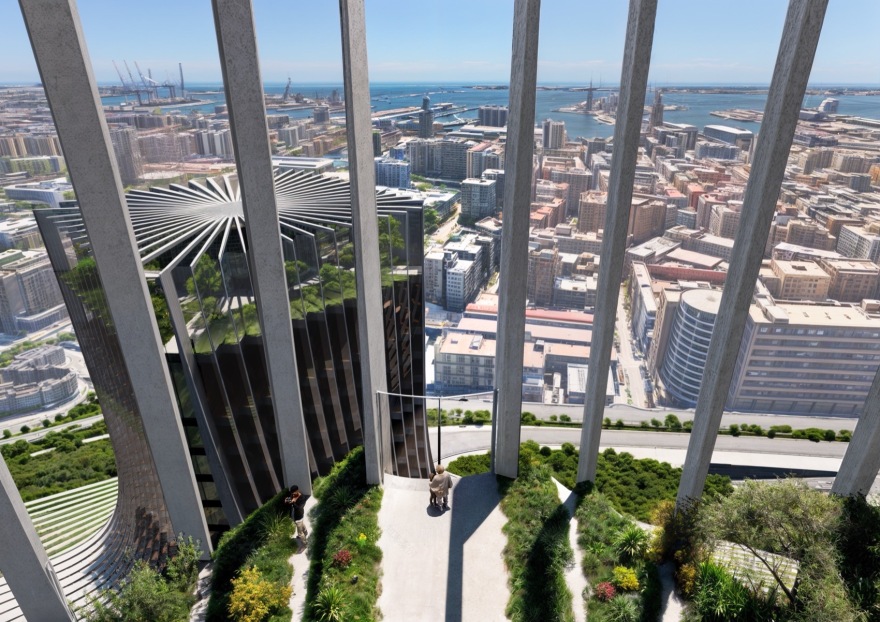
▼由塔楼顶部花园看那不勒斯东部海岸,view of the eastern coast of Naples from the top garden of the tower© ZHA
Project Team
Project credits: Zaha Hadid Architects (Architecture and Masterplanning)
Responsible Director: Michele Pasca di Magliano
Director (rail & TOD): Filippo Innocenti
Design Director: Maria Tsironi
Project Associates: Andrea Balducci Caste, Cristina Barrios Cabrera, Domenico Di Francesco, Torsten Broeder, Vincenzo Barilari
Design Team: Bechara Malkoun, Cemre Demirci, Cherry Lee, Ghanem Younes, Hanadi Izzuddin, Haoyue Zhang, HyunJin Kim, Irfan Bhakrani, Martina Rosati, Olivia Dolan, Sera Su Abac, Yaseen Bhatti, Jing Xu
Workplace Analitics: Uli Blum, Lorena Espaillat Bencosme, Danial Haziq Hamdan, Christoph Geiger
Sustainability: Abhilash Menon, Aditya Ambare, Bahaa Alnassrallah, Disha Shett
Acquisitions: Marcella Fedele
Consultants
Local Architect: Barracco Smith
Structural and Civil Engineering: Interpogetti SRL
M&E Engineering: Macchiaroli & Partners
Landscape Design: Martha Schwartz Partners
Artist and Lighting Design: Jason Bruges Studio
Cost Consultant: BC Consulting
Traffic and Urban Mobility: MiC-HUB
Safety in construction: Gianni Artuso
Archeologo: Viviana Mancusi
Economista: Prof. Massimo Marrelli
南京喵熊网络科技有限公司 苏ICP备18050492号-4知末 © 2018—2020 . All photos and trademark graphics are copyrighted by their owners.增值电信业务经营许可证(ICP)苏B2-20201444 苏公网安备 32011302321234号
苏公网安备 32011302321234号客服
消息
收藏
下载
最近