

创作上传
VIP
收藏下载
登录 | 注册有礼
查看完整案例

收藏

下载

分享
这是一个关于“常磐食堂(ときわ食堂)”新餐厅的室内设计项目。常磐食堂是一家拥有百年历史的老字号食堂,本次设计的核心在于“暖簾”——这一传统的日式门帘,希望在延续百年传统的同时,塑造适用于未来百年的全新空间体验。
This is an interior design project for a new restaurant of “Tokiwa Shokudo”, a long-established diner that has been in business for 100 years. We focused on the “noren,” a traditional blind curtain, to create a new look for the next 100 years while preserving 100 years of tradition.
▼餐厅外观,exterior of the restaurant ©Naomichi Sode

▼室内概览,overview of the restaurant ©Naomichi Sode

暖簾最初用于门口和出口处,以遮挡阳光或保护隐私。这一独特的日本文化元素大约在镰仓时代开始融入家徽等图案,逐渐具备了“媒介”功能。如今,暖簾已成为店铺营业中的普遍象征,顾客看到暖簾便能辨识店铺是否营业。此外,日语中有“守护暖簾(のれんを守る)”的说法,意为维护店铺的信誉和传统,可见暖簾对于经营者而言,已成为一种承载时间与信念的象征。因此,我们希望在本次室内设计中,通过引入暖簾元素,展现其作为物件的独特魅力。
▼轴测图,axonometric ©UENOA

Originally installed at entrances and exits to block sunlight or to shield people’s eyes from the sun, the noren, which is a uniquely Japanese cultural element, began to incorporate unique designs such as family crests around the Kamakura period and began to function as a “media”. The noren has become a common recognition among Japanese people that it is a sign that a store is open for business, and as the phrase “noren wo mamoru” (“to protect goodwill”) suggests, it has become a special presence that includes time for those who are in the business of doing business. In this way, the noren displayed in front of the storefront is a symbol with multiple meanings, and we wanted to bring out the charm of the noren as an object by incorporating it into the interior design.
▼悬挂在天花上的暖簾,the “noren” hang from the ceiling ©Naomichi Sode

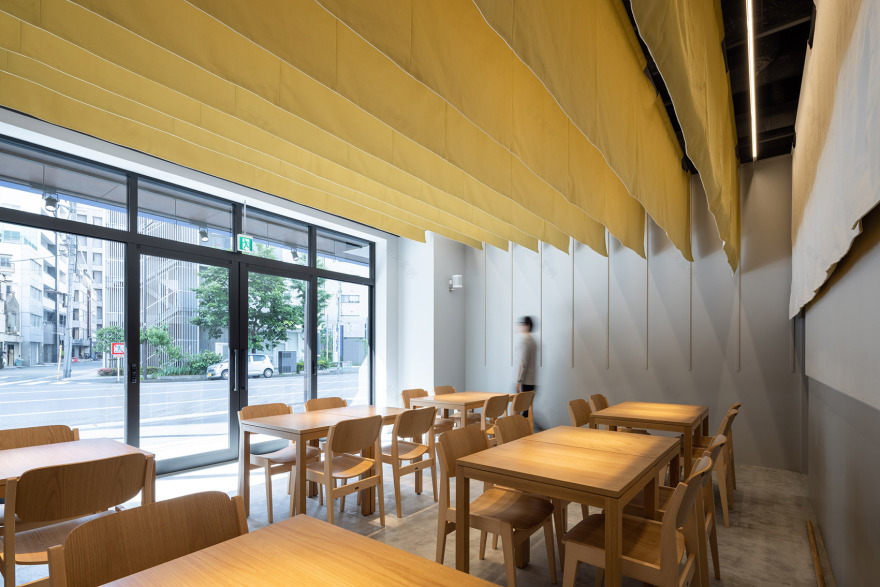
餐厅的座席区悬挂着十片大型暖簾,层层相叠,营造丰富的空间感。通常,暖簾采用11号帆布制成,而此次设计选用了更厚的8号帆布,并以袋状缝制,使其更加厚重。单片暖簾尺寸达6米宽,柔软且富有重量感,轻触时会随之摇曳,形成独特的动感体验。此外,暖簾的正反两面采用不同颜色的帆布,并且随着位置向后延展,每片的长度逐渐增加。这种设计使得从街道进入餐厅、在店内用餐,乃至用餐结束离开时,都会对空间产生不同的视觉感受。
▼模型,model ©UENOA
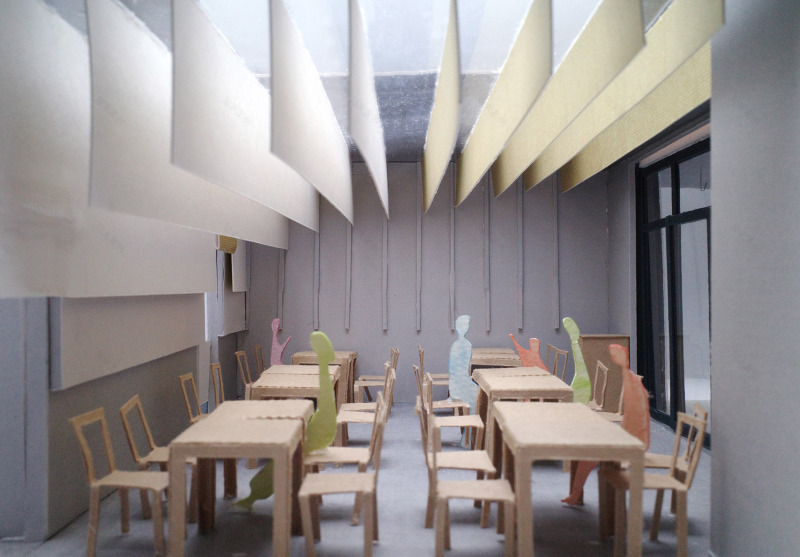
Ten large “noren” curtains are hung in a series of layers in the seating area. While a typical noren is made of No. 11 canvas, the curtains used for the interior are made of thicker No. 8 canvas, sewn together in a bag-like shape, and are very large and heavy, measuring 6 meters wide. These curtains are soft, yet have a sense of weight, and move when touched.
The front and back sides of the curtain are made of different colors of canvas, and the length of each side increases as one moves toward the back. The length of each side is longer the further back you go. This gives a different impression when you stop by the restaurant from the street and when you take a seat or leave the restaurant after finishing your meal.
▼餐厅的座席区悬挂着十片大型暖簾,
Ten large “noren” curtains are hung in a series of layers in the seating area ©Naomichi Sode


餐饮空间通常是固定的背景,但通过暖簾的应用,我们希望打破传统墙面的僵硬与静止,创造一种更为放松、富有层次感的空间体验。当人们移动时,暖簾会随之缓缓摆动,使空间氛围更加柔和。
The intention was to create a sense of space in the dining area, which tends to be a fixed background for dining. Unlike the hard, immobile wall surface, the noren, which sways slowly when people actually move, is used to create a more relaxed atmosphere.
▼更为放松、富有层次感的空间体验,
create a more relaxed atmosphere ©Naomichi Sode
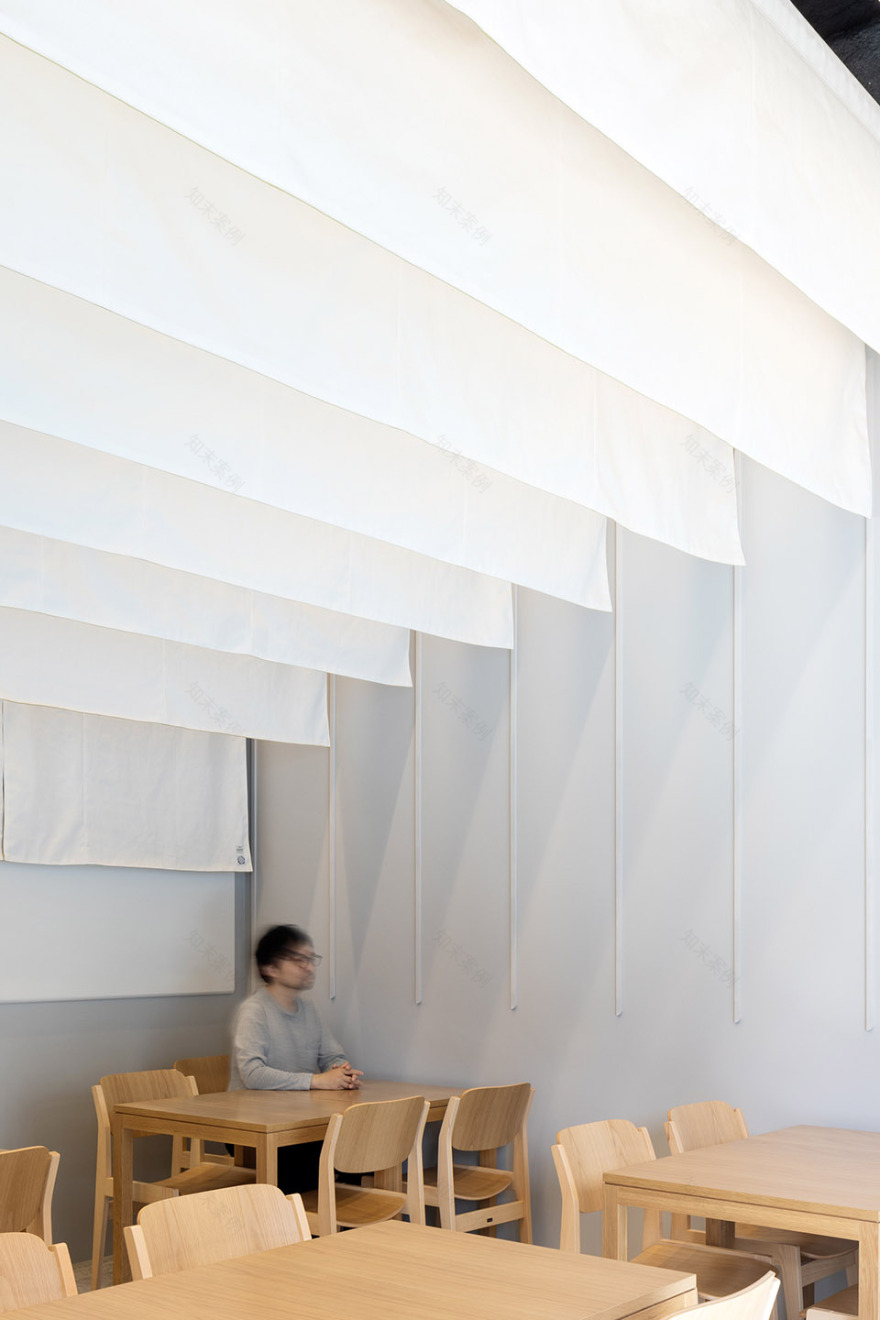


▼细部,detail ©Naomichi Sode


在尊重暖簾传统的同时,我们尝试让其与建筑和室内设计建立新的关系。最终,我们认为这次设计成功地通过暖簾诠释了店铺的理念——“以日本文化丰富日常生活”,让暖簾成为连接传统与未来的媒介。
While respecting the tradition of the noren, we attempted to create a relationship between the noren and the architecture and interior design. We feel that we were able to embody the store’s philosophy of “enriching daily life through Japanese culture” through Noren.
▼平面图,plan ©UENOA

▼概念示意,concept ©UENOA

Project Name:Restaurants in Bakurocho
Architect or Architecture Firm:UENOA architects / Yoshinori Hasegawa+Fumie Horikoshi
Completion Year:2022
Built Area:70.41 m²
Project Location:Tokyo,Japan
Photographer:Naomichi Sode(architecture),UENOA(model)
Logo design:ido Shouhei Iida
Lighting design:ModuleX Katsumasa Asada
Cooperation:Kurashikihampu

南京喵熊网络科技有限公司 苏ICP备18050492号-4知末 © 2018—2020 . All photos and trademark graphics are copyrighted by their owners.增值电信业务经营许可证(ICP)苏B2-20201444 苏公网安备 32011302321234号
苏公网安备 32011302321234号客服
消息
收藏
下载
最近