

创作上传
VIP
收藏下载
登录 | 注册有礼
查看完整案例

收藏

下载

分享
设计概念
Concept
“一个既承载亚洲温暖与轻盈感,又能融入墨尔本在地文化的家。”坐落于墨尔本东南部繁忙的郊区,茶屋旨在为四口之家打造一个充满舒适感、文化联结与熟悉感的居住空间。
‘A home that reflects Asian warmth and lightness while integrating Melbourne’s local context.’ Set in the busy south-east suburb of Melbourne, the ‘Tea House’ hoped to capture comfort, cultural connection and a sense of familiarity for a family of four.
▼住宅概览,overview of the house©Peter Bennetts Studio

设计对于概念与说明的回应
Design Response to Concept and Brief
业主对东方建筑的热爱,引导了设计在传统与现代之间的平衡。每一处细节与材质皆营造出静谧氛围,让住宅沉浸在一种宁静不被打扰的环境中。厚重的砖石基座形成稳固的地面层,与轻盈的木质格栅立面形成对比,使房屋如同一盏温暖的灯笼。大面积木质推拉门引导人步入室内,深色砖墙的运用进一步强化了内外空间的连续性,营造沉浸式居住体验。茶室被置于住宅前方,重新演绎传统门廊概念。家人可以在晨光中品茶,延续东方生活的仪式感。▼平面图,plan©Krisna Cheung Architects

The client’s passion for oriental architecture guides the balance of tradition and modernity. Each element and material instill tranquility, enveloping the home in an undisturbed atmosphere. A heavy masonry brick on the ground floor contrasts with a lightweight timber batten façade above, creating a lantern effect. Large timber doors lead inside, where dark brick walls invert the outdoor experience, emphasizing continuity. The tearoom, positioned at the front, reinterprets the traditional porch, where the family can enjoy morning sunlight while sipping tea—a homage to timeless rituals.
▼住宅入口,entrance of the house©Peter Bennetts Studio
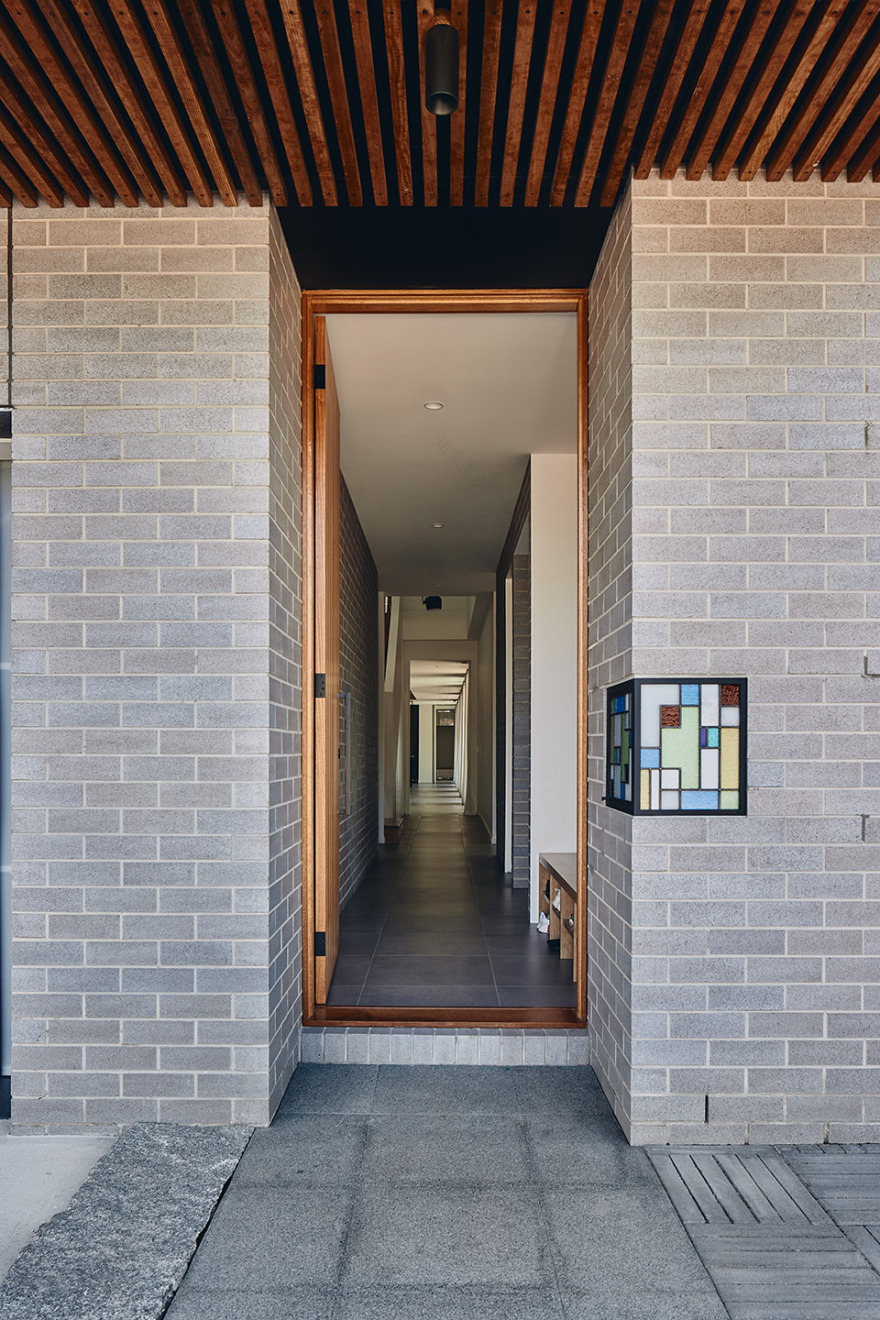
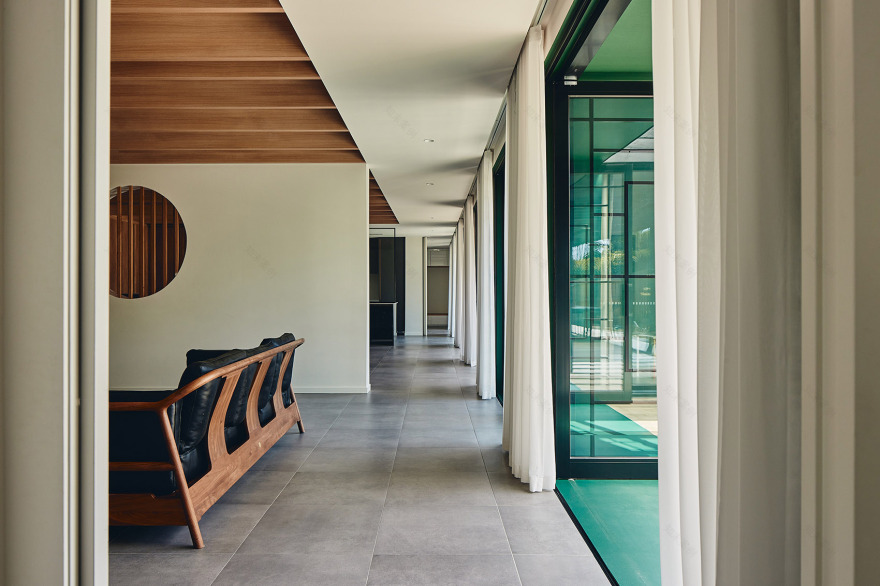
▼走廊,corridor©Peter Bennetts Studio
▼露台,outdoor decking©Peter Bennetts Studio

应对场地限制
Response to Constraints
与周边密集的都市环境形成对比,茶屋提供了一处宁静的居住空间。同时,设计并未与周围割裂,而是通过本地材料和文化元素的融合,使建筑与环境相协调。Monier Nullarbor 赤陶屋瓦的使用回应绿墨尔本本地的建筑风格。AustralBrick 金属质感砖为建筑提供质感与深度。Cambia Ash木格栅形成的半透明立面,则增强了光影效果。
Contrasting the suburb’s chaotic density, the house offers spaces of calm. However, the materiality seeks to describe its context, blending cultural nuances with local influences through locally sourced materials like Monier Nullarbor Terracotta Roof Tiles, Austral Brick Metallic Platinum Bricks, and Cambia Ash Timber Battens.
▼本地材料和文化元素的融合,blending cultural nuances with local influences ©Peter Bennetts Studio

祖父母居住的区域既要保证私密性,又要与其他家庭成员联系联系。该区域位于住宅后方,结合墨尔本“祖母房(granny flat)”概念,适应多代同堂的居住模式。通过中央廊道连接主屋,使祖父母拥有独立空间的同时,与家庭紧密联系联系。
The grandparents’ retreat required balancing separation with accessibility while avoiding isolation. Positioned at the rear, it integrates Melbourne’s granny flat with multigenerational design. A central hallway, acting as the spine, links the retreat to the main house, allowing the grandparents their own space while keeping them connected to the family.
▼厨房区域,kitchen area©Peter Bennetts Studio
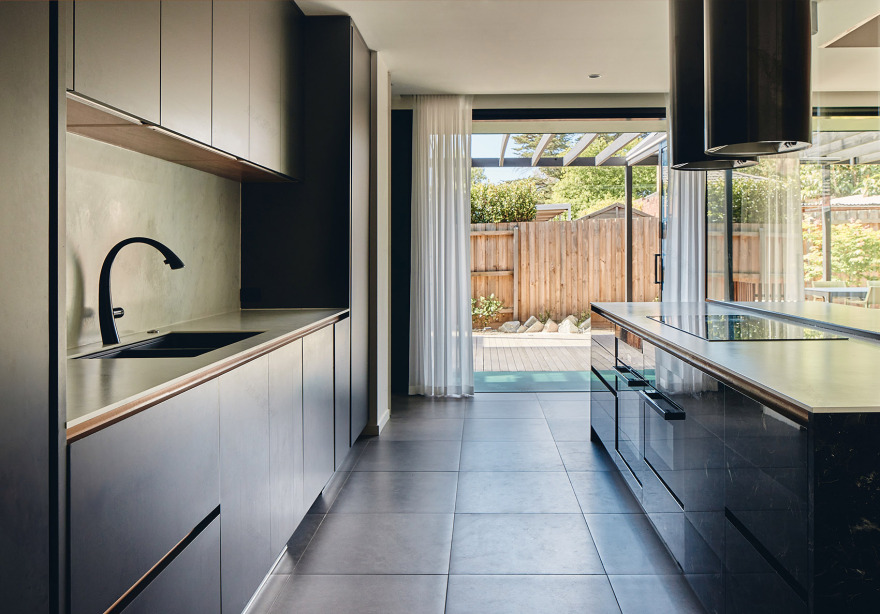
融入环境:共享共享与互动互动
Relationship to Context and Broader Public Benefit
茶屋扎根于场地,同时如灯笼般漂浮于环境之中,木质格栅外立面映照四周。设计不仅关注业主需求,更意在回应墨尔本的多元文化背景。借鉴并尊重周围住宅的屋顶形式与材料,在传承与创新之间找到平衡。
The Tea House roots itself in place while appearing to float like a lantern, its timber batten façade illuminating the surroundings. The design isn’t only about the clients; it is about the local context. It blends cultural influences with the local context, supplementing Melbourne’s multicultural identity. We considered the roof forms and materials of the surrounding dwellings, taking cues from and complementing the context.
▼茶室,tea house©Peter Bennetts Studio

建筑通过形态上的推拉,创造多个私密的户外角落,并以木质屏风限制邻近视线。开放式屋顶提供广阔的天空视野,墙面开窗巧妙框景,让住宅与街区、城市景观交融。作为家庭与社区的交汇点,庭院不仅能促进家庭成员之间的互动,也为潜在租户提供共享空间。这一设计顺应了多代同堂的趋势,提出了一种灵活适应郊区住宅的居住模型,契合未来城市住宅的发展方向。
Outdoor nooks created from architectural push and pull prioritize privacy with timber screens limiting adjacent views. An open roof design offers an expansive sky, while façade punctures frame glimpses of the streetscape and cityscape beyond, integrating it into the home. A shared courtyard serves as a meeting point, strengthening connections among extended families or potential tenants. Reflecting trends toward multi-generational living, this flexible design model is adaptable to suburban settings and addresses evolving housing needs.
▼从室内望向庭院,from the indoor space to the courtyard©Peter Bennetts Studio

可持续性
Sustainability
我们对可持续发展的承诺体现在对当地材料的使用上,以减少对环境的影响并支持当地经济。朝北的木板条提供遮阳效果,提高了保温性能和私密性,而传统的瓦片屋顶则提供了隔热效果,提高了能源效率。大型绿色防护门和电动窗优化了交叉通风,减少了对机械制冷的依赖,促进了节能。
Our commitment to sustainability is reflected in the use of locally sourced materials, reducing environmental impact and supportinglocal economies. North-oriented timber battens provide sun shading for thermal performance and privacy, while the traditional tiled roofoffers insulation, enhancing energy efficiency. Large green shrouded doors and motorized windows optimize cross ventilation, reducing reliance on mechanical cooling and promoting energy conservation.
▼夜景,night view©Peter Bennetts Studio

通过将前门和圆形墙壁开口沿着连接房间的轴线排列,实现了空间的连续性和正能量流动。这些设计选择遵循了风水原则,为房屋增添了和谐与平衡,尊重了传统,为家庭带来了宁静、联系和归属感。
Spatial continuity and positive energy flow is achieved by aligning the front entry door and a circular wall opening along an axis that connects rooms. These design choices follow Feng Shui principles, adding harmony and balance to the house, honouring tradition, offering a sense of peace, connection, and belonging for the family.
▼夜景,night view©Peter Bennetts Studio

▼草图及模型,sketch and model©Krisna Cheung Architects

▼场地平面,site plan©Krisna Cheung Architects

▼立面及剖面细部,elevation and section detail©Krisna Cheung Architects
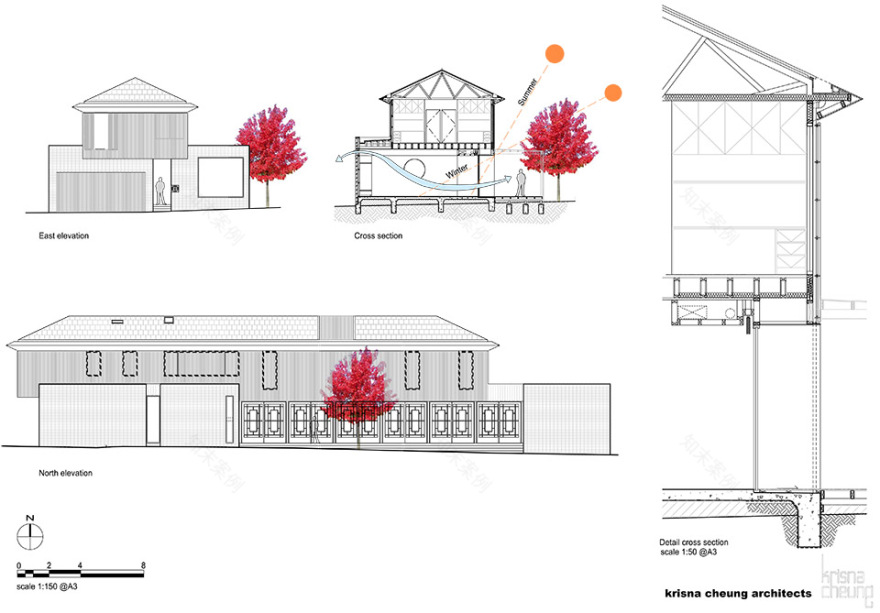
▼细部,detail©Krisna Cheung Architects

Project Name: Tea House
Project Location: Glen Iris, Melbourne, Australia 3146
Architect office Name: Krisna Cheung Architects
Social Media Accounts: Krisna Cheung Studio (Instagram)
Architect firm Location: 29 Erskine Street, North Melbourne Victoria. Australia 3051
Completion Year for Tea House: 2023
Gross Built Area (m2/): 720sqm
Program / Use / Building Function: A new double storey residential dwelling
Lead Architects:
Design & Project Architect: Ray Cheung
Graduate of Architecture: Welan Chu
Student of Architects: Stewart Wu & De Lester Wong
Photographer
Photo Credits: Peter Bennetts Studio
南京喵熊网络科技有限公司 苏ICP备18050492号-4知末 © 2018—2020 . All photos and trademark graphics are copyrighted by their owners.增值电信业务经营许可证(ICP)苏B2-20201444 苏公网安备 32011302321234号
苏公网安备 32011302321234号客服
消息
收藏
下载
最近