

创作上传
VIP
收藏下载
登录 | 注册有礼
查看完整案例

收藏

下载

分享
出品人:向玲 / Producer: Xiang Ling
编辑:石安,亓慧、庞任飞,张笑然、高天旗 / Editor: Shi An, Qi Hui, Pang Renfei, Zhang Xiaoran, Gao Tianqi
___________
“冶是”与“冶世”
About YEAS
“‘冶’既有‘锻造’‘锤炼’的意味,同时也象征着‘美丽’。‘是’则代表了顺其自然,轻松愉快。”
“’冶’carries the connotations of ‘forging’ and ‘refinement,’ while also symbolizing ‘beauty.’‘是’ represents going with the flow, effortlessly and joyfully.”
周渐佳:“冶是”是我和丹锋从美国留学归国后创立的。当时,我完成了库珀联盟的硕士课程,而丹锋则刚结束在哥伦比亚大学的访学。回国后,我们满怀热情与期许,觉得与其遵循传统职业路径,不如尝试做一些属于自己的事情。可以说,“冶是”是在一种冲动和憧憬下诞生的。“冶”来源于《园冶》,我们非常喜欢这个字的寓意:既有“锻造”“锤炼”的意味,同时也象征着“美丽”。于是决定用这个字作为工作室名字的核心。而“是”则相对轻松一些,选取的是“是不是”的“是”,顺其自然,轻松愉快。英文名“yeas”则完全是一个巧合,是缩写也是谐音。
另一个品牌“冶世”和我们这几年经历的变化有关。一是我们的兴趣和能力,研究和表达一直是我们很重视但是在传统行业划分中不太有人专注去做的部分,所以一开始真是被兴趣驱动,不问回报地去做。二是多多少少预见到了建筑设计需求的萎缩,那么有没有可能把自己的擅长和兴趣变成一个新的赛道?大概是从2022年开始,我们开始重新思考公司的方向,有意识地“两条腿走路”,把一些看似和建筑设计关联度低的泛设计业务从原有的冶是建筑架构中剥离出来,尝试新的模式。取名“冶世”是希望用“世”表达一种开放、包容的态度,以及面向更大世界的决心。
▼冶是设计logo,logo of YEAS© YEAS
0

0
Zhou Jianjia: “YEAS” (冶是) was founded by me and Danfeng after we returned to China from studying in the United States. I had just completed my master’s program at Cooper Union, and Danfeng had finished an exchange program at Columbia University. After coming back, we were filled with enthusiasm and aspirations. Instead of following the traditional career path, we decided to try something of our own. In a way, “YEAS” was born out of a mix of impulsiveness and hope.
The word “冶” comes from The Craft of Gardens (《园冶》), and we love its layered meanings: it carries the connotations of “forging” and “refinement,” while also symbolizing “beauty.” We decided to make it the core of our studio’s name. The word “是” (meaning “is”) was a more casual choice—lighthearted and natural, conveying a sense of ease and joy. The English name “YEAS” was a happy coincidence, serving both as an abbreviation and a phonetic echo.
Our second brand, “冶世” (also YEAS), emerged from the changes we’ve experienced in recent years. First, our interests and capabilities have evolved. Research and expression have always been important to us, yet these areas are often overlooked in the traditional architecture industry. Initially, our efforts in this space were purely driven by passion, with little regard for returns. Second, we foresaw a decline in demand for architectural design and began to wonder: could we transform our skills and interests into a new path?
Around 2022, we started rethinking the direction of our company, consciously adopting a “two - track approach.” We began separating broader design - related activities that seemed less tied to architectural design from the original YEAS framework, experimenting with new models. The name “冶世” reflects our aspiration to embrace openness and inclusivity, as well as our determination to engage with a larger world.
▼冶是设计办公室环境,YEAS Studio © YEAS

判断和应对能力帮助我们在不断变化的需求中找到自己的节奏和特色。
“These instincts and adaptive capabilities have helped us carve out our rhythm and identity in a landscape of ever-changingdemands.”
李丹锋:目前“冶是”包含了“冶是建筑”和“冶世文化科技”,前者专注建筑,后者涉及的领域包括咨询、策展、多媒体表现等和文化、科技关系更为密切的泛设计内容。我们做了统计,2023年开始,两个类型的项目量走向持平;从2024年开始,泛设计类项目的数量达到传统建筑设计的两倍。
很长一段时间里,我和周渐佳都在以求学和实践的双重身份在工作,这使得我们和学校之间有着紧密的联系,在某种程度上这种经历也在引导我们对项目的选择。工作室规模最大时也不超过10人,采用相对轻量化和扁平化的架构,以项目为核心推进工作。这也决定了内部没有复杂的层级关系,所有成员都是直接交流的合作关系。除了设计项目以外,我们有相当一部分精力花在内容、技术的研发上,这就决定了所有人都得是多面手,还要有主动扩充知识的意识,找到自己擅长又感兴趣的发力点。
我们的状态好像一直在变化,甚至没有意识到工作室成立已经有些年头了。最近的一个观察是,过去十几年大量空间被生产出来,但是缺乏相应的内容填充进来。有的时候我们从具体的需求出发,一个一个解决问题。更多的时候,我们是带着一种倾向,有意识地想在项目里尝试些新的东西。这些判断和应对能力帮助我们在不断变化的需求中找到自己的节奏和特色。
▼冶是设计近年项目统计,Project Summary in Recent Years© YEAS

▼冶是最新项目《顺昌路:一次新的传承》展览现场,the Latest Exhibition SHUNCHANG ROAD: Inheriting The Past And Giving To The Future © 北北

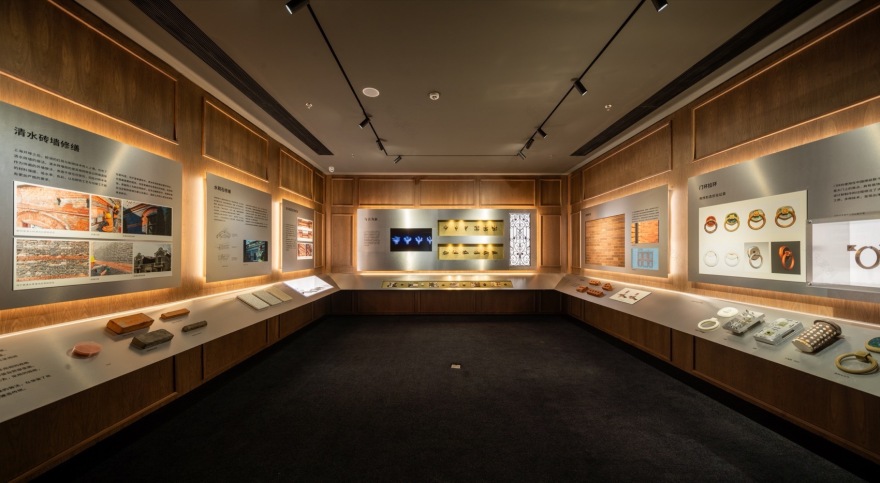
Li Danfeng: Currently, YEAS includes two main branches: YEAS Architecture and YEAS Cultural & Tech. The former focuses on architectural projects, while the latter encompasses broader design-related fields such as consulting, curating, and multimedia production, with a stronger emphasis on the intersection of culture and technology. According to our statistics, starting in 2023, the volume of projects in these two categories reached parity. By 2024, the number of broader design projects had doubled that of traditional architectural design.
For a long time, both Zhou Jianjia and I have balanced dual roles as students and practitioners, which has kept us closely connected with academia. To some extent, this background has guided our project choices. Even at its largest, our studio has never exceeded 10 members, operating with a lightweight and flat organizational structure. Projects are at the core of everything we do, and this framework ensures direct collaboration without hierarchical layers.
In addition to design projects, a significant portion of our energy goes into research and development in content and technology. This requires every team member to be versatile and proactive about expanding their knowledge base, identifying their strengths, and finding areas where their interests align with their skills.
Our approach seems to be in constant evolution, and we hardly noticed how many years the studio has been operating. Recently, we observed that while a vast number of physical spaces have been produced over the past decade, many lack the corresponding content to fill them meaningfully. At times, we start with specific needs and tackle one problem at a time. More often, we intentionally explore new ideas and approaches in our projects. These instincts and adaptive capabilities have helped us carve out our rhythm and identity in a landscape of ever-changing demands.
▼冶是团队2024年山西、日本考察,YEAS Annual Domestic and Overseas Field Trips in 2024 © YEAS


_________
三条线索
ThreeClues
周渐佳:我们没有主动给自己的工作设定过主题,更像是从不断接触的项目中总结出一些共性。这些项目都有这样的特征,要不是这样的需求刚刚出现,要不就是问题和解决方案恰好处在几个行业交界的部分,以往都是各管各的。或者说,现行的常规模式无法给出解答,只有打破以往的条框,以项目为基础统领几个专业共同工作,才能给出有意思的答案。建筑师接受的训练在这方面有先天优势。
可以用三个比较直白的描述来总结我们经手的这类项目,“不知道该怎么处理的空间”,“不知道该怎么表达的内容”还有“不知道该怎么解决的技术”。其实这几句话已经很直观的描述建筑与环境、文化和技术之间的关系,更确切地说是以往未被处理的缝隙。
Zhou Jianjia: We’ve never consciously set themes for our work. Instead, themes naturally emerge from the projects we encounter. These projects often share a common thread: they either address newly arising demands or exist at the intersections of multiple industries—areas where problems and solutions don’t neatly align within established boundaries. In many cases, conventional approaches fail to provide answers, requiring us to break traditional frameworks and bring together multiple disciplines to create meaningful solutions. Architects, with their broad training, have a natural advantage in this regard.
We can summarize our work with three straightforward descriptions: “spaces no one knows how to handle,” “content no one knows how to express,” and “technologies no one knows how to solve.” These phrases encapsulate the relationships between architecture, environment, culture, and technology, specifically addressing gaps that traditional approaches have left untouched.
▼三条线索及部分项目,Three Clues and Related Projects© YEAS

建筑学的背景让我们有理解并且转译工作原理的能力,也天然地担负起捏合各个工种工作的角色,推动整体工作往前走。
Our architectural background equips us to comprehend and translate technical principles, while also serving as the glue that binds different specialties together, driving the project forward
周渐佳:“不知道该怎么处理的空间”很适合用来描述城市更新状态下的常见状况,比如因为拆违得到的边角空地,因为打通围墙从背弄转变为公共空间的通道,高架桥下的空间,或者公交首末站等。这些空间当然是一笔财富,另一方面,这些空间往往有自己的限制,也很像是在问,“现在我收拾好了,你打算怎么安排我呢?”这个过程往往伴随着管理、协调、执行的大量工作,或者说是这些空间从产生到解决的深层逻辑,它们超越了设计,但是最终在设计中显现。
Zhou Jianjia: “Spaces No One Knows How to Handle” This phrase aptly describes situations in urban renewal projects. Examples include irregular plots of land freed up after illegal structures are removed, pathways transformed from enclosed alleys to public spaces after walls are torn down, spaces beneath elevated highways, or unused areas like bus depots. These spaces are undeniably valuable, but they also come with limitations, as if they’re asking, “Now that I’m cleared up, how do you plan to use me?” Addressing these spaces requires extensive management, coordination, and implementation—tasks that extend beyond design but ultimately manifest within it.
▼长宁公交首末站复合利用项目,Bus Terminal Complex Utilization Project, Changning District© YEAS

“不知道该怎么表达的内容”和我们的咨询、研究和表达工作直接相关。在现在行业分类里,往往会把内容、价值和表现方式完全切分开来,简化为策展——收集展品或者展陈——设计空间。建筑师理解的展览会把最终呈现的效果置于评价首位,因此很容易把这样一个工作等同为视觉或体验的创造,但是当我们越了解这种类型的项目,就越意识到赋予意义才是令一种理解路径和讲述方式走向深刻的核心。反过来说,这个工作要求我们摆脱一些建筑师依赖效果的惯性,让研究和论述成为筑底的能力。
“Content No One Knows How to Express” This connects directly to our work in consulting, research, and representation. The traditional industry divides content, value, and expression into separate categories, simplifying them into curation (collecting exhibits) and spatial design (exhibition design). Architects often view exhibitions primarily as a visual or experiential endeavor. However, the more we delve into these projects, the more we realize that creating meaning is the core of developing a profound narrative. Conversely, this challenges us to move beyond architects’ reliance on aesthetics and instead develop research and argumentation as foundational skills.
▼徐汇滨江主题展览,Themed Exhibition featuring West Bund© YEAS
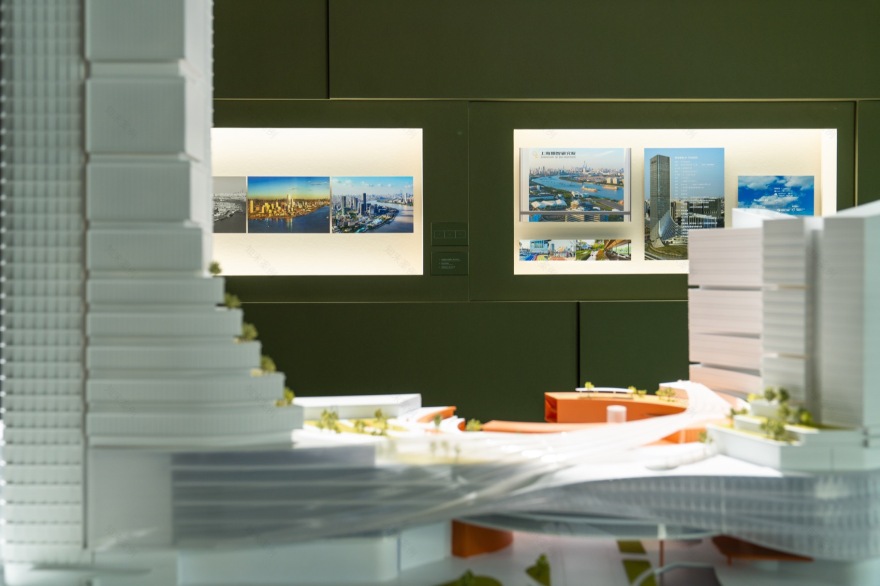
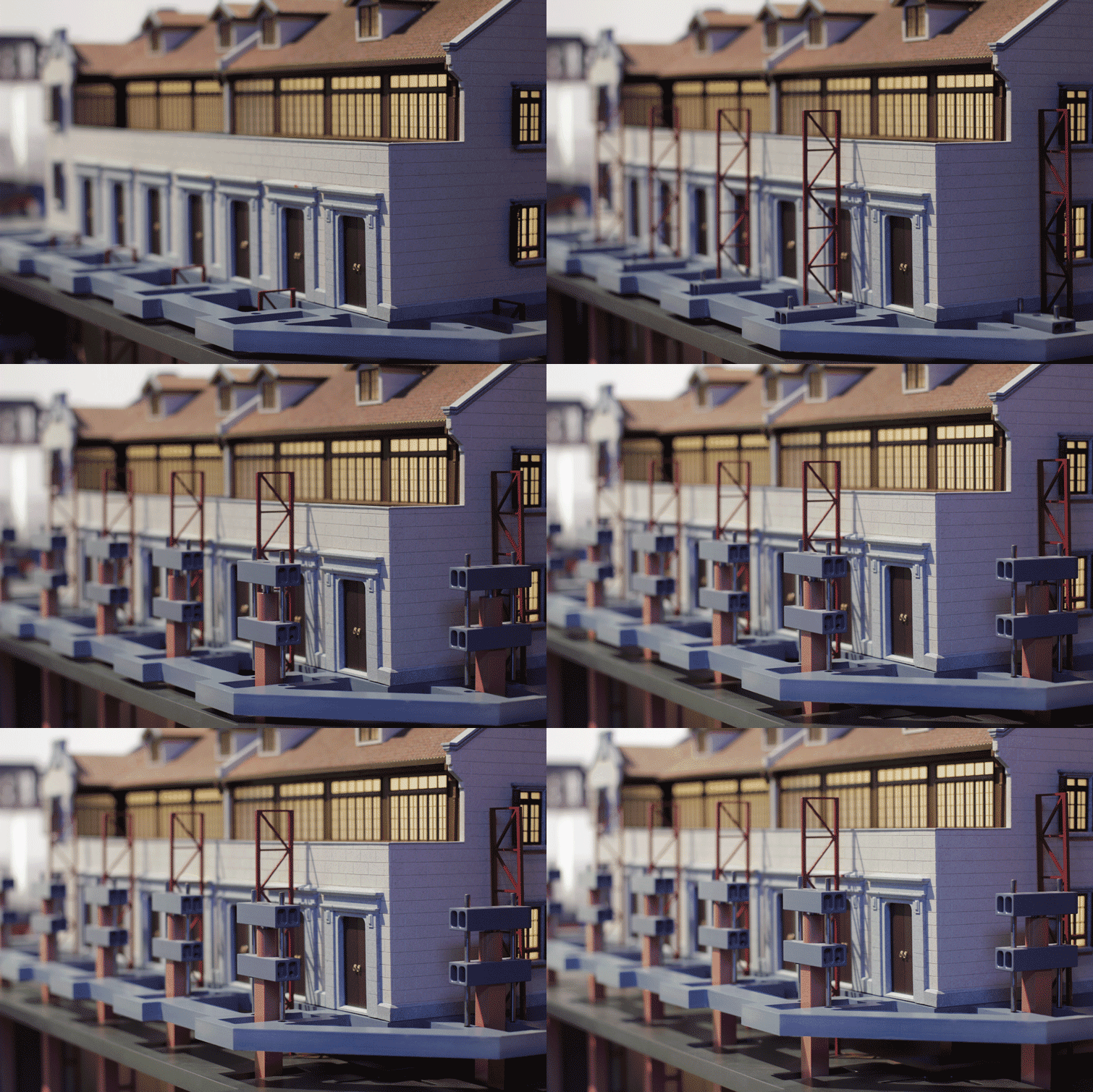
“不知道该怎么解决的技术”渗透在我们环境中的方方面面,小到一个接口怎么隐藏,大到要在一个全新的数字环境下去考虑系统、设备、空间元素之间的关系。比如今年我们受委托为中国建筑科技展的定制一项说明历史建筑顶升托换的展品,要以大众可以理解的深度如实地还原过程中的关键技术其实并不容易,因此联合了机械工程师、艺术家一起完成这项高度定制的工作。这个经历很重要的启示在于,建筑学的背景让我们有理解并且转译工作原理的能力,也天然地担负起捏合各个工种工作的角色,推动整体工作往前走。
“Technologies No One Knows How to Solve” This theme pervades every aspect of our work, from hiding a small interface to orchestrating the relationships between systems, equipment, and spatial elements in a new digital environment. For instance, this year we were commissioned to create a custom exhibit for China’s Architectural Science & Technology Expo. The task involved illustrating the process of raising and relocating a historic building’s foundation, accurately showcasing key technical details in a way the public could understand. This was no easy feat and required collaboration with mechanical engineers and artists. The project taught us that our architectural background equips us to comprehend and translate technical principles, while also serving as the glue that binds different specialties together, driving the project forward.
▼中建科技展定制机械装置,合作单位:九质科技,Customed Mechanic Demonstration for CSCEC Science and Technology Exhibition,in Collaboration with JIUZHI © 王令杰
“综合解决问题的人”
Integrated Problem Solver
从建筑师到“综合解决问题的人”|From architect to “Integrated Problem Solver”
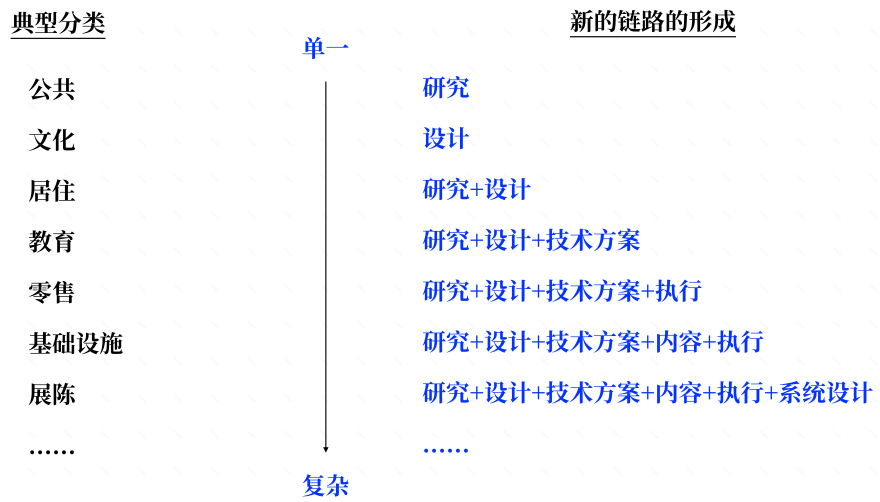
我想变化一下视角,用链路的方式而非功能类型的方式来看待我们的工作。会发现这条链路可以从最初的想法挖掘开始一直延续到落地执行,从可以拆分出当中某个或者某段环节,比如单纯的研究、空间设计、技术方案。但是无论如何,都应该努力地继续往上游和下游继续拓展,这样才有机会尤其是通过空间这样的机会把所有内容、技术、表现方式整合在一起思考。
I want to shift perspectives and view our work not by its functional categories but as a workflow chain. This chain extends from the initial conceptual exploration to final execution, with segments such as research, spatial design, or technical solutions that can be separated out if needed. However, the ultimate goal is to expand both upstream and downstream, enabling us to integrate content, technology, and representation into a cohesive whole—especially through the medium of space.
▼项目分类与链路,Programs and Chains© YEAS
我们一直强调作为团队解决问题的能力,这种能力并不是与生俱来的,是在现实的不断挑战和磨练中锻造的。我们要学习去和不同的人合作,无论是同行还是跨行业,在目前高度综合化的工作现实下,这种能力尤其重要。
We’ve always emphasized our ability to solve problems as a team. This capacity isn’t innate—it’s forged through continual challenges and practice. We must learn to collaborate with different people, whether within our own field or across industries. In today’s highly integrated working environment, this skill is especially critical.
周渐佳:在我们接受的教育中,有一个被反复强调的理念:个体性对于建筑师而言是非常重要的。这个职业要求你有创造力,知识广博,是肩负社会责任的“精英”。强调个体性的潜台词就是竞争,无论是影响力还是竞赛都在放大这种竞争。但是在这种关注无限放大时,我们也应该看到整个建筑师群体的现状,一些最基本的保障,比如工作量、工作时长、以及到手的回报在不断被牺牲。这种现状有一种深刻的分裂感:一方面被鼓吹为英雄;另一方面,在巨大的冲击下不断自贬。从我们进入学校到初入行业时的满怀欣喜,再到现在的局面,我们需要正视其中的落差。应对这种落差有两个方式:一是放下对这个职业过高的期待,二是调整我们的角色和工作内容。这种身份的转变就是从传统意义上的建筑师转变成“综合解决问题的人”,更强调整合能力,而非个体的光芒。这也是为什么我们一直强调作为团队解决问题的能力,这种能力并不是与生俱来的,是在现实的不断挑战和磨练中锻造的。我们要学习去和不同的人合作,无论是同行还是跨行业,在目前高度综合化的工作现实下,这种能力尤其重要。回到展览,可以说是一场小型的综合调度。
Zhou Jianjia: In our education, a recurring theme is the importance of individuality for architects. This profession demands creativity, broad knowledge, and a sense of social responsibility, casting architects as “elite heroes.” The subtext of this emphasis on individuality is competition—whether in influence or design competitions—which amplifies this competitive narrative. Yet, as this focus grows, we must also acknowledge the stark reality of the architectural profession. Basic guarantees like manageable workloads, reasonable hours, and adequate compensation are increasingly sacrificed. This creates a deep sense of division: on one hand, architects are celebrated as heroes; on the other, they’re continually undervalued amid immense challenges.
From the excitement we felt entering architecture school and the industry to the current state of affairs, we need to confront this disparity. There are two ways to address it: one is to lower our lofty expectations of the profession, and the other is to redefine our roles and work content. This shift in identity involves transitioning from the traditional notion of an architect to a “Integrated Problem Solver,” with a stronger focus on integration rather than individual brilliance.
This is why we’ve always emphasized our ability to solve problems as a team. This capacity isn’t innate—it’s forged through continual challenges and practice. We must learn to collaborate with different people, whether within our own field or across industries. In today’s highly integrated working environment, this skill is especially critical. Returning to the context of exhibitions, they can be seen as small-scale exercises in comprehensive coordination.
高回报 vs 高创意|High Rewards & High Creativity
周渐佳:我想用一张象限图来描述工作和回报的关系。纵轴表示回报,从低到高;横轴是我们非常重视的一个指标,就是判断我们的工作到底是生产性的还是创造性的。这两条轴划分出了四个象限:高创意、高回报;低创意、高回报;低创意、低回报;高创意、低回报。核心问题是,你想落在哪个象限?这个问题也可以问所有人。我们的理想是第一象限,高创意,高回报。要达到这一点,前提就是摆脱现行的建筑设计收费标准,让我们的工作无法再用这个条框定价。这个决定需要一些主动的规划,也需要主动地从生产性的工作中脱离,这个转变其实需要下挺大的决心,不是说起来这么容易。以建筑展览为例,这些展览的策划、执行和受众之间通常会有一个错位,在“很好看但看不懂”和“看得懂但信息量不够”之间其实错过了很多交流和传达的机会。
Zhou Jianjia: I’d like to use a quadrant chart to describe the relationship between work and reward. The vertical axis represents reward, ranging from low to high, while the horizontal axis represents a metric we highly value: whether our work is productive or creative. These two axes divide the chart into four quadrants: High Creativity, High Reward; Low Creativity, High Reward; Low Creativity, Low Reward; High Creativity, Low Reward.
The key question is: Which quadrant do you want to be in? This is a question anyone can ask themselves. Our ideal is the first quadrant: high creativity and high reward. Achieving this requires breaking free from the current architectural design fee standards so that our work can no longer be constrained or priced within such frameworks.
This decision involves proactive planning and a deliberate effort to move away from purely productive work—a transformation that requires significant determination and is far from easy.
Take architectural exhibitions as an example. There is often a disconnect between the planning, execution, and audience of these exhibitions. Many opportunities for communication and understanding are lost in the gap between “visually impressive but hard to comprehend” and “easily understood but lacking depth.”
▼“导向-回报”象限图,“Input-Reward”Quadrant Diagram © YEAS

从建筑和城市的背景出发和合作伙伴共同挖掘价值。这种尝试在文化上是有意义的,也是回报上最有潜力的部分。
“Starting from the context of architecture and the city and working with partners to uncover deeper significance. This approach is culturally meaningful and holds the most potential for long-term rewards.”
周渐佳:可以以我们去年在上海历史博物馆呈现的“顺昌路:一次重逢的机会”为例子。展览的主旨是想介绍一个城市更新片区,而建筑行业内通常的讲法是找一批案例来诠释这个概念。但是我们和委托方中海地产都觉得这种方式不够,反而想从一条道路历史作为微观的切口,引出石库门里弄、建筑风貌、修缮和建造技艺等内容,或者说把“城市更新”的概念拆解开来,通过很具体的内容来建立理解。我们发现,一是这些内容可能分布在各个专业,有地方志,有租界史,有摄影,有建筑史,有技术史,但是最终要用一个故事讲出来,难度不小。最后有数十万人来看了这个展览,有原来住在这里的居民专门找到我们,说感谢帮他们讲清楚了自己从小住到大的一条马路的历史,甚至最近还有博物馆团队因为很喜欢这个展览而想和我们合作,这让我意识到,一个短期展览可以在长期中产生深远的影响,成为认知城市和文化的方式。这是一个充满压力又带来极大享受的过程。但是这个过程中最有价值的部分也是最打动人的部分是对意义的创造,并且找到恰当的手段表达。这也决定了我们必须往这条链路的更上游去走,从建筑和城市的背景出发和合作伙伴共同挖掘价值。这种尝试在文化上是有意义的,也是回报上最有潜力的部分。
Zhou Jianjia:We can take last year’s exhibition, RE-ENCOUNTER SHUNCHANG ROAD, presented at the Shanghai History Museum, as an example. The exhibition aimed to introduce an urban renewal area. Typically, in the architectural industry, this concept would be explained through a collection of case studies. However, both we and our client, China Overseas Land and Investment Limited, felt this approach was insufficient. Instead, we wanted to take the history of a single street as a micro-level entry point to explore topics such as the shikumen alleyways, architectural styles, restoration, and construction techniques. In other words, we aimed to deconstruct the concept of “urban renewal” and build understanding through specific, tangible content.
We found that this content spanned across various disciplines—local chronicles, concession history, photography, architectural history, and technical history. Bringing these elements together into a coherent story was no small challenge. Ultimately, the exhibition attracted hundreds of thousands of visitors. Former residents of the area sought us out specifically to express their gratitude, saying the exhibition helped explain the history of the street they had lived on since childhood. More recently, a museum team, impressed by the exhibition, reached out to explore collaboration opportunities. This experience made me realize that a short-term exhibition can have long-term and profound impacts, serving as a means to understand cities and culture.
The process was intense and rewarding. The most valuable and moving part of this experience was the creation of meaning and finding the right methods to express it. This realization drives us to move further upstream in the value chain—starting from the context of architecture and the city and working with partners to uncover deeper significance. This approach is culturally meaningful and holds the most potential for long-term rewards.
▼《顺昌路:一次重逢的机会》展览现场,Exhibition of RE-ENCOUNTER SHUNCHANG ROAD © 北北


周渐佳:今年我刚好有机会采访了两位女性建筑师——OMA的前合伙人Ellen van Loon和Diller+Scofidio的主持建筑师Liz Diller,巧合的是,采访她们的机缘都是展览。van Loon当时为LOEWE设计了“匠艺天地 Crafted World”,Diller则呈现了可能是上海近几年最好的城市建筑类展览“摩登巴黎 Paris Moderne 1914-1945”,她们都谈到从建筑设计转向展览并不是一种“降维”,更像是一次小型建筑演习,甚至在情绪的调动,空间和材料的实验性使用上可以比建筑走得更远,甚至为实践项目积累经验。
Zhou Jianjia: This year, I happened to interview two female architects—Ellen van Loon, a former partner at OMA, and Liz Diller, a principal architect at Diller Scofidio + Renfro. Coincidentally, both interviews were connected to exhibitions. Van Loon had designed Crafted World for LOEWE, while Diller had presented Paris Moderne 1914–1945, arguably one of the best urban and architectural exhibitions in Shanghai in recent years. Both architects mentioned that transitioning from architectural design to exhibitions is not a “step down” but more like a small-scale architectural exercise. In fact, exhibitions often allow for greater experimentation with emotions, space, and materials than buildings do, and they can even serve as a valuable learning experience for practical projects.
担忧与优势|Worries and advantages
“我们希望把每一个项目,看成是一个研究的过程。既然是研究,就需要调动综合的能力。”
We aim to treat each project as a research process. Since it is research, it necessitates a comprehensive skillset.
周渐佳:策展类项目非常好玩儿,同时它具备高创意性,目前来看也有较高的回报率。展览项目的一体化呈现,在很大程度上源于我们的建筑师背景。从设计到实施,再到与其他工种和设备的对接,本就是建筑师工作的一部分。无论是建筑项目还是展览项目,都需要协调大量细节,而对我们来说,这一过程的路径已经非常成熟,与各方的交流也完全没有障碍。
Zhou Jianjia: Curatorial projects are incredibly enjoyable, highly creative, and, at present, seem to yield significant returns. The integrated presentation of exhibition projects owes much to our background as architects. From design and execution to coordinating with other disciplines and equipment, these tasks are inherently part of an architect’s work. Whether it’s an architectural project or an exhibition project, both require managing a multitude of details. For us, the process has become highly streamlined, and communication with all parties involved is seamless.
This proactive approach seems ingrained in our DNA—a deep-seated tendency to observe cities and architecture and to express these observations in an organic manner. Looking back, this was the critical starting point for our later involvement in curatorial and research-driven projects. Interestingly, this starting point emerged entirely unconsciously.
▼同济新村研究图纸,Tongji New Village Research Drawings © YEAS

▼虹口1617研究图纸,Hongkou 1617 Research Drawings © YEAS

周渐佳:这倒不是我们态度或能力上的担忧,而是同类需求还能走多远。回想上一个阶段对建筑需求量极大的时候,没有人会想到这轮浪潮会这么快过去。那么在学到这一课之后,我也不免有些担心现在对内容的需求会不会也很快消耗殆尽?这些年一些大品牌开始通过展览推介自己时,一开始确实获得了很好的效应,但是这种形式和新鲜感也很快走向重复甚至枯竭。或者说现在已经进入了一种争夺观众的状态,而平庸就意味着没有记忆,就意味着出局。在这一轮消耗完之后,下一个增长点又会出现在哪里?
Zhou Jianjia: This isn’t about concerns over our attitude or capabilities, but rather about how far this type of demand can go. Looking back at the previous period of high demand for architecture, no one expected that wave to pass so quickly. Having learned that lesson, I can’t help but wonder whether the current demand for content might also deplete rapidly. In recent years, some major brands have used exhibitions to promote themselves, and initially, this approach yielded excellent results. However, this format and its novelty quickly became repetitive, even exhausting. In some ways, we’ve already entered a phase of competing for audiences, where mediocrity means being forgotten—and being forgotten means being out of the game. After this round of consumption is over, where will the next point of growth emerge?
向差异学习
Learning from the Difference
在合作中学习|Learning from Collaboration
李丹锋:我们在刚开始实践的时候,很幸运地获得了和很多前辈合作的机会。通过这些合作,我们不仅学到了丰富的设计经验,还学习了如何管理和运营,我们对这样的经历非常感恩。合作过的单位还是以独立事务所居多,主持建筑师往往有鲜明而连续的个人特点。这样就存在着一种很自然的互补关系,一方面尊重合作方的创作习惯,另一方面也带入我们自己的思考,这样的合作往往能激发出新的碰撞。和同辈的合作在专业上跨度更大,有结构、景观、照明、平面设计,和他们一起实验新的想法。
比如,在长宁驿站项目中,我们与致正建筑合作设计了四个驿站。尽管整体策略是一致的,但每个驿站仍然展现出一些细微的差异。这种差异正是由我们不同的工作习惯和关注点决定的。我们会用行为化、场景化的方式来考虑一些空间,这可能也和我们对展览、装置的工作经历相关,会关注使用者、建筑、空间之间的关系。比如在其中的一座驿站里,我们设计了一座通向树林的观鸟桥,设想人们在通过这座桥时是以一种不同的标高在观察树,观察鸟。这可能也能解释一些我们的独特性。
Li Danfeng: When we first started practicing, we were fortunate to have the opportunity to collaborate with many senior professionals. Through these collaborations, we not only gained rich design experience but also learned how to manage and operate, for which we are very grateful. The units we have worked with are mostly independent firms, and the lead architects often have distinct and continuous personal characteristics. This naturally creates a complementary relationship—on one hand, respecting the creative habits of our collaborators, and on the other hand, bringing in our own thoughts. Such collaborations often lead to new sparks of innovation. Collaboration with peers spans a wider range of specialties, including structure, landscape, lighting, and graphic design, and working with them allows us to experiment with new ideas.
For example, in the Service Stations of Changning Outer-Ring Ecological Park Belt project, we collaborated with Zhizheng Architecture to design four service stations. Although the overall strategy was consistent, each station still displayed subtle differences. These differences were determined by our distinct working habits and areas of focus. We tend to think about space in a behavioral and scenographic way, which may also be related to our experience in exhibitions and installations, where we focus on the relationships between users, architecture, and space. For instance, at one of the service stations, we designed a bird-watching bridge leading into the forest, envisioning that people would observe the trees and birds from different heights while crossing the bridge. This may also explain some of our uniqueness.
▼冶是建筑与致正建筑合作设计的上海长宁外环公园带市民服务驿站,Service Stations of Changning Outer-Ring Ecological Belt designed by YEAS in collaboration with Atelier Z+ ©杨敏 / 北北 点击这里查看更多,Click HERE for details

▼冶是建筑与阿科米星建筑设计事务所合作设计的上海三林北港桥及三林塘港桥,North Sanlin Bridge and Sanlintang Bridge designed by YEAS in collaboration with Atelier Archmixing© 吴清山 点击这里查看更多,Click HERE for details

李丹锋:起初我们将工作室命名为“冶是建筑”,意义就在于我们将许多设计类型都视为建筑设计的一部分,即便尺度不同,态度和视角却是完全一致的。这种一致的态度往往能带来跨越甚至反差,比如用小去完成大,用坚硬去表现柔软,用变化去表现一致。
Li Danfeng: Initially, we named our studio “YEAS Architecture,” meaning that we regard various types of design as part of architectural design. Even though the scales may differ, the attitude and perspective are completely consistent. This consistent attitude often leads to breakthroughs or even contrasts, such as using small to achieve big, using hardness to express softness, and using variation to express unity.
▼装置作品集合,YEAS Collection of Installations© YEAS

“我们想把有限的时间和精力投入到喜欢的、有价值的事情上,而不是去做重复型的工作。”
“We want to invest our limited time and energy into things we love and find valuable, rather than doing repetitive work.”
李丹锋:我认为我们的包容性体现在对新设计类型的兴趣上,以及对重复性劳动的排斥。我们不喜欢做同样类型的工作。例如,我们于2018到2020年间参与的凌云路街道417街区更新。当时参与社区尺度的建筑设计单位很少,因为这类项目规模小,周期长,而且需要与各种人群打交道。这类项目会给我们机会也是因为我们愿意尝试,愿意总结,愿意试错。后来随着社区工作的全面铺开,很多大型设计院和公司反而开始成为这类项目的主力。但是对我们来说这个类型已经摸清楚了,就没有继续做重复生产。
所以,在我们的实践案例中,每种类型的项目通常不会有很多个,很多领域可能只有一个代表性案例。比如,我们参与了上海嘉定向阳村和霍山县三线兵工厂的项目,做完之后同样很少再做乡村振兴或美丽乡村的项目。在我们参与这几个项目时,都没有成型的标准可参考,所以能很自由地去探索。其实这和我们挑选项目的原则是一致的,想把有限的时间和精力投入到喜欢的、有价值的事情上,而不是去做重复型的工作。但是今年态度也有点变化,觉得可能同类型的项目应该再多积累几个,让自己想得更深一些。
Li Danfeng: I believe our inclusiveness is reflected in our interest in new types of design and our rejection of repetitive work. We don’t like to do the same type of work repeatedly. For example, we participated in the Lingyun 417 Regeneration, Xuhui District, between 2018 and 2020. At that time, there were few design firms involved in community-scale architectural projects because these projects are small in scale, long in duration, and require interaction with a variety of people. The reason this type of project was an opportunity for us was that we were willing to try, summarize, and make mistakes. Later, as community projects became more widespread, many large design firms and companies started to dominate these kinds of projects. But for us, once we figured out this type of project, we no longer continued with repetitive work.
Therefore, in our practice, we usually don’t have many projects of the same type; many areas may only have one representative case. For example, we participated in the Xiangyang Village in Jiading, Shanghai, and the third-line Military Factory in Huoshan County. After completing these, we didn’t engage in more rural revitalization or beautiful countryside projects. When we worked on these projects, there were no established standards to follow, so we had the freedom to explore. This approach aligns with our principle of choosing projects that we like and find valuable, rather than doing repetitive work. However, this year our attitude has shifted slightly, and we feel that we should accumulate a few more projects of the same type to deepen our thinking.
▼上海市徐汇区凌云417街坊,Lingyun 417 Regneration, Xuhui District © 吴鉴泉
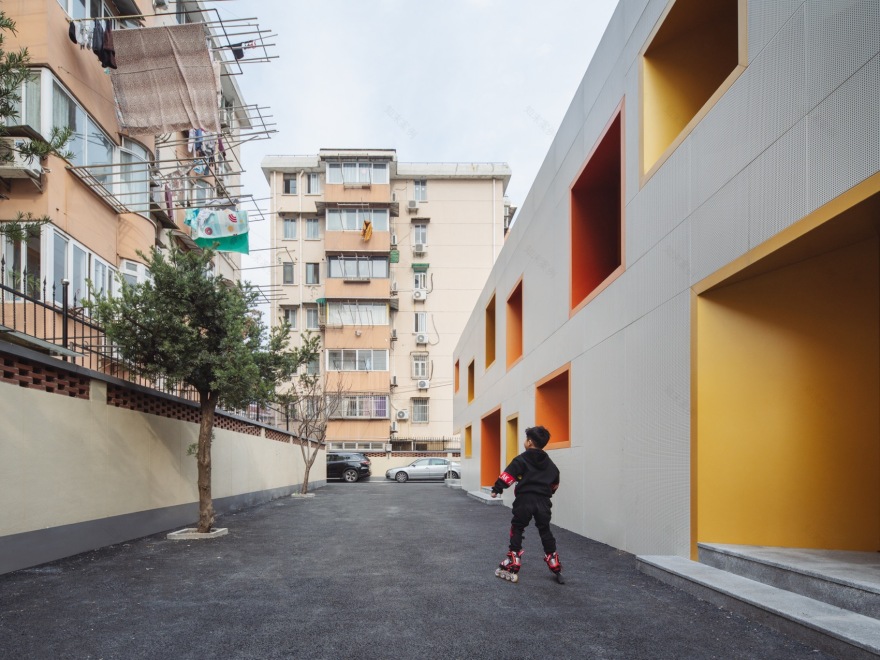
▼上海嘉定向阳村接待中心,Shanghai Xiangyang Reception© 吴清山
点击这里查看更多,Click HERE for details

在比较中学习|Learning from Comparison
李丹锋:九三五六厂是安徽霍山的一个三线兵工厂,它的开始和一段宏大的历史有关。当地希望把三线厂改造成作家村和旅游目的地,以此带动地区经济和环境面貌的改变,让更多年轻人看到本地的机会回乡工作。我们的工作重点是形成有针对性的改造方式,保持原来工业建筑的味道,做适应性改造满足新的使用需求。我认为这个项目的成功之处在于,当城市人来到现场时,依然能够感受到这里曾经发生过的历史,通过保护性设计,工厂和集体生活的气质仍然保留着。另一方面,当年在这里工作的工人们多年后重新回到这里时,仍然很有触动。他们回忆起曾经的生活场景,仿佛回到了他们在这里生活和工作的那个年代。对于我们来说,这种反应是我们采用学术性、克制性、保护性设计最大的价值。
在大城市中的更新中,通常不缺人力和资金。只要能够带来改变,做出一些标志性的项目,自然会吸引大量的人来参观使用。但是在边远的地区,特别是在有明确历史背景的工业遗址中,我们反而需要更加谨慎。资金是另一个现实的问题,改造的过程往往是漫长的,因为资金有限,必须采取有策略、分步实施的方式进行改变。每完成一个阶段的改造,就能增强当地的信心,并为下一步推进打下基础。因此,改造和反馈的过程是同步进行的,也是逐步展开的,这与城市中的大规模、快速、一步到位的改造方式有很大的不同。
Li Danfeng: The 9356 Factory is a former third-line military factory in Huoshan, Anhui, and its origins are tied to a significant period of history. The local community hoped to transform the factory into a writers’ village and a tourist destination, aiming to boost the regional economy and improve the environment, while also encouraging young people to return to their hometowns for work. Our focus was on creating a targeted renovation strategy that preserved the industrial character of the original buildings while adapting them to meet new usage needs.
I believe the success of this project lies in the fact that when urban visitors come to the site, they can still feel the history that once took place there. Through protective design, the essence of the factory and collective life remains intact. On the other hand, when the workers who once worked there return years later, they are still deeply moved. They recall the scenes of their past lives, as if they have returned to the time when they lived and worked there. For us, this response represents the greatest value of our academic, restrained, and protective design approach.
In urban renewal projects, there is typically no shortage of manpower or funding. As long as a project brings about change and creates some iconic work, it naturally attracts many people to visit and use. However, in remote areas, particularly in industrial heritage sites with clear historical backgrounds, we need to be more cautious. Funding is another practical challenge, as the renovation process is often lengthy due to limited resources. Changes must be made in a strategic and phased manner. With each completed stage of renovation, local confidence is boosted, laying the foundation for the next phase. Therefore, the renovation and feedback processes occur simultaneously and gradually, which is very different from the large-scale, rapid, and one-step completion methods typically seen in cities.
▼安徽省霍山县三线兵工厂改造, Third-Front Arsenal Renovation in Huoshan County, Anhui© 吴鉴泉


能够记录并意识到这些转变,并且推动更多尝试发生,是非常有价值的。
“Being able to document and recognize these changes and push for more attempts is incredibly valuable.”
周渐佳:2015年在西岸举办的第一届上海城市空间艺术季就是以“城市更新”为主题。当你将这一切放在十年的时间跨度中回顾时,就会发现自己已经经历了巨大的转变,无论是城市环境还是一些观念。2015年的时候,我和丹锋采访了几位上海建筑师,请他们谈谈对城市更新的期许。可能现在他们看到自己当时的观点都会觉得很诧异吧。我们的工作,有的像是在不断提醒那些身处这种变化中的人们,通过不同的输出方式——无论是写作、展览,还是设计——去设置一些小的节点。原本认为无法接受的事物,实际上是可以接受的。过去曾经出现过的事物,现在消失了。背后的原因是什么?这是我在实践或者记录城市更新相关工作的过程中,不断提醒自己的一个问题。
最近我正在完成两本书的收尾工作,其中一本是与李翔宁老师合写的上海城市更新,收录了120多个建成案例,从最早的社区微更新,到两岸公共空间的贯通,再到市民空间的创造,我们的观念发生了翻天覆地的变化。另外一本书是与上海城市公共空间设计促进中心合作编写的《桥下空间更新的上海实践》。在2018年左右提出要利用桥下空间的想法时,没有人知道该如何做,做完了有没有人用,有没有人管。通过三到四年的实践,这一做法已经成为大家普遍接受的模式,在价值和路径上形成了共识,甚至在思考怎么干得更好。能够记录并意识到这些转变,并且推动更多尝试发生,是非常有价值的。
Zhou Jianjia: The first Shanghai Urban Space Art Season (SUSAS) held in 2015 on the West Bund focused on “urban renewal” as its theme. When you look back at this over a ten-year span, you realize how much change has taken place, both in the urban environment and in certain ideas. In 2015, Danfeng and I interviewed several Shanghai architects, asking them about their expectations for urban renewal. I think now, they might be surprised by their own perspectives from back then. Our work sometimes feels like a constant reminder to those experiencing this change, setting small milestones through different forms of output—whether writing, exhibitions, or design. Things that were once considered unacceptable are, in fact, acceptable. Things that once existed have now disappeared. What is the reason behind this? This is a question I continually remind myself of as I practice or document urban renewal-related work.
Recently, I’ve been finishing up two books. One is Shanghai Urban Renewal, co-written with Professor Li Xiangning, which includes more than 120 completed cases—from the earliest community micro-renewals, to the integration of cross-strait public spaces, and the creation of civic spaces. Our perspectives have undergone a dramatic transformation. The other book, Shanghai Practice of Under Bridge Space Renewal, is written in collaboration with the Shanghai Urban Public Space Design Promotion Center. When the idea of utilizing under-bridge spaces was proposed around 2018, no one knew how to proceed or if anyone would use them or manage them after completion. After three to four years of practice, this approach has become a widely accepted model, with a consensus formed on its value and direction, and even how to improve it. Being able to document and recognize these changes and push for more attempts is incredibly valuable.
▼《桥下空间更新的上海实践》封面及内页,Cover and inner pages of SHANGHAI PRACTICE OF UNDER BRIDGE SPACE RENEWAL

未来与挑战
Future and Challenges
李丹锋:我们事务所未来的方向其实也一直是我们在思考的一个事情,我们工作室在最近运营过程中,也看到了社会的非常大的变化,我觉得适应这种变化,以及主动地去和他们一起去同步去改变这个世界,还是比较重要的也是非常有挑战性的事情,我们想未来可能也一直会延续着这样一种策略以跟城市同步的方式去做我们的设计实践。
周渐佳:未来的发展方向一个非常模糊的印象,虽然很模糊,但是至少对我来讲这段时间越来越强烈。除了研究能力以外,得花一点心思去想一下高创新性和高回报率,对于建筑背景的人来讲,它的可能在哪?我还在同济大学担任博博士后研究员的工作,而我研究的一个非常重要的方向就是未来建筑学的方向,未来建筑学的方向里面,建筑学科可以再去跟哪些新的,比如说创造建造的需求,建造的情境,建造的技术相结合。主动朝外面去寻找新的结合的机会,去证明我们的学科是有用的,是有价值的。
Li Danfeng: The future direction of our firm is something we’ve been thinking about for a while. Recently, as we’ve been operating the studio, we’ve seen significant societal changes. I think adapting to these changes and actively working together with them to change the world is an important and very challenging task. We hope that in the future, we will continue to follow this strategy, synchronizing with the city in our design practices.
Zhou Jianjia: The future development direction is still a very vague impression. Although it’s unclear, this feeling has become stronger for me over time. Beyond research ability, it’s important to think about high creativity and high returns—what possibilities do they have for those with an architectural background? I am still working as a postdoctoral researcher at Tongji University, and one of the very important directions in my research is the future of architecture. In the future of architecture, the discipline can further integrate with new areas, such as the demands of creative construction, the context of construction, and construction technologies. Actively seeking new opportunities for integration outside our field to prove that our discipline is useful and valuable.
▼李丹锋与周渐佳


南京喵熊网络科技有限公司 苏ICP备18050492号-4知末 © 2018—2020 . All photos and trademark graphics are copyrighted by their owners.增值电信业务经营许可证(ICP)苏B2-20201444 苏公网安备 32011302321234号
苏公网安备 32011302321234号客服
消息
收藏
下载
最近