

创作上传
VIP
收藏下载
登录 | 注册有礼
查看完整案例

收藏

下载

分享

翻译
Revealing the Pattern- constructing Cultural Narratives Through Pattern makingFinal Installation of the research conducted forMa Interior and Spatial DesignUniversity of the Arts, London.Chelsea College of artSeptember 2015 to September 2016


“Revealing the pattern” has stemmed from a desire to develop a personal spatial expression rooted in culture. Over the course of the year, I have researched this through pattern making techniques and exploring their theoretical relationship with crafts, culture and spatial design. Therefore, The project explores traditionally relevant patterns, drawing upon Islamic pattern making technique and explores their representation in contemporary spatial dialogue. A 3d printing pen is a device that allows users to draw with molten extruded plastic much like a hot glue gun. The plastic cools off in a few seconds and therefore allowing for the creations to be 3dimensional. The pattern making for this project is made using such a device called the 3doodler. This is important as the project explores the notion of handcraft in relation to the re-emergence of pattern in contemporary spatial design.


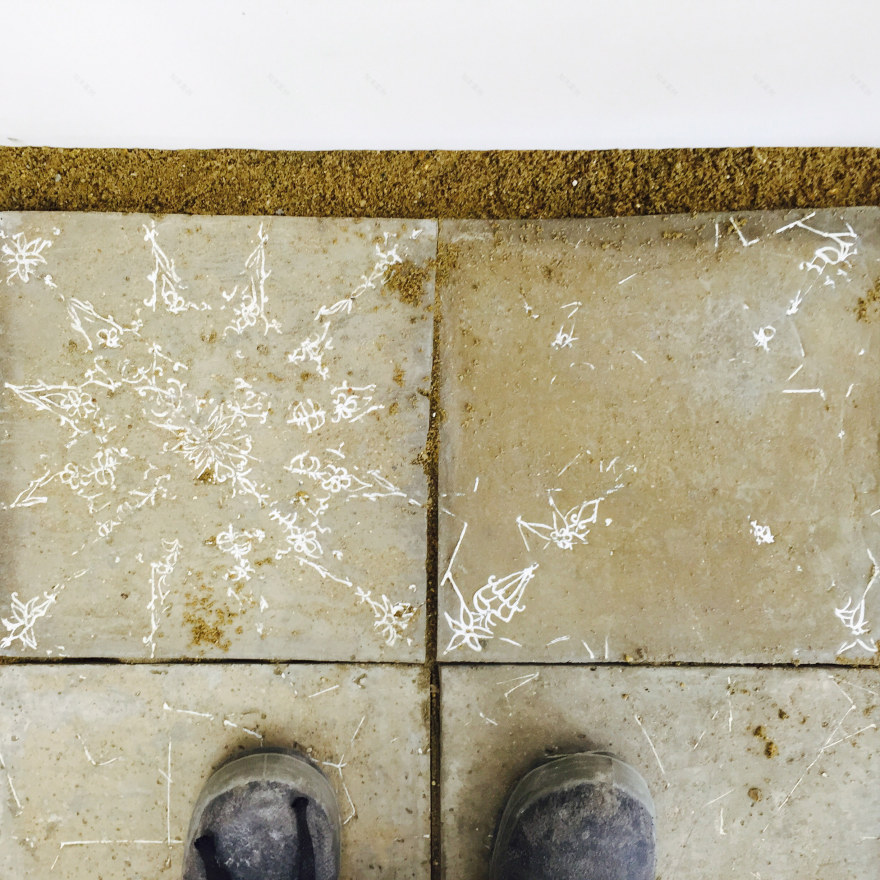


In Unit 1 pattern making has been studied through drawing and embedding patterns made with the 3d Pen into glass wax, wax and Concrete tiles. Laid together the tiles suggested ideas of pattern revealing and appearing from within the surfaces. Unit 2 furthered this research by making several tiles that come together to make a surface. To locate the patterns in space, a narrative is constructed based on the current surrounding. However, it is not until a visit to the city of Porto in Portugal that a contextually relevant site is located at the leça da Palmeira, Greater Porto. With the site in mind, the concrete and glass wax materials were further explored by changing the concrete mixtures, adding colour and adding rocks to the two materials. This was done along with photomontage of images of the tiles onto images from the site. Unit 3 brings together the research from previous units and forms a synthesis. Ideas of patterns being revealed through weathering are further explored, and Spatial narratives are constructed into the Piscina des mares, leça da Palmeira, by weaving into the current movement pattern. To do this, a historical research of patterns in Islamic setting and Portugal's Moorish background was done, and a floral pattern is designed using Islamic star pattern as a grid. Analyses of the narrative break the design down to four architectural instances: 1. Patterns on the floor are creeping up onto the walls 2. Patterns on staircases or ramps 3. instances where the architecture collides with nature 4. Leftover pockets in the natural setting. Using these instances the final show setup is designed. To bring in the element of water into the show, Tiles from unit 2 are taken to the Thames river bank and the seaside at Margate. The Installation setup brings in new processes of adding pattern to the concrete such as those of applying to the wall and folding onto rocks.
Reflecting back to the beginning, of course, the research had started off with several images from Pakistan, mostly of old worn out buildings and some craft objects. These buildings were not very well maintained and over the years the cladded tiles have worn out in areas, revealing the surface of the structure. The surfaces where the tiles remain create fragmented instances on the built, dissolving that area visually and conceptually. As a whole, the building stands as a narrative of time where the pattern is disappearing with passing time. The material and pattern making research during the course have led me to develop a spatial language which is similar in essence to this historical example but a reversal of the process. The cement tile or surfaces designed hides most of the pattern until it is revealed slowly over time, wearing away, dissolving the building surface as it appears. The pattern introduced in glass wax similarly freezes this pattern in a 3dimensional instance. The introduction of these in a culturally relevant location, therefore, plays with this notion of time that is past but also a future and encourages dialogue of their cultural relevance. The desire to develop a spatial language with pattern making was a direct response to the modernist background of my studies. By making this spatial proposition at Leca da Palmeira, it sets up a direct dialogue to such a modernist setting by interweaving into the building and becoming part of the context. The pattern and the non-patterned surface live together as if part of one body where opposites that have been brought together in a union. Each highlight and compliments the other by the nature of being an opposite. The project has progressed through series of intuitive moments which are analysed in retrospective to move on further. As pointed out earlier, the locations proposed for patterns within the piscine das Mares can be broken down to 4 architectural instances. 1. Patterns on the floor 2. patterns creeping up onto the walls 3. Patterns on staircases or ramps 4, instances where the architecture collides with nature. This Analysis was critical to make as it identifies situations in sites elsewhere where the pattern may be introduced. Countries with similar historical memories such as Pakistan or the United Arab Emirates, where I shall move to after the end of this course, both have coastal locations where the proposition may further expand too. The end of the MA course sets up a show to display the research. My setup embodys the essence of the four architectural instances and proposes a spatial installation that the visitor can view and interact with. The course is yearlong and therefore there are limitations to what can be explored during this time. Further explorations could look into diversifying the pattern research, to include other motifs of the same or different cultures. The material research along with the 3d pen may also be further explored to include more materials or iterations of 3d pen outputs. My personal research journey interacts with social and cultural conditions where these patterns that emerge from a deep-rooted place of pattern and craft making within the individual culture. The project is an interface of contemporary engagement with these traditional processes but also one that values the notion of revealing. A revealing that is not only a material one but also of a social, cultural memory.
南京喵熊网络科技有限公司 苏ICP备18050492号-4知末 © 2018—2020 . All photos and trademark graphics are copyrighted by their owners.增值电信业务经营许可证(ICP)苏B2-20201444 苏公网安备 32011302321234号
苏公网安备 32011302321234号客服
消息
收藏
下载
最近