

创作上传
VIP
收藏下载
登录 | 注册有礼
查看完整案例

收藏

下载

分享
江西大鲵文创体验中心位于江西省靖安县——九岭山脉脚下,群山环抱,自然景观优渥的一处微坡场地。体验中心的创作灵感来源于两只合抱的大鲵在自然环境中畅游的抽象表达,设计整合大鲵科普、亲子研学、文创体验功能,通过曲线坡道串联双层展厅,结合古樟溪流营地构建生态文旅链。
The Jiangxi Giant Salamander Cultural and Creative Experience Center is situated on a gently sloping terrain at the foot of the Jiuling Mountains in Jing’an County, Jiangxi Province, surrounded by mountains and abundant natural landscapes. Its architectural design draws inspiration from an abstract expression of two intertwined giant salamanders navigating their natural habitat, embodying ecological harmony.
▼文创中心鸟瞰,aerial view of the Cultural and Creative Experience Center©李逸

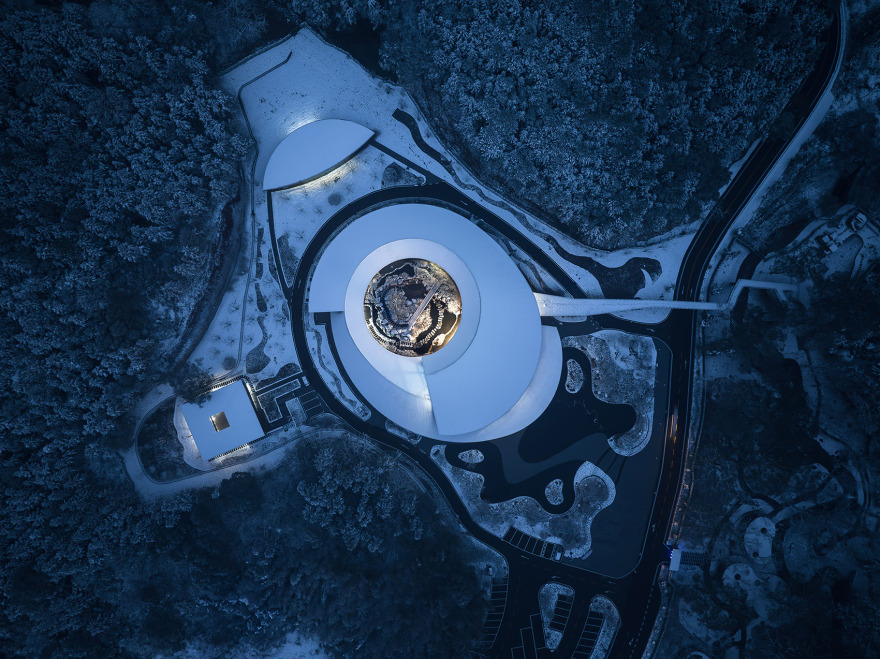
作为国际濒危物种,中国大鲵的保护长期陷入困境。基于综合科学考察研究,中科院昆明动物研究所联合江西省科学院研究团队发文报道并描述新种——江西大鲵。这是我国首个遗传身份明确且野外稳定繁殖的大鲵纯种种群。Science杂志以A new hope为题,在Research Highlight (Conservation) 撰文对该进展进行了介绍。
As an internationally endangered species, the Chinese giant salamander (Andrias davidianus) has long faced conservation challenges. Based on comprehensive scientific investigations, researchers from the Kunming Institute of Zoology (Chinese Academy of Sciences) and Jiangxi Academy of Sciences jointly identified and described a new species – the Jiangxi giant salamander (Andrias jiangxiensis sp. nov.) This marks China’s first genetically confirmed and stably breeding purebred giant salamander population in the wild. The journal Sciencehighlighted this breakthrough under the title A New Hope in its Research Highlight (Conservation) section.
▼文创中心鸟瞰,aerial view of the Cultural and Creative Experience Center©李逸
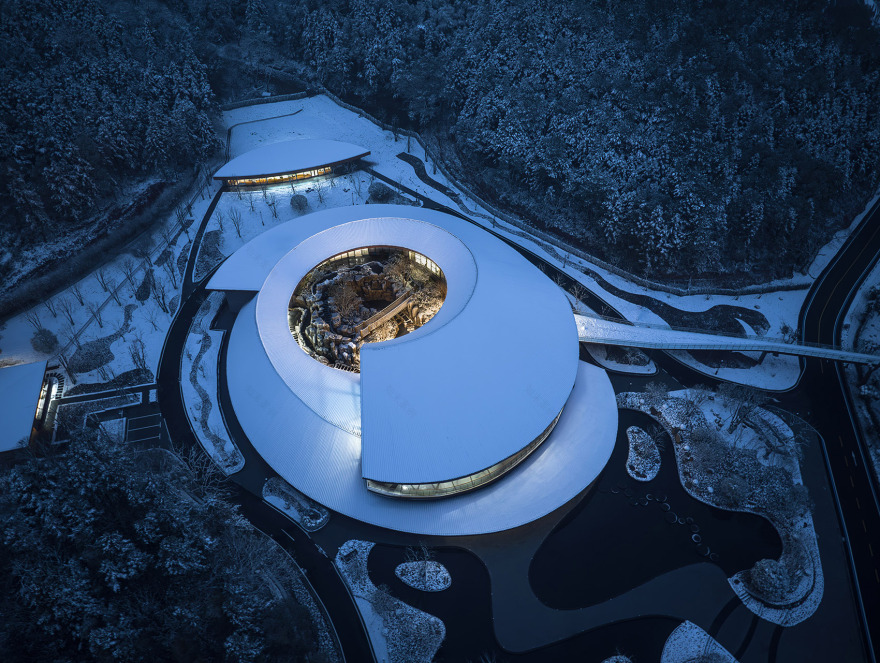

Currently, the Jiangxi giant salamander has been officially recognized by authoritative databases including AmphibiaChina, Amphibian Species of the World (ASW), and AmphibiaWeb. Jing’an County in Jiangxi Province, the native habitat of this species, is designated as “China’s Hometown of Giant Salamanders”. As the country’s only cultural experience center dedicated to giant salamanders, this facility serves as a public education hub for salamander conservation and promotes creative cultural derivatives inspired by the species.
▼文创中心雪景,snowy view of the Cultural and Creative Experience Center©李逸

▼文创中心雪景,snowy view of the Cultural and Creative Experience Center©李逸

01相地与生长
Land Assessment and Growth
和向建筑参与了项目最初的场地选址工作。原有的主场地选址位于群山脚下一处微坡场地,与之相隔一条马路的南侧有一条自然溪流,溪流周边散布了十几棵近百年的古樟树。经过现场多次的踏勘调研,最终将南侧场地也纳入其中与在后期规划时将其与北侧主馆做联动,扩充主馆的使用功能,丰富游客动线与体验。
HESION participated in the initial site selection. The original main site was located on a gentle slope at the foot of mountains, with a natural stream to the south across a road, surrounded by over a dozen century-old camphor trees. After multiple on-site surveys, the southern area was integrated into the plan and linked with the northern main hall to expand functionality and enrich visitor circulation.
▼周围环境,surrounding environment©李逸

南北两侧场地,被一条蜿蜒通路分割,为了保持南北场地之间的功能互通,我们在主馆南侧架设一座人行天桥,南侧为结合百年古樟树林及自然溪流所营造的自然营地。
Separated by a winding path, a pedestrian bridge was built south of the main hall to connect the northern and southern zones. The southern area features a natural campsite blending ancient camphor forests and the stream.
▼南北两侧场地,the northern and southern zones©李逸

02 以仿生现代的空间线条解构传统建筑风貌
Deconstructing Traditional Architectural Features through Biomimetic Modern Spatial Lines
建筑设计以大鲵的体态为原型,通过连续变化的圆弧勾勒出建筑的平面形态和立体空间,试图抽象化表达自然状态下的大鲵游动。平面空间通过两条曲线围合成室内空间,中间形成环抱的圆形中庭。屋顶是整体设计的核心,通过参数化设计,将屋顶的曲线与环境进适配,由建筑主入口开始逐步上升 ,直达二层的最高处,呼应远山的山形。
▼抽象化表达自然状态下的大鲵游动,abstractly expressing giant salamander’s movement©HESION和向建筑&李逸

The architectural design takes inspiration from the body posture of the Chinese giant salamander, using continuous curves to outline planar and three-dimensional forms, abstractly expressing its movement. Two curved walls enclose the interior space, forming a central circular atrium. The roof, designed parametrically, ascends from the main entrance to the second-floor peak, echoing distant mountain contours.
▼通过参数化设计的屋顶曲线,the parametrically designed roof line©李逸

03 形态控制参数化
Parametric Design for Form Control
通过参数化设计将一层屋顶檐口在主立面方向控到到通行的最低要求,以保持整体低趴的建筑形态,使建筑藏匿于环境之中,尽量弱化建筑空间需求在整体环境中的压迫感。同时为了突出建筑的入口,将曲线调高,在建筑入口形成拱起的形态,模拟大鲵嘴部,衔接景观的入口。
Parametric design minimized the first-floor roof eave height to maintain a low-profile structure that blends into the environment. The entrance curve rises to mimic the salamander’s mouth, integrating with the landscape. Radial purlins, all converging toward the atrium’s center, ensure smooth roof curvature and reduce positioning difficulty during construction.
▼保持整体低趴的建筑形态,maintain a low-profile structure©李逸


屋顶结构檩条呈放射状布置,所有檩条的圆心指向中庭的中心,以达到屋顶三维曲面的顺滑过度,同时降低施工过程中的放线定位难度。▼结构体系,structure system©陈浩

The roof structural purlins are arranged radially, with all centers of curvature aligned to the atrium’s core. This design achieves a seamless transition of the three-dimensional roof curvature while simplifying positioning and alignment during construction.
▼隐藏在山体间的屋顶,the roof hidden in the mountain©陈浩

▼景观中的坡屋顶,the pitched roof in the landscape©陈浩

04 连续贯通的展陈空间和虚实交织的观景界面
Continuous Exhibition Flow and Interwoven Visual-Landscape Interfaces
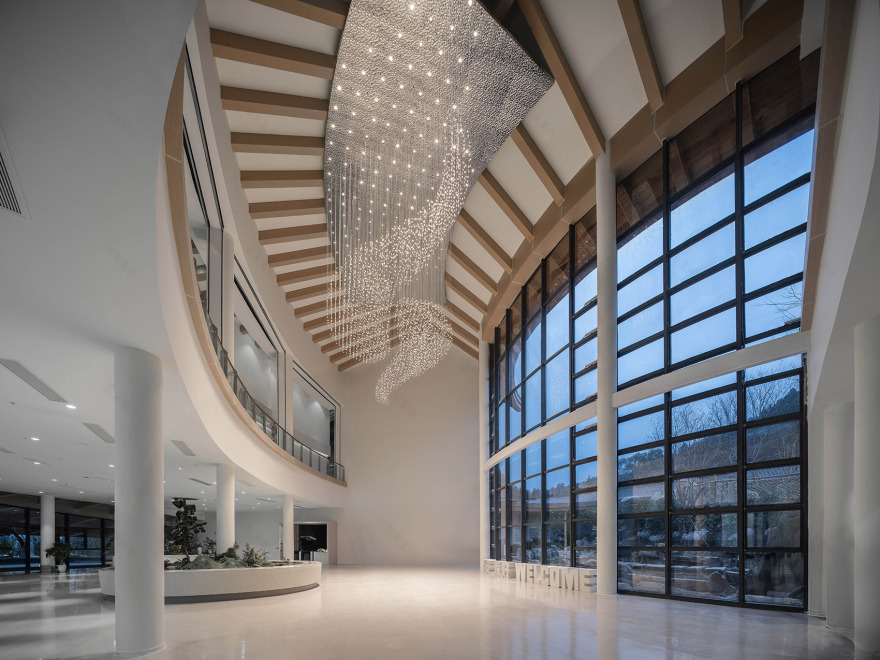
室内设计以连贯展陈动线为核心,入口处二层通高中庭形成入口空间视觉焦点,联动入口门厅及二层餐厅;通高的玻璃幕墙面向中心室外庭院,将自然光景及水体引入室内,强化建筑与自然的对话。曲线坡道衔接首层与二层展厅,开放式布局结合高低错落的展示台,实现空间连续性与视觉层次统一。二层的水平景窗延伸至景观面,形成虚实交织的观景界面。
The interior focuses on continuous exhibition flow: a double-height atrium at the entrance links the lobby and second-floor restaurant. A full-height glass curtain wall facing the central courtyard introduces natural light and water elements, enhancing dialogue with nature. A curved ramp connects first- and second-floor galleries, while staggered display platforms unify spatial continuity and visual hierarchy. Horizontal view windows on the second floor create interwoven visual and physical viewing interface.
▼室内空间,indoor space©李逸

05 结语
Conclusion
建筑是记录人与自然的容器,设计以仿生曲线形态模拟大鲵游动,参数化屋顶呼应远山轮廓,玻璃幕墙与水平景窗消融室内外界限,形成贯通展陈动线与自然对话的空间。
Architecture serves as a vessel recording human-nature interactions. The biomimetic curves evoke the salamander’s motion, parametric roofs mirror mountain silhouettes, and glass walls dissolve indoor-outdoor boundaries, crafting a space where exhibitions and nature converse seamlessly.
▼参数化屋顶呼应远山轮廓,parametric roofs mirror mountain silhouettes©李逸


▼夜景,night view©李逸


▼夜景鸟瞰,aerial view of the building at night©李逸

▼模型,model©HESION 和向建筑设计事务所


▼场地平面,site plan©HESION 和向建筑

▼一层平面,ground floor plan©HESION 和向建筑

▼二层平面,second floor plan©HESION 和向建筑

▼立面,elevation©HESION 和向建筑

▼剖面,section©HESION 和向建筑

项目名称:江西大鲵文创体验中心
项目地点:江西省宜春市靖安县
建筑设计单位:HESION 和向建筑设计事务所
结构设计单位:苏州筑境建筑科技有限公司
室内设计单位:然也设计、HESION和向建筑
景观设计单位:朴野景观
主持建筑师/项目主创:陈浩、吴敏
设计团队:席晨、崔众、胡振坤、陈俊(建筑);陈小龙、钟梦甜 、汤萱、王俏、杨少康(景观);安召乐 、柳明(室内);方超、吴敏(VI系统)
业主:靖安县农业农村局
展陈设计:崇生造物局
建筑面积:6,500平方米
建设时间:2022年10月-2023年12月
结构:钢结构
材料:混凝土、小青瓦、青砖、红雪松、木纹铝板
摄影:李逸、陈浩
Project Name: Jiangxi Giant Salamander Cultural and Creative Experience Center
Location: Jing’an County, Yichun City, Jiangxi Province
Architectural Design Firm: HESION Architecture Office
Structural Design Firm: Suzhou Zhujing Architectural Technology Co., Ltd.
Interior Design Firm: Ran Ye Design,HESION Architecture Office
Landscape Design Firm: Puye Landscape Design
Chief Architects/ Project Principal: Chen Hao, Wu Min
Design Team: Xi Chen, Cui Zhong, Hu Zhenkun, Chen Jun(Architecture); Chen Xiaolong, Zhong Mengtian, Tang Xuan, Wang Qiao, Yang Shaokang (Landscape); An Zhaole, Liu Ming (Interior); Fang Chao, Wu Min(VI System)
Client: Jing’an County Agriculture and Rural Affairs Bureau
Exhibition Design: Chongsheng Creation Bureau
Building Area: 6,500 square meters
Construction Period: October 2022 – December 2023
Structure: Steel Structure
Materials: Concrete, Small Blue Tiles, Blue Bricks, Red Cedar, Wood-Grain Aluminum Panels
Photography: Li Yi, Chen Hao


南京喵熊网络科技有限公司 苏ICP备18050492号-4知末 © 2018—2020 . All photos and trademark graphics are copyrighted by their owners.增值电信业务经营许可证(ICP)苏B2-20201444 苏公网安备 32011302321234号
苏公网安备 32011302321234号客服
消息
收藏
下载
最近