

创作上传
VIP
收藏下载
登录 | 注册有礼
查看完整案例

收藏

下载

分享
位于深圳光明区的深圳科技馆新馆5月1日正式向公众开放。这座全新机构将聚焦于科学探索、前沿研究及未来技术的发展潜力,致力于展示科学的力量和塑造未来的科技进步。该项目被设想为粤港澳大湾区——全球最大城市群之一(人口接近一亿)的重要文化地标之一。博物馆将与该地区著名的科技企业、高校、学校及研究机构展开合作,培育创新力,并展示深圳在新兴科技发展方面所具备的全球领先地位。
The Shenzhen Science & Technology Museum in the Guangming District of the city opens May 1st 2025. Showcasing the scientific endeavour, ground-breaking research and future possibilities of technology, this new institution will explore the power of science and the technological advancements defining our future. Designed as a leading visitor destination of the Greater Bay Area — the world’s largest metropolitan region with its population approaching 100 million residents — the museum will collaborate with the region’s renowned tech industries, universities, schools and research centres to cultivate innovation, as well as present the ongoing inventiveness that places Shenzhen as a global leader in the development of new technologies.
▼建筑鸟瞰,设计采用U形平面,aerial view of the museum using U-shaped plan©Virgile Simon Bertrand


博物馆紧邻深圳地铁光明站,其建筑设计呈现为面向城市的坚实球形体量,坐落于新建科学园的东南角。其体量向西延展至公园区域,并逐渐转化为一系列动态的室外露台,俯瞰整片园区。这些露台是环绕中央大厅的展厅空间的延伸,构成了一处城市重要的公共空间。
Adjacent to Guangming Station of Shenzhen’s metro network, the design responds to its location as a solid, spherical volume facing the city and defining the southeast corner of the new Science Park. Extending westwards into the park, the building’s volume stretches and transforms into a dynamic sequence of outdoor terraces overlooking the park. These terraces are functioning extensions of the interior galleries that surround the grand central atrium, creating a significant new civic space for the city.
▼项目外观,external view of the project ©Virgile Simon Bertrand

▼夜景,night view©Virgile Simon Bertrand

深圳科技馆新馆包括35,000平方米的常设及临时展厅、6,000平方米的沉浸式剧场与影院空间、5,400平方米的科研实验室、教育设施与创新中心。此外,还有34,000平方米的游客服务设施、储藏空间及生产与维修车间。馆内多个展厅从中央大厅的地面与墙面自然“生长”而出,也有部分展厅“漂浮”于大厅恢弘的空间之上,每个展厅的造型都为观众提供直观的导引线索,带领他们穿梭于层层相连的展览空间之中。
The Shenzhen Science & Technology Museum incorporates 35,000 sq. m of permanent and temporary exhibition halls and galleries, together with 6,000 sq. m of immersive theatres and cinemas, as well as 5,400 sq. m of research laboratories, educational facilities and an innovation centre. Additionally, 34,000 sq. m of visitor amenities and storage join production and maintenance workshops.The many galleries within Shenzhen’s new scientific institution emerge from the floor and walls of its central atrium, while other galleries float above the awesome scale and composition of the atrium’s grand public space, each giving visual clues that intuitively direct visitors through the museum’s series of interconnected spaces.
▼入口空间,多层露台,entrance space, layers of terraces ©Virgile Simon Bertrand
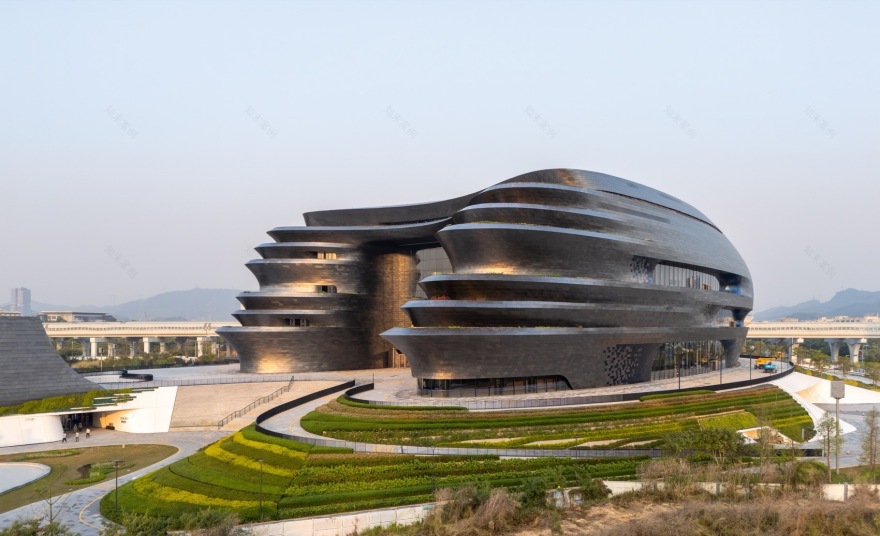
▼建筑外观,exterior view©Virgile Simon Bertrand

中央大厅多角度的空间体验和材料表达为每一位观众的探索之旅提供了震撼的起点。面向公园的整面大玻璃墙模糊了内外界限,让自然光线与景观、甚至人类无尽的好奇心,共同渗入建筑的核心。
The atrium’s multiple perspectives and materiality also provide a thrilling launching point for every visitor’s journey of discovery. With its large, glazed wall facing the park, the atrium blurs the boundary between inside and out; inviting natural light and landscapes — as well as our boundless curiosity — into the heart of the building.
▼通透的大堂,transparent atrium©Virgile Simon Bertrand

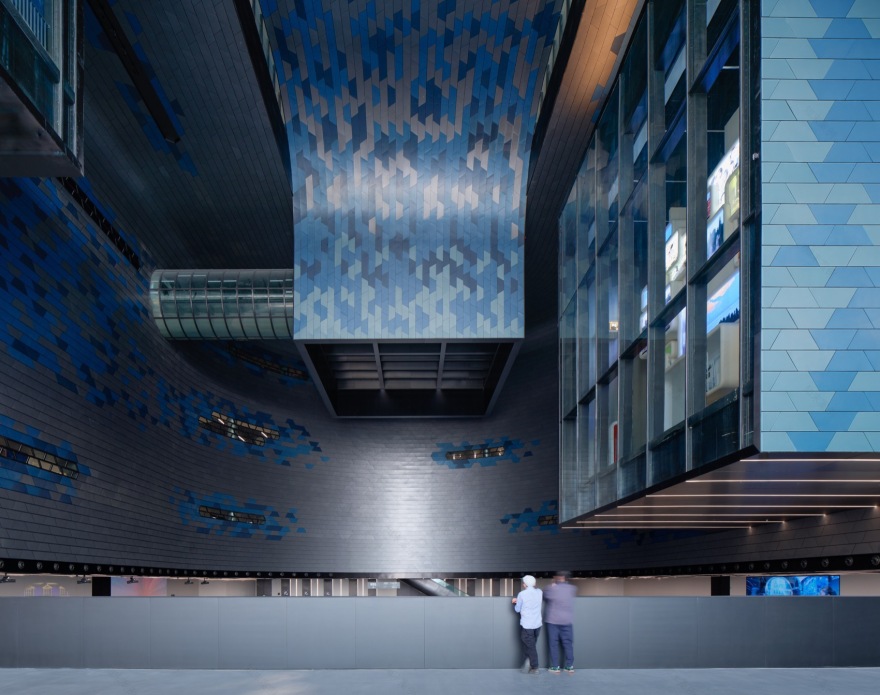
在设计过程中,团队结合被动式环保策略,运用先进的计算机模拟,对建筑形体、空间及外壳进行测试与优化,以适应深圳亚热带气候下的全年太阳辐射、温度、湿度、风向、空气质量等多种变量。建筑的朝向经过精心设计,尽量减少中央大厅的太阳热辐射负荷,同时保持对公园的全景视野。为了提升参观体验并遮挡阳光直射,每层露台不仅改善了环境性能,也创造出多个朝向公园的半室外观景空间,为游客在参观过程中的停留与沉思提供舒适场所。
Guided by passive environmental strategies, the design process employed advanced computer simulations to test and refine the building’s form, spaces and envelope for optimal performance within the annual solar radiation, temperatures, humidity, prevailing winds, air quality and other variable conditions of Shenzhen’s subtropical climate and location. The building’s orientation has been determined to minimise solar heat gain within its central atrium while maintaining panoramic views of the park.Designed to shield the atrium’s glazed façade from direct sunlight to enhance visitor comfort, the terraces on each floor improve environmental performance and create a series of sheltered outdoor spaces overlooking the park; giving visitors places for rest and contemplation while exploring the exhibitions.
▼露台创造出多个朝向公园的半室外观景空间,the terrace creates multiple semi-outdoor viewing Spaces facing the park ©Virgile Simon Bertrand

▼外观近景,closer view of exterior©Virgile Simon Bertrand


为减少对外部环境与太阳辐射的直接暴露,建筑采用由不锈钢板构成的双层通风外壳系统,在外墙与幕墙之间形成通风空腔。该系统延伸至屋面,并整合光伏发电,实现场地能源自给。这也是中国首次大规模应用双色INCO氧化技术于建筑幕墙。通过精准控制电解液配方与氧化时间,在不锈钢表面形成纳米氧化膜,打造自保护、自清洁的微观涂层,不仅增强其耐候与防腐性能,延长幕墙寿命,还赋予其无需涂漆的独特质感与色彩。
Mitigating direct exposure to the elements and solar radiation, a system of stainless-steel panels creates a ventilated cavity between the façade and the external walls. This system extends to the roof, which also incorporates photovoltaics for on-site energy generation. The museum’s façade incorporates the first large-scale application of dual colour INCO technology in China. Precisely controlling an electrolyte formula and oxidation time, a nanoscale oxide film is generated on the surface of the steel, giving the façade a self-protecting, self-cleaning micro-layer that extends its life cycle by increasing resilience to weather and Shenzhen Science & Technology Museum Shenzhen, China Press Release Continued corrosion, while also enriching the stainless-steel with a fine texture and colour without any painting.
▼幕墙色彩由深蓝渐变至多种灰色调,为立面赋予层次与动感,The façade’s colour gradient transitions from deep blue to various shades of grey adding depth and texture©Virgile Simon Bertrand


幕墙色彩由深蓝渐变至多种灰色调,唤起人们对天体运行的联想,为立面赋予层次与动感。项目力求达到中国绿色建筑评价标准中的最高三星级认证。该博物馆总建筑面积达128,276平方米,结合被动式设计策略与智能化高效系统管理,年综合能耗预计降至15.47公斤标准煤/平方米,运行电力年均消耗预计为125.89千瓦时/平方米,从而大幅降低碳排放。
The façade’s colour gradient transitions from deep blue to various shades of grey, evoking a dynamism of celestial bodies orbiting in space, while adding depth and texture. Aiming to achieve the highest three-star rating of China’s Green Building Evaluation Standard, the 128,276 sq. m museum’s passive design features combined with smart management networks operating high-efficiency systems are projected to reduce the building’s comprehensive energy consumption to 15.47 kgce/sqm per year, with a subsequent reduction in emissions achieved by lowering the museum’s operational electricity demand to an estimated 125.89 kWh/sqm a year.
▼大堂夜景灯光效果,light effects in the atrium©Virgile Simon Bertrand


▼楼梯,staircase©Virgile Simon Bertrand

在建筑施工中,共计使用可回收建材达389,238.92吨。其水资源管理系统采用中水回用及雨水收集储存,年总用水量预计控制在14,906立方米以内。项目施工采用数字孪生(Digital Twin)系统,结合BIM与3D扫描技术,对复杂表面的建造精度进行毫米级控制。遍布全馆的关键节点网络使施工过程与数字模型同步验证,复杂构件则通过机器人多点成型技术高精度加工,确保设计方案的完美呈现。
The museum’s procurement targeted the use of 389,238.92 tonnes of recyclable materials in construction, while its water management system implements grey-water recycling in addition to the collection and storage of rainwater to reduce overall water consumption to an estimated 14,906 cubic metres per year.The project’s digital twin construction process employed BIM+3D scanning technology to maintain and control tolerances of complex surfaces within millimetres. A comprehensive network of key nodes throughout the building enabled the synchronous verification of all construction from the digital simulation in real-time, while robotic multi-point forming technology precisely shaped the complex surfaces to the exact requirements of the design.
▼展厅,exhibition hall ©Virgile Simon Bertrand

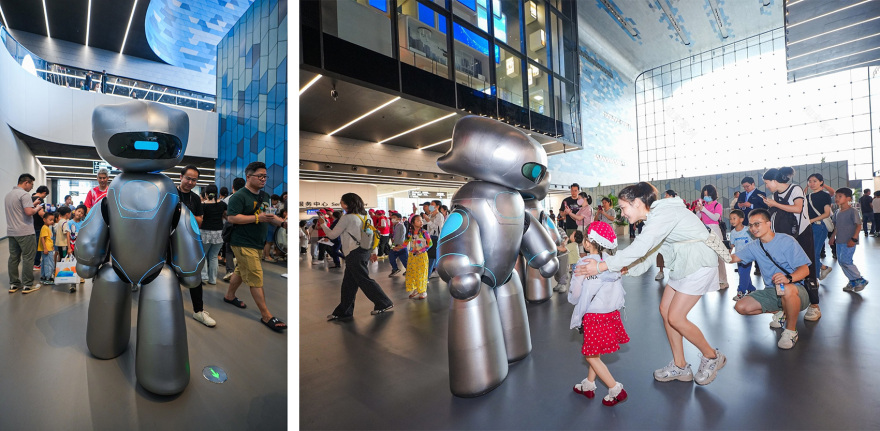
▼科技馆开馆后的活动场景,the scene of activities after the opening of the science and technology museum© Photo courtesy of SSTMuseum

▼总平面图,master plan© ZHA

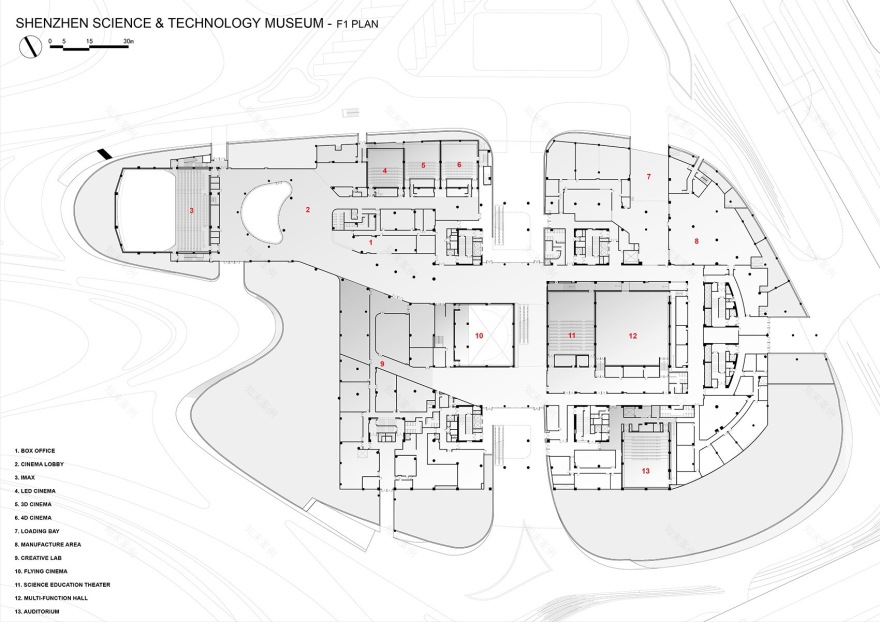
▼一层平面图,F1 plan© ZHA
▼二层平面图,F2 plan© ZHA

▼三层平面图,F3 plan© ZHA

▼四层平面图,F4 plan© ZHA
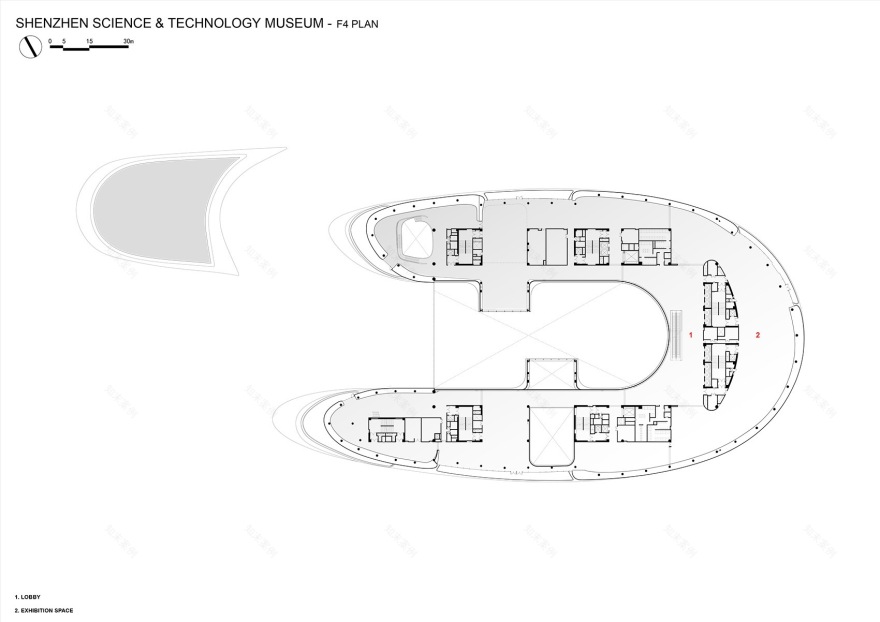
▼五层平面图,F5 plan© ZHA

▼六层平面图,F6 plan© ZHA

▼屋顶平面图,roof plan© ZHA

▼立面图,elevations© ZHA


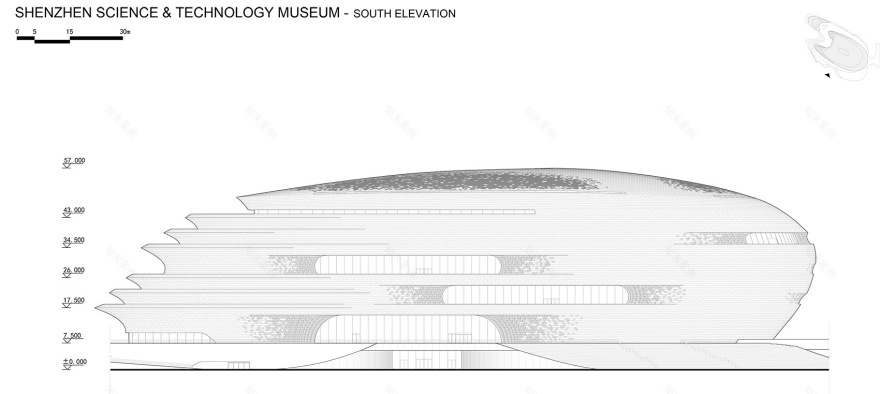

▼剖面图,sections© ZHA


Client: The Bureau of Public Works of Shenzhen Municipality
Operator: The Shenzhen Association for Science and Technology
Design: Zaha Hadid Architects (ZHA)
Consortium Local Design Institute: Beijing Institute of Architectural Design Co. Ltd. (BIAD)
Consortium Lead (ZHA) Team: ZHA Principal: Patrik Schumacher
ZHA Project Directors: Charles Walker (Commercial Director), Paulo Flores, Simon Yu
ZHA Project Architect: Edgar Payan
ZHA Project Senior Associate: Lydia Kim
ZHA Project Package Leads: Juan Montiel, Jinqi Huang, Niran Buyukkoz, Saman Dadgostar, Julian Lin, Richard Wasenegger.
ZHA Project Team: Berkin Islam, Cheryl Lim, John Kanakas, Sven Torres, Michael On, Yuxuan Zhao, Enoch Kolo, Karina Linnsen, Boyan Hristov, Bechara Malkoun, Mansel Haynes, Haohao Chen
ZHA Competition Team: ZHA Project Design Directors: Paulo Flores, Simon Yu
ZHA Project Architects: Karoly Markos, Edgar Payan ZHA Design Leads: Niran Buyukkoz, Saman Dadgostar.
ZHA Project Team: Jinqi Huang, Berkin Islam, Billy Webb, Cheryl Lim, Christos Koukis, Federico Fauli, Juan Montiel, Jurij Licen, Michal Wojtkiewicz, Bogdan Zaha, Michael On, Yuxuan Zhao, Enoch Kolo, Nastasja Mitrovic
Competition Stage Consultants:
Acoustics Consultants: Marshall Day Acoustics
Exhibitions Consultants: Art of Fact
Cinema Consultants: Teecom
Landscape Consultants: Gillespies
Specialist Consultants (Schematic Design Stage):
Façade Consultant: GYAC (Shanghai) Co. Ltd.
Acoustics Consultants: Acoustics & Theatre Design Division, East China Architectural Design & Research Institute Co. Ltd.
Green Building Consultants: Jorjun Green Building Technology Co., Ltd, Guangdong
Exhibitions Consultants: Art of Fact
Cinema Consultants: Teecom
Landscape Consultants: Gillespies
Specialist Consultants (Preliminary Design Stage):
Local Design Institute (Structure & MEP): Capol International & Associates Group
Local Design Institute (Architectural): Beijing Institute of Architectural Design Co. Ltd
Façade Design Consultants: Dadi Facade Technology Co. Ltd.
Interior Design Consultants: J&A (Jiang & Associates)
Exterior Lighting Consultants: GD-Lighting Design Consultancy Co. Ltd


南京喵熊网络科技有限公司 苏ICP备18050492号-4知末 © 2018—2020 . All photos and trademark graphics are copyrighted by their owners.增值电信业务经营许可证(ICP)苏B2-20201444 苏公网安备 32011302321234号
苏公网安备 32011302321234号客服
消息
收藏
下载
最近