

创作上传
VIP
收藏下载
登录 | 注册有礼
查看完整案例

收藏

下载

分享
安于泽畔——沁河之滨的生态瑰宝
Sit in the riverside
田家庄坐落于山西省临汾市安泽县,依偎在山西省第二大河流——沁河之畔。沁河是山西唯一未被污染的河流,至今保留着原始的自然风貌。尽管洪水偶有泛滥,但田家庄凭借传统的选址智慧,始终安然无恙。作为沁河生态治理与乡村振兴的重要节点,田家庄的再生规划与乡村建设不仅是对村庄的保护,更是对流域可持续发展的探索。
Tianjiazhuang is located in Anze County, Linfen City, Shanxi Province. It is located on the side of the Qin River, the second largest river in Shanxi Province, which runs through the county. Qin River is also considered to be the only unpolluted river in Shanxi, which is particularly rare. Because of this, it partly retains its natural state, and even in the part of Tianjiazhuang, artificial flood control measures have not been built, although the flood will flood Tianjiazhuang at most, the traditional wisdom of its location has kept Tianjiazhuang safe. Tianjiazhuang regeneration planning and design is only a node of the Qin River ecological governance and rural revitalization planning project.
▼中心广场鸟瞰图,aerial view of the central square©李逸

古庄新生——文旅融合的振兴之路
Newborn of an old village
安泽县历史悠久,是思想家荀子的故里、名相蔺相如的栖居地,也是革命老区;生态资源丰富,拥有国家级生态示范区、省级森林公园,以及全国连翘产量第一的美誉。如何激活这些资源,让凋零的村庄重焕生机?规划提出“一村一品”的发展策略,田家庄凭借其完整的空间格局、优越的区位条件和目前较少的居住人口,非常适合面向旅游进行整体保护开发。因此成为“太岳人家”民宿品牌的首批示范项目。通过农文旅融合,这座古村正书写新的篇章。
Anze County is the land of heroes and talents, which is the hometown of Xunzi who is the great thinker of ancient times, the residence of Lin Xiangru who is the famous minister of ancient times, and the memorial where the older revolutionaries lived and fought all over the county; Anze County has good ecology and is a national ecological demonstration zone, a provincial forest park, the first county of forsythia production in China and a large county of coal resources that has not yet been developed in a large area. How to make full use of these resource advantages and local characteristics to revitalize the fading countryside? We carried out a detailed assessment of all the villages in the planning area, combining cultural and ecological characteristics, and proposed the development goal of one village, one product. Tianjiazhuang has obvious location advantages, its overall spatial pattern is preserved intact, and the current resident population is small, which is very suitable for the overall protection and development of tourism. Anze County is located in the south of Huoshan Mountain (also called Taiyue Mountain), so it is also called “Yueyang”, and Tianjiazhuang has become a demonstration project of the local brand of “Taiyue Family” in Anze County.
▼田家庄建成后增强了活力,Tianjiazhuang was built to enhance the vitality©李逸
整体规划——尊重自然与传统的再生设计
Overall planning
1 场地环境:与湿地共生的村落
Site environment
田家庄位于沁河湿地公园段,规划以“太岳人家”体验为核心,融入非遗元素,打造特色民宿集群。湿地公园与村庄相映成趣,既保护了原有的风水格局,又为游客提供了亲水休闲空间。湿地公园段规划依托基地内现有的滩涂湿地资源,以及沿河的山地资源形成以亲水为主导、湿地体验运动为特色的湿地休闲中心。
Tianjiazhuang, as a node of ecological governance and rural revitalization of the Qinhe River, belongs to the wetland park section, and its positioning in the planning of villages on both sides of the central Qinhe River is the experience of Taiyue family. We try to inject the elements of intangible cultural heritage and design the Taiyue series of homestays with different themes and architectural styles according to the characteristics of the villages, to promote the balanced and characteristic homestay tourism development of all villages in the upper and lower reaches of the Qinhe River. The planning of the wetland park section relies on the existing beach wetland resources in the base and the mountain resources along the river to form a wetland leisure center dominated by hydrophilic and characterized by wetland experience sports.
▼湿地公园段规划策划,wetland park landscape planning©LandscapeInLab
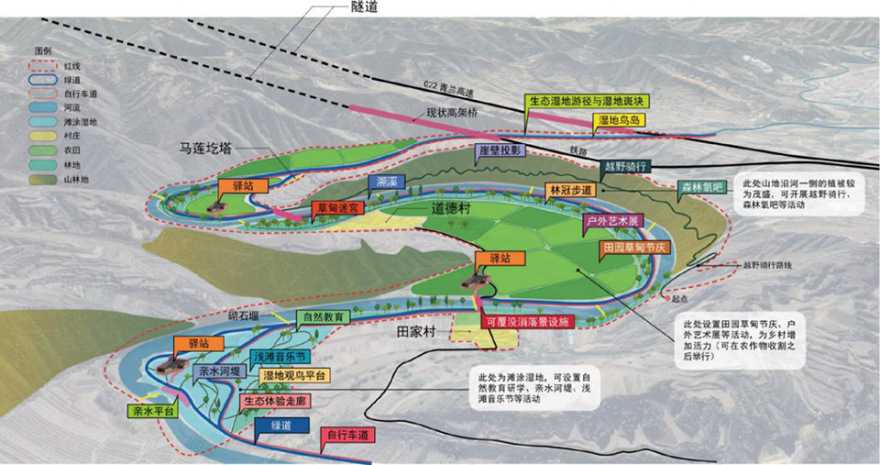
建成后的湿地公园和田家庄相映成辉,规划上慎重考虑了田家庄和周边环境的整体关系,保护了其良好的风水格局。
The constructed wetland park and Tianjiazhuang shine together. The overall relationship between Tianjiazhuang and the surrounding environment was carefully considered in the planning to protect its good feng shui pattern.
▼田家庄鸟瞰图(建设前),aerial view before the renovation©寻常⼯作室

▼田家庄鸟瞰图(建设后),aerial view after the renovation©李逸
2 功能分区:古今交融的活力布局
Functional partition
尊重原有村庄的空间结构,功能上主要分为4部分:
Respecting the spatial structure of the original village, the function is mainly divided into 4 parts:
▼功能分区示意图,function distribution diagram©寻常⼯作室

游客服务区
Tourist service area
规划上考虑到整体的人车分流,主要的车行交通由东北方向的道路进入田家庄,而南部的滨河道路是规划建设中的慢行系统,一直向西延伸到安泽中心城区。利用西北部较为宽松的场地建设停车场,并通过建筑的改造,建设游客服务中心、餐厅、管理服务用房、员工用房等。
The planning takes into account the overall separation of people and vehicles, with the main vehicle traffic entering Tianjiazhuang from the road in the northeast, while the riverside road in the south is a slow-moving system under planning and construction, extending uniformly west to the central city of Anze County. We used the relatively loose site in the northwest to build parking lots and through the renovation of buildings to build visitor service centers, restaurants, management services, etc.
▼改造后院落,courtyard after renovation©李逸

公共活动区
Public activity area
从游客服务区继续往西,东西与南北两条主要道路交汇的地方是田家庄的中心区域。在这里通过对质量较差的既有民房进行拆除重建,有效地改善了原有的空间结构,强调了中部公共空间的形成,规划有咖啡厅、农产品商店、童玩乐园及会议中心、窑洞房间以及掩藏在树林中的树屋等特色度假房间。
Continuing west from the visitor service area, where the two main roads from east to west and from north to south meet, is the center of the town. Through the demolition and reconstruction of the existing civil houses with poor quality, the original spatial structure is effectively improved, and the formation of the central public space is emphasized. The holiday rooms are planned to include self-service cafes, agricultural products stores, a children’s park, cave rooms, and tree houses hidden in the woods.
▼窑洞民宿,the guestroom©李逸

南部民宿区
Southern homestay area
田家庄南部民宿由现有的民房改造更新而成,完全尊重居民的意愿,通过租借的方式确定改造的规模、位置。南部主要包括3个院子,约有房间10间。
Tianjiazhuang Southern Homestay is renovated and updated from the existing houses, fully respecting the will of residents, and determining the scale and location of the transformation through renting. The south mainly includes 3 courtyards with about 10 rooms.
▼窑洞民宿,the guestroom©李逸

北部民宿区
Northern homestay area
北部民宿位于地势较高的台地,规模相对而言较大,依山就势布局了5组建筑,4种类型的院落,约30多个房间。
Northern Homestay is located on the higher platform, the scale is relatively large, according to the mountain layout of 5 groups of buildings, 4 types of courtyards, and about 30 rooms in total.
▼北部民宿组团,northern guest room cluster©李逸

3 空间织补:延续村庄肌理
Space darning
规划在保护生态环境,与周边自然环境融为一体的基础上,对建筑的留改拆进行了长时间的调查、审计的工作,尊重居民的意愿,最大程度的保护村庄原有空间肌理,采取空间织补的方法,修补田家庄的建筑与外部空间。建成后不仅保留了村庄的空间肌理,更进一步完善了村庄的空间结构,特别是村庄空间与周边树林和田地的结构自然衔接,犹如有机生成的整体。
▼村庄改造后建筑肌理示意图,village building fabric after renovation©寻常⼯作室

On the basis of protecting the ecological environment and integrating with the surrounding natural environment, the planning carried out a long-term investigation and audit on the retention, renovation, and demolition of the buildings, respected the wishes of the residents, protected the original spatial texture of the village to the greatest extent, and adopted the method of spatial darning to repair the buildings and external Spaces of Tianjiazhuang. After the completion, not only the spatial texture of the village is preserved, but also the spatial structure of the village is further improved, especially the natural connection between the village space and the surrounding woods and fields, like an organic whole.
▼田家庄航拍图(建成后),aerial view of the village after renovation©李逸

4 地方再生
Local regeneration
田家庄的规划设计体现了团队一贯秉持的再生设计的理念,不仅体现在上述对环境的尊重、功能的转化、空间的织补,更是体现在对地方性的深入理解和现代解读。包括在建筑形式上对地方建筑特色的理解和创新;在业态经济上考虑经济的可持续发展和公众利益;在基础设施和公共服务上为村民、游客提供高品质的体验;以及在日常生活上尊重空间的记忆和村民的日常需求。让一个位于沁河滨水,日渐凋零的村落重获新生。
he planning and design of Tianjiazhuang reflect the concept of regenerative design that the team has always upheld, which is not only reflected in the above respect for the environment, the transformation of functions, and the darning of space, but also reflected in the in-depth understanding and modern interpretation of the local area. It includes the understanding and innovation of local architectural characteristics in architectural forms, consideration of sustainable economic development and public interests in the form of business economy, provision of high-quality experience for villagers and tourists in infrastructure and public services, and respect for the memory of space and the daily needs of villagers in daily life. Revitalize a dying village located by the Qinhe River.
▼田家庄建成后村庄入口,Tianjiazhuang village entrance©李逸

▼田家庄建成后村民生活如故,Villagers’ lives remain the same after the completion of Tianjiazhuang©李逸

▼田家庄建成后基础设施和公共服务的提升改善了村民的日常生活,Upgraded infrastructure and public services after the completion of Tianjiazhuang have improved the daily lives of villagers©李逸

建筑设计——在地性与创新性的对话
Architectural design
1 游客接待中心
Visitor Reception Center
游客接待中心由一组2层建筑为主体的开放式院落组成,其中新建的钢结构建筑,采用玻璃幕墙的立面,让四周的农田风景尽收眼底;连廊延伸到庭院中,既是庭院的边界,也是建筑对外部空间的探寻,现代的建筑材料和结构方式,仅使用了坡屋顶的传统建筑空间形式以及木纹铝板作为外饰取得和地方的联系。庭院中的小品是一个新建的“遗存”,一个破败的墙垣和“幸存”的门头,叙述着安泽地方的故事。
The visitor reception center consists of a set of open courtyards with 2 floors as the main body, including a new steel structure with a glass facade that offers panoramic views of the surrounding farmland; The corridor extends into the courtyard, which is not only the boundary of the courtyard, but also the exploration of the external space of the building. The modern building materials and structural methods only use the traditional architectural space form of the pitched roof and the wood-grain aluminum plate as the exterior decoration to obtain the connection with the place. The landscape sketch in the courtyard is a newly built “relic”, consisting of a broken wall and a “surviving” gate head, which tells the story of Anze place.
▼游客接待中心,visitor reception center©李逸

穿过钢结构的玻璃建筑,进入一个较为封闭的半围合院落,采用传统的草泥灰抹灰立面的两层建筑是具有多功能的房间,下层是餐厅的包房,上层则是舒适的卧室。再往南,则是餐厅和厨房,它们与巷子对面的管理服务用房形成了接待中心的主要服务空间。
Entering a semi-enclosed courtyard through a glass building with a steel structure, you will find a two-story building with a traditional straw-mud plaster facade, featuring multifunctional rooms. The ground floor serves as a private dining rooms, while the upstairs offers comfortable bedrooms. Proceeding southwards, you will find the restaurant and kitchen, which along with the management service rooms across the alley, form the main service spaces of the reception center.
▼游客接待中心,visitor reception center©李逸

▼接待中心附属茶饮院落组团,Annex tea courtyard cluster©李逸

▼游客接待中心室内空间,Visitor Centre interior space©李逸

▼游客餐厅与管理用房有机嵌入村庄,Visitors’ restaurant and administration building organically embedded in the village©李逸

2 中心广场
Central Plaza
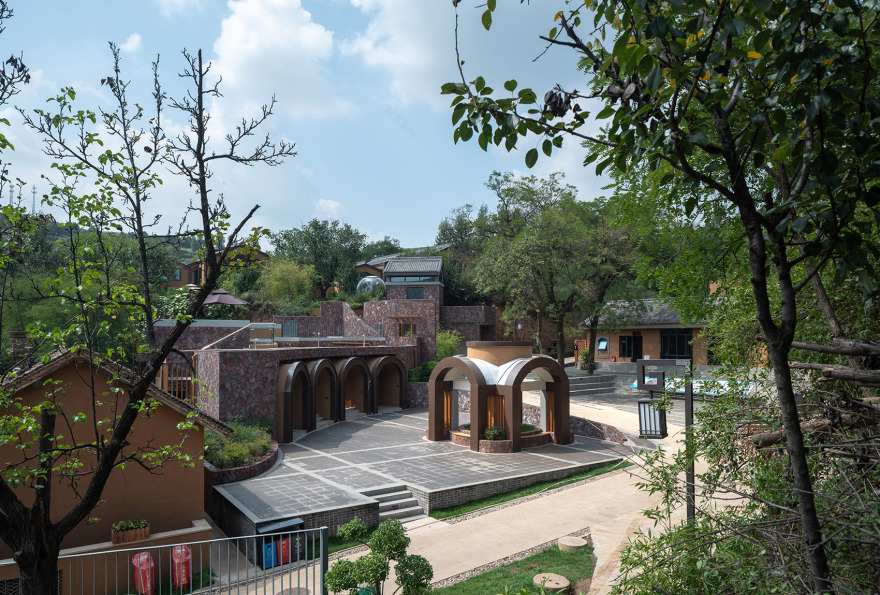
游客接待中心西侧,南北主要道路交接的地方,通过一个民房的腾挪,置换出西侧的一片广场,通过台阶适应北高南低的整体地形走势,保留原有的三棵乔木成为广场的地标,北侧由民房改造而成的商店和西南侧新建的自助咖啡馆形成围合,朴素的网格铺装将异形的广场空间进行统一,一切设计手法都保持着低调,唯一试图体现中心的“动作”是在道路交叉点西南侧设计了一个亭子,同样采用了窑洞拱门的意向,并在亭子中做了一个花坛座椅,与敞开的顶部对应,体现出开放的空间形态,却用并不灵巧的结构形式暗示北方的地域特色和窑洞的厚重感。
At the junction of the main north-south road and the west side of the tourist reception center, a square is created by displacing a residential house. The square adapts to the overall terrain with steps, retaining three existing trees as landmarks. The renovated store on the north side and the newly built self-service coffee shop on the southwest side enclose the square. The simple grid paving unifies the irregular space, with the only “movement” attempting to reflect the center’s design at the southwest corner of the road intersection. The pavilion features cave arches and includes a flower bed and seats, corresponding to the open roof and expressing an open space concept. However, the sturdy structure implies the regional characteristics of northern China and the thickness of cave dwellings.
▼中心广场,the center plaza©李逸

3 自助咖啡馆
Self-service Cafe
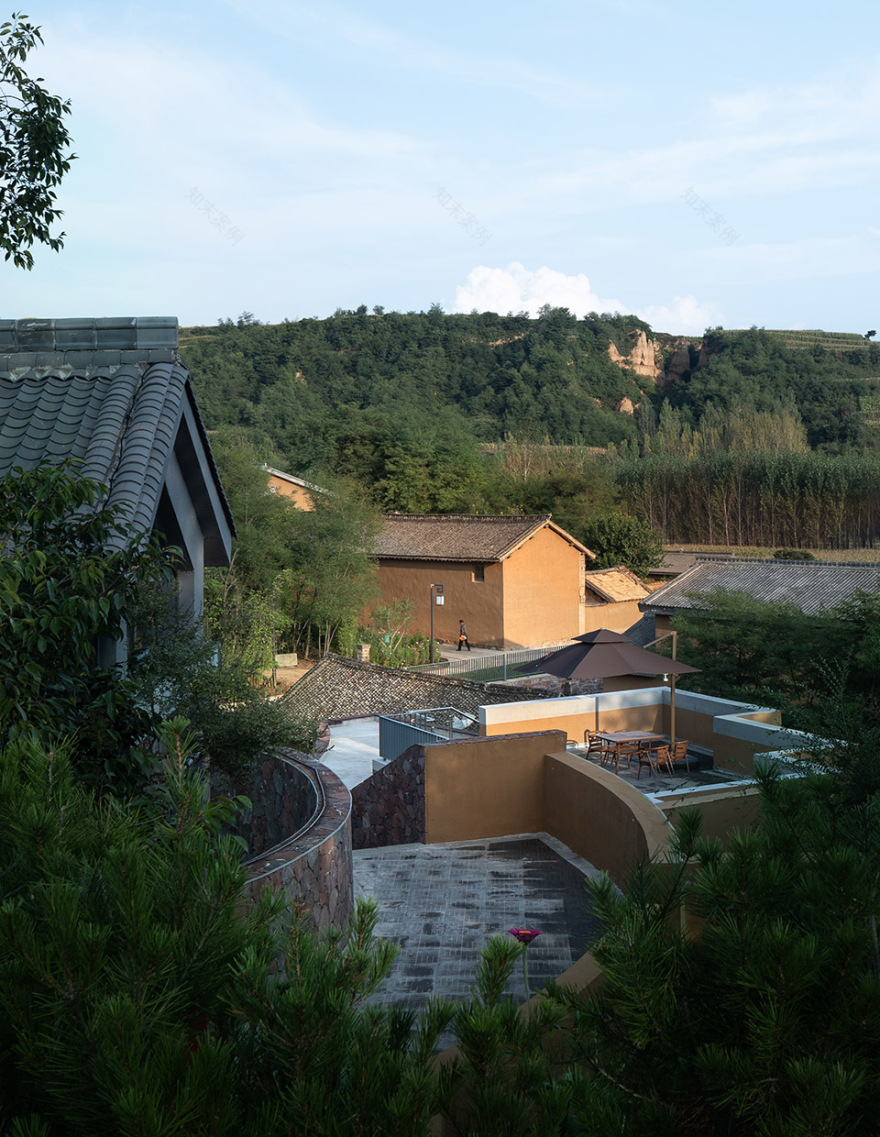
咖啡馆连接中心广场,并通往西侧台地上的民宿院落。石砌立面以及错落的建筑空间和屋顶平台,将自身融入到整体空间结构之中,看似随意的空间转换体现出对高差和视线进行融合的逻辑。
The cafe connects to the central square and leads to the residential compound on the terrace on the west side. The stone facades, as well as the scattered building Spaces and roof terraces, integrate themselves into the overall spatial structure, and the seemingly arbitrary spatial transformation reflects the logic of integrating the height difference and the sight line.
▼村庄咖啡馆,village cafe©李逸

▼村庄咖啡馆屋顶露台,the roof terrace of the village cafe©李逸
4 童玩乐园与会议中心
Children’s Park&Huddle Hub
延续村庄整体处理逻辑,但更加隐藏的一组建筑是商店北面的童玩乐园,似乎是被外部空间切割剩下的建筑体量,采用了类似咖啡馆的外轮廓但更为朴素的立面处理。但是屋顶空间则更为丰富,层层的屋顶平台提供了会议中心室外的休憩空间。
The children’s park, which is similar to the spatial processing logic but more hidden, is located north of the store. It seems to be the remaining architectural volume after the external space is cut. It adopts a simpler facade treatment similar to that of a cafe. However, the roof space is more diverse, with layered roof platforms providing outdoor resting spaces. The indoor space transforms the building’s bland appearance, becoming dynamic, and colorful, and catering to a variety of children’s activity needs.
▼童玩乐园与会议中心屋顶平台,children’s park and the roof terrace of the conference center©李逸

▼童玩乐园与会议中心,children’s park and the conference center©李逸
5 民宿建筑
Residential buildings
院落
Courtyard
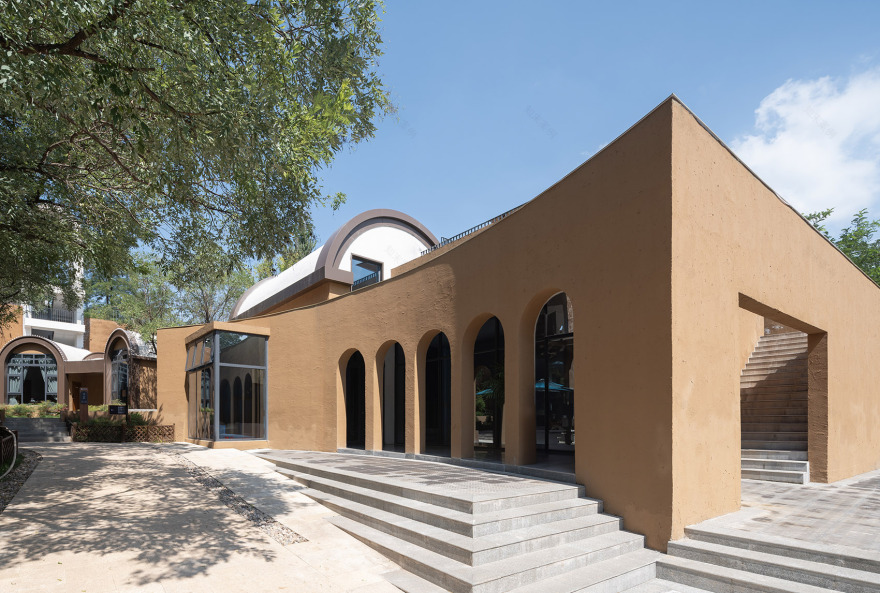
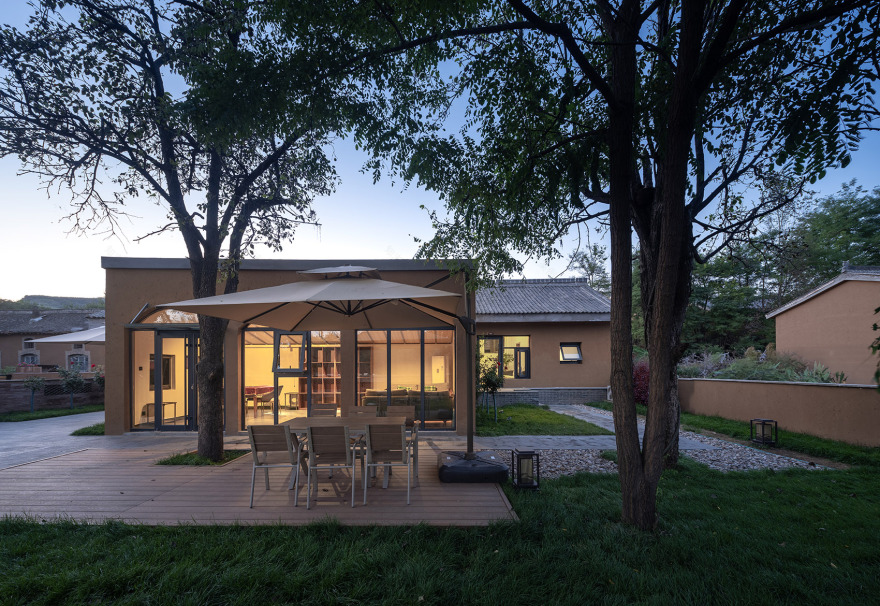
院落是当地民居最主要的形式之一。改造更新的民宿多半采用了各种不同类型的院落形式,围合、半围合、开放式,三种主要的院落形式结合不同的庭院设计,让民宿建筑具有了不同的空间体验。院落之间的组合方式也各不相同,南部三个院落是一个独立的开放式院落,以及两个串联的围合式院落;北部则主要是两组串联的院落。院落临街的立面和围合的院墙是需要精心设计的地方,如何朴素而又体现精致,是设计和施工的博弈和合作的结果。建筑基本采用原有建筑的空间格局,将当地建筑二层(主要是储藏功能)提高层高,增加了房间的数量;东西向的房间主要是入口接待空间和共享生活空间,设计的更为多样和开敞,或者是独立设置在庭院中的休憩空间,与庭院景观混为一体。建筑立面主要采用了草泥灰饰面,局部用灰砖点缀,与保留的建筑既保持整体风格的一致,又略有差异。
The courtyard is one of the main forms of local residences. Renovated guesthouses often adopt various types of courtyard forms, including enclosed, semi-enclosed, and open ones. Combining these three main courtyard forms with different courtyard designs creates different spatial experiences for guesthouse architecture. The combination of courtyards also varies between the south and north sides. The south has an independent open courtyard and two connected enclosed courtyards, while the north mainly has two sets of connected courtyards. The facades facing the street and the enclosed courtyard walls require careful design, striking a balance between simplicity and elegance in both design and construction. The architectural layout primarily adopts the original space structure, raising the height of the second floor (mainly for storage purposes) to increase the number of rooms. The east-west rooms are primarily designed as entrance reception spaces and shared living spaces, offering greater diversity and openness. Some serve as separate resting spaces within the courtyard, integrating with the courtyard landscape. The building facade primarily uses mud plastering, with occasional highlights of gray bricks, maintaining overall consistency with the preserved buildings while still showcasing slight differences.
▼改造后院落展示,courtyard after renovation©李逸


▼改造后院落夜景,courtyard after renovation at night©李逸

窑洞民宿
Cave dwelling
除了院落,窑洞是当地民居的特色形式之一。原有的设计意图是尽量修复利用现有破败的窑洞,但经过结构检测和经济分析,发现这一想法可行性不高。因此,在重要特色地段,借用拱形的空间结构形式,新建了一组窑洞建筑,而对原来的台地进行结构加固,通过白色的楼梯间兼观景台的构筑形成视觉焦点,这个退而求其次的设计方案不仅加固了原来的窑洞崖壁,也利用了台地下的空间,并强化了窑洞的地方特色。
Apart from courtyard houses, cave dwellings are another distinctive form of local residences. The original design intention was to repair and utilize the existing dilapidated cave dwellings as much as possible. However, after structural testing and economic analysis, it was found that this idea was not feasible. Therefore, at important characteristic sections, a new group of cave-dwelling buildings was constructed using the arched spatial structure, and the original terrace was strengthened structurally. The white staircase and viewing platform formed the visual focus, creating a secondary design solution that not only reinforced the original cave-dwelling cliff but also utilized the space under the terrace and emphasized the local characteristics of cave dwellings.
▼改造后院落夜景,courtyard after renovation at night©李逸

北部民宿
White House
在村落最北侧的一组建筑,继续沿用了窑洞的意向,只是这一意象成为建筑立面、拱廊的符号,并用白色作为立面的主要用色,甚至采用碳酸聚酯中空板这一轻质的材料对简单朴素的建筑体量进行塑形,这是一种经济但是适宜的方法,在乡村建筑中的材料实验。是田家庄再生设计中,谨慎、协调的整体思路的略微放纵,作为空间序列最后的高潮。
The group of buildings in the northern village continues the intention of the cave, with this image becoming a symbol of the building facade and arches. White is used as the main color of the facade, and even sunlight panels, a lightweight material, are employed to shape the simple and modest architectural volume. This is a cost-effective but suitable method for material experimentation in rural architecture. It represents a cautious and coordinated overall approach with a slight indulgence, serving as the climax of the spatial sequence in the Tianjiazhuang regeneration design.
▼北部民宿组团,northern guest room cluster©李逸

结语——乡村振兴的品质实践
Conclusion
在中国乡村振兴进入强调空间品质的阶段,对规划设计工作提出更高的要求。安泽田家庄的再生设计是这样背景下做出的思考。本文仅仅简单介绍了我们在规划设计上的部分工作内容,而这仅仅是全部工作的冰山一角。我们的经验是,多学科的团队、整体设计的方法、创新理念与在地实践,才能让每一个村庄找到独特的复兴之路。再生的理念和创新的勇气是规划设计师在行业下行的整体行业环境下生存之道。
As China’s rural revitalization enters a stage emphasizing spatial quality, higher demands are placed on planning and design work. The regenerative design of Tianjiazhuang in Anze County is a reflection of this backdrop. This article merely introduces part of our work in planning and design, which is just the tip of the iceberg in terms of the entire project. Our experience suggests that a multidisciplinary team, a holistic design approach, a regenerative philosophy, and the courage to innovate are survival strategies for planning and designers in the overall downward industry environment.
▼游客接待中心,visitor reception center©李逸

名称:田家庄再生改造
地点:安泽县田家庄
业主:山西安泽玉华煤业有限公司
规划设计:上海同济城市规划设计研究院有限公司
项目负责人:戴代新
建筑与景观设计:寻常工作室
主创设计:汤里平
参与成员:李尚、陈静、陈剑、李军、杨电
设计时间:2021年2月-2021年6月
建成时间:2023年6月
建筑摄影:李逸
位置:中国 山西 安泽
类型:建筑 乡村振兴
材料:金属 混凝土 草泥灰 涂料 玻璃
分类:村庄改造 旅游设施 民宿 休闲娱乐


南京喵熊网络科技有限公司 苏ICP备18050492号-4知末 © 2018—2020 . All photos and trademark graphics are copyrighted by their owners.增值电信业务经营许可证(ICP)苏B2-20201444 苏公网安备 32011302321234号
苏公网安备 32011302321234号客服
消息
收藏
下载
最近