

创作上传
VIP
收藏下载
登录 | 注册有礼
查看完整案例

收藏

下载

分享
项目概况
Project Overview
2017年初,教育部、广东省、广州市、华南理工大学于北京签署华南理工大学广州国际校区四方共建协议。作为中外合作办学史上的首次探索,“中方为主、国际协同”的办学理念为校园规划设计带来了全新命题。立足于岭南地域特色,彰显国际化办学模式,打造中西文化学术社区,是国际校区规划设计的核心表达。同时,作为华南理工大学”一校三区”(五山校区、大学城校区、国际校区)战略布局的重要组成部分,新校区在设计上需着重考虑与百年老校区的传承关系,实现历史底蕴与现代创新的融合。
At the start of 2017, the Ministry of Education, Guangdong Province, Guangzhou and South China University of Technology (SCUT) signed a four-party agreement on the construction of the Guangzhou International Campus (GZIC) of SCUT in Beijing. As the first exploration in the history of Chinese-foreign cooperation on education, the educational philosophy of “China leads, international coordinates” brings a brand-new proposition for campus design. Based on the regional characteristics of Lingnan district, highlighting the international mode of school running, and creating an academic community of Chinese and Western cultures are the core expressions of the planning and design of the GZIC Campus. At the same time, as an important part of the strategic layout of SCUT’s “One University, Three Campuses” (Wushan Campus, University Town Campus, Guangzhou International Campus), the new campus needs to consider the inheritance relationship with the centennial campus in its design, and realize the fusion of historical heritage and modern innovation.
▼南向鸟瞰,aerial view from the south © 九里建筑摄影

国际校区选址广州番禺区大学城南岸创新城,“校城融合”,致力于打造开放共享、产学研协同的未来高校模式。通过强化校区与城市的互动纽带,构建高校引领、区域联动的发展格局,实现教育与城市的共生共荣。
The GZIC Campus is located in the Guangzhou International Innovation City, in the south bank of the University Town in Panyu District. It is committed to creating a future university model of open sharing and industry-academia-research synergy through “campus-city integration”. By strengthening the interaction between the campus and the city, the campus will build a development pattern led by the university and linked to the surrounding region, and finally realize the symbiosis and co-prosperity between education and the city.
▼设计理念:合璧,design concept: harmony © 华南理工大学建筑设计研究院有限公司

国际校区规划以“合璧”理念为核心,系统地结合建设背景、教育理念以及由此产生的需求拓展,探索如何塑造一所“无界大学”。设计紧扣“中西合璧、新旧合璧、学宿合璧”的主旨,洋为中用、古为今用,以创新思维建构既彰显岭南特色又契合时代精神的国际化一流校区。
The planning of the GZIC campus is centered on the concept of “harmony”, systematically integrating the construction background, education concept and the resulting demand expansion to explore how to shape a “border-less university”. The design closely follows the main theme of “harmonious combination of the Chinese and the West, the traditional and the new, as well as the college and the residence”, drawing from past and foreign achievements, and constructing a first-class international campus that not only highlights the characteristics of Lingnan district but also matches the spirit of the times with innovative thinking.
▼仪式广场鸟瞰,aerial view of the ceremonial plaza © 九里建筑摄影

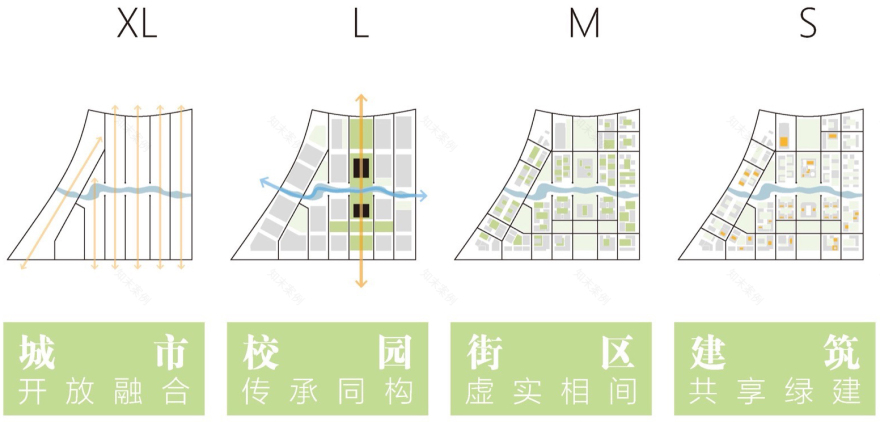
设计以街区式布局为基础模型,构建可外向拓展的开放式校园。通过系统性梳理和强化校园结构关系,建立国际校区与五山老校区的场所同构与空间传承。这里,街区式布局既是对校园高密度建设和便捷高效需求的回应,也耦合了岭南地区自发性形成的梳式布局,极有利的改善了校园微气候。基于“桑基鱼田”的地域智慧,我们在校园内部建立起南北贯通且东西错落、虚实相间的规划格局。通过多层级共享空间系统的构建,实现从城市到街区、街区到建筑的完整公共领域序列。
▼规划构思,planning concept © 华南理工大学建筑设计研究院有限公司
▼规划总图,masterplan © 华南理工大学建筑设计研究院有限公司

The design takes the block layout as the basic model to build an open campus that can be expanded outwards. By systematically sorting out and strengthening the structural relationship of the campus, it establishes the place isomorphism and spatial inheritance between the GZIC Campus and the Wushan Campus. Here, the block layout is a response to the demand for high - density construction, convenience and efficiency of the campus. This in turn works with coupling the spontaneous comb layout of the Lingnan district, which is extremely beneficial to improving the microclimate of the campus. Based on the regional wisdom of “Sangji Fish Field”, we have established a planning pattern running through the south to the north, scattering east - west, interlacing with the real and the virtual within the campus. Through the construction of a multi - level sharing space system, a complete public realm sequence from city to block and from block to building is achieved.
▼仪式广场西向鸟瞰,aerial view of ceremony square from the west © 盛竞

▼景观河北向鸟瞰,aerial view of landscape river from the south © 明境建筑摄影

街区式布局 打造高密度且可弹性校园规划
Block Layout: High Density and Flexible Campus Planning
规划在东西向沿用地边界以150~180米的尺度将校园划分为城市尺度下的适宜街区,并吸取中国古代书院并置布局的形制,将教学与生活功能沿南北线性排布,形成较强的场所秩序感。东西向则由道路、广场、绿化、河道等横切形成相对自由的界面。规划强调街区内外部开放共享空间的营造,从空间、交通、功能等层面为校园未来融入城市、服务周边提供了物理层面的可操作性。
▼共享空间布局,shared space layout © 华南理工大学建筑设计研究院有限公司

The plan divides the campus into a suitable urban-living block with a scale of 150-180 meters along the east-west boundary of the site, and draws on the juxtaposed layout of the ancient Chinese classical academies, arranging the teaching and living functions along the north-south linear row to form a strong sense of order in the place. In the east-west direction, roads, squares, greenery and rivers cut across to form a relatively free interface. The plan emphasizes the creation of open and sharing spaces inside and outside the block, providing a physical level of operability for the campus to integrate into the city and serve the neighbourhood in the future from the spatial, traffic and functional perspectives.
▼学院楼,college building © 九里建筑摄影

▼街区外部共享连廊,shared corridor outside the block © 九里建筑摄影

▼建筑内部共享连廊,shared corridor inside the building © 九里建筑摄影

▼建筑内部共享连廊,shared corridor inside the building © 明境建筑摄影

传承与同构 转译华工五山老校区空间模型
Inheritance and Isomorphism: Translation the Space of the South China University of Technology Wushan Old Campus
在国际校区南北中轴上,设计依次布置了校前区广场、礼仪广场、图书馆、滨水景观带、活动中心等,建立收放自如的空间节奏。同时借用场地原有水体,因势利导在校区腹地再现了自西向东蜿蜒而行的带状水系。南北中轴线和东西滨水景观带形成交织的“十”字轴线,与五山校区东、西湖带状水体景观轴与南北向校园核心建筑轴“十”字交叉的轴线结构建立了空间上的传承和关联。
▼校区文脉传承的空间组织,the spatial organization of the cultural heritage of the campus © 华南理工大学建筑设计研究院有限公司
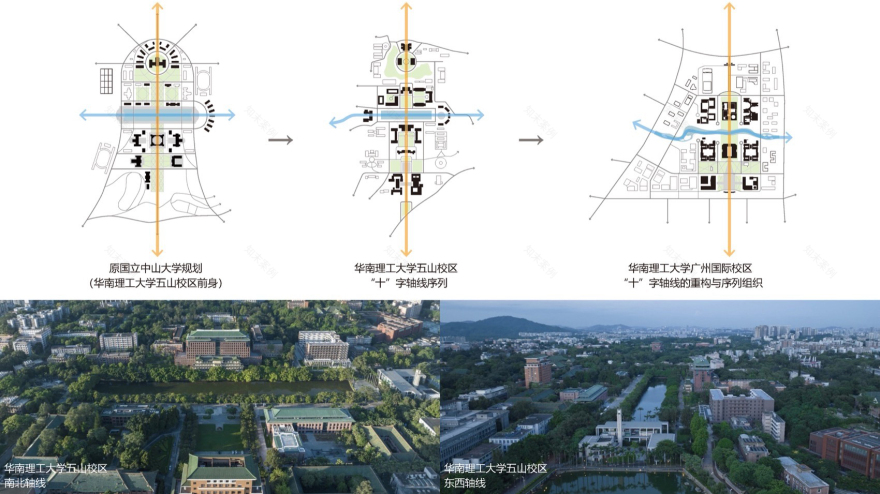
On the north-south axis of the GZIC Campus, the design sequentially arranges the plaza of the front area, the ceremonial plaza, the library, the waterfront landscape belt, and the activity center, etc., so as to establish a spatial rhythm of freedom. At the same time, the original water body is borrowed from the site, and the meandering water system from west to east is reproduced in the hinterland of the campus. The north-south central axis and the east-west waterfront landscape belt form an intertwined cross axis, which establishes the spatial inheritance and correlation of the cross axes in the Wushan Campus, including the ribbon water landscape axis of the East and the West Lake, and the core building axis of the north-south campus.
▼公共实验楼,public laboratory building © 九里建筑摄影
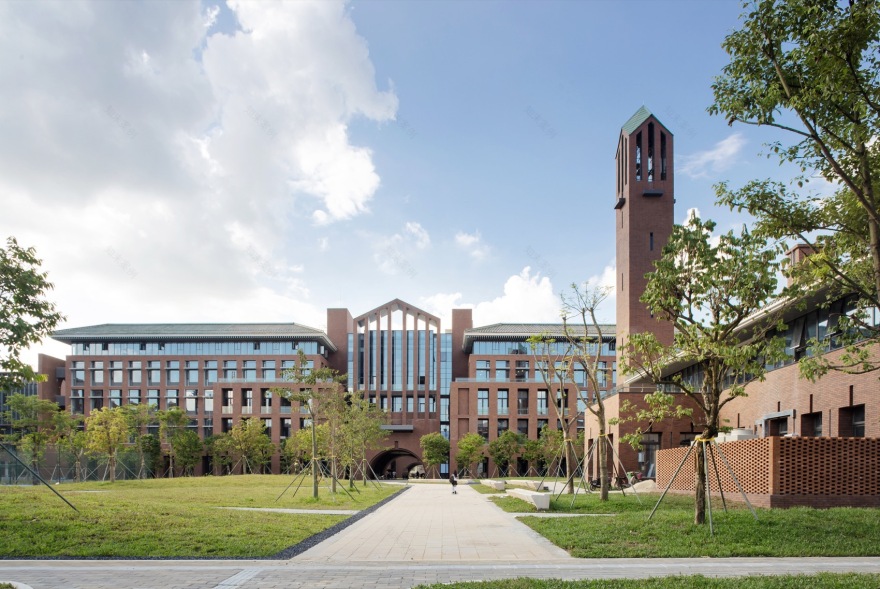
▼风貌传承:公共教学楼,landscape inheritance: the public teaching building © 九里建筑摄影

▼仪式广场望图书馆,view of the library from the ceremony square © 盛竞
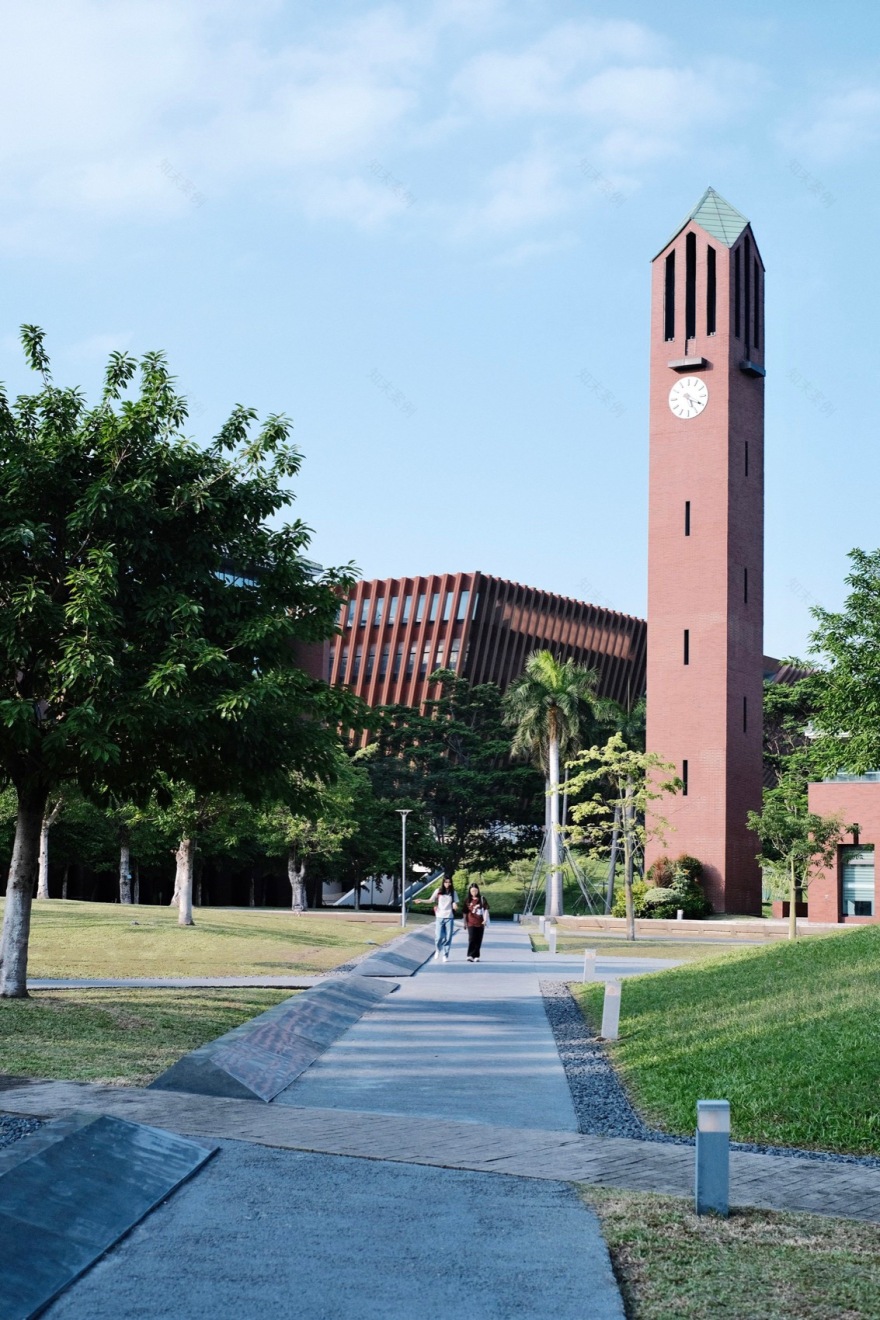
▼仪式广场望学院楼,view of the academy building from the ceremony square © 盛竞

多样化活动 理性与感性交织的景观活力带
Diversified Activities: Rational and Sensual Intertwined Landscape Vitality Belt
以东西滨水景观带为界,校区南岸为教学功能区,实验楼、图书馆、教学楼设置在中心区域,各学院围绕周边布置。校区北岸为生活配套区,分布着文化活动中心、运动场馆、学生宿舍与餐厅、创新创业基地和教师公寓等。南北两岸通过立体交通系统和滨水景观体系,构建充满活力的滨水公共空间。
▼“十”字纵轴景观,landscape of the cross vertical axis © 华南理工大学建筑设计研究院有限公司

▼“十”字横轴景观,Landscape of the cross horizontal axis © 华南理工大学建筑设计研究院有限公司

Taking the east-west waterfront landscape belt as the boundary, the south bank of the campus is the teaching area, with experimental buildings, the library and teaching buildings set in the central area, and various colleges arranged around. The north bank of the campus is the living area, with the distribution of the cultural activity center, sports venues, student dormitories and restaurants, innovation and entrepreneurship bases, teachers’ flats, etc. The north and south sides of the campus are connected by vibrant waterfront public spaces through a three-dimensional transport system and a waterfront landscape system.
▼景观河鸟瞰,aerial view of landscape river © 九里建筑摄影

▼景观河及图书馆,the landscape river and library © 九里建筑摄影
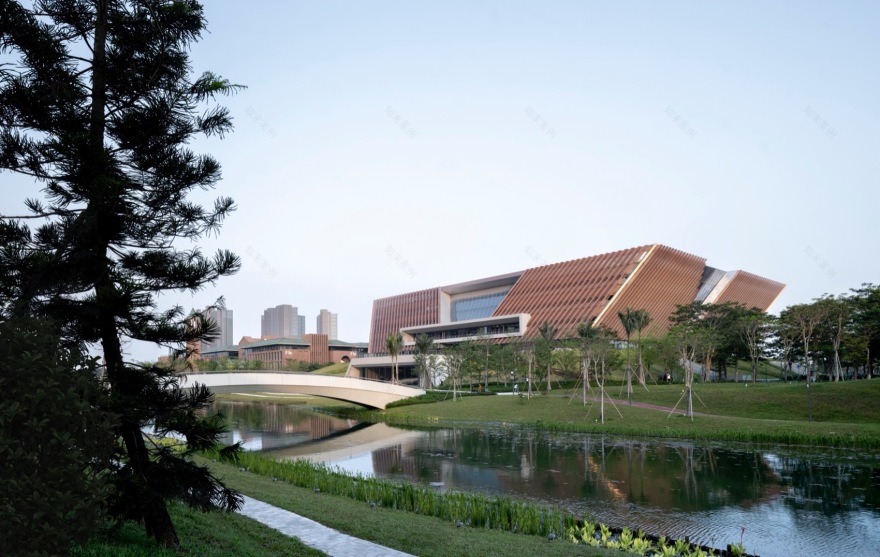
▼图书馆,library © 九里建筑摄影
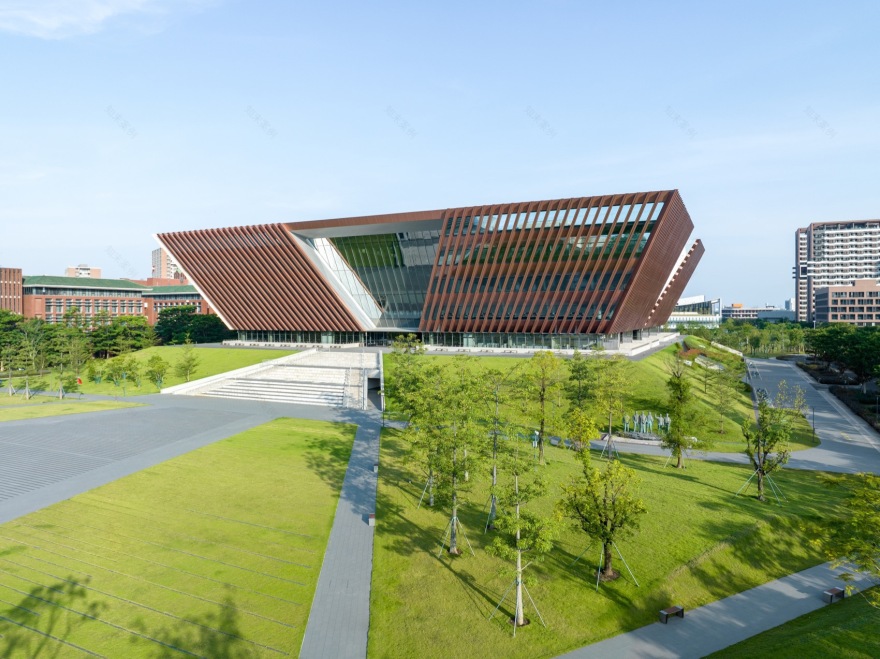
▼公共教学楼及周边景观,public teaching building and the surrounding landscape © 超越视觉

▼景观河道细部,details of the landscape river © 超越视觉

生态型校园 岭南地域的校园可持续化建设
Ecological Campus: Sustainable Campus Construction in Lingnan District
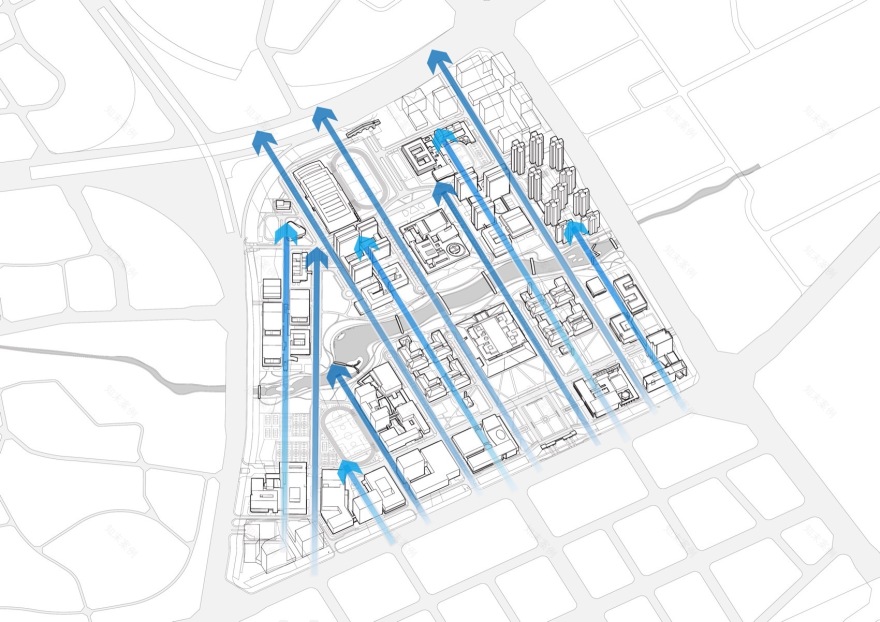
规划精准契合岭南地区地域性气候特征,构建了系统化的绿色校园体系:类“梳式布局”的地域化冷巷式通风体系,组织了更有效的自然通风;通过带状水系与其向南北延伸的雨洪海绵走廊,汇集各类地表径流并导向城市管道;校园街区内部的折线景观带、空中连廊、步行支路等组成连贯的立体步行系统,辅以电能公交、自行车等,实现校园的绿色交通体系;校园各建筑单体达到了绿色建筑二星评价标准,图书馆则是达到了绿色建筑三星评价标准。
▼冷巷式通风体系,cold alley ventilation system © 华南理工大学建筑设计研究院有限公司
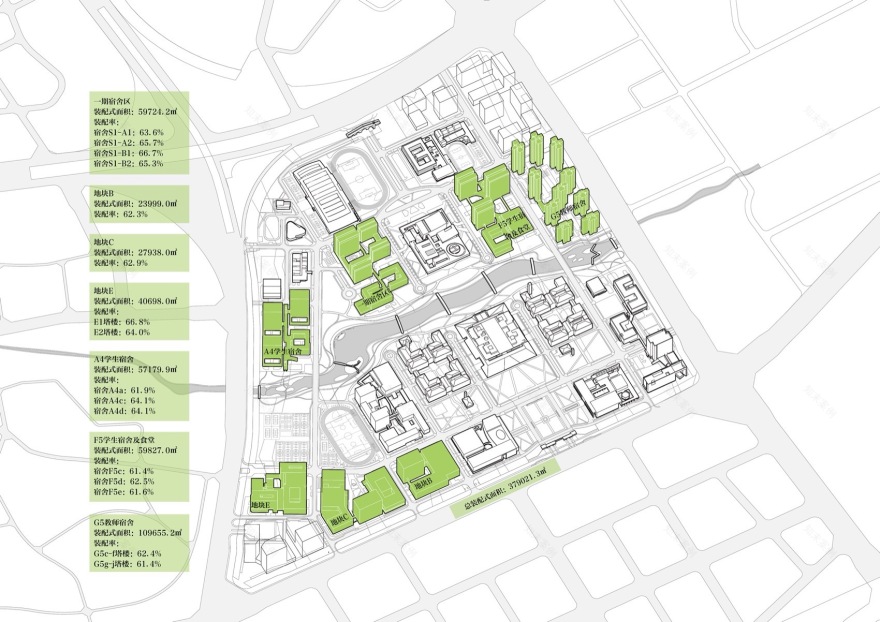
▼装配式建筑体系,assembly building system © 华南理工大学建筑设计研究院有限公司
▼海绵校园体系,sponge campus system © 华南理工大学建筑设计研究院有限公司

The masterplan precisely fits the regional climatic characteristics of Lingnan district, and builds a systematic green campus system: the regionalized cold-alley ventilation system with “comb layout” organizes more effective natural ventilation; the rainwater sponge corridor extending north and south through the ribbon water system collects all kinds of surface runoff and directs it to the urban pipeline; the folded landscape belt and sky corridor within the campus block form a coherent three-dimensional pedestrian system, supplemented by electric buses, bicycles, etc., to realize a green traffic system for the campus; the plan also includes a green traffic system for the campus. The campus blocks are composed of a coherent three-dimensional pedestrian system with zigzag landscape zones, space corridors and pedestrian bypasses, supplemented by electric buses and bicycles to realize a green transport system; the campus buildings have achieved the two-star green building evaluation standard, and the library has achieved the three-star green building evaluation standard.
▼景观河鸟瞰,aerial view of landscape river © 九里建筑摄影
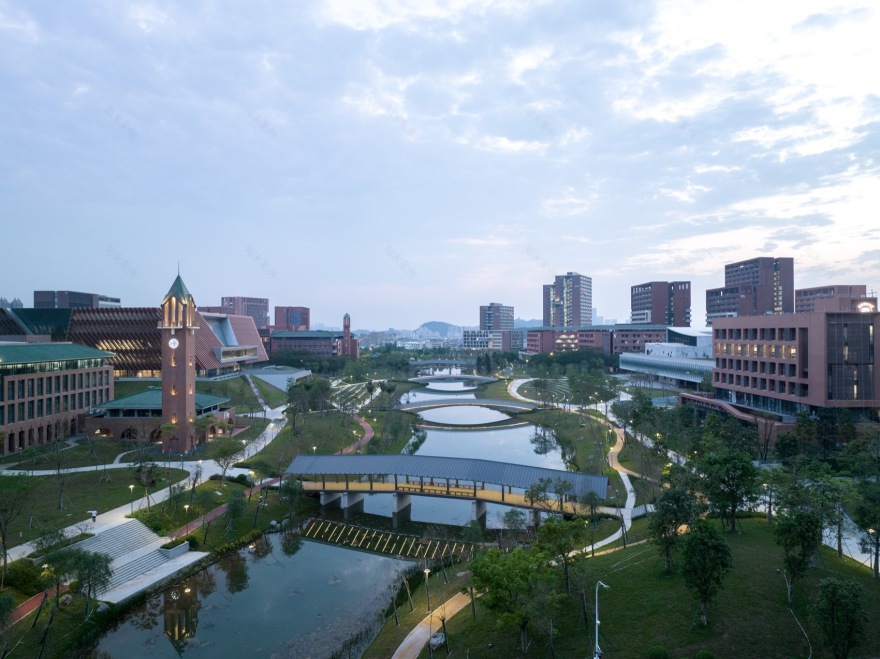
▼学院楼实景,academy building © 九里建筑摄影


▼学院楼实景,academy building © 九里建筑摄影

▼图书馆实景,library © 九里建筑摄影


▼公共实验楼实景,public laboratory building © 九里建筑摄影

华南理工大学广州国际校区探索开放式大学校园建设模型,实现了人、建筑与环境的高度融合。规划采用城市型街区生长式的布局模式,体现了华南理工大学新老校区的延续,也展现了岭南地域性城市与建筑文化的内涵。
Guangzhou International Campus of SCUT explores the model of open university campus construction, realizing a high degree of integration between people, buildings and the environment. The plan adopts an urban-type block-growth layout model, reflecting the continuation of the old and new campuses of South China University of Technology, as well as showing the connotation of the Lingnan regional city and architectural culture.
▼校区南岸鸟瞰,aerial view from the south © 九里建筑摄影

▼校区北岸鸟瞰,aerial view from the north © 明境建筑摄影

▼学生活动中心,student activity center © 九里建筑摄影

项目名称:华南理工大学广州国际校区
项目类型:教育建筑
项目地址:广州市番禺区
用地面积:1074406㎡
建筑面积:一期50万㎡;二期59万㎡
设计时间:2018 - 2021
竣工时间:2023
设计单位:华南理工大学建筑设计研究院有限公司
业主单位:华南理工大学
建设单位:一期工程:广州市重点公共建设项目管理中心;二期工程:广州越秀城开房地产开发有限公司
施工单位:一期工程:中国建筑第四工程局有限公司、广州市建筑集团有限公司;二期工程:中国建筑第五工程局有限公司
获奖情况:教育部2023年优秀勘察设计规划设计一等奖;一期工程获第十二届广东省土木工程詹天佑故乡杯奖,获第二十届2023年度中国土木工程詹天佑奖
一期工程项目主持:倪阳 韦宏
二期工程项目主持:倪阳 韦宏 邓孟仁 叶青青
规划设计团队:倪阳 韦宏 邓孟仁 郭昊栩 盛竞 王俊君 刘兆丰 吴中平 包莹 陈欣燕 陈祖铭 俞洋 耿望阳 伍朝晖 石刚 张敬军 李东沅 郑明明 韩谨如 王志明 原玮 桂梓期 谢燮 张帆 黄莹 黄冠南 李颜 郭文智 赵成臣 黄韵露等
EPC管理:黄光锐 郑晖
摄影版权:九里建筑摄影 超越视觉 盛竞
南京喵熊网络科技有限公司 苏ICP备18050492号-4知末 © 2018—2020 . All photos and trademark graphics are copyrighted by their owners.增值电信业务经营许可证(ICP)苏B2-20201444 苏公网安备 32011302321234号
苏公网安备 32011302321234号客服
消息
收藏
下载
最近