

创作上传
VIP
收藏下载
登录 | 注册有礼
查看完整案例

收藏

下载

分享
Idea by
Bálint Halász, Iván Patrik Kund, András Páll
Budapest Cooperative
49 Delej Street, Budapest, Hungary
Our Budapest-based team is answering urban challenges with projects that are rooted in interdisciplinary research. We believe that designs should extend beyond the physical, and they should be susceptible to temporal change; we want to build links between our always altering spatial settings and the evolving social organizations that are inhabiting them.
Call for ideas 2017
Back.Ground
Shifting the productive-logistical orientation of the Viennese space to a space of interaction and co-creation.
Back.Ground
Shifting the productive-logistical orientation of the Viennese space to a space of interaction and co-creation.
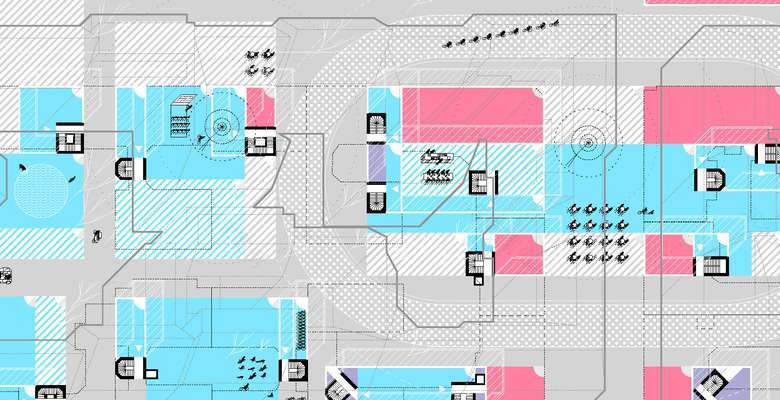
Challenge the primacy of infrastructure, explore possibilities of multiplication of urban networks.
The spatial logic of Vienna’s urban grid is not supporting the emergence of new models in open urban space usage, gives little opportunity for the reconsideration of private-common-public relationships. Altering the spatial logic supports activity models built upon shared economies by improving accessibility to common resources. A new logic for laying out public space is needed to influence activities inside and outside the private domain of the apartment, to give incentives to outsource to the shared domain. Altering the logic of the grid patterned historical neighborhoods may be corroborated with the following societal changes: transition to information economy, growing importance of leisure and emerging cooperative practices of urban space production. To frame such a new logic, it is necessary to explore how social production, production logistics and consumption of urban space can be changed. The new logic can have a stronger focus on local nexuses instead of city scaled ones.
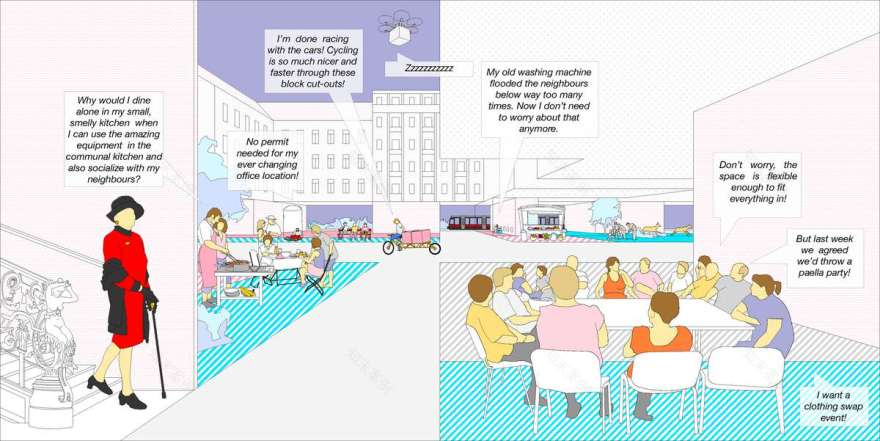
The ground floor structures of the typical Viennese perimeter blocks are gradually becoming porous by opening up the building structures. The ground floor is progressively turning into a continuous surface passing under the blocks, and only the vertical circulation and service cores, shafts and architectural heritage are kept. It is a space of a territorial character, a dynamic, operative topography.

The urban layout is re-configured with seven intervention types which results in a new ground floor pattern, rebalancing open spaces from productive-logistical space to a space of leisure, interaction and co-creation. The re-configuration of the space happens in an organic way, with small, continuous interventions applied on strategic nodes within the city. The transformation of the ground floor permits the long-term reconfiguration of the apartment structure of the floors above.

Land usage categories are differentiated by operating body (Private, Community, Public). Community areas are operated by NGOs, local community groups, block committees, functions are negotiated through self-organizing processes. This spatial category provides a framework for using space in a co-operative form. Land usage categories by time frame can be permanent (suited for “stable” urban functions) and temporary (usage is constantly re-negotiated, adding a reversible layer to urban space).

Today the separation of space based on traditional domestic functions are taken for granted and the real estate market offers little variation. However, outsourcing different activities means certain spaces are not needed inside the apartment and can be reconverted according to the individual changing lifestyles. They can either be reduced to minimum or completely removed from private apartments, trading them, for instance, for well-equipped communal spaces.

The transformation of the ground floor permits the simultaneous, long-term reconfiguration of the apartment structure of the floors above. One person households, potentially involved more in community activities and more susceptible for outsourcing private activities may be located on the subdivided apartments of the lower floors, closer to the community oriented space of leisure, interaction and co-creation. Larger and more autonomous households may be on the upper floors, in larger apartments.
Back.Ground
Shifting the productive-logistical orientation of the Viennese space to a space of interaction and co-creation.
Back.Ground
Shifting the productive-logistical orientation of the Viennese space to a space of interaction and co-creation.
Challenge the primacy of infrastructure, explore possibilities of multiplication of urban networks.
The spatial logic of Vienna’s urban grid is not supporting the emergence of new models in open urban space usage, gives little opportunity for the reconsideration of private-common-public relationships. Altering the spatial logic supports activity models built upon shared economies by improving accessibility to common resources. A new logic for laying out public space is needed to influence activities inside and outside the private domain of the apartment, to give incentives to outsource to the shared domain. Altering the logic of the grid patterned historical neighborhoods may be corroborated with the following societal changes: transition to information economy, growing importance of leisure and emerging cooperative practices of urban space production. To frame such a new logic, it is necessary to explore how social production, production logistics and consumption of urban space can be changed. The new logic can have a stronger focus on local nexuses instead of city scaled ones.

The ground floor structures of the typical Viennese perimeter blocks are gradually becoming porous by opening up the building structures. The ground floor is progressively turning into a continuous surface passing under the blocks, and only the vertical circulation and service cores, shafts and architectural heritage are kept. It is a space of a territorial character, a dynamic, operative topography.

The urban layout is re-configured with seven intervention types which results in a new ground floor pattern, rebalancing open spaces from productive-logistical space to a space of leisure, interaction and co-creation. The re-configuration of the space happens in an organic way, with small, continuous interventions applied on strategic nodes within the city. The transformation of the ground floor permits the long-term reconfiguration of the apartment structure of the floors above.

Land usage categories are differentiated by operating body (Private, Community, Public). Community areas are operated by NGOs, local community groups, block committees, functions are negotiated through self-organizing processes. This spatial category provides a framework for using space in a co-operative form. Land usage categories by time frame can be permanent (suited for “stable” urban functions) and temporary (usage is constantly re-negotiated, adding a reversible layer to urban space).
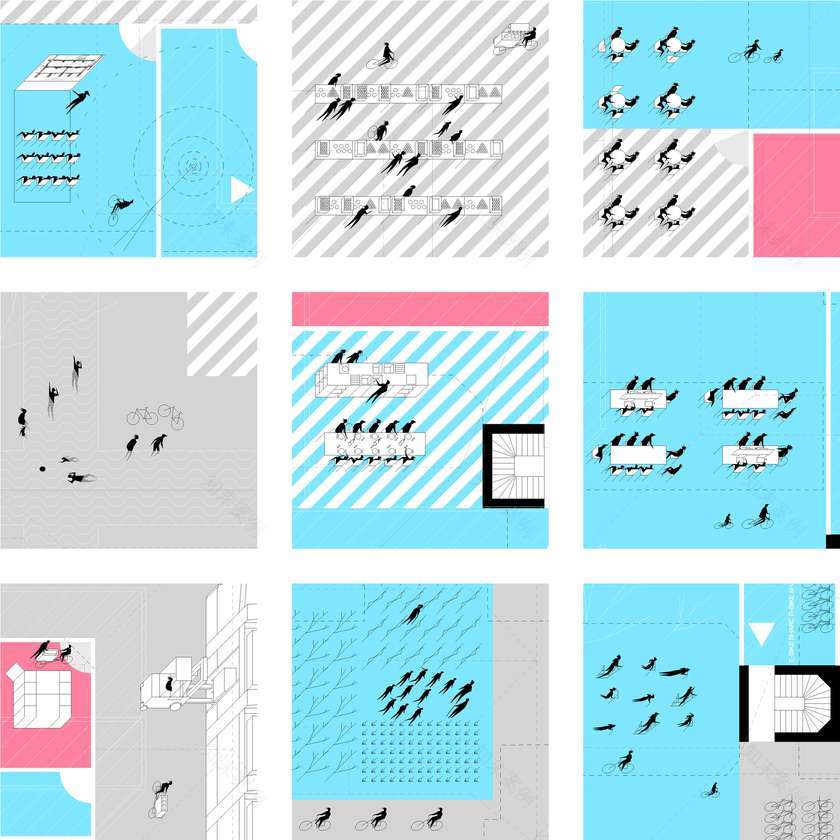
Today the separation of space based on traditional domestic functions are taken for granted and the real estate market offers little variation. However, outsourcing different activities means certain spaces are not needed inside the apartment and can be reconverted according to the individual changing lifestyles. They can either be reduced to minimum or completely removed from private apartments, trading them, for instance, for well-equipped communal spaces.

The transformation of the ground floor permits the simultaneous, long-term reconfiguration of the apartment structure of the floors above. One person households, potentially involved more in community activities and more susceptible for outsourcing private activities may be located on the subdivided apartments of the lower floors, closer to the community oriented space of leisure, interaction and co-creation. Larger and more autonomous households may be on the upper floors, in larger apartments.
Idea by
Bálint Halász, Iván Patrik Kund, András Páll
Budapest Cooperative
49 Delej Street
Budapest
Hungary
Our Budapest-based team is answering urban challenges with projects that are rooted in interdisciplinary research. We believe that designs should extend beyond the physical, and they should be susceptible to temporal change; we want to build links between our always altering spatial settings and the evolving social organizations that are inhabiting them.
南京喵熊网络科技有限公司 苏ICP备18050492号-4知末 © 2018—2020 . All photos and trademark graphics are copyrighted by their owners.增值电信业务经营许可证(ICP)苏B2-20201444 苏公网安备 32011302321234号
苏公网安备 32011302321234号客服
消息
收藏
下载
最近