

创作上传
VIP
收藏下载
登录 | 注册有礼
查看完整案例

收藏

下载

分享
Idea by Matej Banozic & Horia Daniel Brad da_sign
Graz, Austria
Matej Banožic teaches computational design and advanced geometry at the Institute of Building Construction at Graz University of Technology. During his studies at TU Graz he also worked at HKW Architekten, Wolfgang Steinegger, and at &structures in Munich. His research is devoted to the relationship between architecture and cybernetics in contemporary architectural discourse. He received his diploma in architecture from TU Graz in 2013 with a thesis entitled Cybernetics of Architecture.
Inflection matching realities
Inflection matching realities

Our modern world, that is computation-based in all areas of human life, is to be understood as a network of logical relationships, that is filled by humans who are moving, working and finally living in it. Through this interaction an architecture of networks is shaped.
The systems which interact in Inflection mean to create an interactive platform which act partly as architecture partly as urban space. The project intends to allow communication between the programmatic endeavors and sustain them in their natural development.
Because systems like rigid and smooth or fluid architecture are intended to be looked upon as separate entities, Inflection addresses the question of interaction between them.
Vocabulary is an important element of architecture and urban design which can attract people to accept historical elements like this Italian fabric hall. Not only does inflection change the coordinates of the initial design but it also values its existing space.
Also the project communicates the important idea of grasping elements of the local cultural background which can be reintegrated into creating contemporary architecture. Meaning and identity are key words and interactive systems chosen to complete the conceptual gesture.

Functions arise following the interaction with users, in the case of this project they are the result of cultural activity. The structure is to become an architectonical stage for social interaction and its interdependencies with virtual space. In order to allow development the following uses are defined by the designers: exhibition hall, art studio, co - working spaces, media room and café. These are to shape an environment that will foster interaction in order to create new functions

Bologna today - Highlighting two defining rules that constitute the planning of the city core (of course, from different epochs). The combination of these development concepts define the morphological substance of the urban tissue. However, the most interesting issue to be thematised may be found in the intertwining area of these.
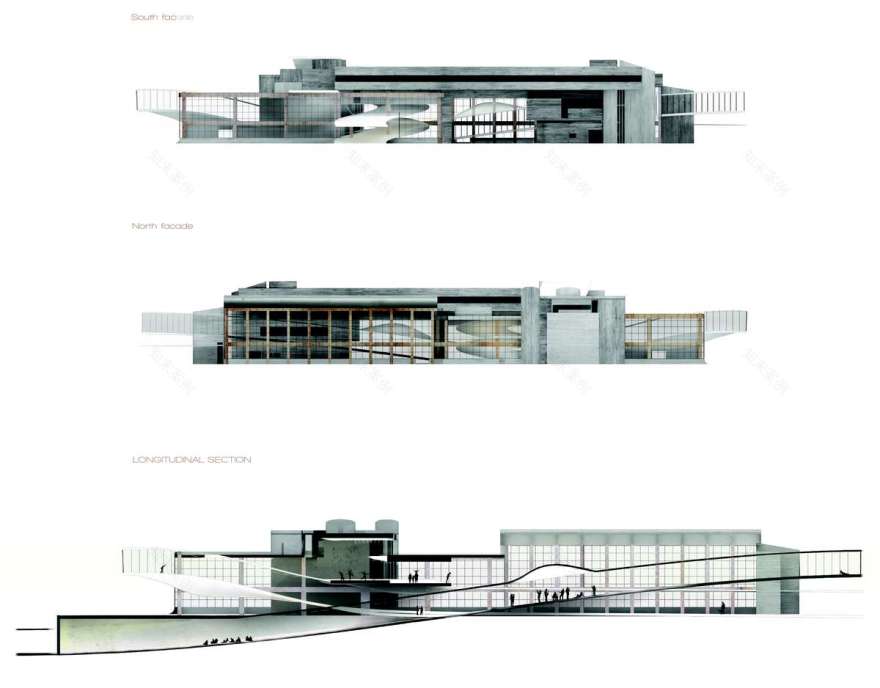
The rigid structure of the grid was a fundamental development basis for improvement. However, the key decision was to keep and honour the original structure.

The given design does not just simply define the building for a new purpose, but provides the necessary outline for the various activities that should be brought to life.

The existing static structure of the hall is overlaid with a dynamical intervention and is supposed, amongst other things, to portray the urban development that has been changing from strict geometries to fluid ones.
Inflection matching realities
Inflection matching realities
Our modern world, that is computation-based in all areas of human life, is to be understood as a network of logical relationships, that is filled by humans who are moving, working and finally living in it. Through this interaction an architecture of networks is shaped.
The systems which interact in Inflection mean to create an interactive platform which act partly as architecture partly as urban space. The project intends to allow communication between the programmatic endeavors and sustain them in their natural development.
Because systems like rigid and smooth or fluid architecture are intended to be looked upon as separate entities, Inflection addresses the question of interaction between them.
Vocabulary is an important element of architecture and urban design which can attract people to accept historical elements like this Italian fabric hall. Not only does inflection change the coordinates of the initial design but it also values its existing space.
Also the project communicates the important idea of grasping elements of the local cultural background which can be reintegrated into creating contemporary architecture. Meaning and identity are key words and interactive systems chosen to complete the conceptual gesture.
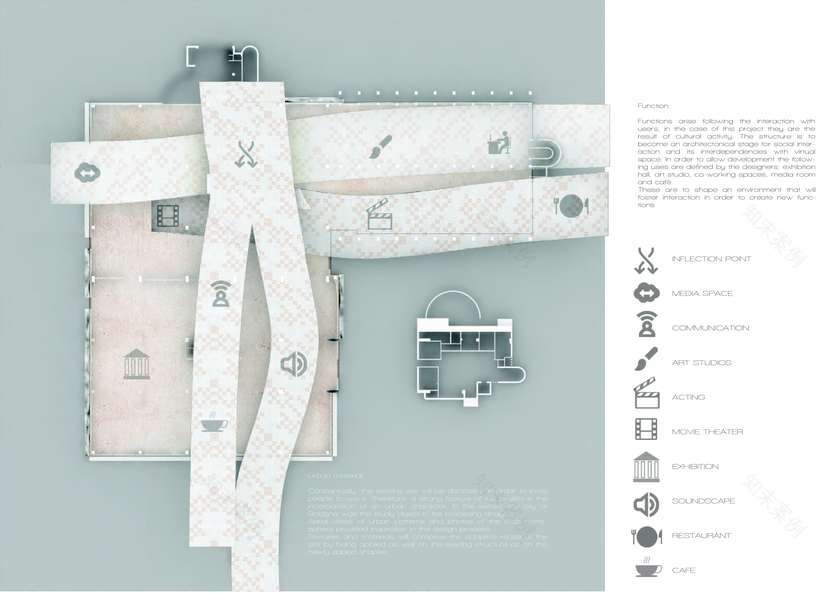
Functions arise following the interaction with users, in the case of this project they are the result of cultural activity. The structure is to become an architectonical stage for social interaction and its interdependencies with virtual space. In order to allow development the following uses are defined by the designers: exhibition hall, art studio, co-working spaces, media room and café. These are to shape an environment that will foster interaction in order to create new functions

Bologna today - Highlighting two defining rules that constitute the planning of the city core (of course, from different epochs). The combination of these development concepts define the morphological substance of the urban tissue. However, the most interesting issue to be thematised may be found in the intertwining area of these.

The rigid structure of the grid was a fundamental development basis for improvement. However, the key decision was to keep and honour the original structure.

The given design does not just simply define the building for a new purpose, but provides the necessary outline for the various activities that should be brought to life.

The existing static structure of the hall is overlaid with a dynamical intervention and is supposed, amongst other things, to portray the urban development that has been changing from strict geometries to fluid ones.
Idea by Matej Banozic & Horia Daniel Brad
da_sign
Graz
Austria
Matej Banožic teaches computational design and advanced geometry at the Institute of Building Construction at Graz University of Technology. During his studies at TU Graz he also worked at HKW Architekten, Wolfgang Steinegger, and at &structures in Munich. His research is devoted to the relationship between architecture and cybernetics in contemporary architectural discourse. He received his diploma in architecture from TU Graz in 2013 with a thesis entitled Cybernetics of Architecture.
南京喵熊网络科技有限公司 苏ICP备18050492号-4知末 © 2018—2020 . All photos and trademark graphics are copyrighted by their owners.增值电信业务经营许可证(ICP)苏B2-20201444 苏公网安备 32011302321234号
苏公网安备 32011302321234号客服
消息
收藏
下载
最近