

创作上传
VIP
收藏下载
登录 | 注册有礼
查看完整案例

收藏

下载

分享

翻译

A network of organic 3D-printed concrete columns makes up Tor Alva, a 30-metre-high tower modelled on a cake, unveiled yesterday in a small mountain village in Switzerland.
Created by cultural foundation Nova Fundaziun Origen in collaboration with professors from the university ETH Zurich, the tower is intended to revive Mulegns – a village currently home to 11 people.
According to the team, it is the tallest 3D-printed tower in the world. After five years in Mulegns, it will be dismantled and rebuilt elsewhere.

The world's tallest 3D-printed tower unveiled in Switzerland
Tor Alva, or White Tower, was built on an existing building formerly used as a blacksmith's shop. It was revealed yesterday for the first time, after a cover concealing it was removed by a helicopter.
Its four-storey form was prefabricated and is intended to emulate a layered cake, paying homage to the history of confectioners in the region, while blending into its mountainous backdrop.
"The form of the structure is reminiscent of an ornate layered cake – a reference to the emigration history of confectioners from Graubünden who exported their skills from here to the whole of Europe," said the team.

It is 30 metres high. Photo by Birdviewpicture
Tor Alva was developed by architect Michael Hansmeyer and ETH Zurich professors Walter Kaufmann, Robert Flatt and Benjamin Dillenburger, alongside the university's spin-off company Mesh and construction firm Zindel United.
It is constructed from 3D-printed concrete components that double as load-bearing elements, printed by ETH Zurich at its Hönggerberg campus over five months, before being transported to the site.
The concrete components were created by robots in "an additive manufacturing process", meaning the concrete was applied layer by layer and reinforced with steel rings, negating the need for formwork.
Each component is connected without adhesives, using removable screws and post-tensioning cables to ensure the structure can be easily dismantled and rebuilt elsewhere in the future. A spiral staircase connects each level.

The columns were prefabricated
"While one robot applies the concrete in layers, a second places a ring-shaped reinforcement in the new structure every 20 centimetres," explained the team.
"This horizontal reinforcement in the form of rings is supplemented by longitudinal rebars that are added after printing."
To ensure the concrete could support this layering process, professor Flatt developed a specific concrete mix that hardens quickly.
"Just before the concrete leaves the pressurised nozzle, two additives are blended into the mixture, allowing the characteristic droplet-like relief on the columns to be achieved," said the team
"Tor Alva showcases how digital construction techniques can be used to build load-bearing structures without formwork."

A spiral staircase links its four storeys
From Friday, Tor Alva will be open daily for guided tours and later as a performance venue, with a stage contained on its domed top floor.
Hansmeyer told Dezeen that it is the first time the printing method has been used for structural components, as it had previously only been used for decorative features.
"The White Tower is more than a technical triumph – it inspires the building sector, encourages sustainable tourism and offers new cultural space," concluded Nova Fundaziun Origen founder Giovanni Netzer.
"I was fascinated by the interplay between digital design, traditional craftsmanship, cultural memory and artistic form," he continued. "It also gives a fading village a new chance. That's extraordinary."
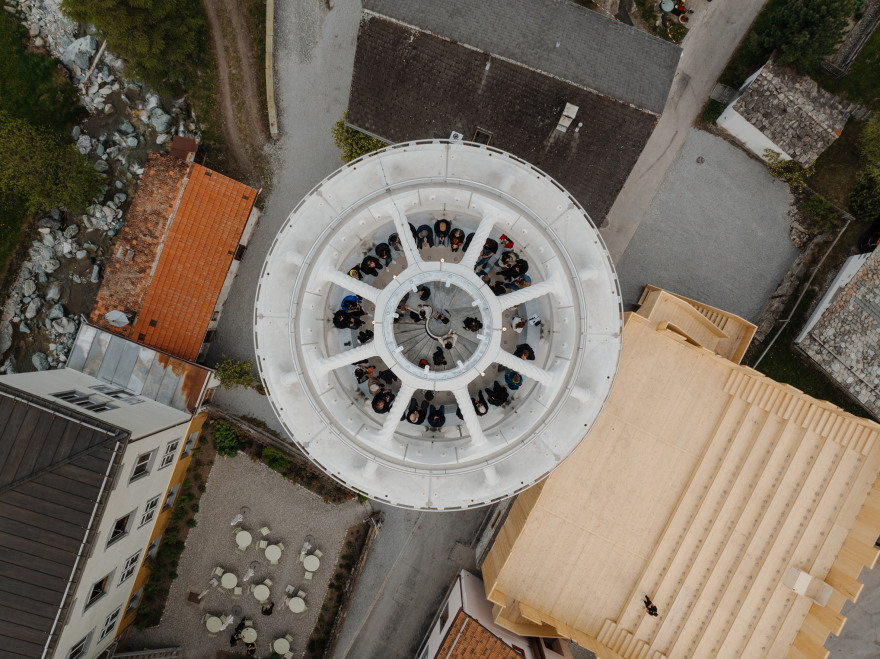
There is a domed performance space. Photo by Birdviewpicture
Other landmark 3D-printed architecture recently revealed on Dezeen include the "world's first" 3D-printed railway station, which was built in Japan in six hours, and the first 3D-printed Starbucks, which is nearing completion in Texas.
Arthur Mamou-Mani also used 3D-printed technology for Harmonic Tides, an installation informed by the movement of water, built at Clerkenwell Design Week after winning the Shaping Water Competition organised by Dezeen in collaboration with bathroom brands Villeroy & Boch and Ideal Standard.
The photography is by Benjamin Hofer unless stated otherwise.
南京喵熊网络科技有限公司 苏ICP备18050492号-4知末 © 2018—2020 . All photos and trademark graphics are copyrighted by their owners.增值电信业务经营许可证(ICP)苏B2-20201444 苏公网安备 32011302321234号
苏公网安备 32011302321234号客服
消息
收藏
下载
最近