

创作上传
VIP
收藏下载
登录 | 注册有礼
查看完整案例

收藏

下载

分享
Princeton Grad, Olga Zakharova, Considers Thesis "a Territory for One to Discover Future Areas of Research, Passions, and Career Interests"

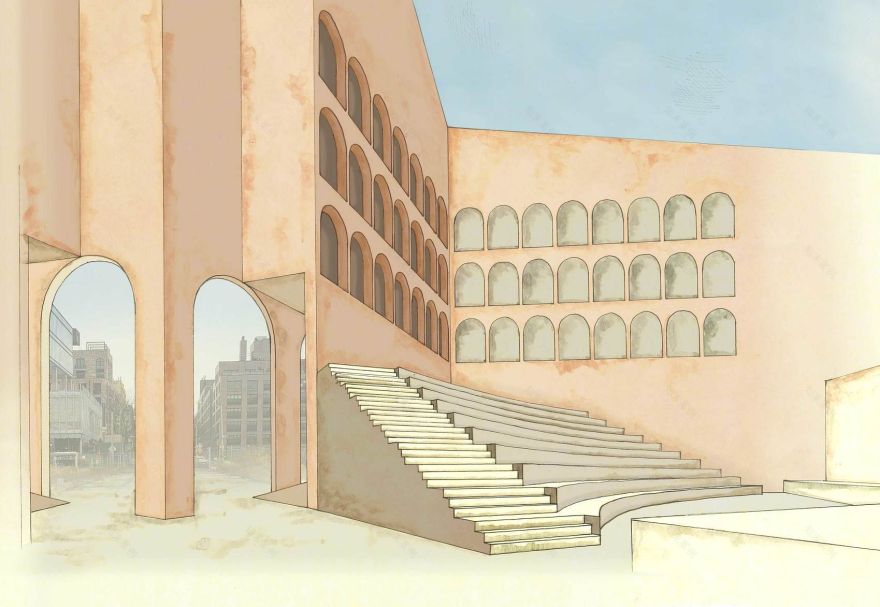
The view of the first proscenium. The spectator is meant to locate himself/herself in the middle of the industrial atmospheric scenery of New York at the turn of the century. Image by Olga Zakharova
Olga Zakharova is a recent M.Arch graduate of
Princeton University School of Architecture
. Archinect was able to chat with Zakharova and learn about her experiences as a student who was graduating during the pandemic. Her exploration of urbanism and the historical organization of buildings, spaces, and landscapes emphasizes on the "industrialized past" of Brooklyn’s Williamsburg neighborhood.
Zakharova shares with us the focus of her thesis and the pivot points she made when adjusting her model-specific project to fit a digital narrative. One of the many students whose final year was impacted by the abrupt transition towards remote learning amid the pandemic, Zakharova offers a resilient perspective. "A thesis project is not just another studio project. I would say it is more of a territory for one to discover future areas of research, passions, and career interests."

Diagram of the site’s location. Two empty waterfront lots that are divided by Metropolitan Avenue. When zoomed out one can observe that the avenue is formed by a curve in its nature and that it cuts through the urban grid of the neighborhood. Image © Olga Zakharova

Concept collage studies that manifest the idea of theatrical inversion of the pictureplane and its application to an urban setting (Brooklyn). Manhattan skyline used as a backdrop. Image © Olga Zakharova
Briefly describe your thesis/final project and your inspiration.
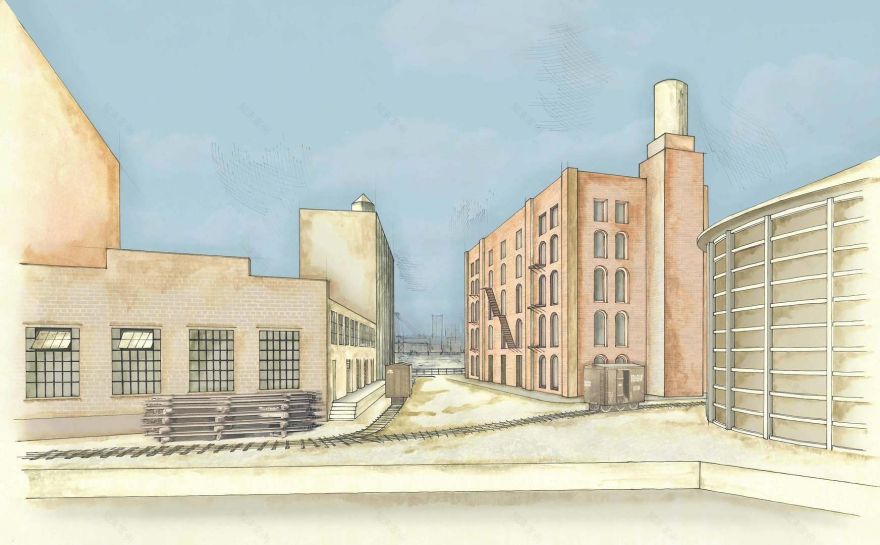
My thesis project is a design for a heritage complex featuring an outdoor waterfront theater that is located in Brooklyn’s Williamsburg neighborhood. The complex itself is an urban scale intervention formed by a theatrical orchestration of buildings. The buildings themselves could house various programs, including a museum, administrative facilities, and performance spaces. However, the building exteriors are a representation of a historical street appearance of Williamsburg at the turn of the century.
The idea to focus much of the project design on the industrialized past of the area came when I was presented a summary of the site’s history by collaborator and archaeologist Dominic Bush. The stage component is a two-street historical scenography and the views of the stage from the seating area are precisely projected in alignment with Manhattan’s skyline, with the city serving as a backdrop. Additionally, much of my research also addressed the study of Renaissance theaters and theories of perspective that were a major source of inspiration.

Physical Model - work in progress. Image © Olga Zakharova
My thesis project was always intended to center on physical model making [...] It was around 3 weeks before the opening of our post-professional group exhibition when Princeton School of Architecture officially closed its access to the wood shop and metal shop facilities [...] things changed drastically for myself, which forced me to be more creative and quick in decision making at that moment.

Concept collage studies that manifest the idea of theatrical inversion of the pictureplane and its application to an urban setting (Brooklyn). Manhattan skyline used as a backdrop. Image © Olga Zakharova

Physical Model - in progress. Image © Olga Zakharova
How did your thesis change as studios transitioned to remote learning?
My thesis project was always intended to center on physical model making. Many of the paper conceptual models were done early on, but my goal was to have three large scale basswood models that were planned to be exhibited at a gallery space in Manhattan.
It was around three weeks before the opening of our post-professional group exhibition when Princeton School of Architecture officially closed its access to the wood shop and metal shop facilities. Therefore, things changed drastically for myself, which forced me to be more creative and quick in decision making at that moment. I am thankful to my academic advisor Cameron Wu who helped me work through these new working conditions and supported me along the way.

The theatrical orchestration depicted in this rendering optically creates a mechanism that joins the shores together emphasizing the memories of the area’s first ferry line. The farthest point into the water is a lighthouse that serves as an observation tower; a visual obelisk. Monumental appearance of the structure is meant to commemorate and celebrate the maritime history of the site, as the welcoming, inviting point to the land, as a point of connection. Image © Olga Zakharova
A thesis project is not just another studio project. I would say it is more of a territory for one to discover future areas of research, passions, and career interests.
The view of the first proscenium. The spectator is meant to locate himself/herself in the middle of the industrial atmospheric scenery of New York at the turn of the century. Image © Olga Zakharova

The view of the second proscenium. The focus is on the representation of historical street appearance. Image © Olga Zakharova
The school provided an opportunity to feature our exhibition in form of a virtual show that you can see here:
unbuildingbuilding.princeton.edu
. My project then took a drastically different form, featuring hand-drawn renderings, 3D computer models, and digital animations. Yet, I believe this still communicated the project’s original ambitions and ideas. However, I am planning to finish the physical basswood models when facilities are reopened.
...in these unprecedented times, I think students have to be able to maneuver through any environment of change.
Theatrical Urbanism: Concept Model Video
. Courtesy of Olga Zakharova.
Any tips for students working through their thesis?
I would suggest that students work through problems creatively and most importantly let their thesis project be a testing ground for defining architectural arguments that they are interested in exploring after graduation. A thesis project is not just another studio project. I would say it is more of a territory for one to discover future areas of research, passions, and career interests.
However, in these unprecedented times, I think students have to be able to maneuver through any environment of change. I highly suggest embracing one’s design skills, learning new software, continue creating and fabricating within your at-home work space.
南京喵熊网络科技有限公司 苏ICP备18050492号-4知末 © 2018—2020 . All photos and trademark graphics are copyrighted by their owners.增值电信业务经营许可证(ICP)苏B2-20201444 苏公网安备 32011302321234号
苏公网安备 32011302321234号客服
消息
收藏
下载
最近